


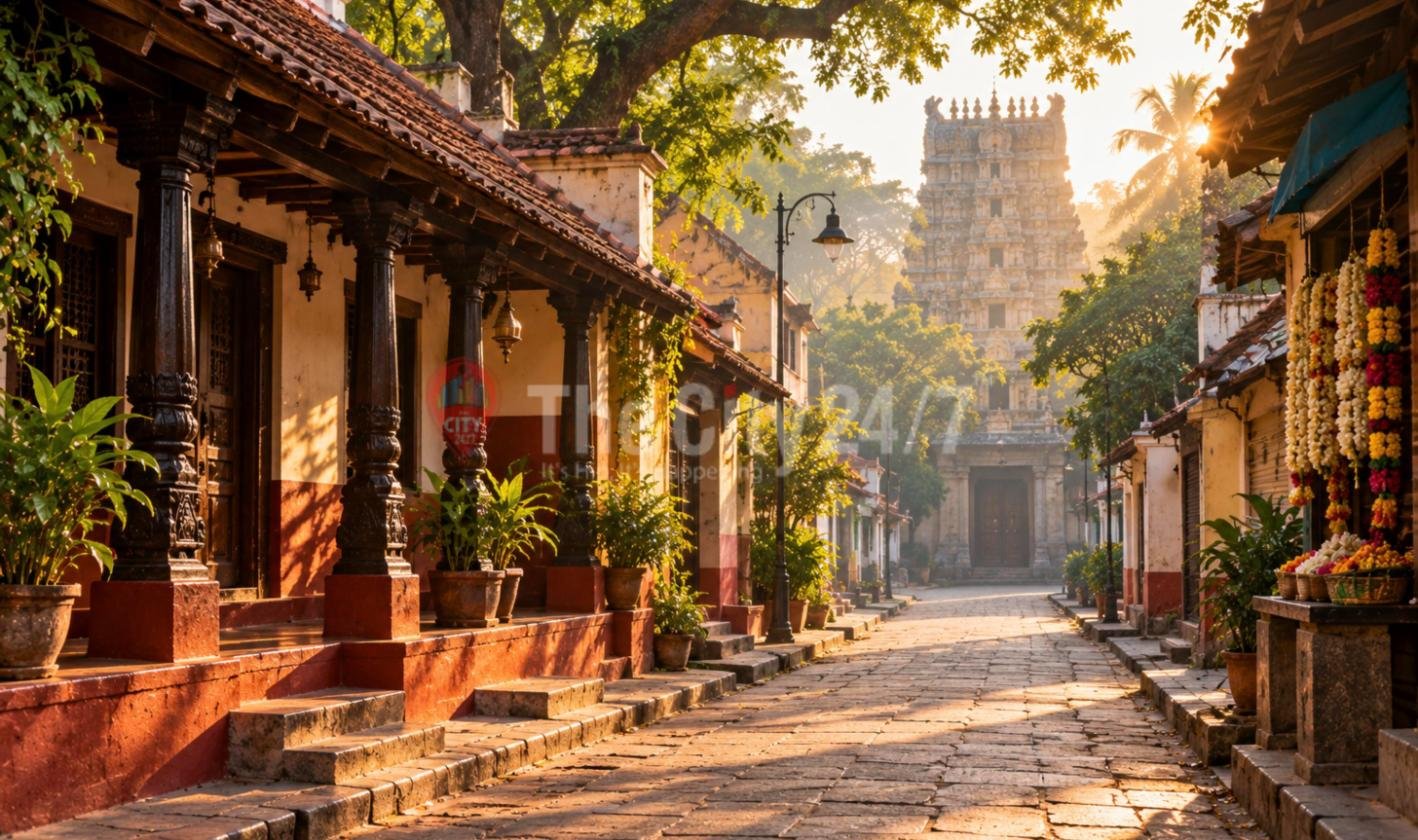
“Bengaluru is not an old city with new bits attached. It is four or five separate towns that grew into each other and are still, if you look at the street plans, arguing about it.”
• On why the city feels different every ten minutes
Most cities have an old town. Bengaluru has several, built in different centuries by different authorities for different reasons, and the reason the place feels incoherent to newcomers is that it genuinely is. You can cross from a sixteenth century market grid into a 1890s planned suburb into a British garrison town inside twenty minutes, and each has its own street pattern, architecture, food and language of daily life.
The four that matter are the petes, the original walled market town founded in 1537; Basavanagudi and Malleshwaram, both laid out in the 1890s after a plague epidemic; Halasuru, which predates all of it; and the Cantonment, the British military and civil settlement that ran as a separate administration for a century.
This guide takes each in turn with what it is, what to see and how to walk it, because walking is genuinely the only way these areas make sense. Read it alongside our neighbourhoods guide for the modern picture and our history of Bangalore for the full chronology.
Quick Information
Four old Bengalurus, with the practical detail for walking each. Mornings, in all four cases.
What Are Bangalore's Petes and Why Do They Matter?
The petes are the original city: a grid of market streets laid out by Kempe Gowda in 1537 inside a mud fort, with each street named for the trade practised on it. Most of those names, and a surprising amount of the trade, are still there.
Akkipete sold rice, Balepete bangles, Cottonpete cotton, Chickpete cloth, Taragupete grain. Nearly five hundred years later Chickpete is still the wholesale cloth district, and walking through it at seven in the morning as the shutters go up is the single most direct connection to the founding of this city available to anyone. It is dense, loud, commercial and completely unromantic, which is exactly what a market town is supposed to be.
Walk it early, from Chickpete Metro station down Avenue Road, which is the old spine, with its second hand bookshops and printing trades. From there you reach the surviving Bangalore Fort gateway, Kempe Gowda's 1537 fort as rebuilt in stone by Hyder Ali and Tipu Sultan, and Tipu Sultan's Summer Palace a short walk on. Add KR Market at dawn and you have the best historical morning in Bengaluru.
What Is the Oldest Neighbourhood in Bangalore?
Halasuru, now called Ulsoor, which predates the 1537 founding of the city. It holds Someshwara Temple, the oldest temple in Bengaluru, with Vijayanagara period work.
Halasuru was a settlement before Kempe Gowda built his fort to the west, and the temple is the proof. Someshwara has Vijayanagara era construction and later additions, it sits quietly among shops and houses, and it receives almost no visitors, which is remarkable for the oldest structure in a city of this size. There is also one of the four Kempe Gowda watchtowers nearby, and Ulsoor Lake, which the British later developed.
The Begur inscription, in the south east of the modern city, is older still as a record: a ninth century Western Ganga stone bearing the name Bengaluru. Begur itself is now absorbed into the urban sprawl near Electronic City, and visiting it is more of a pilgrimage than a walk, but it is where the name of this city first appears in writing.
“Chickpete at seven in the morning is the closest anyone can get to standing in 1537 and still buying a shirt.”
• On the oldest working street grid in the city
Why Were Basavanagudi and Malleshwaram Built?
Because of plague. Both were laid out in the 1890s as planned extensions to relieve the overcrowded petes after epidemics, which is why they are spacious, gridded and full of trees while the old city is dense and narrow.
This is one of the most consequential facts about the shape of Bengaluru. The plague outbreaks of the 1890s made the crowding of the petes untenable, and the response was two new suburbs laid out with wide streets, generous plots, sanitation and space, one to the south at Basavanagudi and one to the north at Malleshwaram. They were, in effect, the city's first exercise in urban planning.
Which is why they remain among the most pleasant parts of the city to live in and walk through. The plot sizes allowed trees, the grid allowed air, and the century since has added markets, temples, schools, sweet shops and three generations of the same families. Both are covered in more detail in our old south Bengaluru living guide, because both are still excellent answers to the question of where to live.
- Basavanagudi: start at the Bull Temple. Sixteenth century, monolithic Nandi, free, and a working temple. Then Bugle Rock beside it, with its Kempe Gowda watchtower and deep shade.
- Then walk Gandhi Bazaar and DVG Road. Flower vendors, fruit sellers, sweet shops and darshinis. Breakfast here is the point of the walk as much as the buildings are.
- Malleshwaram: start at 8th Cross. The market street, with flowers, produce, sweets and shops that have not changed in decades. Green Line Metro puts you close.
- Then the temples and the crosses. Malleshwaram's numbered crosses hold mature rain trees, old houses and several important temples. Wander rather than route.
- Finish at Sankey Tank. An 1880s tank with the best lake walk in the city, roughly a kilometre and a half around, a short distance from Malleshwaram proper.
- Eat standing up in both. The darshini counters in these two neighbourhoods are among the best in India, and a full breakfast costs under 150 rupees a head.
What Is the Cantonment and Why Does It Feel Different?
The Cantonment was the British military and civil settlement established from 1809, east of the old city, and it was administered separately for about a century. That is why Frazer Town and Cooke Town look and feel like a different city, because for a long time they were.
The Cantonment had its own municipal administration, its own street naming, its own architecture of bungalows and verandahs, and a population that included the British garrison alongside Tamil, Anglo Indian and Muslim communities who came with or served the military economy. English and Tamil were more common here than Kannada, and that linguistic and culinary difference persists in a softened form today.
To walk it, take the bungalow streets of Richards Town and Cooke Town for the architecture, then Frazer Town for the bakeries, kebab shops and Mosque Road, which during Ramzan becomes one of the great food events of the Bengaluru year. St Mary's Basilica in Shivajinagar is the oldest church in the city, and Russell Market, from 1927, is the Cantonment's answer to KR Market. Coles Park is the neighbourhood green space and a good place to end.
How Do I Walk These Neighbourhoods Properly?
Early, on foot, on a weekday or a weekend morning, using the Metro to arrive and leave. All four are unreadable from a car and immediately legible when you walk them.
- Go between six and nine in the morning. The petes and the markets are at their most alive, the temples are in use, the light is good and the heat has not arrived. After ten all four are considerably harder work.
- Use the Green Line. Chickpete and KR Market for the petes, National College for Basavanagudi, Malleshwaram for the north. Parking in all of these areas is genuinely difficult.
- Plan around breakfast, not around monuments. In practice these walks are structured by where you stop to eat. A darshini in Basavanagudi or Malleshwaram, a bakery in Frazer Town, street food in the petes.
- Ask before photographing. These are working neighbourhoods and working temples, not sites. Ask before photographing people, shop interiors and shrines, and accept no as an answer.
- Dress for temples. Covered shoulders and knees, shoes off before entering, and be aware that some sanctums restrict entry. This is ordinary courtesy rather than a rule you will be shouted at about.
- Consider a guided heritage walk. Bengaluru has a genuinely good heritage walk scene, and a guide who knows the petes will show you doorways and inscriptions you would walk past ten times.
- Do one neighbourhood per morning. Trying to do the petes and the Cantonment in one day means seeing neither. Each of these is a three hour walk with a meal in it.
Bangalore's Oldest Neighbourhoods: Frequently Asked Questions
What is the oldest neighbourhood in Bangalore?
Halasuru, now Ulsoor, which predates the city's 1537 founding and holds Someshwara Temple, the oldest temple in Bengaluru with Vijayanagara era work. Begur, in the south east, is older as a record, carrying a ninth century inscription bearing the name Bengaluru.
What are the petes in Bangalore?
The original market town laid out by Kempe Gowda in 1537 inside a mud fort, west of the modern centre. Each street was named for its trade, so Akkipete sold rice, Balepete bangles, Cottonpete cotton and Chickpete cloth, and Chickpete is still the wholesale cloth district today.
Why were Basavanagudi and Malleshwaram created?
Both were laid out in the 1890s as planned suburbs to relieve overcrowding in the petes after plague epidemics. The wide streets, generous plots and sanitation that resulted are why they remain among the greenest and most pleasant parts of the city.
What is the Bangalore Cantonment?
The British military and civil settlement established from 1809 east of the old city, administered separately for roughly a century. Frazer Town, Cooke Town, Richards Town and Shivajinagar came from it, and their bungalow architecture, food and linguistic character still differ from the older Kannada neighbourhoods to the west.
How do I walk through Bangalore's old city?
Start at Chickpete Metro station between six and nine in the morning, walk down Avenue Road, then on to the surviving Bangalore Fort gateway and Tipu Sultan's Summer Palace. Add KR Market at dawn for the best historical morning in the city.
What should I see in Basavanagudi?
The Bull Temple, sixteenth century with a monolithic Nandi, then Bugle Rock beside it with its Kempe Gowda watchtower, then a walk down Gandhi Bazaar and DVG Road for flowers, sweets and a darshini breakfast.
What should I see in Malleshwaram?
8th Cross for the market, the temples and older houses along the numbered crosses, and Sankey Tank a short distance away for the best lake walk in the city. The Green Line drops you in the middle of it.
Is Frazer Town worth visiting?
Yes, for the Cantonment's architecture and food. Walk the bungalow streets of Richards Town and Cooke Town, then Frazer Town for bakeries and kebab shops. During Ramzan, Mosque Road becomes one of the great food events of the Bengaluru year.
Why does Bangalore feel like several different cities?
Because it is. The petes from 1537, Halasuru which is older still, Basavanagudi and Malleshwaram from the 1890s, and the Cantonment from 1809 were built by different authorities in different centuries for different reasons, and two of them were separately administered until the twentieth century.
Are there guided heritage walks in Bangalore?
Yes, and the scene is genuinely good. A guide who knows the petes will show you doorways, inscriptions and trade histories you would otherwise walk past repeatedly, and the same applies to the Cantonment and Basavanagudi.
Useful Links
For heritage information, protected monuments and getting to these neighbourhoods.
Grew up in One of These Neighbourhoods?
The people who know these areas properly are the families who have been in them for generations, and I learn something every time one of them writes in. If I have a detail wrong, or your street has a history worth recording, click the WhatsApp icon at the bottom right of your screen and tell me. Old Bengaluru is badly documented and readers are a real part of fixing that. That is also the fastest way to reach The City 24/7 about anything at all.
And if you want the city explained one useful thing at a time, join our ever growing community. One weekly email, free, and often about somewhere four hundred years old.
Same city, new stories, always.

Related Stories
 CITY GUIDE
Bangalore's Most Interesting Streets, and What Each One Is For
July 29, 2026
 CITY GUIDE
Bangalore's Neighbourhoods: A Complete Guide to the Cities Inside This City
July 9, 2026
 CITY GUIDE
Bengaluru's Theatres and Cultural Venues: Where to Actually See Something Live
September 8, 2026
 CITY GUIDE
Morning Walks in Bangalore: The Best Route in Every Part of the City
September 3, 2026
 CITY GUIDE
A Guide to Bangalore's Markets: Go at Six, Leave by Nine
August 1, 2026
 CITY GUIDE
Bangalore's Heritage Buildings You Should Know, Including the Ones We Lost
July 30, 2026
