


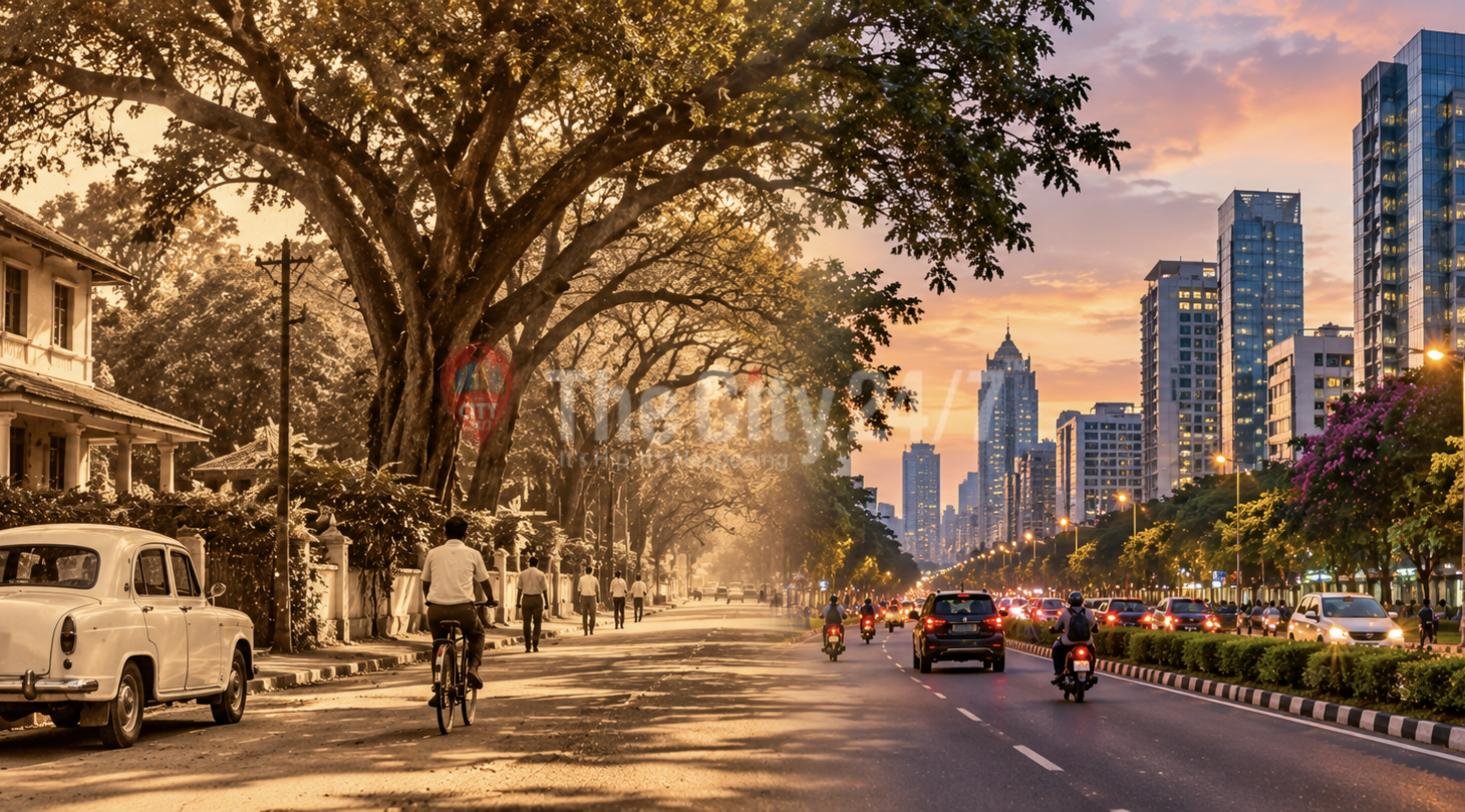
“Every generation in Bengaluru believes the city was better ten years before they arrived. What is unusual is that the city has changed fast enough for all of them to be describing genuinely different places.”
• On the most rebuilt major city in India
Bengaluru has been at least six different cities in living memory. A garrison and administrative town. A public sector engineering city built deliberately by the Indian state. A green, slow, middle class retirement city. A software outsourcing hub. A startup and venture capital centre. And now a metropolitan region of roughly fourteen million people with a metro network, a housing crisis and an unresolved argument about water.
Each transition took about a decade and each left its architecture, its neighbourhoods and its grievances behind. That is why the city feels incoherent: Malleshwaram was built for one Bengaluru, Jayanagar for another, Koramangala for a third and the Sarjapur corridor for a fourth, and they are all still here, functioning simultaneously and competing for the same roads.
This is the story decade by decade, with what got built, what it did to the city and what survives. It sits alongside our history of Bangalore, which covers the founding and the pre independence centuries in more depth, and our oldest neighbourhoods guide. I find this the most useful way to understand why the city works the way it does, so I have kept each decade short and focused on what it left behind.
Quick Information
Nine decades on one screen. Read the population column top to bottom and the whole story is there.
What Was Bangalore Like Before the 1940s?
Two separate cities. The Kannada speaking pete, founded in 1537 as a market town, and the British Cantonment established from 1809 to the east, each with its own administration, language of daily life and architecture.
That division is the foundation of everything that followed. The pete was dense, commercial and organised by trade, with the plague era suburbs of Basavanagudi and Malleshwaram added in the 1890s to relieve overcrowding. The Cantonment was spacious, English and Tamil speaking, built of bungalows and verandahs, with its own market at Russell Market, its own churches and its own clubs.
Princely Mysore under the Wadiyars also made this a technocratic place well before independence: hydroelectric power in 1905, the first city in Asia to be lit that way, and the Indian Institute of Science in 1909. So when the Indian state later wanted to build engineering industries somewhere, the choice of Bengaluru was not accidental.
How Did the 1940s and 1950s Change Bangalore?
They made it an industrial city. Hindustan Aircraft was founded in 1940, and after independence the public sector giants followed: HAL, Bharat Electronics, HMT and Indian Telephone Industries, all state owned and all here.
This is the decade that set Bengaluru's trajectory and it is the one most often skipped. The Indian state deliberately located aerospace, electronics, machine tools and telecom manufacturing in this city, partly for its distance from contested borders, partly for its climate, and partly because the Indian Institute of Science and the Mysore engineering tradition were already here.
The effect was to create a large, stable, technically educated, salaried middle class decades before software existed. Company townships were built, engineering colleges expanded to feed the factories, and Jayanagar was laid out in the late 1940s as one of Asia's largest planned suburbs. The Vidhana Soudha, completed in 1956 in Neo Dravidian granite, was the statement of a confident new state. Every later boom drew on the talent pipeline built in this period.
“The software industry did not create Bengaluru's engineering talent. It inherited it from three decades of state owned aircraft, electronics and machine tool factories.”
• The most commonly skipped fact about this city
Why Was Bangalore Called a Pensioners' Paradise?
Because through the 1960s and 1970s it was cool, green, cheap, well serviced and slow, which made it the obvious place in India to retire. Both that nickname and Garden City date from this era.
The combination was genuinely rare: 900 metres of elevation giving mild weather year round, wide tree lined planned layouts, good hospitals and schools, low costs, and a pace that suited people who had finished working. Retired officers, civil servants and professionals moved here from across India, and the city acquired a reputation for gardens, clubs, filter coffee and nothing happening particularly fast.
Residents who remember this Bengaluru describe it with an affection that newer arrivals find hard to credit, and the physical evidence is still there in Malleshwaram, Basavanagudi, Jayanagar, Sadashivanagar and the Cantonment streets, where the canopy survives and the plots are large. It is also the source of the city's most persistent grievance, because that Bengaluru was dismantled by the thing that made it prosperous.
What Happened in the 1980s and 1990s?
Texas Instruments opened a design centre in 1985, liberalisation arrived in 1991, and Infosys and Wipro scaled from here. Within a decade the city's identity flipped from retirement town to software capital.
- 1985: Texas Instruments. The first multinational technology design operation in the city, and the proof of concept that skilled engineering work could be done here for global clients.
- 1991: liberalisation. Economic reform opened the way for export services at scale, and Bengaluru had the engineers, the colleges and the public sector legacy to take it.
- 1990s: Infosys and Wipro. Both scaled dramatically in this period, and Electronic City in the south became the first purpose built technology district of the new economy.
- The 1980s pub era. Bengaluru's pub culture began well before the microbreweries, and by the 1990s the city had acquired the Pub City nickname alongside its older ones.
- Migration begins in earnest. Engineers arrived from across India, changing the linguistic and cultural composition of the city and putting the first real pressure on housing and roads.
- The first infrastructure gap. Growth outpaced roads, water and drainage from this point onward, and never caught up. Most of today's civic problems were set in motion here.
What Did the 2000s and 2010s Do to the City?
The 2000s built the outsourcing city: Whitefield, the Outer Ring Road corridor and a new airport in 2008. The 2010s built the startup city: Koramangala, HSR, venture capital and the first metro lines.
Through the 2000s the technology industry moved from campuses in the south to enormous new clusters in the east and along the ORR, and residential development followed it. Whitefield went from a quiet settlement to a region. The airport moved from HAL in the east to Devanahalli in the north in 2008, which created an entirely new growth corridor and added an hour to everybody's journey. Bangalore became international shorthand for outsourcing.
The 2010s changed the character again. Product startups replaced services as the story, venture capital arrived, Koramangala and HSR Layout became the centre of gravity, and co-living and flat sharing became normal. Namma Metro opened in 2011 and slowly became essential. The city was officially renamed Bengaluru in 2014, restoring the name from that ninth century inscription. And Bellandur Lake caught fire, which was the decade's other, less flattering headline.
Where Does Bangalore Stand in the 2020s?
Roughly thirteen to fourteen million people in the metropolitan region, an expanding metro network, a corridor of new development running south east, and an overdue reckoning with water, traffic and tree cover.
The good news is real. The metro has expanded substantially, including the Purple Line out to Whitefield, which changed the economics of living in the east, and further lines are under construction. Remote and hybrid work spread the load slightly. Several lakes are in better condition than twenty years ago, brought back mostly by residents rather than by government. And the city remains the centre of Indian technology by a wide margin.
The problems are equally real and structurally harder. A city with no river depends on Kaveri water pumped uphill roughly a hundred kilometres, plus borewells that are falling, and the eastern corridors run on tankers through summer. The street tree canopy has thinned badly. Peak hour traffic at Silk Board, Agara and the ORR is among the worst anywhere. And housing costs have risen faster than the infrastructure serving the new housing. Bengaluru in the 2020s is a city that has succeeded faster than it has been able to build, and the next decade is about whether the building catches up.
Bangalore Through the Decades: Frequently Asked Questions
Why was Bangalore called the Pensioners' Paradise?
Through the 1960s and 1970s it was cool, green, cheap, well serviced and slow, with mild weather from its 900 metre elevation, wide tree lined planned layouts and good hospitals and schools, which made it the obvious place in India to retire. The Garden City nickname comes from the same era.
When did Bangalore become a technology city?
The foundations were laid in the 1940s and 1950s with Hindustan Aircraft, BEL, HMT and ITI, which built a technically educated middle class. Texas Instruments arrived in 1985, liberalisation came in 1991, and Infosys and Wipro scaled through the 1990s, which is when the city's public identity flipped to software.
What was Bangalore like before independence?
Two separate cities: the Kannada speaking pete founded in 1537, with the plague era suburbs of Basavanagudi and Malleshwaram added in the 1890s, and the British Cantonment established from 1809 to the east, each with its own administration, language and architecture.
How has Bangalore's population changed?
From about 1.2 million at the 1961 census to roughly thirteen to fourteen million in the metropolitan region today. That growth, compressed into six decades and driven by migration for work, is the single cause of most of the city's current infrastructure pressures.
When did Namma Metro open?
The first stretch opened in 2011 and the network has expanded substantially since, including the Purple Line extension out to Whitefield which materially changed the economics of living in east Bengaluru. Further lines, including along the Outer Ring Road, are under construction.
Why was Bangalore renamed Bengaluru?
Officially in 2014, restoring the older Kannada name that appears in a ninth century Western Ganga inscription at Begur, which predates the city's 1537 founding by around six hundred years. Both names remain in common use.
What did Bangalore lose as it grew?
Street tree canopy, to road widening, metro construction and plot redevelopment; hundreds of the rainwater tanks the city was built around, filled in for bus stands, stadiums and layouts; most of the old bungalow stock; and the pace that defined the Pensioners' Paradise era.
When did the Bangalore airport move?
In 2008, from HAL airport in the east to Kempegowda International at Devanahalli, roughly 35 to 40 km north of the city. It created an entirely new northern growth corridor and added substantial travel time for most residents.
Why does Bangalore have water problems?
Because it has no river. The city was built on a cascading system of rainwater tanks, most of which were lost, and now depends on Kaveri water pumped uphill roughly a hundred kilometres plus borewells with falling tables. The eastern and south eastern corridors run heavily on tanker supply through summer.
What is the through line in Bangalore's history?
Engineering. Hydroelectric power in 1905, the Indian Institute of Science in 1909, aircraft in 1940, the public sector electronics and machine tool industries in the 1950s, software in the 1990s and product startups in the 2010s, each drawing on the talent pipeline the previous era built.
Useful Links
Archives, records and institutions for anyone researching the city's past.
Remember a Bengaluru I Have Described Wrongly?
The people who lived through these decades know them far better than any summary can, and the 1960s and 1970s city in particular is thinly documented. If I have a detail wrong, or you remember a Bengaluru that deserves recording, click the WhatsApp icon at the bottom right of your screen and tell me. Those messages are among the most valuable I get. That is also the fastest way to reach The City 24/7 about anything at all.
And if you want the city explained one useful thing at a time, join our ever growing community at thecity247.com/newsletter. One weekly email, free, and frequently about how we got here.
Same city, new stories, always.

Related Stories
 CITY GUIDE
The History of Bangalore: From a Mud Fort in 1537 to India's Tech Capital
November 1, 2026
 CITY GUIDE
Bangalore's Oldest Neighbourhoods, and How to Walk Each One
July 29, 2026
 CITY GUIDE
The Ultimate Guide to Bangalore: Everything You Need to Know
November 1, 2026
 CITY GUIDE
Aquarium Paradise, Palace Road: India's Longest Underwater Tunnel Is in Bengaluru
September 24, 2026
 CITY GUIDE
Shivoham Shiva Temple: Bengaluru's 65 Foot Shiva, and the Cave Walk Under It
September 20, 2026
 CITY GUIDE
The Indian Music Experience Museum: Bengaluru's Most Underrated Two Hours
September 19, 2026
