


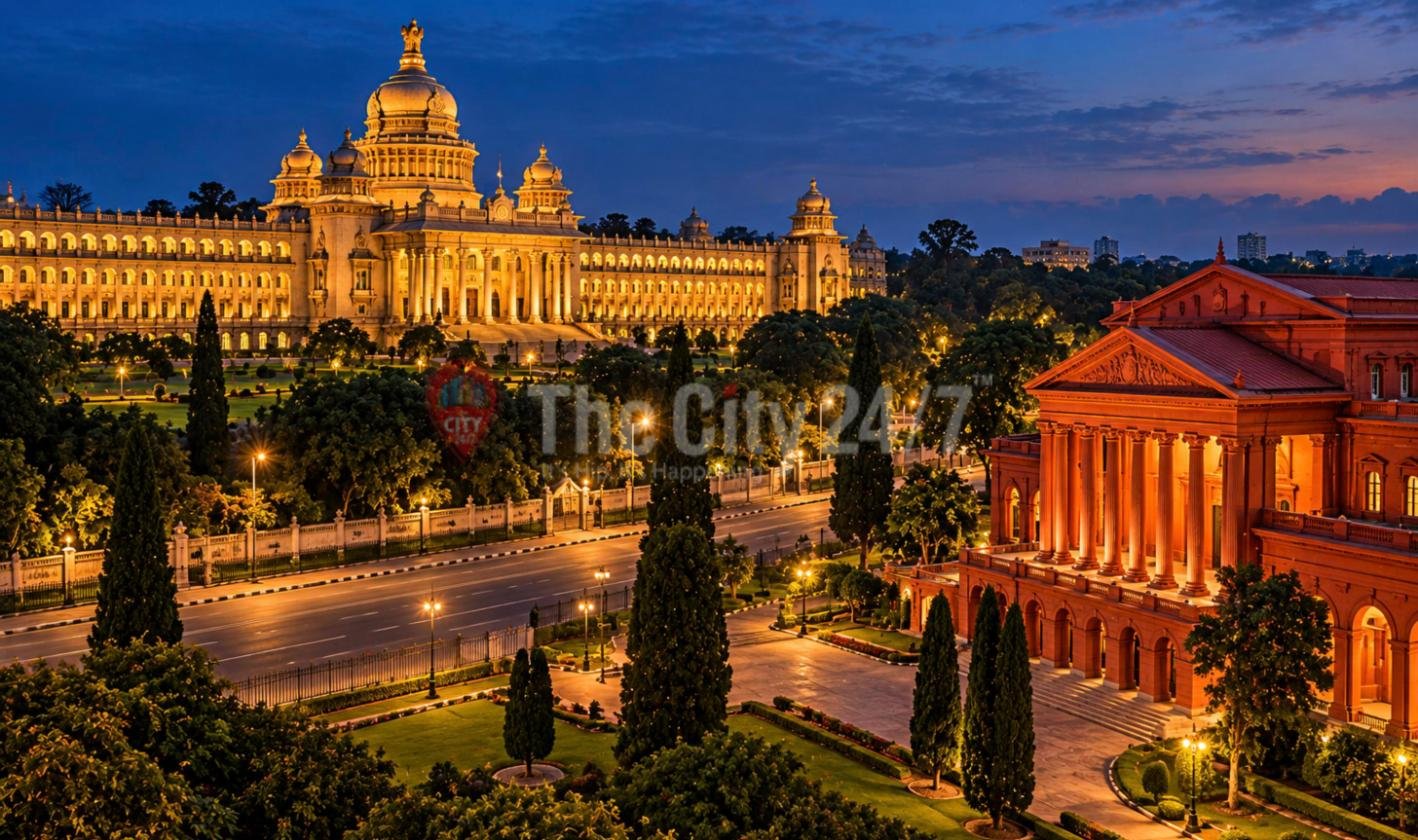
“Kengal Hanumanthaiya wanted a building that would make people stop arguing that Indians could not build. He got one, and it is still the most confident structure in this city.”
• On why Vidhana Soudha looks like that
Vidhana Soudha is the seat of the Karnataka legislature on Ambedkar Veedhi, completed in 1956, and Attara Kacheri, the red Gothic Karnataka High Court, faces it across the road. Neither is generally open to casual visitors, but both are free to view from outside, and Vidhana Soudha is illuminated on Sundays and public holidays, typically in the evening.
Vidhana Soudha was driven by Kengal Hanumanthaiya, then Chief Minister of Mysore, who wanted a state building in an Indian architectural idiom rather than a colonial one. The result is what is usually called Neo-Dravidian: granite, columns, domes and a monumental central portico, and it is among the largest legislative buildings in India.
Attara Kacheri, meaning eighteen offices, is the older of the two, a red brick and plaster Gothic revival building of 1868 that housed the colonial administration and is now the High Court. The two facing each other across one road is, to my eye, the single best piece of urban composition in Bengaluru. In this guide I cover what you can see, when, and from where.
Quick Information
Two working government buildings you mostly admire from the pavement. Bring a camera, not a petition.
Can You Go Inside Vidhana Soudha?
Not as a casual visitor. Vidhana Soudha is a working legislature and secretariat, and entry requires official permission, an appointment or an organised arrangement. There have been periods when limited public or guided access was discussed or trialled, but the practical position for a visitor is that you view it from outside.
- What you can do. Walk along Ambedkar Veedhi and the Cubbon Park side and view the building from the public road and grounds. This is free and unrestricted.
- What you cannot do. Walk in. Entry requires official permission and there is meaningful security.
- If you have a reason to go in. Access is arranged through official channels, typically via a department, a legislator's office or an institutional request.
- Photography. Photographing the building from the public road is normal and fine. Do not photograph security personnel or arrangements.
- Republic Day and state occasions. Ceremonial events take place here and the area is closed off. Check advisories.
The honest advice: treat these two as buildings to look at rather than visit. That sounds like a limitation and it is not. The view along Ambedkar Veedhi with Vidhana Soudha on one side and Attara Kacheri on the other is the best five minutes of architecture in this city, and it costs nothing.
When Is Vidhana Soudha Illuminated?
Typically on Sunday evenings and public holidays, when the facade is floodlit. The illumination is the reason to plan an evening visit, and the best photographs are taken in the short window when there is still colour in the sky and the lights are already on.
- When. Generally Sunday evenings and public holidays. Arrangements have changed over the years, so a Sunday is the safest bet.
- Best time to be there. Blue hour, roughly 6.30 to 7.15 PM depending on the season. Lights on, sky still blue.
- Where to stand. On Ambedkar Veedhi directly in front of the main portico, and from the Cubbon Park side for a longer view.
- Special illuminations. The building is sometimes lit in colours to mark particular occasions and awareness days.
- Combine with. An evening walk in Cubbon Park, which is adjacent, or dinner on MG Road and Church Street afterwards.
What Is the Architecture of Vidhana Soudha?
Granite, in a style generally described as Neo-Dravidian, drawing on south Indian temple architecture for its columns, cornices and central dome while functioning as a modern legislative building. The scale is deliberate: a monumental central portico with a broad flight of steps, and four storeys of granite behind it.
- The material. Granite throughout, quarried locally. The refusal to use plaster and paint was part of the point.
- The style. Neo-Dravidian, combining Dravidian temple elements with Indo-Saracenic and modern features. Contested as a category and unmistakable as a building.
- The central dome. Over the main portico, and the element that gives the building its silhouette.
- The steps and portico. The ceremonial front, and the backdrop to a great many political photographs over seventy years.
- The inscription. Government work is God's work, carved on the portico. Hanumanthaiya's own framing of what the building was for.
- Kengal Hanumanthaiya. Chief Minister of Mysore from 1952 to 1956, and the political force behind the building. His insistence on an Indian idiom shaped everything about it.
- The context. It was built in the first decade after independence, and the confidence of the design is the confidence of that moment.
“Granite, no plaster, and a portico big enough to be a statement. Vidhana Soudha was built in the first decade after independence, and it looks exactly like that.”
• On the building's politics
What Is Attara Kacheri?
The red Gothic revival building facing Vidhana Soudha, completed in 1868, which houses the Karnataka High Court. The name means eighteen offices, referring to the departments of the Mysore administration it originally accommodated, and it is one of the finest colonial-era buildings in the city.
- The building. Two-storey Gothic revival in red brick and plaster, with Corinthian columns and arched corridors. Completed 1868.
- The name. Attara Kacheri means eighteen offices in Urdu and Kannada usage, from the administrative departments originally housed here.
- Now. The Karnataka High Court. It is a working court, so public access is limited and subject to security.
- The demolition that did not happen. There was a proposal in the 1980s to demolish the building, which was resisted and stopped. It is one of the city's better heritage outcomes.
- The view. From Cubbon Park's lawns, with the red facade against the trees. This is the classic Bengaluru photograph.
- Best time. Early morning from the Cubbon Park side, when the light is on the facade and the park is quiet.
Where Are the Best Places to Photograph These Buildings?
Attara Kacheri from the Cubbon Park lawns in the early morning, and Vidhana Soudha from Ambedkar Veedhi at blue hour on an illumination evening. Those are the two shots I would plan for, and both are from public ground.
- Attara Kacheri, morning. From inside Cubbon Park, looking across the lawns at the red facade with trees framing it. 7 to 8.30 AM.
- Vidhana Soudha, evening. From Ambedkar Veedhi in front of the portico, at blue hour on a Sunday. 6.30 to 7.15 PM.
- The pairing. Stand on Ambedkar Veedhi between them and look both ways. Granite on one side, red Gothic on the other.
- Wide angle. Both buildings are long, and a wide lens or a panorama helps. Vidhana Soudha in particular does not fit in a standard frame.
- What to avoid. Do not photograph security personnel, checkpoints or arrangements. Do not use a drone anywhere near either building.
- Tripods. You may be asked to move on. Keep it quick and unobtrusive on the public footpath.
How Do You Get There and What Else Is Nearby?
Dr BR Ambedkar Station, Vidhana Soudha, on the Purple Line puts you at the buildings. Cubbon Park is immediately adjacent, the Kasturba Road museums are a ten-minute walk, and the planetarium and NGMA are both within two kilometres.
- Metro. Dr BR Ambedkar Station, Vidhana Soudha, on the Purple Line. Directly there.
- Bus. Extensive BMTC service to Shivajinagar, Corporation and MG Road.
- Car. Restricted and enforced around the government district. Take the metro.
- Cubbon Park. Immediately adjacent, and the best way to approach both buildings on foot.
- The museums. VITM, the Government Museum and the Venkatappa Art Gallery on Kasturba Road, ten minutes away.
- A good route. Cubbon Park at 7 AM, Attara Kacheri from the lawns, the museums when they open at 10, and back for the Vidhana Soudha illumination on a Sunday evening.
FAQs
Can you go inside Vidhana Soudha?
Not as a casual visitor. It is a working legislature and secretariat, and entry requires official permission or an arranged appointment. You can view and photograph the building freely from Ambedkar Veedhi and the Cubbon Park side, which is what visitors do.
When is Vidhana Soudha illuminated?
Typically on Sunday evenings and public holidays, when the granite facade is floodlit. The best time to be there is blue hour, roughly 6.30 to 7.15 PM depending on the season, when the lights are on and there is still colour in the sky.
When was Vidhana Soudha built?
It was completed in 1956, driven by Kengal Hanumanthaiya, then Chief Minister of Mysore, who wanted a state building in an Indian architectural idiom rather than a colonial one. It is among the largest state legislature buildings in India.
What is the architectural style of Vidhana Soudha?
Generally described as Neo-Dravidian: granite throughout, with columns, cornices and a central dome drawing on south Indian temple architecture, combined with Indo-Saracenic and modern elements. The inscription on the portico reads that government work is God's work.
What is Attara Kacheri?
The red Gothic revival building of 1868 facing Vidhana Soudha, which houses the Karnataka High Court. The name means eighteen offices, referring to the administrative departments originally housed there. A proposal to demolish it in the 1980s was resisted and stopped.
Can you visit the Karnataka High Court?
It is a working court, so public access is limited and subject to security. For a visitor, the building is best appreciated from the Cubbon Park lawns, where the red facade framed by trees makes the classic Bengaluru photograph.
Which metro station is closest to Vidhana Soudha?
Dr BR Ambedkar Station, Vidhana Soudha, on the Purple Line, which puts you directly at the buildings. Driving is a poor option because the government district has restricted and enforced parking.
What is the best time to photograph Vidhana Soudha?
Blue hour on a Sunday evening or public holiday, roughly 6.30 to 7.15 PM, from Ambedkar Veedhi in front of the main portico. For Attara Kacheri, early morning from inside Cubbon Park. Do not photograph security arrangements, and do not fly a drone anywhere near either building.
Contact Details
Official sources, relevant if you need actual access rather than a view from the road.
Got a Better Vantage Point?
If you know a spot on public ground with a better view of either building, or if the illumination schedule has changed, click the WhatsApp icon at the bottom right of your screen and tell me. That is also the easiest way to reach The City 24/7 about anything at all.
And if you want city guides, weekend plans and neighbourhood notes landing in your inbox, join our ever growing community at thecity247.com/newsletter. Free, and about ten seconds of your life.
Same city, new stories, always.

Related Stories
 CITY GUIDE
Bangalore's Oldest Neighbourhoods, and How to Walk Each One
July 29, 2026
 CITY GUIDE
Bangalore Fort and the Four Kempegowda Towers: How to Find What Is Left of 1537
September 8, 2026
 CITY GUIDE
Bangalore Palace: Timings, Entry Fee and Whether It Is Worth Rs 230
September 8, 2026
 CITY GUIDE
Bengaluru's Theatres and Cultural Venues: Where to Actually See Something Live
September 8, 2026
 CITY GUIDE
Visvesvaraya Industrial and Technological Museum: The Best Three Hours in the City With Children
August 30, 2026
 CITY GUIDE
Bangalore's Most Famous Landmarks, and What Makes Them Special
July 29, 2026
