



“Four towers marked the limits of Bengaluru in the sixteenth century. All four still stand, and all four are now deep inside the city. You can visit them in a morning and understand exactly how much this place has grown.”
• The best way to grasp the scale of it
Bangalore Fort survives as the Delhi Gate and a section of rampart near KR Market, generally open during daylight hours with free or nominal entry. The four Kempegowda watchtowers that marked the sixteenth-century city's boundaries stand at Lalbagh, Ulsoor, Mekhri Circle and Gavipuram. All are free to visit.
Kempe Gowda I founded Bengaluru in 1537 with a mud fort, and his successor Kempe Gowda II is credited with the four towers that marked how far the city was expected to grow. Hyder Ali rebuilt the fort in stone in the 1760s, and in 1791 Cornwallis breached it during the Third Anglo-Mysore War.
What is left is fragmentary, and that is the story. The fort was largely dismantled as the city expanded, and the towers now sit in a botanical garden, beside a lake, on a traffic island and next to a cave temple. This guide tells you where each one is, what to look for, and how to walk the set.
Quick Information
One fort gate, four towers, five hundred years, and a lot of city built on top of it all.
What Is Left of Bangalore Fort and Can You Visit It?
Yes. The Delhi Gate and a section of rampart and bastion survive near KR Market, along with a Ganapathi temple inside the walls. It is a small site, generally open during daylight hours, free or nominally ticketed, and it sits a short walk from Tipu Sultan's Summer Palace.
- The Delhi Gate. The principal surviving entrance, with the stonework and arch intact. The most photographed part of the fort.
- The ramparts and bastions. Sections of wall and the curved bastion form, which give you a sense of the original scale of the fortification.
- The Ganapathi temple. Within the fort walls, and still in worship.
- The breach point. Local accounts identify where Cornwallis's forces broke through in 1791. Ask on site.
- How to find it. Near Krishna Rajendra Market, and locals call the area Kote. It is easy to walk past, so use a map.
- Time needed. Thirty to forty-five minutes. Combine with the Summer Palace, which is minutes away.
Do the fort and Tipu Sultan's Summer Palace as one visit. They were part of the same complex, they are a few minutes apart, and neither makes complete sense without the other. Together they take about ninety minutes.
What Happened at Bangalore Fort in 1791?
Lord Cornwallis besieged and stormed the fort in March 1791 during the Third Anglo-Mysore War, breaching the walls and taking the city from Tipu Sultan's forces. It was one of the significant actions of that war and it effectively ended Bengaluru's role as a fortified Mysore stronghold.
- The context. Four Anglo-Mysore wars were fought between the British East India Company and the rulers of Mysore between the 1760s and 1799.
- Hyder Ali's fort. He rebuilt Kempe Gowda's mud fort in stone in the 1760s, making it a serious military position.
- March 1791. Cornwallis's forces breached the fort. The assault is well documented and the breach location is part of local accounts.
- After 1799. Tipu was killed at Srirangapatna and the British took control of the region. The fort lost its purpose and was progressively dismantled.
- What the city did next. The cantonment grew to the east, the old city continued to the west, and the fort became a quarry and then a market district.
- Why so little survives. Urban expansion rather than war. The fort was taken apart because the city needed the land and the stone.
“The fort did not fall to the city's enemies. It fell to the city itself, which needed the land and the stone.”
• On why there is so little left
Where Are the Four Kempegowda Towers?
At Lalbagh, Ulsoor, Mekhri Circle and Gavipuram. Kempe Gowda II is credited with building them in the sixteenth century to mark the boundaries within which the city was expected to grow, and all four still stand, now deep inside the modern city.
- Lalbagh tower. On top of the peninsular gneiss rock inside Lalbagh Botanical Garden, south Bengaluru. The easiest to visit and the best setting, on a rock estimated at 3,000 million years old.
- Ulsoor tower. Near Ulsoor Lake in east Bengaluru. In the old cantonment-adjacent area, and easy to combine with the lake.
- Mekhri Circle tower. In north Bengaluru near Palace Grounds and the Mekhri Circle junction. The hardest to see well, because of the traffic around it.
- Gavipuram tower. In south Bengaluru near Gavi Gangadhareshwara Temple and Bugle Rock. Quiet, and often visited alongside the temple.
- What they are. Simple stone watchtowers, not elaborate structures. The significance is entirely in what they marked.
- Entry. Free. All four are in publicly accessible locations, though the Lalbagh one requires garden entry outside the free walking hours.
Why Do the Kempegowda Towers Matter?
Because they are a sixteenth-century statement about the intended limits of a city that has since grown roughly a hundredfold beyond them. Kempe Gowda II set the boundary markers, the city filled that boundary within a few centuries, and then kept going for another forty kilometres in every direction.
- The original intent. The towers marked how far the founders expected Bengaluru to expand. Standing between two of them, you can walk the whole distance in an hour.
- The modern comparison. The area enclosed by the four towers is a small fraction of the current city. Whitefield, Electronic City and the airport are all far outside it.
- Kempe Gowda I and II. The founder in 1537, and his successor credited with the towers. Their statues stand at various points in the city, including outside the Corporation building.
- The tank system. The other half of their legacy. The city was built on a cascade of man-made lakes, most of which are now gone.
- Why to do the walk. There is no better way to understand this city's growth than to visit two towers on the same day and note how ordinary the distance between them now feels.
What Is the Best Heritage Walk Connecting These Sites?
Lalbagh tower at 6.30 AM, Gavipuram tower and Gavi Gangadhareshwara at 9, then the fort and Tipu's Summer Palace at 10.30. That covers two of the four towers, the surviving fort gate and the eighteenth-century palace, in one morning on foot and by metro.
- 6.30 AM, Lalbagh. Free walking window. The rock and the first tower, with the sun coming up.
- 8.15 AM, Gandhi Bazaar. Breakfast in Basavanagudi.
- 9 AM, Bull Temple and Bugle Rock. The sixteenth-century temple, and the park above Gavipuram.
- 9.45 AM, Gavipuram tower and Gavi Gangadhareshwara. The second tower and the cave temple.
- 10.45 AM, Bangalore Fort. Metro or auto to KR Market. The Delhi Gate and the ramparts.
- 11.30 AM, Tipu Sultan's Summer Palace. The teak palace within the old fort walls.
- The other two towers. Ulsoor and Mekhri Circle are in different parts of the city. Do them separately, with Ulsoor Lake and with a north Bengaluru trip respectively.
How Do You Get to Bangalore Fort?
Green Line metro to Krishna Rajendra Market or Chickpet, then a short walk. The fort is in the KR Market and Kalasipalya area, which is the most congested part of the city, so driving is not a realistic option.
- Metro. Krishna Rajendra Market or Chickpet on the Green Line, both a short walk from the fort remains.
- Bus. KR Market and Kalasipalya are major BMTC hubs.
- Car. Do not. There is no realistic parking in the wholesale market district.
- Finding it. Ask for Kote or Bangalore Fort. It is adjacent to the Vani Vilas hospital area and easy to walk past.
- Combine with. Tipu Sultan's Summer Palace, KR Market at dawn, Chickpet and Avenue Road.
FAQs
Can you visit Bangalore Fort?
Yes. The surviving Delhi Gate, sections of rampart and bastion, and a Ganapathi temple within the walls are open during daylight hours with free or nominal entry. The site is near KR Market, a short walk from Tipu Sultan's Summer Palace.
Where are the four Kempegowda towers?
At Lalbagh, on the ancient gneiss rock inside the botanical garden, at Ulsoor near the lake, at Mekhri Circle in north Bengaluru, and at Gavipuram near Gavi Gangadhareshwara Temple and Bugle Rock. All four are free to visit and in publicly accessible locations.
Who built Bangalore Fort?
Kempe Gowda I founded it as a mud fort in 1537 when he founded Bengaluru. Hyder Ali rebuilt it in stone in the 1760s, making it a serious military position. It was breached by Cornwallis in March 1791 during the Third Anglo-Mysore War.
What happened at Bangalore Fort in 1791?
Lord Cornwallis besieged and stormed the fort in March 1791 during the Third Anglo-Mysore War, breaching the walls and taking the city from Tipu Sultan's forces. After Tipu's death at Srirangapatna in 1799 the fort lost its purpose and was progressively dismantled as the city expanded.
Why did the Kempegowda towers get built?
Kempe Gowda II is credited with building them in the sixteenth century to mark the boundaries within which Bengaluru was expected to grow. The area they enclose is now a small fraction of the modern city, which makes visiting two of them the clearest possible illustration of how much this place has expanded.
How much of Bangalore Fort survives?
Very little. The Delhi Gate, sections of wall and bastion, and a temple within the walls. The fort was largely dismantled not by war but by urban expansion, as the city needed both the land and the stone.
Which metro station is closest to Bangalore Fort?
Krishna Rajendra Market or Chickpet on the Green Line, both a short walk away. Do not drive, since the fort sits in the KR Market and Kalasipalya wholesale district where parking is effectively impossible.
Can you see all four Kempegowda towers in one day?
It is possible but not ideal, since they are spread across the city. The practical approach is Lalbagh and Gavipuram together on a south Bengaluru morning with the fort and Tipu's palace, then Ulsoor with a visit to the lake, and Mekhri Circle separately on a north Bengaluru trip.
Contact Details
Official sources for the protected monuments and their access arrangements.
Have You Found All Four?
If you have visited all four Kempegowda towers, or you know something about the fort's surviving fabric that this guide has missed, click the WhatsApp icon at the bottom right of your screen and tell me. I would like to map this properly. That is also the easiest way to reach The City 24/7 about anything at all.
And if you want city guides, weekend plans and neighbourhood notes landing in your inbox, join our ever growing community at thecity247.kit.com/join-the-community. Free, and about ten seconds of your life.
Same city, new stories, always.

Related Stories
 CITY GUIDE
The Indian Music Experience Museum: Bengaluru's Most Underrated Two Hours
September 22, 2026
 CITY GUIDE
The Musical Fountain, Sadashivanagar: Bengaluru's Most Charmingly Dated Evening Out
September 22, 2026
 CITY GUIDE
Visvesvaraya Industrial and Technological Museum: The Best Three Hours in the City With Children
September 18, 2026
 CITY GUIDE
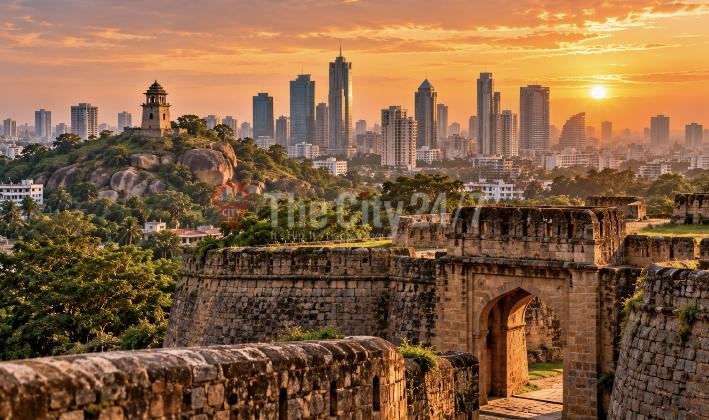
The History of Bangalore: From a Mud Fort in 1537 to India's Tech Capital
September 8, 2026
 CITY GUIDE
Aquarium Paradise, Palace Road: India's Longest Underwater Tunnel Is in Bengaluru
September 22, 2026
 CITY GUIDE
Dodda Ganapathi, Basavanagudi: The 18 Foot Ganesha They Cover in Butter
September 22, 2026
