


“You can read this city's whole argument with itself in five buildings: a fort, a temple, a palace, a courthouse and a parliament. They were each built to answer the one before.”
• On why Bengaluru's landmarks are worth more than a photograph
Bengaluru's landmarks suffer from being compared to the wrong cities. Against Delhi or Jaipur they look modest, and visitors who arrive with that comparison in mind tick them off in an afternoon and feel slightly cheated. That is the wrong frame entirely.
What this city has instead is a small set of buildings that each mark a distinct regime and a distinct idea. Kempe Gowda's towers mark a sixteenth century town's ambition. The Bull Temple marks its religious life. Tipu's summer palace is the last domestic architecture of an independent Mysore. Attara Kacheri and the Cantonment bungalows are the British administrative city. Bangalore Palace is princely Mysore's answer to British taste. And the Vidhana Soudha, in 1956, is independent India's reply to all of it, in granite, deliberately.
So this guide takes them one at a time, with what each one is, why it matters, what it costs to visit and when to go. Read it alongside our places to visit guide for the practical itinerary and our history of Bangalore for the full narrative.
Quick Information
Every landmark worth the trip, with the practical details. Fees shift, so treat them as the right order of magnitude.
What Is Bangalore's Most Important Landmark?
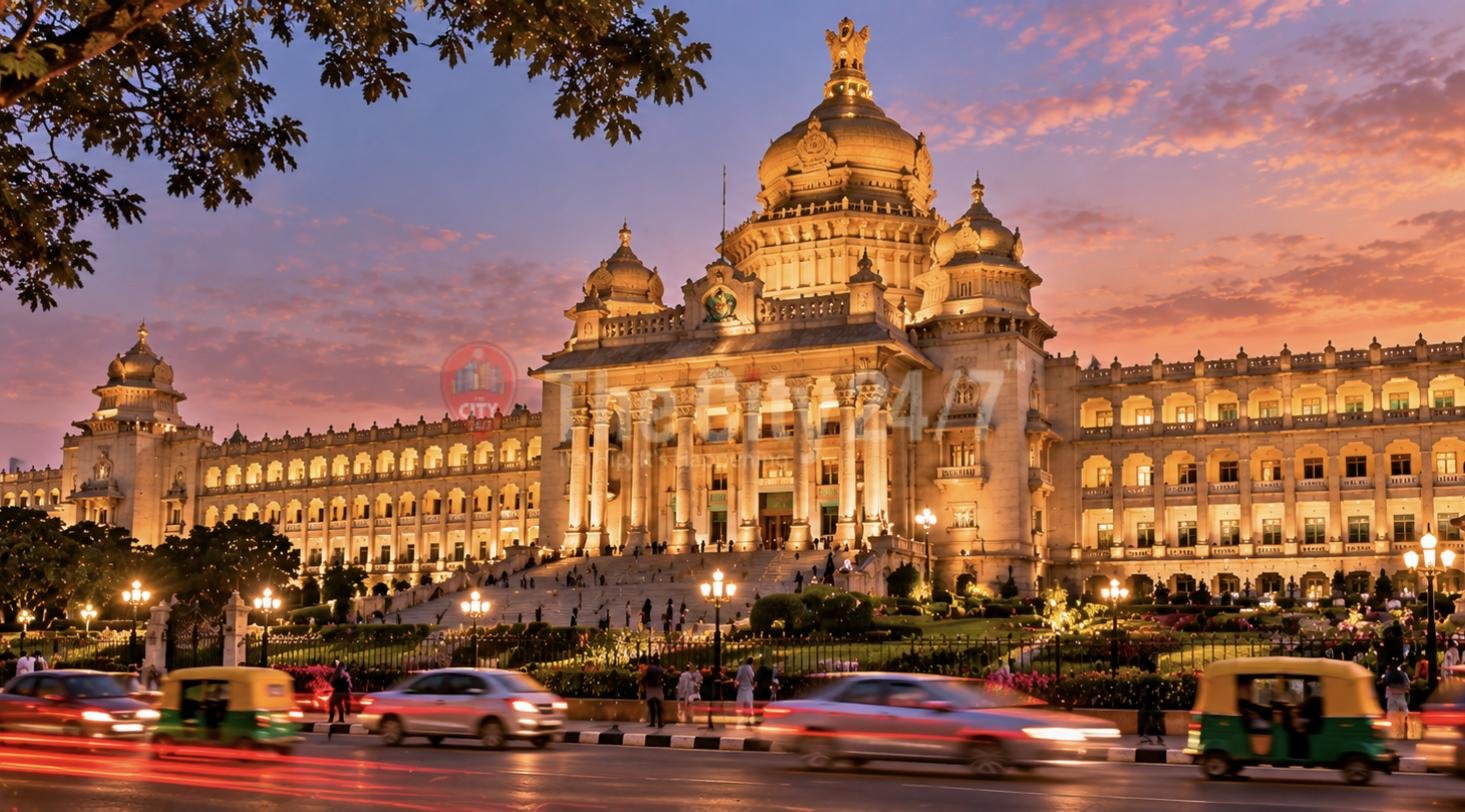
The Vidhana Soudha. Completed in 1956, it is the largest state legislature building in India and the clearest architectural statement the city has ever made.
The story is the point. Built immediately after independence under Chief Minister Kengal Hanumanthaiya, it was deliberately designed in a Neo Dravidian idiom, using granite and drawing on south Indian temple architecture, as a conscious rejection of the colonial style that dominated the administrative buildings around it. The Attara Kacheri, red and Gothic and British, sits nearby, and the two buildings facing each other is one of the most legible architectural arguments in the country.
Interiors are not generally open to visitors, so this is an exterior landmark, and the way to see it is after dark when it is floodlit. It is a five minute walk from Cubbon Park Metro station, it costs nothing, and it is worth twenty minutes of standing still. The inscription on the building reading Government Work is God's Work remains, depending on your mood, either inspiring or very funny.
Is Bangalore Palace Worth Visiting?
Yes. It is a 1870s Tudor revival mansion, still owned by the Wadiyar family, with interiors that are genuinely impressive and by far the most substantial paid heritage site in the city.
The building was bought and developed by the Wadiyars of Mysore, and its style, all timber fretwork, turrets and Gothic windows, is princely Mysore adopting British taste and then outdoing it. Inside are the family's furniture, portraits, photographs and personal collections, and the audio guide is worth taking because the rooms mean much more with the family history attached.
Practically: open roughly 10 AM to 5.30 PM, entry a few hundred rupees with higher rates for foreign nationals, and camera charges on top, which catches people out. Allow an hour and a half. It works best as an afternoon stop when it is too warm to be walking around outside, which pairs neatly with an early morning at Lalbagh or Basavanagudi.
“Tipu's summer palace takes twenty minutes and stays with you longer than buildings ten times its size. Scale and significance are not the same thing.”
• On the most underrated site in the city
Which Landmark Tells You Most About Bangalore's History?
Tipu Sultan's Summer Palace. A two storey teak pavilion from the 1790s with painted ceilings, standing in the middle of the crowded old city, and the last domestic architecture of an independent Mysore.
It is small. That is the first surprise: people expect a palace and find an elegant wooden pavilion on a stone base, with carved columns, arched verandahs and floral ceiling decoration still visible. There is a small museum with documents, weapons and reproductions covering Tipu's reign and the Anglo Mysore wars. Twenty minutes and a modest ticket.
What makes it matter is the timing. Tipu was killed at Srirangapatna in 1799, and after that Mysore became a British subsidiary state and Bengaluru grew a Cantonment. This building is from the last years before that turn, and it is the only place in the city where you can stand inside the world that ended. Combine it with the surviving Bangalore Fort gateway a short walk away, which Tipu's father Hyder Ali rebuilt in stone.
What Are the Kempe Gowda Towers and Where Are They?
Four stone watchtowers built by Kempe Gowda II's era to mark the intended limits of the sixteenth century city, at Lalbagh, Kempambudhi, Halasuru and Mekhri Circle. All four still stand, all are free, and the city passed them centuries ago.
- The Lalbagh tower. The most visited, sitting on the three billion year old peninsular gneiss rock inside the garden. Ten minutes' walk up and the best view of how the old city was laid out.
- The Halasuru tower, Ulsoor. Near Ulsoor Lake, and easy to combine with the Someshwara Temple and a walk through the older Cantonment streets.
- The Kempambudhi tower. By the Kempambudhi tank in the south west of the old city, the least visited of the four and the most easily missed.
- The Mekhri Circle tower. In the north, near the palace grounds, marking what was once the far edge of the settlement and is now inner city traffic.
- Why they matter. They are a founder's statement of how big he expected his town to become. Bengaluru now extends roughly twenty kilometres beyond the furthest of them, which is the whole story of the place in one fact.
- How to see them. The Lalbagh and Halasuru towers are easy and pleasant. Doing all four in a day is a genuinely good way to trace the outline of the original city.
Which Religious Landmarks Should I Visit in Bangalore?
The Bull Temple in Basavanagudi for the sixteenth century city, Someshwara Temple in Halasuru for the oldest structure, and St Mary's Basilica in Shivajinagar for the Cantonment's other history.
The Bull Temple, built under Kempe Gowda, holds a single enormous Nandi carved from local granite, and it remains a working temple with a genuine local rhythm rather than a visitor rhythm. It is free, best early morning or at dusk, and it sits beside Bugle Rock, where watchmen once sounded a bugle at nightfall. The surrounding Basavanagudi streets and Gandhi Bazaar make this the best half day of landmark visiting in the city.
Someshwara Temple in Ulsoor is the oldest temple in Bengaluru, with Vijayanagara period work, and it receives almost no visitors, which is precisely the recommendation. St Mary's Basilica in Shivajinagar is the city's oldest church and a minor basilica, and its September feast is one of the largest religious gatherings in Bengaluru. All three are free, and all three are still in active use, which is the thing that distinguishes them from monuments.
What About Bangalore's Colonial and Modern Landmarks?
The Attara Kacheri and the Seshadri Iyer Memorial Hall for the British administrative city, and the Lalbagh Glass House for its Victorian engineering. For the contemporary city, the central business district skyline is the honest answer.
Attara Kacheri, the red Gothic building facing Cubbon Park, dates from the 1860s and houses the High Court. Its name means eighteen offices, from the administrative departments it once held. It is best viewed from the park, floodlit at night, and its relationship to the Vidhana Soudha across the way is the most interesting thing about either building.
The Seshadri Iyer Memorial Hall from 1915, also red and also in Cubbon Park, holds the State Central Library and you can walk into the reading room, which is one of the quietest and most pleasant interiors in central Bengaluru. The Glass House in Lalbagh, iron and glass modelled on London's Crystal Palace, completes the Victorian set. For the modern skyline, the towers around the central business district are what the twenty first century built here, and whether they qualify as landmarks is a conversation this city is still having.
Bangalore's Landmarks: Frequently Asked Questions
What is the most famous landmark in Bangalore?
The Vidhana Soudha, completed in 1956 and the largest state legislature building in India. Built in Neo Dravidian granite as a deliberate answer to the colonial architecture around it, it is best seen floodlit after dark and is a short walk from Cubbon Park Metro station.
Can you go inside the Vidhana Soudha?
Interiors are not generally open to visitors, so it is an exterior landmark. The best way to see it is in the evening when the building is floodlit, ideally combined with the Attara Kacheri nearby and a walk through Cubbon Park.
How much does it cost to visit Bangalore Palace?
A few hundred rupees for Indian nationals with higher rates for foreign nationals, plus separate camera charges which surprise a lot of visitors. Open roughly 10 AM to 5.30 PM, and worth about an hour and a half with the audio guide.
Is Tipu Sultan's Summer Palace worth seeing?
Yes, and it is the most historically significant building in the city. A two storey teak pavilion from the 1790s with painted ceilings and a small museum, it takes twenty minutes and a modest ticket, and it is the only place in Bengaluru where you can stand inside the world of independent Mysore before 1799.
Where are the four Kempe Gowda towers?
At Lalbagh, Kempambudhi, Halasuru and Mekhri Circle. They were built to mark the intended limits of the sixteenth century city, all four still stand, and all are free. The Lalbagh tower, on a three billion year old rock, is the easiest and most rewarding to visit.
What is the oldest building in Bangalore?
Someshwara Temple in Halasuru, or Ulsoor, is the oldest temple in the city with Vijayanagara era work. The surviving gateway of Bangalore Fort, originally Kempe Gowda's 1537 mud fort and later rebuilt in stone by Hyder Ali and Tipu Sultan, is the oldest fortification.
Which Bangalore landmarks are free to visit?
The Bull Temple, Someshwara Temple, St Mary's Basilica, all four Kempe Gowda towers, Cubbon Park with the Attara Kacheri and Seshadri Iyer Memorial Hall from outside, and the Vidhana Soudha exterior. Lalbagh charges only a nominal fee.
What is the Attara Kacheri?
The red Gothic building from the 1860s facing Cubbon Park, now housing the Karnataka High Court. The name means eighteen offices, after the administrative departments it originally held, and it is floodlit and impressive at night.
Which landmarks can I see in one half day in Bangalore?
The Basavanagudi cluster: the Bull Temple, Bugle Rock and its Kempe Gowda tower, and a walk down Gandhi Bazaar for breakfast and sweets. Go early, and the whole thing is free apart from what you eat.
What is the best time to visit Bangalore's landmarks?
Early morning for the temples, towers and gardens, when they are cool and uncrowded, and after dark for the Vidhana Soudha and Attara Kacheri when both are floodlit. Palaces and museums work best in the afternoon heat.
Useful Links
Official pages for timings and ticketing, which change more often than anything else.
Know a Building This City Forgets About?
Bengaluru has a great deal of quiet heritage wedged between newer buildings, and a fair amount of it I have only found because somebody pointed it out. If a timing or fee here has changed, or you know a building in this city that deserves more attention, click the WhatsApp icon at the bottom right of your screen and tell me. That is also the fastest way to reach The City 24/7 about anything at all.
And if you want the city explained one useful thing at a time, join our ever growing community. One weekly email, free, and often about somewhere older than it looks.
Same city, new stories, always.

Related Stories
 CITY GUIDE
Bangalore's Most Interesting Streets, and What Each One Is For
September 11, 2026
 CITY GUIDE
Bengaluru's Theatres and Cultural Venues: Where to Actually See Something Live
September 18, 2026
 CITY GUIDE
Bangalore's Hidden Gems: Places Most Visitors Never Find
September 11, 2026
 CITY GUIDE
Bangalore's Oldest Neighbourhoods, and How to Walk Each One
September 11, 2026
 CITY GUIDE
Morning Walks in Bangalore: The Best Route in Every Part of the City
September 18, 2026
 CITY GUIDE
Bangalore's Heritage Buildings You Should Know, Including the Ones We Lost
September 11, 2026
