


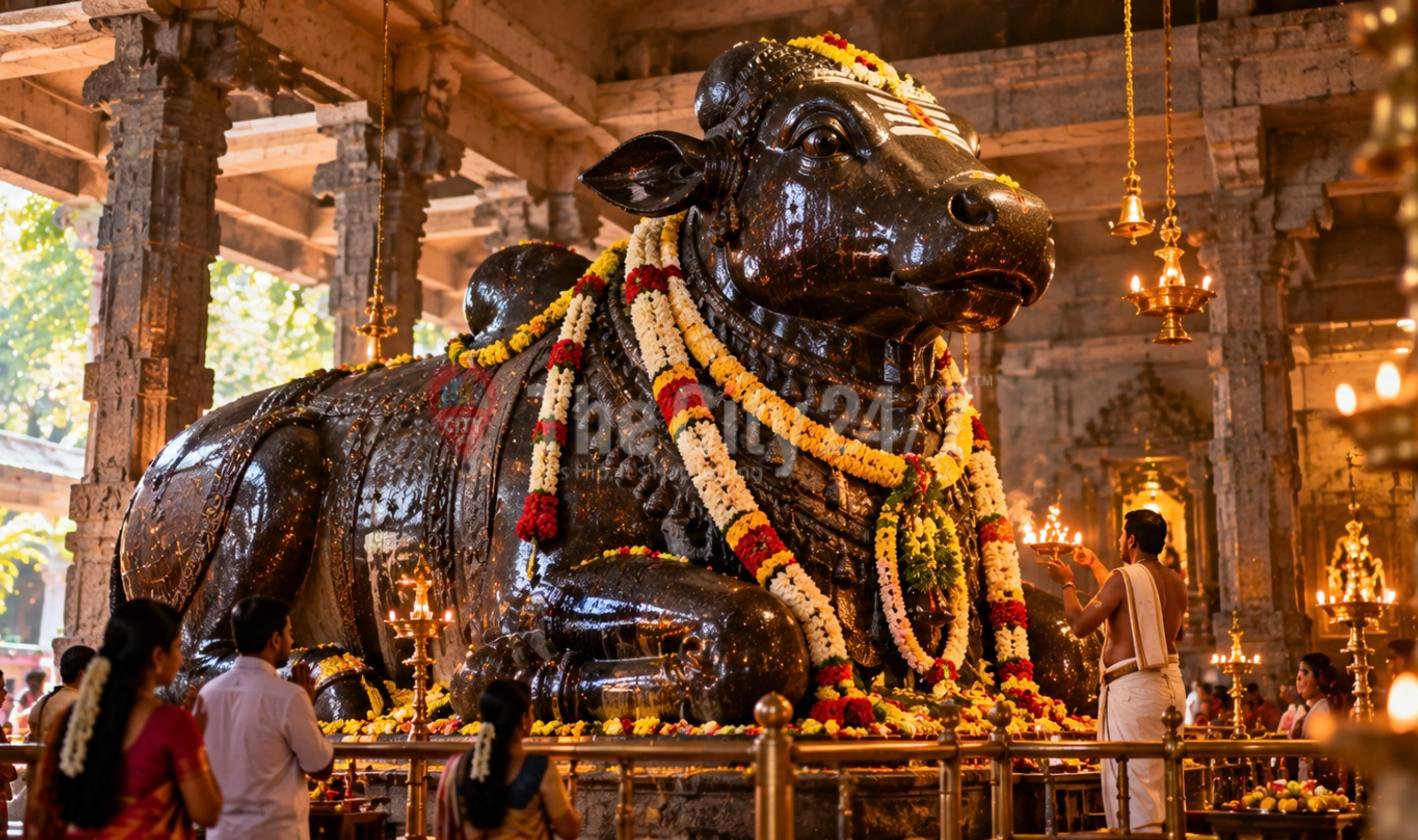
“The neighbourhood is called Basavanagudi because of this temple. Basava means bull, gudi means temple. The building came first and the suburb was named after it.”
• On how old this actually is
Dodda Basavana Gudi, the Bull Temple, is open roughly 6 AM to 12 noon and 5 PM to 8 PM with free entry, in Basavanagudi, south Bengaluru. It was built in the sixteenth century under Kempe Gowda I and houses a monolithic Nandi carved from a single granite block, around fifteen feet tall. The Kadalekai Parishe groundnut fair is held here every November or December.
It is one of the oldest temples in the city and among the few structures that predate everything around it. Kempe Gowda I founded Bengaluru in 1537 and this temple belongs to that period, built in the Dravidian style on Bugle Rock, the granite outcrop that also holds one of the four watchtowers marking the old city's boundary.
The Nandi is the reason to come. Carved from one piece of stone, it fills the sanctum in a way that photographs do not convey, and the local story is that it grew until a trident was driven into its head to stop it. This guide covers timings, the legend, the fair, and the walk it belongs to.
Quick Information
One very large bull, two visiting windows, and a groundnut fair that closes the streets once a year.
What Are Bull Temple Timings and Is Entry Free?
Entry is free, and the temple is generally open roughly 6 AM to 12 noon and again from 5 PM to 8 PM, closing in the afternoon as most working temples in this city do. Timings shift slightly with the season and the festival calendar.
- Morning, 6 to 8 AM. The best time. Cool, quiet, and the neighbourhood is at its best. Combine with Lalbagh, which is ten minutes away.
- Evening, 5 to 8 PM. Busier and more devotional, with aarti and a steady stream of local visitors.
- Afternoon. Closed. Do not plan a 2 PM visit.
- Festival days. Karthika Deepam and the Kadalekai Parishe bring very large crowds. Worth seeing, not a quick visit.
- Time needed. Thirty to forty-five minutes for the temple, plus Bugle Rock park next door.
Do the temple and Lalbagh together. They are about ten minutes apart, both are best in the early morning, and Gandhi Bazaar sits between them for breakfast. It is the best three-stop morning in south Bengaluru.
What Is the Story of the Bull Temple's Nandi?
The local legend is that a bull was damaging the groundnut crops in the area, and a farmer struck it, whereupon the bull turned to stone. A second version holds that the stone Nandi kept growing until a trident was driven into its forehead to stop it, and that a trident remains embedded there.
- The groundnut connection. The legend explains the Kadalekai Parishe, the groundnut fair, where farmers bring the first of the crop as an offering. The story and the festival are the same story.
- The trident. Look at the Nandi's forehead. The trident is part of the legend and part of what devotees point out.
- The spring. There is a tradition associating a spring at the base of the statue with the source of the Vrishabhavathi river, which rises in this part of the city.
- Kempe Gowda I. The founder of Bengaluru in 1537, and the builder of this temple. Basavanagudi takes its name from it.
- The monolith. Carved from a single block of granite, around fifteen feet tall and roughly twenty feet long, and blackened over centuries by oil and charcoal application.
“A farmer struck a bull for eating his groundnuts and the bull turned to stone. Four hundred years later the city still holds a groundnut fair to apologise.”
• On Kadalekai Parishe
What Is the Kadalekai Parishe Groundnut Fair?
An annual groundnut fair held at the temple, usually in November or December on the last Monday of the Karthika month, where farmers from the surrounding districts bring their first groundnut harvest to be offered at the temple and then sold. The streets around Bull Temple Road fill for days.
- When. Usually November or December, tied to the Karthika month. Dates are announced locally each year.
- What happens. Groundnut sellers occupy the streets around the temple in enormous numbers, alongside fairground stalls, food and a great deal of noise.
- Why it matters. It is one of the oldest continuous fairs in the city and one of the few occasions when Bengaluru's agricultural hinterland visibly arrives in the middle of it.
- Practical advice. Take the metro. Bull Temple Road and Gandhi Bazaar are closed or impassable, and the crowds are genuinely large.
- Best time to go. Early evening on a weekday of the fair, if you want to actually move.
- What to eat. Boiled and roasted groundnuts in a dozen preparations, and everything Gandhi Bazaar throws at the occasion.
What Else Is at the Temple and on Bugle Rock?
The Dodda Ganapathi temple with its own large monolithic Ganesha is right beside the Bull Temple, and Bugle Rock park behind it holds one of Kempe Gowda's four watchtowers. All three together are a single short visit and most people only do one.
- Dodda Ganapathi. A large monolithic Ganesha, with the local tradition of covering the idol in butter during certain festivals. Adjacent to the Bull Temple.
- Bugle Rock park. The granite outcrop behind the temple, now a park with old trees, walking paths and an evening crowd.
- Kempe Gowda watchtower. One of the four towers marking the boundaries of the sixteenth-century city. The others are at Lalbagh, Ulsoor and Mekhri Circle.
- The bugle. The rock takes its name from the practice of sounding a bugle from it. Worth knowing while you stand on it.
- Time. Add twenty minutes for Bugle Rock. It is the best free viewpoint in this part of the city.
How Do You Get to the Bull Temple?
Green Line metro to National College or Lalbagh station, then a short walk or auto ride to Bull Temple Road in Basavanagudi. The area is walkable and the metro makes it easy, which is fortunate because parking in Basavanagudi is limited.
- Metro. National College or Lalbagh on the Green Line. Ten to fifteen minutes on foot from either.
- Bus. Good BMTC coverage to Basavanagudi, Gandhi Bazaar and National College.
- Car. Limited street parking on narrow roads. Avoid during festivals entirely.
- Walking. Ten minutes from Gandhi Bazaar, fifteen from Lalbagh's Basavanagudi gate.
- Auto. Easy to find. Ask for Bull Temple or Dodda Basavana Gudi.
What Is the Best Walk Around the Bull Temple?
Lalbagh at 6.30 AM, out at the Basavanagudi gate, breakfast at Gandhi Bazaar, Bull Temple and Bugle Rock at 9, and Gavi Gangadhareshwara at 10. That is the finest morning available in south Bengaluru and it costs almost nothing.
- 6.30 AM, Lalbagh. Free walking window. The Glass House, the rock, the lake.
- 8.15 AM, Gandhi Bazaar. Flower vendors and tiffin rooms. Vidyarthi Bhavan for the famous dosa if you will queue, or one of the quieter alternatives nearby.
- 9 AM, Bull Temple and Dodda Ganapathi. Both open, both quiet at this hour.
- 9.30 AM, Bugle Rock. The watchtower and the old trees, twenty minutes.
- 10 AM, Gavi Gangadhareshwara. The rock-cut cave temple at Gavipuram, ten minutes away, and one of the strangest and best places in the city.
- Total. Four hours, one metro ticket, one breakfast, and more of this city's actual history than most residents see in a year.
FAQs
What are Bull Temple Bangalore timings?
Generally 6 AM to 12 noon and 5 PM to 8 PM, with the temple closed in the afternoon as most working temples in the city are. Entry is free. Timings shift slightly with the season and the festival calendar.
Why is it called the Bull Temple?
Because it houses a monolithic Nandi, the bull that is Shiva's mount, carved from a single block of granite and around fifteen feet tall. Its Kannada name is Dodda Basavana Gudi, meaning big bull temple, and the neighbourhood of Basavanagudi is named after it.
How old is the Bull Temple?
It dates to the sixteenth century and was built under Kempe Gowda I, who founded Bengaluru in 1537. It is one of the oldest structures in the city and predates almost everything around it.
What is the legend of the Bull Temple?
The local story is that a bull damaging groundnut crops was struck by a farmer and turned to stone. Another version holds that the stone Nandi kept growing until a trident was driven into its forehead to stop it, and devotees point out the trident there. The legend is the origin of the annual groundnut fair.
What is Kadalekai Parishe?
The annual groundnut fair held at the Bull Temple, usually in November or December during the Karthika month, where farmers from surrounding districts bring their first harvest to offer at the temple and then sell. The streets around Bull Temple Road fill for days.
Which metro station is closest to the Bull Temple?
National College or Lalbagh on the Green Line, both ten to fifteen minutes on foot. The metro is the better option since street parking in Basavanagudi is limited and the roads are narrow.
What else is there to see near the Bull Temple?
The Dodda Ganapathi temple with its own large monolithic Ganesha is immediately adjacent, Bugle Rock park behind it holds one of Kempe Gowda's four watchtowers, and Lalbagh, Gandhi Bazaar and the Gavi Gangadhareshwara cave temple are all within fifteen minutes.
How long does a Bull Temple visit take?
Thirty to forty-five minutes for the temple and the adjacent Dodda Ganapathi, plus about twenty minutes if you add Bugle Rock park. It works best as part of a longer Basavanagudi morning rather than as a standalone trip.
Contact Details
Useful sources, particularly for the annual fair date, which is announced locally each year.
Do You Go for the Parishe?
If you have been to Kadalekai Parishe, or if the temple timings have changed, click the WhatsApp icon at the bottom right of your screen and tell me. I would like to cover the fair properly in its season. That is also the easiest way to reach The City 24/7 about anything at all.
And if you want city guides, weekend plans and neighbourhood notes landing in your inbox, join our ever growing community at thecity247.kit.com/join-the-community. Free, and about ten seconds of your life.
Same city, new stories, always.

Related Stories
 CITY GUIDE
Dodda Ganapathi, Basavanagudi: The 18 Foot Ganesha They Cover in Butter
September 24, 2026
 CITY GUIDE
Dwadasha Jyotirlinga, Omkar Hills: All Twelve Jyotirlingas Without Leaving Bengaluru
September 23, 2026
 CITY GUIDE
Ghati Subramanya: The Snake God Temple an Hour North of Bengaluru
September 23, 2026
 CITY GUIDE
Ragigudda Temple, Jayanagar: The Hanuman Hill South Bengaluru Actually Runs On
September 20, 2026
 CITY GUIDE
Shivoham Shiva Temple: Bengaluru's 65 Foot Shiva, and the Cave Walk Under It
September 20, 2026
 CITY GUIDE
Shrungagiri Shanmukha Temple: The Six Faced Hill Temple West Bengaluru Keeps to Itself
September 19, 2026
