


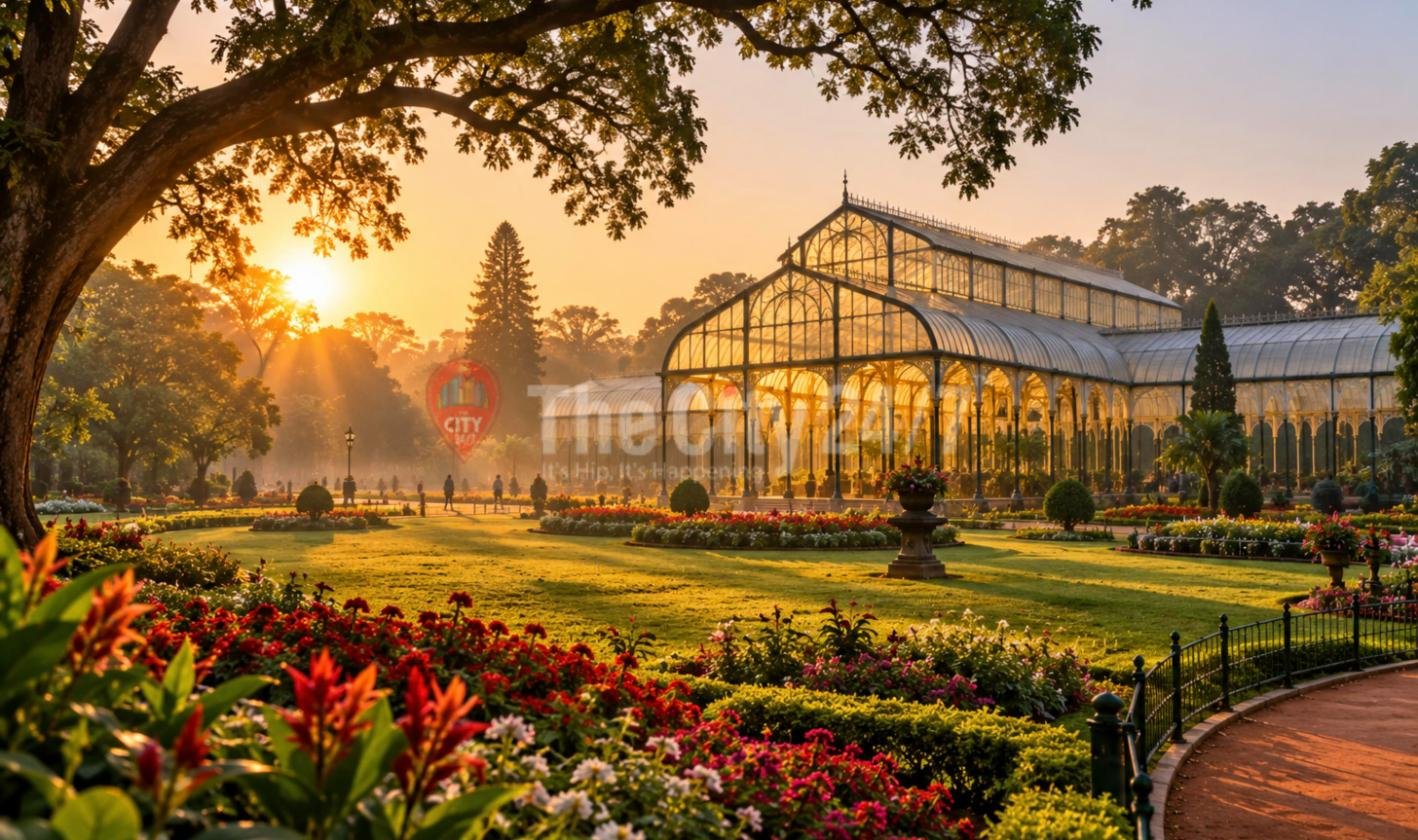
“Lalbagh is older than most of the countries that send tourists to see it. Hyder Ali began it in the 1760s, and it has been continuously gardened ever since.”
• Two hundred and sixty years of the same lawn
Lalbagh Botanical Garden is open daily from about 6 AM to 6 PM, with free entry during the early morning and evening walking hours and a ticket of roughly Rs 30 at other times. It covers about 240 acres in south Bengaluru near Basavanagudi. The Glass House, the lake and the peninsular gneiss rock are the three things you must see.
Lalbagh was started by Hyder Ali around 1760 and extended by Tipu Sultan, who brought plants in from across Asia and beyond. The British turned it into a formal botanical garden in the 1850s, and it has been a working centre of horticulture ever since, which is why it feels less like a park than a collection. There are reportedly over 1,800 species of plants here.
This guide covers timings and the free-entry windows most visitors never hear about, the flower show, which gate to use, the rock, and how to see the whole thing in a morning without accidentally walking twelve kilometres. My one piece of advice before you read on: go early, and pick your gate by what you want to see first, because the wrong one turns a stroll into a trek.
Quick Information
A 240-acre garden with four gates, two flower shows and one very old rock. Here is the entire crux of it.
What Are Lalbagh Timings and the Entry Fee?
Lalbagh is open roughly 6 AM to 6 PM, with gates closing around 7 PM. Entry is free during the designated walkers' hours in the early morning and evening, and costs about Rs 30 for adults at other times, with children under twelve usually admitted free. Fees and free windows have been revised periodically, so treat these as the working position rather than a permanent one.
- The free morning window. Generally about 6 to 9 AM, intended for walkers. This is both the cheapest and by far the best time to be in the garden.
- The free evening window. Usually around 6 to 7 PM. Shorter, and the light is lovely.
- Ticketed hours. Roughly 9 AM to 6 PM at about Rs 30 per adult. Worth paying if you want the Glass House and the collections without the walking crowd.
- Flower show days. A separate and higher ticket applies during the January and August shows, and the garden is extremely busy.
- Best overall. A weekday morning between 6.30 and 8.30 AM. Cool, quiet, free, and the garden at its most beautiful.
Most visitors pay to walk into Lalbagh at eleven in the morning in April. Locals walk in free at half past six. The difference in the experience is not small, and neither is the difference in temperature.
What Is the Lalbagh Glass House?
A cast-iron and glass conservatory at the centre of the garden, built in the late nineteenth century and modelled on the Crystal Palace in London. It is Lalbagh's defining structure and the venue for the two flower shows each year, when it is filled floor to roof with arrangements.
- Outside show season. Largely empty and open, which is when you can actually appreciate the ironwork and the scale. Fifteen minutes.
- During the flower show. Packed with displays and with people. Extraordinary to see, and you will be moving in a slow queue.
- Photography. Early morning light through the glass is the shot. Commercial and pre-wedding shoots need permission from the horticulture department.
- Around it. The bandstand, the formal lawns and the main avenue all radiate from here, which makes it a useful orientation point.
When Is the Lalbagh Flower Show?
Twice a year, timed around Republic Day in late January and Independence Day in mid-August, each running roughly a week to ten days. These are among the largest flower shows in India, and each edition is built around a themed centrepiece inside the Glass House, often a replica of a famous monument made entirely of flowers.
- January show. The bigger of the two, and the better weather. Cool mornings and peak bloom.
- August show. Monsoon season, fewer visitors than January, and often a more interesting theme.
- Go on a weekday morning. Weekends during the show are genuinely crowded, with queues to get into the Glass House itself.
- Tickets. A higher show-period ticket applies, sold at the gates and sometimes online. Exact dates and prices are announced a few weeks ahead.
- Getting there during the show. Take the metro. Parking around Lalbagh Road becomes impossible for the duration.
“There is a rock in Lalbagh roughly three thousand million years old, with a sixteenth-century watchtower on top of it, and most people walk past it looking at their phones.”
• On the oldest thing in Bengaluru
What Is the Lalbagh Rock and Why Does It Matter?
It is an outcrop of peninsular gneiss, among the oldest rock formations on earth at an estimated 3,000 million years, and it is designated a national geological monument by the Geological Survey of India. On top of it stands one of the four watchtowers built to mark the boundaries of Kempe Gowda's Bengaluru in the sixteenth century.
- Getting up. A short climb on bare rock with steps in places. Five to ten minutes, and manageable for most people in reasonable shoes.
- The view. Across the garden and out over south Bengaluru. Best at sunrise, and considerably better than you expect.
- The tower. Kempegowda Tower, one of four marking the old city's limits. The others are at Ulsoor, Mekhri Circle and Gavipuram.
- Safety. There are unbarriered edges and the rock is slippery when wet. Do not go up in rain, and keep children close.
- Why it is remarkable. You are standing on Archaean basement rock, formed before there was complex life on the planet, inside a public garden, for free.
What Else Should You See Inside Lalbagh?
The lake, the Kempegowda tower, the bandstand, the Directorate building, the bonsai garden and a set of trees that are individually worth finding. Lalbagh is a collection, so the pleasure is in specifics rather than in a single big sight.
- Lalbagh lake. At the southern end near the Siddapura side. Best at dawn for herons, egrets, cormorants and the occasional pelican.
- The bandstand. A Victorian structure near the Glass House, and a common meeting point.
- The Directorate and the Lalbagh house. The horticulture department's own buildings, and part of the garden's working history.
- The bonsai garden and topiary park. Small, careful and genuinely good. Most visitors miss both.
- The tree collection. Look for the silk cotton, the mahogany, the Ceylon ironwood and the enormous old rain trees along the main avenues. Several are over a century old.
- The flower clock. Near the west end. Dated, popular, and a fixture of every Bengaluru childhood.
- The aquarium and glasshouse nurseries. Plant sales operate near some gates, and this is a good place to buy for a balcony.
Which Lalbagh Gate Should You Use?
Four main gates, and the choice matters because the garden is 240 acres. Use the West Gate on Lalbagh Road for the Glass House, the Siddapura Gate for the lake, the Double Road Gate for the rock, and the Basavanagudi Gate if you are combining with the Bull Temple.
- West Gate, Lalbagh Road. The main entrance. Closest to the Glass House, the flower clock and the bandstand.
- Siddapura Gate. Southern side, nearest the lake. Quietest gate in the mornings.
- Double Road Gate. Eastern side, closest to the rock and the Kempegowda tower.
- Basavanagudi Gate. South-west, and the right choice if you are walking on to the Bull Temple or Gavi Gangadhareshwara.
- Metro. Lalbagh station on the Green Line, with Jayanagar station also within reach. Far easier than driving.
- Parking. Limited paid parking near the main gates, and effectively impossible during flower shows.
How Should You Plan a Morning at Lalbagh?
Enter at the West Gate at 6.30 AM, walk the main avenue to the Glass House, take the rock, loop down to the lake and leave by the Basavanagudi Gate for breakfast on Gandhi Bazaar. That is about two hours and covers everything that matters.
- 6.30 AM, West Gate. Free entry window, cool air and the best light of the day.
- 7 AM, Glass House and bandstand. Empty at this hour, which is the only time you can properly look at the building.
- 7.30 AM, the rock and Kempegowda Tower. Short climb, wide view, three thousand million years of geology.
- 8 AM, the lake. Birds, water and the quietest part of the garden.
- 8.45 AM, out at Basavanagudi. Breakfast on Gandhi Bazaar. Vidyarthi Bhavan for dosa if you are prepared to queue, or one of the older tiffin rooms nearby.
- If you have longer. Add the bonsai garden, the topiary park and a slow circuit of the tree avenues.
What Is Around Lalbagh?
Basavanagudi and Gandhi Bazaar on one side, Jayanagar on the other, and some of the best old-Bengaluru food in the city within a ten-minute walk. Lalbagh is the right anchor for a south Bengaluru morning.
- Gandhi Bazaar and Basavanagudi. Flower vendors, tiffin rooms and old bookshops. The best breakfast neighbourhood in the city.
- Bull Temple and Gavi Gangadhareshwara. Both a short walk or auto ride from the Basavanagudi side, and both worth folding in.
- Jayanagar. The 4th Block shopping complex and food street, fifteen minutes away.
- Cubbon Park. The city's other great garden, about 6 km north. Doing both in one day is a very long and very good Sunday.
- Metro. The Green Line makes this whole belt easy to reach from the north and west of the city.
FAQs
What are Lalbagh timings?
Lalbagh is open roughly 6 AM to 6 PM daily, with gates closing around 7 PM. The walkers' windows in the early morning, usually about 6 to 9 AM, and the evening window around 6 to 7 PM are the free-entry hours and also the best time to visit.
What is the Lalbagh entry fee?
Around Rs 30 for adults during ticketed hours, with children under twelve usually admitted free. Entry is free during the designated morning and evening walkers' windows. A separate higher ticket applies during the January and August flower shows.
When is the Lalbagh flower show?
Twice a year, timed around Republic Day in late January and Independence Day in mid-August, each running roughly a week to ten days. The January show is the bigger one with better weather. Exact dates are announced a few weeks ahead.
How old is the Lalbagh Rock?
The peninsular gneiss outcrop in Lalbagh is estimated at around 3,000 million years old and is designated a national geological monument by the Geological Survey of India. One of Kempe Gowda's four sixteenth-century watchtowers stands on top of it.
Which metro station is closest to Lalbagh?
Lalbagh station on the Green Line, with Jayanagar station also within reach. The metro is considerably easier than driving, since parking near the gates is limited and becomes impossible during flower shows.
How much time do you need at Lalbagh?
Two hours covers the Glass House, the rock, the lake and the main avenues at a comfortable pace. Half a day if you want the bonsai garden, the topiary park and a slow circuit of the tree collection. Buggy rental is available if 240 acres of walking is not realistic.
What is Lalbagh famous for?
The Victorian Glass House modelled on London's Crystal Palace, the two annual flower shows, a collection of reportedly over 1,800 plant species, and the 3,000 million year old peninsular gneiss rock with a Kempe Gowda watchtower on it. It was begun by Hyder Ali around 1760.
Is Lalbagh or Cubbon Park better?
Lalbagh is a botanical collection, with the Glass House, the flower shows, the lake and the rock, and it charges a small fee outside walking hours. Cubbon Park is free, more central and better for a casual walk or a run. Lalbagh is the destination, Cubbon Park is the routine.
Contact Details
Official sources, since timings, ticket prices, free windows and flower show dates all change from year to year.
Which Tree Should I Go and Find?
If the timings or fees have changed, or you know a corner of Lalbagh that deserves more attention than it gets, click the WhatsApp icon at the bottom right of your screen and tell me. I will go and check and update this guide. That is also the easiest way to reach The City 24/7 about anything at all.
And if you want city guides, weekend plans and neighbourhood notes landing in your inbox, join our ever growing community at thecity247.com/newsletter. Free, and about ten seconds of your life.
Same city, new stories, always.

Related Stories
 CITY GUIDE
Bangalore Palace: Timings, Entry Fee and Whether It Is Worth Rs 230
September 8, 2026
 CITY GUIDE
Cubbon Park Bangalore: The Complete Guide to the City's 300-Acre Lung
September 7, 2026
 CITY GUIDE
Government Museum Bangalore: One of India's Oldest Museums, and Almost Always Empty
September 5, 2026
 CITY GUIDE
NGMA Bengaluru: The Best Gallery in the City Is in a Mansion Nobody Visits
September 3, 2026
 CITY GUIDE
The Bengaluru Festival Calendar: Every Annual Event Worth Planning Your Year Around
September 2, 2026
 CITY GUIDE
Sankey Tank: Timings, Entry Fee and Why Malleshwaram Walks Here Every Morning
September 2, 2026
