


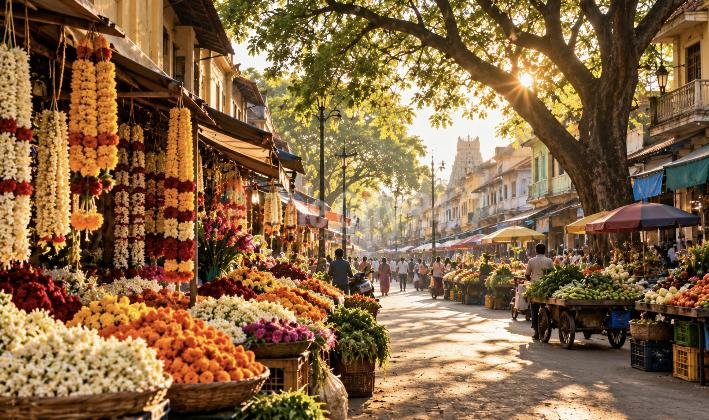
“You can learn more about this city in twenty minutes on Gandhi Bazaar main road than in a whole day of doing the attractions. The difference is that nobody here is performing for you.”
• On the most honest street in Bengaluru
Gandhi Bazaar is the main market street of Basavanagudi in south Bengaluru, a stretch of flower, fruit, vegetable and household shops running off Bull Temple Road, and it is best visited early in the morning or in the hour before dusk. Nothing here needs a ticket, everything is negotiable in a mild way, and it remains the most complete surviving picture of pre tech Bengaluru anywhere in the city.
The street works on a simple geography. Flowers and fruit at the pavement, proper shops behind them, temples at one end, the dosa institutions on the cross roads, and the whole thing wedged into a neighbourhood laid out in 1898 when Basavanagudi was built as one of Bengaluru's first planned extensions.
I should say plainly that this is a working market, not a heritage walk. It is crowded, the pavement is contested, vehicles come through where they should not, and during festivals the street effectively stops functioning as a road. That is not a warning. That is the attraction.
This guide covers what to buy, what things cost, the best time to go, festival shopping, where to eat, how to get there without a car, and how to do the whole Basavanagudi morning in one loop.
Quick Information
A street market with no entry, no branding and no interest in impressing you. The crux.
What Is Gandhi Bazaar and Why Does It Still Matter?
It is the market street that Basavanagudi shops at, and it has been doing that job continuously for over a century. The reason it matters now is that almost nothing else in central or south Bengaluru has held its function so completely against the pressure to become something more profitable.
Basavanagudi itself was planned in 1898, after plague outbreaks pushed the city to build new extensions, and it was laid out with wide roads, a temple quarter and a market street. That market street is this one. The Kannada middle class Bengaluru that everyone now writes nostalgic essays about is still standing here, buying vegetables.
It is also changing, and I would rather say that than pretend otherwise. Road widening proposals, vendor displacement and rent pressure have all hit this street in recent years, and some of the old shopfronts have gone. Which is a reason to visit sooner rather than later.
What Should You Buy at Gandhi Bazaar?
Buy what the street is genuinely best at, which is anything fresh, anything seasonal and anything you need for a festival. This is not a souvenir market and it will disappoint you if you treat it as one.
What the Street Does Best
- Flowers. Jasmine, kanakambara, roses, marigold and garlands, sold by the mola, which is roughly the length of a forearm. Cheaper and fresher here than anywhere with a shop front and a logo.
- Seasonal fruit. Mangoes in summer, oranges in winter, and whatever is in surplus in between. Ask what came in this morning rather than what you were planning to buy.
- Vegetables. The pavement stalls are for volume and value, the shops behind them for the harder to find greens.
- Festival essentials. Banana leaves, mango leaves, sugarcane, coconuts, wicks, puja items and the specific things each festival requires. Nowhere in the city stocks them better.
- Sweets and snacks. The old sweet shops along the main road, especially around festival weeks. Buy by weight.
- Household and hardware. Steel vessels, baskets, brooms and the kind of practical shopping that Basavanagudi residents have never needed a mall for.
Flowers are priced by the mola, not by weight, and the length is measured by the vendor's own forearm. Do not argue with the measurement. It is the oldest unit in this market and you will not win.
When Is the Best Time to Go?
Between 6.30 AM and 9 AM if you are buying, because the produce is fresh, the pavement is walkable and the temples next door are open and empty. Between 5 PM and 7.30 PM if you are looking rather than buying, because that is when the street is at its most alive and best lit.
Avoid the middle of the day. It is hot, half the pavement trade thins out, and you get the traffic without the atmosphere. Avoid a car at all times.
Timing by Purpose
- Best produce. Early morning, before 8.30 AM.
- Best photographs. Golden hour in the evening, from the flower stretch looking down the main road.
- Best food. Breakfast, 7.30 AM to 9.30 AM, which is also when the dosa queue is worth joining.
- Best chaos. The evening before a major festival. Genuinely memorable, genuinely difficult to move through.
- Worst time. Noon to 4 PM, or any attempt to drive here after 6 PM.
What Is Festival Shopping Like Here?
It is the reason people from across south Bengaluru still come to this street rather than shopping locally. On the eve of Sankranti, Ugadi, Varamahalakshmi, Ayudha Pooja and Deepavali, the flower and produce trade expands onto every available inch of ground and the street becomes a single moving crowd.
If you want to understand the Kannada festival calendar in one visit, come on one of those evenings. Every item on sale has a specific ritual purpose, and if you ask politely what something is for, you will usually get an answer and occasionally a short lecture. Both are worth having.
Practical advice for those evenings: come by auto, carry cash as well as UPI, keep bags in front of you, buy flowers first while the selection is good, and accept that you will pay a little more than on an ordinary Tuesday. Everybody does.
Where Should You Eat?
This is the strongest eating neighbourhood in Bengaluru, and the market is the excuse rather than the main event. Plan the meal and build the shopping around it.
The Basavanagudi Eating Order
- Vidyarthi Bhavan. The benchmark masala dosa. Go before 9 AM or accept the queue, and do not ask for modifications.
- The sweet shops on the main road. Buy by weight, especially around festivals, and try whatever the counter is pushing that week.
- Filter coffee anywhere on DVG Road. There is no bad option. There is only the one closest to you.
- The snack counters and chaat carts. Evening trade, and better than most restaurant versions in the city.
- The juice and tender coconut stands. Cheapest way to survive the walk in April and May.
How Do You Get There?
Metro to the nearest Green Line station in the South End or Jayanagar area, then a short auto ride, or simply an auto from anywhere in south Bengaluru. BMTC buses through Basavanagudi are frequent and drop you on or near the market street.
Do not bring a car. Parking here ranges from difficult to genuinely impossible, and on a festival evening the street stops accepting vehicles in any practical sense. The market was designed for people carrying baskets, and it still behaves that way.
How Do You Do the Whole Basavanagudi Loop?
One morning, walking, in this order. It covers the market, two of the oldest temples in the city, a granite park and the best breakfast in Bengaluru, and it takes about three hours at a comfortable pace.
The Loop
- 7.00 AM, Dodda Ganapathi. The monolithic Ganesha on Bull Temple Road. Ten minutes, free, quiet at that hour.
- 7.20 AM, Bull Temple. The Nandi monolith uphill, at the calmest part of its day.
- 7.45 AM, Bugle Rock park. Granite outcrop, old trees and a Kempegowda watchtower.
- 8.15 AM, breakfast. Vidyarthi Bhavan or whichever counter has the shortest queue and the strongest smell of ghee.
- 9.00 AM, Gandhi Bazaar. Flowers, fruit and whatever you can carry home. The market is fully awake by now.
- 10.00 AM, Lalbagh. Ten minutes east, if the legs are willing. Otherwise go home and sleep it off.
Is Gandhi Bazaar Worth Visiting for a Tourist?
Yes, with the right expectation. You are not going to buy anything you can carry back to another country, and nothing here is arranged for your benefit. What you get is an hour inside a functioning century old market, on a street that still belongs to the people who shop on it.
For residents, it is simpler. If you have been buying flowers at a supermarket, go once, buy a mola of jasmine for what the supermarket charges for a sad plastic box, and reconsider your life.
“No entry fee, no branding, no performance. Gandhi Bazaar is the last street in central Bengaluru that has not been redesigned for anybody's benefit.”
• The verdict
Frequently Asked Questions
Where is Gandhi Bazaar in Bangalore?
Gandhi Bazaar main road runs through Basavanagudi in south Bengaluru, just off Bull Temple Road and close to the Bull Temple and Dodda Ganapathi temple. The nearest metro stations are on the Green Line in the South End and Jayanagar area, followed by a short auto ride.
What is Gandhi Bazaar famous for?
Flowers, seasonal fruit and vegetables, festival essentials such as banana leaves, sugarcane and puja items, sweet shops, and the eateries around it, including Vidyarthi Bhavan. It is the market street of Basavanagudi and one of the oldest continuously functioning markets in the city.
What is the best time to visit Gandhi Bazaar?
Between 6.30 AM and 9 AM for the freshest produce and a walkable pavement, or 5 PM to 7.30 PM for the atmosphere and the light. Avoid noon to 4 PM, and avoid arriving by car at any time.
Do you need to bargain at Gandhi Bazaar?
Mildly, and only on produce and flowers. Packaged goods and shop items are fixed price. Flowers are sold by the mola, roughly a forearm length, measured by the vendor, and that measurement is not up for debate.
Is Gandhi Bazaar good for tourists?
Yes, as a slice of working Bengaluru rather than an attraction. There is nothing to buy as a souvenir and nothing staged for visitors, which is precisely why it is worth an hour. Pair it with the Bull Temple, Dodda Ganapathi, Bugle Rock and breakfast.
What should I buy at Gandhi Bazaar?
Flowers, especially jasmine and kanakambara, whatever fruit is in season, vegetables from the pavement stalls, festival items you will not find in a supermarket, and sweets by weight from the old shops on the main road.
Is parking available at Gandhi Bazaar?
Barely. On street parking is limited and difficult on an ordinary day, and effectively impossible on festival evenings. Come by metro and auto, or by BMTC bus, which stop on or near the market street.
What is the nearest metro station to Gandhi Bazaar?
Green Line stations in the South End Circle and Jayanagar area are the closest, and from there it is a short auto ride or a walk of ten to fifteen minutes depending on which end of the market you are heading for.
When is Gandhi Bazaar busiest?
On the eve of major festivals, including Sankranti, Ugadi, Varamahalakshmi, Ayudha Pooja and Deepavali, when the flower and produce trade spreads across the whole street. It is the best and the most difficult time to visit, in equal measure.
Contact Details
There is no single office or website for a street market, so here are the useful civic and transport links for planning a visit.
Shop Here Every Week?
If a shop has closed, a vendor has moved, prices have shifted or the road works have changed how the street runs, click the WhatsApp icon at the bottom right of your screen and tell me. I will update this guide. That is also the easiest way to reach The City 24/7 about anything at all.
And if you want market guides, festival calendars and old Bengaluru stories landing in your inbox, join our ever growing community at thecity247.com/newsletter. Free, and about ten seconds of your life.
Same city, new stories, always.

Related Stories
 SHOPPING
Chickpet Bangalore: A Shopper's Guide to the Cloth Quarter
August 23, 2026
 SHOPPING
Electronics Shopping in Bangalore: SP Road and When Not to Use It
August 23, 2026
 SHOPPING
Winter Wear Shopping in Bangalore: Where to Buy Jackets and Sweaters Without Overpaying
November 13, 2026
 SHOPPING
Diwali Shopping in Bangalore: Which Market for What, Before the Whole City Gets There
November 6, 2026
 SHOPPING
Bangalore Central, Residency Road: India's First Seamless Mall, Two Decades Later
September 24, 2026
 SHOPPING
Jayanagar 4th Block: The Best Street Shopping in Bengaluru, and It Is Not Close
September 22, 2026
