


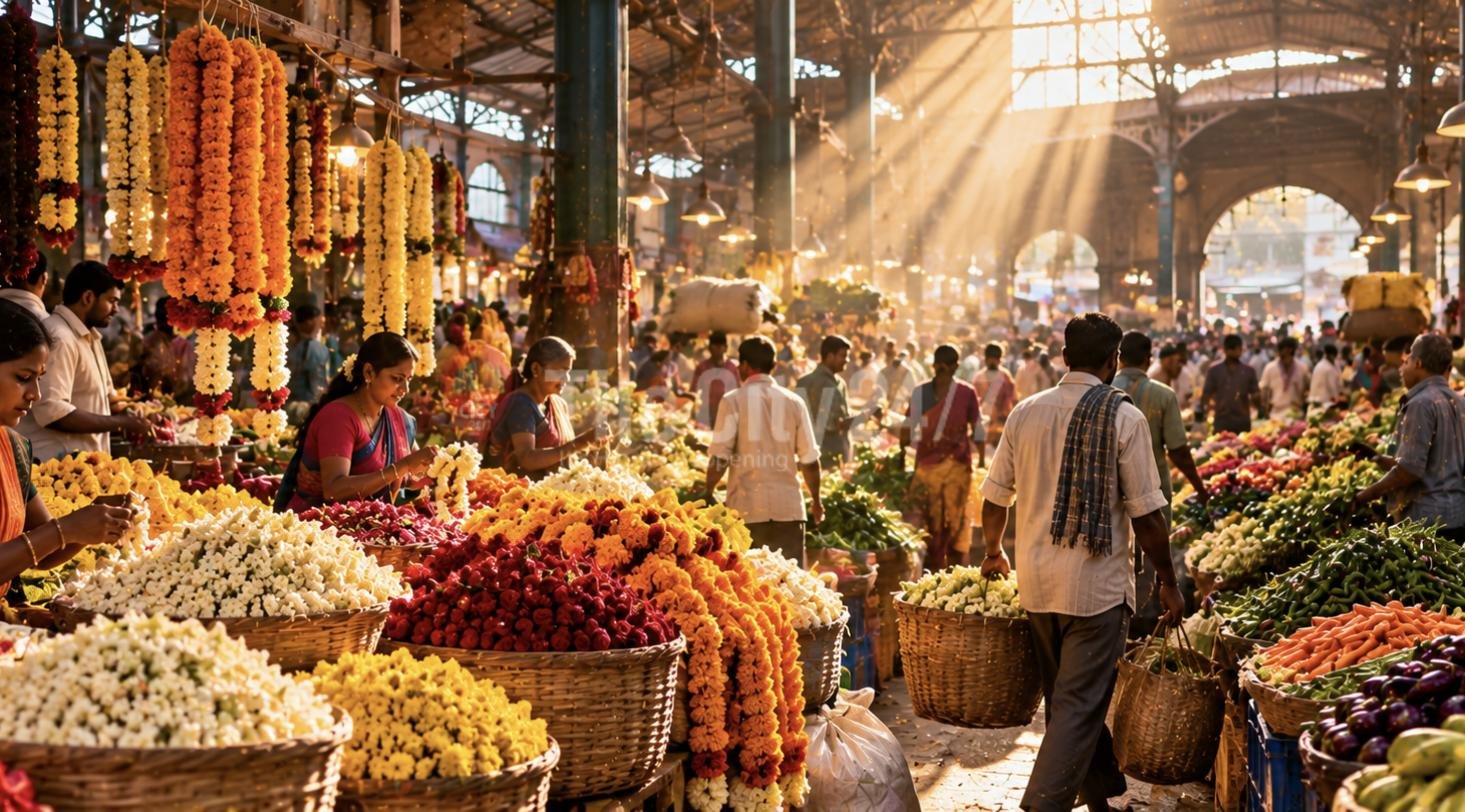
“The flower market at five in the morning is the single most extraordinary free thing in this city, and almost nobody who lives here has ever seen it.”
• On the case for setting an alarm
Bengaluru's traditional markets are working infrastructure, not preserved heritage. KR Market moves flowers and produce for the whole region. Russell Market has supplied the Cantonment since 1927. Malleshwaram 8th Cross, Gandhi Bazaar and the Jayanagar complex feed their neighbourhoods daily. None of them exist to be visited, which is exactly why visiting them is worth it.
The one rule that governs all of them is time. Markets here operate on a clock that has nothing to do with retail hours. The wholesale flower trade is a dawn event. Produce is best before ten. By afternoon most of these places are a quieter, less interesting version of themselves, and people who turn up at noon conclude the city's markets are overrated.
This guide covers each market, what it trades, the hour that matters, how to get there, what to buy and the practical business of photography, bargaining and navigating a working market politely.
Quick Information
Every market and the hour it actually matters. The hour is the whole article, honestly. The rest is commentary.
Which Traditional Market Should I Visit First?
KR Market at dawn, specifically the flower section, because nothing else in Bengaluru comes close to it and because the whole thing is effectively over by nine in the morning.
The wholesale flower trade runs before sunrise, with tonnes of jasmine, marigold, rose and chrysanthemum moving through in a few hours to supply temples, weddings, florists and every household that buys flowers daily. The colour, the volume and the speed of it are genuinely difficult to describe, and it costs nothing to watch.
Go between five and seven, take the metro or a cab, wear shoes you do not mind ruining and stay out of the way of people who are working. Buy something, because you are in somebody's workplace, and flowers by the kilo here cost a fraction of anywhere else.
“By nine o'clock the flower market is a floor being hosed down. Everything worth seeing happened in the dark.”
• On why the alarm is non negotiable
What Is Russell Market and Why Does It Matter?
Russell Market is a market hall in Shivajinagar built in 1927 to serve the Cantonment, and it remains one of the city's main markets for meat, fish, fruit and flowers, with a distinctive architecture and an atmosphere that has survived nearly a century of change.
The Greater Bengaluru Authority has finalised a redevelopment plan of around Rs 140 crore for the market ahead of the building's centenary in 2027. The heritage facade, clock tower and fruit and vegetable sections are to be kept, while the weakened meat and fish block is to be rebuilt in phases so that trading carries on.
It is best in the morning, when the fish and meat trade is at its most active and the fruit stalls are freshly stocked. The building itself is worth the visit, and the surrounding Shivajinagar streets are among the best eating in the city, which makes the market and a breakfast a natural pairing.
It is also ten minutes from Commercial Street, which means the most efficient shopping day in central Bengaluru is Russell Market early, Commercial Street from eleven, and Brigade Road or Church Street in the evening.
Which Neighbourhood Markets Are Worth a Trip?
- Malleshwaram 8th Cross. Flowers, produce, festival supplies and traditional provisions, in a neighbourhood that has kept its character. At its most extraordinary in the run up to major festivals.
- Gandhi Bazaar, Basavanagudi. A street market of flowers, fruit, vegetables and sweets with the unhurried temperament of the neighbourhood around it. Good in the morning and pleasant in the early evening.
- Jayanagar 4th Block. A produce and flower market attached to the most complete shopping high street in the city, which makes it the easiest market visit to combine with everything else.
- Johnson Market, Richmond Town. Meat and produce with a strong surrounding food scene, particularly during Ramzan when the evening street food here is a citywide draw.
- Madiwala Market. A large and genuinely local produce and fish market serving the south of the city. Busy, cheap and not remotely touristic.
- Yeshwanthpur APMC. The wholesale commodity market for grain and pulses. Early hours, serious volumes, and only worth visiting if that kind of trade interests you.
- Kalasipalya. Wholesale produce beside KR Market, at the same pre dawn hours, and part of the same enormous supply operation.
How Should I Behave in a Working Market?
Remember that these are workplaces rather than attractions. People are moving goods to a deadline, and the visitors who are welcome are the ones who stay out of the way and buy something.
- Ask before photographing people. Most traders are relaxed about it and some enjoy it. Asking costs nothing and changes the interaction entirely.
- Stand out of the walkways. Handcarts and head loads move fast and cannot stop. This is the single most common visitor mistake.
- Buy something. Flowers, fruit, a kilo of whatever looks good. It is the price of admission and it is very low.
- Do not grind over small amounts. Daily produce rates leave very little room. Bargaining hard over ten rupees with a vendor marks you out and achieves nothing.
- Wear closed shoes. Wet floors, market debris, and in the flower market a permanent layer of petals and water.
- Carry your own bag and small notes. Plastic is restricted and nobody has change at six in the morning.
- Go with somebody the first time if you can. KR Market in particular is overwhelming on a first visit, and a second person makes it far easier to navigate.
When Are the Markets at Their Best?
Early morning every day, and extraordinary in the days before major festivals, when the volume of flowers, fruit and puja supplies moving through them increases dramatically.
Varamahalakshmi, Ganesha Chaturthi, Ayudha Puja and Deepavali each transform the markets, particularly Malleshwaram and KR Market, with mountains of flowers, banana stems, mango leaves and festival goods spilling into the surrounding streets. If you want to see these markets at their peak, that is when to go, accepting that they will also be at their most crowded.
The monsoon is the least pleasant time, with wet floors and covered stalls, and the produce is at its most expensive when supply is disrupted. The cooler months from November through February are the easiest for a comfortable market morning.
“Go to Malleshwaram the day before Varamahalakshmi. You will not get through the street quickly and you will not forget it either.”
• On the best market day of the year
Frequently Asked Questions
Which is the oldest market in Bangalore?
The trade quarter of the Pete, laid out from 1537, is the oldest market area in the city, with streets like Chickpet and Balepet still trading in roughly what they were named for. Among built market halls, Russell Market in Shivajinagar dates from 1927 and is the best known historic market building still in daily use.
What time does KR Market open?
The wholesale flower trade runs from before dawn, and five to seven in the morning is the window that matters. By nine it is essentially finished and the floors are being washed down. Vegetables and fruit trade through the day around it, but the extraordinary part of KR Market is a pre dawn event.
Is Russell Market worth visiting?
Yes, particularly in the morning when the meat, fish, fruit and flower trade is most active. It is a 1927 market hall built to serve the Cantonment, still in daily use, and it sits ten minutes from Commercial Street with the Shivajinagar food streets immediately around it, which makes for an excellent combined morning.
Which traditional market is best for a first time visitor?
Malleshwaram 8th Cross or Gandhi Bazaar in Basavanagudi, both of which are calmer, easier to navigate and more comfortable than KR Market while still being genuine working markets. KR Market at dawn is the more extraordinary experience but is overwhelming on a first visit, and easier with somebody who has been before.
Can I take photographs in Bangalore's markets?
Generally yes, and many traders are relaxed or even pleased about it, but ask before photographing people. These are workplaces with deadlines, so stay out of the walkways where handcarts and head loads move, and buying something from the stall you have photographed is both good manners and very cheap.
Are Bangalore's markets cheaper than supermarkets?
Substantially, for fruit, vegetables, flowers, meat and fish. The gap on produce between a neighbourhood market and a supermarket is large, and buying a full kilo rather than a small quantity improves the rate further. There is little bargaining room on daily rates themselves, which are set by supply.
When are Bangalore's markets busiest?
In the days before major festivals, especially Varamahalakshmi, Ganesha Chaturthi, Ayudha Puja and Deepavali, when flowers, banana stems, mango leaves and puja supplies flood the markets and the surrounding streets. That is also when they are most spectacular. Ordinary weekday mornings are the best balance of activity and comfort.
How do I get to KR Market?
Take the Green Line metro to KR Market station, which puts you at the market itself, or to Chickpete for the surrounding trade quarter. For a pre dawn visit before metro services begin, a cab is the practical option. Driving and parking there is not realistic at any hour.
Useful Links
Transport and civic information for market visits.
Is Your Neighbourhood Market Missing From This List?
Almost every part of this city has a morning market on a specific street that appears in no guide at all, and those are the ones I most want to document. Click the WhatsApp icon at the bottom right of your screen and tell me where yours is and which hour matters. That is also the easiest way to reach The City 24/7 about anything at all.
And if you want the city explained one useful thing at a time, join our ever growing community. One weekly email, free.
Market timings and trading arrangements change, particularly around festivals and civic works, so check before travelling early in the morning. Same city, new stories, always.

Related Stories
 SHOPPING
Bangalore's Shopping Districts Explained, One Street at a Time
August 24, 2026
 SHOPPING
The Best Flea Markets in Bangalore, and When They Actually Happen
August 21, 2026
 SHOPPING
Bangalore Shopping: Malls vs Markets vs Street Shopping
August 24, 2026
 SHOPPING
Electronics Shopping in Bangalore: SP Road and When Not to Use It
August 23, 2026
 SHOPPING
Street Shopping in Bangalore: The Complete Guide to Paying Less
August 22, 2026
 SHOPPING
The Best Places to Shop in Bangalore, Ranked by What You Need
August 20, 2026
