


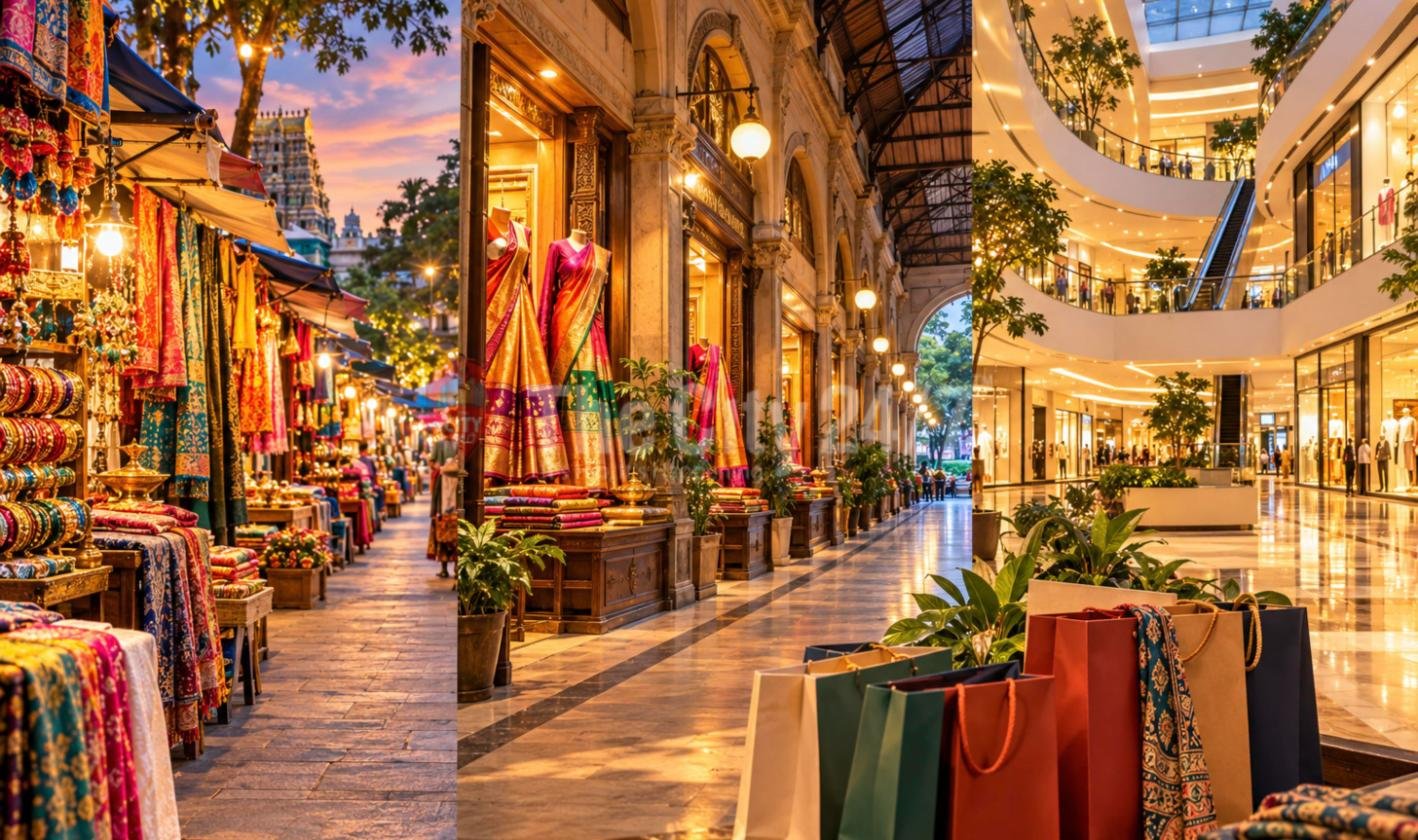
“Bengaluru does not sort its shopping by price. It sorts it by street. Learn which street sells what and the whole city becomes navigable.”
• The one rule that explains everything below
I have lived here long enough to have made every shopping mistake this city offers. I have paid mall prices for something sold three hundred metres from Chickpet metro station at a third of it. I have driven to KR Market at eleven in the morning and found the good part over. I have bought a phone charger on SP Road without asking a single question and learnt what that costs you. This guide is the thing I wish somebody had handed me in my first month.
Here is the structure of the place. Bengaluru runs three parallel shopping economies at once. There is the old Pete, the dense grid of trade lanes west of the city centre where Chickpet, Balepet, Nagarthpet and Avenue Road have specialised by commodity for over four centuries and still do. There is the colonial-era retail belt around Commercial Street, MG Road and Brigade Road, which is where the city learnt to shop for pleasure rather than necessity. And there is the mall and brand layer, built in the last twenty years, spread deliberately so that every direction of the city has one.
Nobody shops in only one of these. The useful skill is knowing which layer answers which need, and that is almost entirely a question of what you are buying. A wedding sari, a laptop SSD, a sofa, a birthday present, a kilo of beans. Five different parts of town, and getting that wrong is what turns a two hour errand into a whole Saturday.
Quick Information
Everything below, compressed into one screen for people who are already in an auto and need an answer now. Screenshot it, honestly.
Where Should I Shop in Bangalore If I Only Have One Day?
Commercial Street, and nowhere else. It is the only part of the city where clothes, footwear, fabric, ethnic wear, accessories and small jewellery sit inside a ten minute walk of each other, at prices that run from street stall to mid brand.
Go on a weekday, arrive around eleven when the shutters are properly up, and treat the side lanes as the actual destination. Ibrahim Sahib Street, Dispensary Road and Narayan Pillai Street hold most of what people remember buying, while the main strip holds the brands you could have found anywhere. Eat in Shivajinagar afterwards, which is two minutes away and better value than anything on the shopping street itself.
If your one day is a Sunday, invert the plan. Much of the old trade quarter shuts, so use the day for a mall, for Church Street, or for whichever flea market is running that weekend.
What Is the Pete, and Why Does It Still Matter?
The Pete is Bengaluru's original market town, laid out in the sixteenth century around Kempegowda's fort, and it is still organised the way it was built: one trade per street, with the street named after the trade.
Chickpet is cloth. Cottonpet is cotton and yarn. Balepet historically dealt in bangles and brassware and still carries musical instruments. Nagarthpet is the goldsmiths' quarter. Tharagupet handled grain. Avenue Road is books, stationery, paper and hardware stacked in shops narrower than most corridors. Akkipet was rice. The names are not decoration, they are the directory.
What this means in practice is that the Pete is a wholesale machine that tolerates retail customers rather than courting them. Prices are low because margins are thin and volumes are high. Nobody will style you, nobody will offer you a trial room, and if you want six metres of a fabric you saw on Instagram, this is the cheapest place in South India to get it.
- Take the metro. Chickpete station on the Green Line opens directly into the quarter. Driving in is a genuine mistake and parking is close to impossible.
- Go early on a weekday. Ten to one is the productive window. Many shops are shut or quiet on Sundays, and the lanes are unpleasant after four.
- Expect minimums. Some shops sell only by the piece, the bundle or the dozen. Ask before you fall in love with something.
- Carry cash as backup. UPI is everywhere now, but the oldest shops still run on paper and the network in those lanes is not always willing.
- Bargain gently, not theatrically. Wholesale margins are small. A polite ask for a better rate on a bulk purchase works. Halving the opening price does not.
- Dress for the walk. Narrow lanes, handcarts, no pavement worth the name. This is not a heels afternoon.
“The Pete has been selling cloth on the same street since before the East India Company existed. It did not survive four centuries by being expensive.”
• On why the old quarter still wins
Which Bangalore Shopping Street Is Best for What?
Each of the main streets has one thing it does better than anywhere else in the city, and knowing that list is most of the skill.
- Commercial Street, for range. Ethnic wear, footwear, fabric, imitation jewellery, bags and a hundred small shops per lane. The best single street in the city for buying several unrelated things in one trip.
- Chickpet, for fabric and sarees. Wholesale volumes, wedding trousseau territory, and prices that make the retail showrooms look decorative.
- Brigade Road, for high street brands and footwear. Denim, sneakers, casual brands, and the best people watching in the city centre.
- MG Road, for silk, handicrafts and books. The government emporia, the old saree houses and Higginbothams. Metro at both ends.
- SP Road, for anything electronic. Components, cables, drives, tools, drone parts, things that no branded store stocks.
- Jayanagar 4th Block, for the complete South Bengaluru shop. Sarees, gold, utensils, clothes, flowers and a shopping complex, all walkable, all sane.
- Malleshwaram 8th Cross and Sampige Road, for traditional everything. Silver, silk, puja items, filter coffee powder and the best sambar powder in the city.
- Indiranagar 100 Feet Road, for labels and design. Boutiques, homegrown fashion, concept stores, and prices to match the address.
- Avenue Road, for books and paper. Second hand textbooks, printing, stationery and the sheer pleasure of shops that have not been renovated since 1970.
- Gandhi Bazaar, for produce, flowers and Basavanagudi character. A market street that still feels like the neighbourhood it serves.
Are Bangalore's Malls Worth It, or Should I Stick to Markets?
Malls win on air conditioning, parking, returns and the presence of a trial room. Markets win on price, range and the chance of finding something nobody else owns. The honest answer is that they solve different problems and the city expects you to use both.
Use a mall when you need a specific brand, a warranty, a refund policy, a cinema attached, or somewhere to keep a family occupied for four hours in the rain. Use a market when the price matters, when you want choice rather than curation, or when you are buying something where the seller's knowledge is worth more than the packaging.
Geographically, the mall map is simple. North has Phoenix Mall of Asia at Hebbal and the Bhartiya complex at Thanisandra. West has Orion at Brigade Gateway and Lulu at Rajajinagar. Central has UB City for luxury, Garuda off MG Road and Mantri Square at Malleshwaram, which sits directly on the metro. South has Nexus Koramangala, Forum South Bengaluru at Konanakunte Cross on Kanakapura Road and the Bannerghatta Road cluster. East has Phoenix Marketcity, VR Bengaluru and Nexus Shantiniketan around Whitefield and Mahadevapura. Pick by direction before you pick by name, because in this city the traffic decides.
How Does Bargaining Actually Work Here?
Bargaining is expected in street markets and open stalls, mildly acceptable in small independent shops, and completely absent in malls, chain showrooms and anywhere with a printed price tag. Applying the wrong mode is the fastest way to mark yourself out.
- Street stalls and flea markets. Negotiate. Opening prices carry room, especially on bags, accessories, imitation jewellery and anything aimed at tourists. Bundling two items is the most effective lever.
- Market produce. Very little room on vegetables and flowers, which run on daily rates, but plenty on quantity. Buying a full kilo rather than two hundred grams changes the price per kilo.
- Wholesale lanes. Ask for the bulk rate rather than a discount. The language matters. Volume gets you a number, sentiment does not.
- Independent showrooms. Ask what the best they can do is, once, politely, at the end. Often you get a rounding down or a free alteration rather than a percentage.
- Gold. The metal rate is fixed daily and not negotiable. Making charges are. Always ask for the making charge as a separate number.
- Malls and brands. No. Save the energy and check whether an end of season sale is three weeks away instead.
“Never open with a number. Ask what it costs, look mildly unconvinced, and let the second price arrive on its own. It nearly always does.”
• On the only bargaining technique that works
When Is the Best Time to Shop in Bangalore?
Weekday mornings, in almost every category. The city's shopping districts are pleasant between ten and one, tolerable until four and genuinely unpleasant on Saturday and Sunday evenings.
For markets the clock is stricter. The wholesale flower trade at KR Market is a dawn event and is effectively finished by nine. Produce is best before ten, when it is freshest, and cheapest in the last hour of the day, when sellers would rather not carry it home. Meat and fish markets are morning institutions.
For sales, the two end of season windows in January and July are when brands clear stock properly, and the festive stretch from Dussehra through Diwali is when everything from gold to electronics runs offers. Wedding season pushes silk and jewellery prices and crowds up, so if you are buying a sari for yourself rather than for a wedding, buy in the off months.
What Should I Know Before My First Bangalore Shopping Trip?
- The metro is the shopping tool. Chickpete, KR Market, Majestic, MG Road, Trinity, Mantri Square Sampige Road, Rajajinagar, Nagasandra and the Whitefield stretch all sit on or beside shopping destinations. Parking in those areas is worse than the journey.
- Sunday closures are real. Much of the old trade quarter and many neighbourhood shops shut or run short hours. Check before travelling across the city.
- Hallmarking is not optional on gold. Insist on hallmarked jewellery with the identification marking, and get a proper invoice showing the rate, weight, making charge and stone value separately.
- Warranty and bill discipline on electronics. Grey market pricing on SP Road is real and so are the compromises. For anything you will claim warranty on, buy where the invoice is clean.
- Silk needs a mark. For genuine Mysore silk, look for the prescribed silk mark and buy from an established house or a government showroom. Price alone tells you very little.
- Alterations are cheap and fast. Almost every clothing market has a tailor within fifty metres. Buy the better fabric and adjust the fit rather than compromising on both.
- Carry your own bag. Plastic carry bags are restricted, and market sellers will hand you produce in whatever they have.
- Keep a cash float. UPI has reached the handcarts, but a dead network in a basement lane is a solved problem only if you have two hundred rupees on you.
Frequently Asked Questions
What is Bangalore famous for shopping?
Silk sarees, sandalwood and handicrafts, gold jewellery, and electronics components. Mysore silk from the state corporation's showrooms, sandalwood and rosewood craft from the government emporia on MG Road, gold from the Nagarthpet and Jayanagar jewellers, and everything electronic from SP Road, which has no real equivalent in South India outside Chennai. Add Channapatna lacquer toys and coffee from the Karnataka plantations and you have the list most visitors leave with.
Which is the best shopping street in Bangalore?
Commercial Street, if you are buying several different things in one trip. It packs clothes, footwear, fabric, ethnic wear, accessories and small jewellery into a walkable grid of lanes with a wide price range. If you are buying one specific category, another street will beat it: Chickpet for fabric and sarees, SP Road for electronics, Avenue Road for books, Indiranagar for boutiques.
Is shopping cheaper in Bangalore markets or malls?
Markets, substantially, for anything unbranded. The same kurta, bag or length of fabric can cost a third of the mall price in Commercial Street or Chickpet. Malls compete on convenience, brand, warranty and returns rather than price, and their genuine bargains appear during the January and July end of season sales.
What time do shops open in Bangalore?
Most retail opens around 10.30 or 11am and closes between 8.30 and 9.30pm. Malls generally run 11am to 10pm. Wholesale lanes in the Pete start earlier and wind down earlier, and many are closed or quiet on Sundays. Produce and flower markets work on a different clock entirely, with the serious trading done before nine in the morning.
Can I bargain in Bangalore shops?
In street markets, flea markets and open stalls, yes, and it is expected. In small independent shops a single polite ask at the end often gets you a rounding down or a free alteration. In wholesale lanes ask for a bulk rate rather than a discount. In malls, chain showrooms and anywhere with a printed tag, no.
Where do locals shop in Bangalore?
By neighbourhood, mostly. South Bengaluru shops Jayanagar 4th Block and Gandhi Bazaar, the north and west use Malleshwaram, Rajajinagar and Yeshwanthpur, the east uses Indiranagar, Koramangala and the Whitefield malls. For anything big, weddings, festivals, house setup, half the city still converges on Chickpet and Commercial Street regardless of where they live.
Is Commercial Street open on Sunday?
Largely yes, and it is busy. The difference is that the surrounding wholesale quarter and many of the older trade lanes are quiet or shut on Sundays, so a Sunday trip works for Commercial Street and the malls but not for Chickpet or Avenue Road. Weekday mornings remain the better experience everywhere.
How do I get to Bangalore's shopping areas without a car?
The metro covers most of them. Green Line for Chickpete, KR Market, Mantri Square Sampige Road, Rajajinagar and Nagasandra for IKEA. Purple Line for MG Road, Trinity for the Commercial Street and Brigade Road area, Majestic for the interchange, and the Whitefield stretch for the eastern malls. Autos and app cabs cover the rest, and in the old quarter walking is the only option that works anyway.
Useful Links for Shopping in Bengaluru
Transport, official emporia and civic information worth having before a big shopping day.
Found a Shop This Guide Should Know About?
The best shopping in Bengaluru travels by word of mouth, and every one of my favourite finds came from somebody telling me where they buy things. Click the WhatsApp icon at the bottom right of your screen and send me the street, the shop and what it is good for. That is also the easiest way to reach The City 24/7 about anything at all.
And if you want the city explained one useful thing at a time, join our ever growing community. One weekly email, free.
Timings, closures and prices move around, particularly during festivals and wedding season, so a quick call before a long trip across town is always worth it. Same city, new stories, always.

Related Stories
 SHOPPING
The Best Places to Shop for Kids in Bangalore, Without Losing the Day
September 15, 2026
 SHOPPING
The Best Flea Markets in Bangalore, and When They Actually Happen
September 15, 2026
 SHOPPING
The Best Home Decor Stores in Bangalore, From Craft to Concept
September 15, 2026
 SHOPPING
The Best Places to Shop in Bangalore, Ranked by What You Need
September 15, 2026
 SHOPPING
The Best Places for Clothes Shopping in Bangalore, by Budget
September 15, 2026
 SHOPPING
Bangalore Shopping: Malls vs Markets vs Street Shopping
September 15, 2026
