


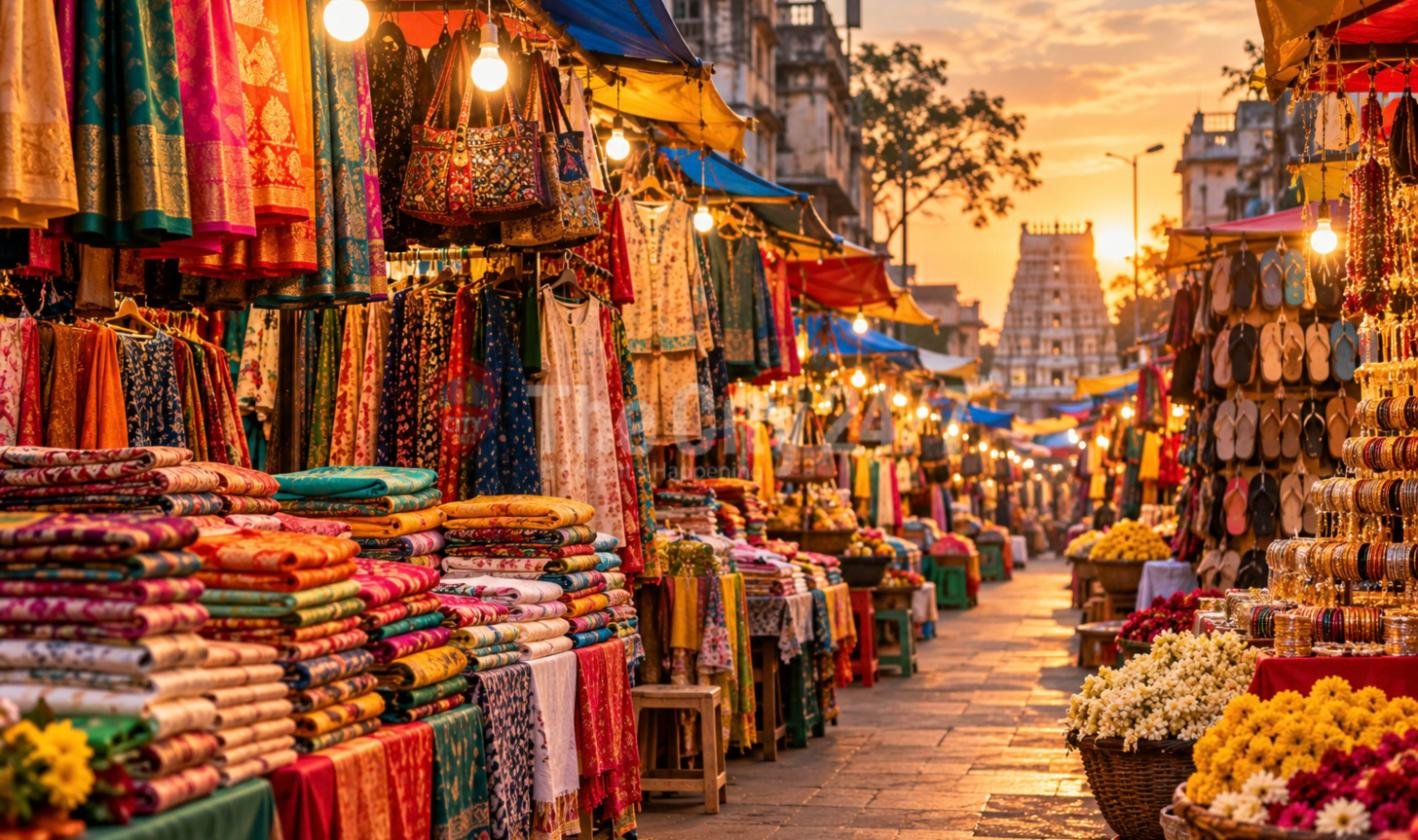
“Street shopping here is not a downgrade from the mall. It is the same factory, minus the label, minus the rent, minus about seventy percent of the price.”
• On why the footpath wins
My first year in Bengaluru I bought work shirts from a mall because I assumed street shopping was for tourists and students. Then somebody took me down a lane off Commercial Street and showed me the same export surplus shirts, from the same units that supply the brands, for a fraction of the price with the label snipped out. I have not fully recovered from the arithmetic.
Street shopping in this city works because Bengaluru sits next to one of India's largest garment manufacturing clusters. Surplus, seconds and cancelled export orders flow into the pavement trade constantly, which is why a footpath here carries genuinely good cotton rather than only novelty items. Add the wholesale quarter feeding accessories, footwear and imitation jewellery into the same channel and you have the cheapest well stocked retail in South India.
This guide covers where to go for what, what things should cost, how bargaining actually functions, how to tell surplus from rubbish, and the practical business of carrying cash, trying things on and getting alterations done. Prices move, so treat the numbers as ranges rather than promises.
Quick Information
Street shopping, condensed for people standing at a stall right now pretending to read their phone while they think about the price.
Where Is the Best Street Shopping in Bangalore?
The lanes behind Commercial Street, without serious competition. Ibrahim Sahib Street, Dispensary Road, Narayan Pillai Street and the smaller cuts between them hold the widest mix of clothes, footwear, bags, accessories and fabric at street prices anywhere in the city.
The main street has the brand showrooms, which is not why you came. Turn off it within the first hundred metres and the prices drop by half almost immediately. The stalls set up through the morning and are fully out by midday, and the trade runs until about nine in the evening.
After that, in order: Jayanagar 4th Block for a calmer version of the same thing with better pavements, the Majestic and Gandhi Nagar area for the cheapest prices in the city and the most chaotic experience, Brigade Road for footwear and casual clothing aimed at a younger crowd, and Chickpet if you want fabric rather than finished garments.
- Commercial Street lanes, for everything. Clothes, footwear, bags, belts, imitation jewellery, dupattas, fabric and luggage. Best range, moderate prices, heaviest crowds.
- Jayanagar 4th Block, for comfort. Street stalls plus the shopping complex plus real pavements. The most pleasant street shopping in Bengaluru and the best for families.
- Majestic and Gandhi Nagar, for price. The lowest prices in the city, particularly on basics, bags and footwear. Crowded, chaotic and worth going with a clear list.
- Brigade Road, for casual fashion. Sneakers, t-shirts, denim, sunglasses and the occasional very good surplus find, with the evening crowd as a bonus or a deterrent.
- Chickpet, for fabric. Metres rather than garments. If you have a tailor, this is where street shopping actually gets dangerous for your wallet.
- Avenue Road, for books. Pavement stacks of second hand books, textbooks and remainders, at prices that make you buy three you will not read.
- Russell Market surroundings, for the Sunday trade. A Sunday market atmosphere around Shivajinagar covering second hand goods, tools, oddments and things you did not know you needed.
“Walk the whole lane first. Every single time I have bought at the first stall, I have seen the same thing cheaper before I reached the end of the street.”
• On the discipline that saves the most money
What Can I Actually Buy on the Street, and What Should I Skip?
Buy anything where the value is in the material and the make rather than the brand or the warranty. Skip anything electronic, anything you will need to return, and anything where a fake carries a real cost.
- Buy: cotton basics and export surplus. T-shirts, shirts, trousers, kurtas. This is the category the city is genuinely good at because the garment industry is next door.
- Buy: bags, belts and luggage. Perfectly serviceable, wildly cheaper, and nobody inspects your rucksack for provenance.
- Buy: imitation jewellery and accessories. Designed to be occasional. Paying showroom prices for something worn twice makes no sense.
- Buy: fabric, dupattas and trim. Especially in Chickpet, where a tailor turns two hundred rupees of cloth into something better fitting than anything off a rack.
- Buy: books on Avenue Road. Second hand and remaindered, and the only risk is the weight you carry home.
- Skip: electronics and chargers. The failure rate is real and the fire risk is not a joke. Buy these from a shop that will honour a bill.
- Skip: cosmetics and skincare. Counterfeits are common and you are putting it on your face. Not the place to save four hundred rupees.
- Skip: anything with a warranty in the pitch. A verbal warranty on a footpath is a story, not a contract.
- Careful: branded goods at impossible prices. Sometimes genuine surplus, sometimes not. If the label matters to you, that uncertainty is the whole problem.
How Does Bargaining Work on Bangalore's Streets?
Assume the opening price carries twenty to forty percent of room, more if the stall is in a tourist-facing spot and you have arrived looking like you might not know. The technique that works is patience and quantity, not confrontation.
- Never open with your number. Ask the price, pause, look at it properly, and let the seller's second price arrive. It usually does, unprompted.
- Bundle. Three shirts gets a rate that one shirt never will. The most effective lever on any street in India.
- Ask in Kannada if you can. Even a broken attempt shifts the tone of the conversation and often the number with it.
- Be ready to walk. Genuinely walk, not theatrically. If the price was reachable you will hear about it within ten steps.
- Do not bargain hard over small money. Grinding a vendor over twenty rupees on a hundred rupee item is bad form and marks you as an amateur, not a negotiator.
- Pay in cash for the final push. Exact notes in hand at your number is a surprisingly persuasive argument.
- Know when it does not apply. Fixed price shops, anywhere with printed tags, and the produce trade where daily rates rule. Asking there is just noise.
How Do I Tell Good Export Surplus From Rubbish?
Check the fabric and the construction, not the label. Genuine export surplus has proper stitching, matched seams, real buttons and cotton that feels substantial. Poor stock announces itself in thirty seconds if you look.
- Turn it inside out. Seam finishing tells you everything. Loose threads, uneven stitching and raw edges mean it will not survive five washes.
- Stretch the seam gently. If you can see gaps between stitches, the tension was wrong on the machine and it will split.
- Check the cut of the label area. Snipped labels usually indicate genuine surplus. A crisp printed logo on suspiciously thin cotton usually indicates the other thing.
- Look for the defect. Seconds are cheap for a reason and the reason is often findable: a mark, a missed buttonhole, a slightly short sleeve. Find it, then decide if you care.
- Unfold completely. Stalls fold strategically. Every garment should be opened out fully in daylight before you pay.
- Check zips and soles. On bags and footwear these are the failure points. Run the zip end to end and flex the sole.
- Buy one first. If you like the stall's stock, come back. Buying six of something untested is how a bargain turns expensive.
“Good surplus has a snipped label and a tiny flaw. Bad surplus has a perfect logo and a seam that gives way when you pull it.”
• On the thirty second quality test
What Are the Practical Rules for a Street Shopping Day?
- Go on a weekday afternoon. Stock is out, crowds are manageable and sellers have time to negotiate. Weekend evenings are the opposite of all three.
- Take the metro. MG Road or Trinity for Commercial Street, Majestic for Gandhi Nagar, Chickpete for the fabric lanes. Driving to any of these is a self inflicted problem.
- Dress to try things on. Trial rooms mostly do not exist. A fitted t-shirt lets you hold garments against yourself usefully, and leggings under a kurta solve the rest.
- Know your measurements. Shoulder, chest, waist and inseam in inches on your phone. Street sizing is not consistent with anything.
- Carry a cloth bag and small notes. Plastic bags are restricted and nobody has change for a five hundred at the start of trading.
- Keep your phone and wallet in front pockets. Crowded lanes are crowded lanes. This is ordinary city sense rather than alarm.
- Budget for the tailor. A hundred or two for alterations turns a cheap garment into one that fits, which is the entire point.
- Eat where the traders eat. Shivajinagar next to Commercial Street, the Gandhi Bazaar end near Jayanagar. Your shopping day improves considerably.
Frequently Asked Questions
Which is the best street shopping place in Bangalore?
The lanes behind Commercial Street in Shivajinagar, including Ibrahim Sahib Street, Dispensary Road and Narayan Pillai Street. They carry the widest mix of clothes, footwear, bags, accessories and fabric at street prices. Jayanagar 4th Block is the calmer alternative with better pavements, and Majestic or Gandhi Nagar is cheaper still if you can handle the crowds.
How much can you bargain on Bangalore streets?
Typically twenty to forty percent off the opening price, and more at stalls that mainly serve visitors. The most effective approach is to ask the price, say nothing, and let the second number arrive, then bundle two or three items to get a rate. Walking away genuinely works if the price was ever reachable.
Is street shopping in Bangalore safe?
Yes, with ordinary city sense. The lanes are busy and well populated until well into the evening. Keep your phone and wallet in front pockets, be deliberate in dense crowds, and check what you are buying before paying since there are no returns. The main risks are pickpocketing in crowds and buying a defective item you cannot take back.
What is export surplus and is it genuine?
Export surplus is stock from garment units that supply international brands, released through the local market as overruns, cancelled orders or seconds. Bengaluru has a large garment manufacturing base, so a great deal of it is genuine. Look for snipped labels, proper seam finishing and substantial cotton, and expect a small defect somewhere, which is why it is cheap.
What should I not buy from street shops in Bangalore?
Electronics and chargers, cosmetics and skincare, and anything whose value depends on a warranty or a return policy. Counterfeit cosmetics are a genuine health issue and cheap chargers are a genuine fire risk. Clothes, bags, footwear, fabric, accessories and books are where the street trade is actually good.
What time does street shopping start in Bangalore?
Stalls generally set up through the morning and are fully out by around midday, trading until about nine in the evening. Early afternoon on a weekday is the best window: full stock, room to negotiate and manageable crowds. Weekend evenings have the most people and the least flexible pricing.
Can I use UPI for street shopping in Bangalore?
Almost always. UPI has reached pavement stalls and handcarts across the city and most vendors display a code. Still carry some cash, because the final stage of a negotiation often moves when exact notes appear, and because network coverage in the dense lanes is not reliable.
Where can I get clothes altered after street shopping?
There is usually a tailor within fifty metres of any clothing street in Bengaluru, and alterations cost very little and often take a day or less. Commercial Street, Jayanagar and Chickpet all have tailoring shops embedded in the same lanes, which is why buying good fabric cheaply and fitting it properly is the strategy that works here.
Useful Links
Getting to the street shopping districts, and where to complain if something goes wrong.
Got a Stall Everyone Should Know About?
Street shopping intelligence has a short shelf life and travels entirely by word of mouth, which is exactly why it belongs here. Click the WhatsApp icon at the bottom right of your screen and tell me the lane, the stall and what it is good for. That is also the easiest way to reach The City 24/7 about anything at all.
And if you want the city explained one useful thing at a time, join our ever growing community. One weekly email, free.
Stalls move, prices move and enforcement on pavement trading changes from time to time, so treat every number here as a range. Same city, new stories, always.

Related Stories
 SHOPPING
Bangalore's Shopping Districts Explained, One Street at a Time
August 24, 2026
 SHOPPING
Bangalore Shopping: Malls vs Markets vs Street Shopping
August 24, 2026
 SHOPPING
The Best Places to Shop in Bangalore, Ranked by What You Need
August 20, 2026
 SHOPPING
The Best Places for Clothes Shopping in Bangalore, by Budget
August 20, 2026
 SHOPPING
The Best Shopping Places in Bangalore for Women, Budget by Budget
August 19, 2026
 SHOPPING
The Ultimate Bangalore Shopping Guide: Every Street, Market and Mall
August 19, 2026
