


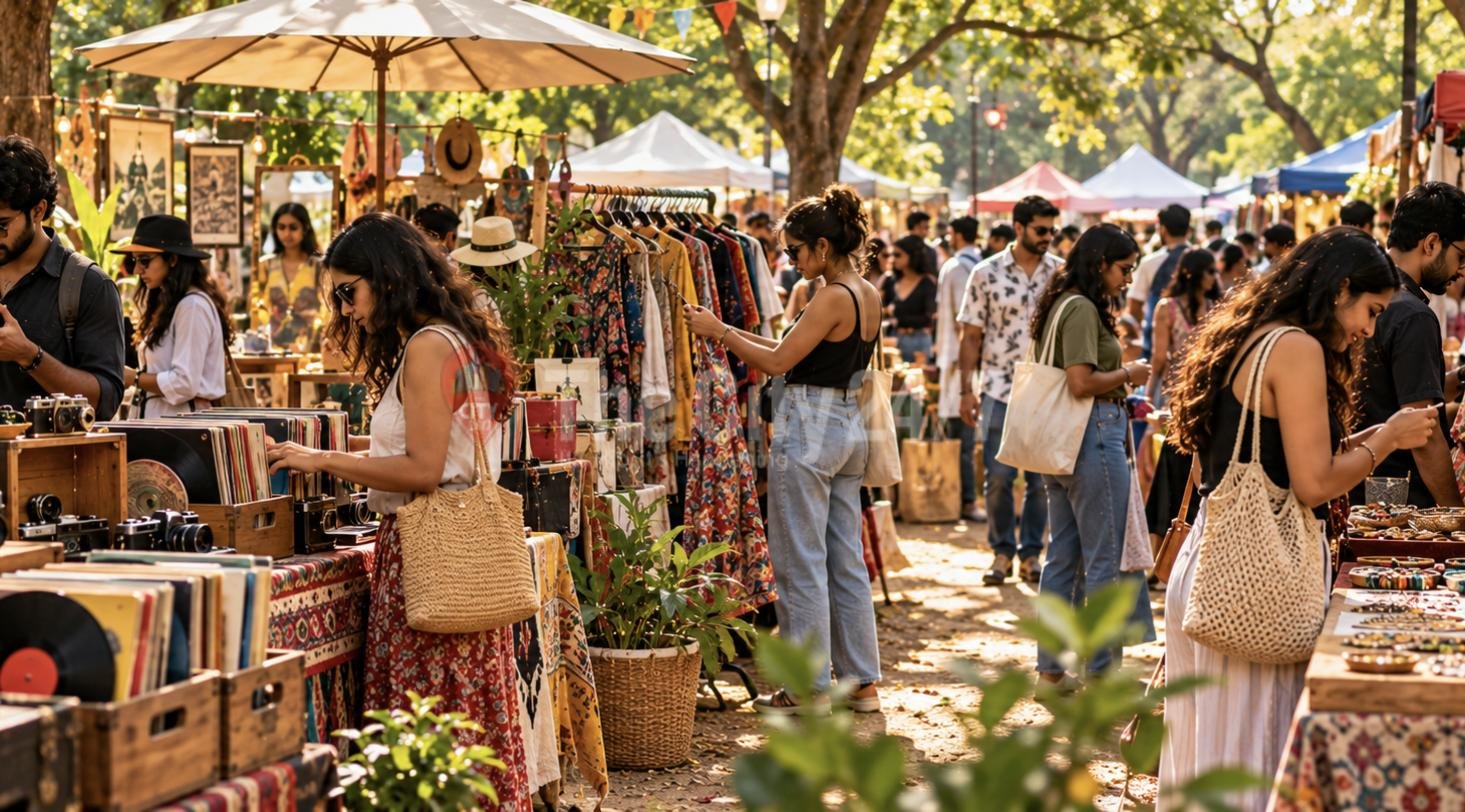
“Bengaluru's flea markets are not addresses, they are dates. Miss the date and the whole market ceases to exist until the next one.”
• On why people never find them
Ask where the flea market is in Bengaluru and you will get an unsatisfying answer, because most of them are periodic events held at rotating venues rather than permanent markets. They are announced a few weeks out, run for a day or two, and vanish. If you are not following the organisers, you will hear about every one of them the day after.
There are three types worth knowing. The large curated markets, which bring hundreds of independent brands, makers and food stalls together at a big venue. The neighbourhood and community markets, smaller and more frequent, often in cafes, parks and apartment complexes. And the genuine old secondhand trade, particularly the Sunday market culture around the older parts of the city, which is a different animal entirely.
Plus one annual event that is not a flea market and belongs on every list anyway: Chitra Santhe, the street art fair that closes Kumara Krupa Road and draws crowds in the hundreds of thousands.
Quick Information
The flea circuit, summarised. Dates move every year, so treat this as a map rather than a calendar.
Which Are the Main Flea Markets in Bangalore?
Sunday Soul Sante is the largest and best known, Kitsch Mandi is the one for independent design and quirk, and Chitra Santhe is the annual art event that dwarfs both in sheer scale.
- Sunday Soul Sante. The city's flagship flea market, held periodically at large venues with hundreds of stalls covering fashion, accessories, home, art and food, plus music. Expect crowds, expect to queue, expect to enjoy it anyway.
- Kitsch Mandi. Smaller, more curated and more design led, with a strong emphasis on independent makers, illustrators and small labels. The better market if you want to actually talk to the people who made things.
- Chitra Santhe. Held each January by Karnataka Chitrakala Parishath, this street art fair fills Kumara Krupa Road with thousands of artists selling directly. Not a flea market technically, and unmissable regardless.
- Travelling market brands. Several national flea market organisers bring editions to Bengaluru periodically, usually at large event venues with a mix of fashion, food and lifestyle stalls.
- Community and cafe markets. Smaller weekend markets held at cafes, breweries, parks and community spaces, often themed around sustainability, crafts or pre loved clothing. Frequent and relaxed.
- Apartment and neighbourhood markets. Bengaluru's large gated communities run their own markets, and many are open to visitors. Genuinely good for handmade food, crafts and children's items.
- The Sunday secondhand trade. Around Shivajinagar and the older quarters, a Sunday market culture in tools, hardware, secondhand goods and oddments that long predates the curated circuit.
“Chitra Santhe is an entire road of artists selling directly to the public for one day a year. Nothing else in this city looks remotely like it.”
• On the January event to plan around
What Should I Actually Buy at a Flea Market?
Things made by the person selling them, which is the whole point of the format. Independent fashion, jewellery, ceramics, prints, candles, leather goods, plants and small batch food.
- Independent fashion and accessories. Small labels that have no retail presence, often at prices below what a store would charge for the same piece.
- Jewellery. Silver, brass and contemporary handmade pieces. One of the strongest categories on the Bengaluru circuit.
- Ceramics and home objects. Studio pottery, planters and tableware, usually cheaper direct from the maker than through a design store.
- Art and prints. Especially at Chitra Santhe, where you buy directly from artists at a range of prices.
- Plants and planters. Common at community markets, and a good way to buy something unusual from someone who can tell you how to keep it alive.
- Pre loved clothing. Most markets have several wardrobe clearance stalls, which is where the real bargaining happens.
- Food and preserves. Small batch bakers, sauce makers, coffee roasters and cheese producers. Frequently the best part of the market.
- Skip: mass produced imports. A proportion of stalls at the big markets sell generic wholesale goods. Recognisable, and available cheaper on Commercial Street.
How Do I Find Out When They Are Happening?
Follow the organisers directly on social media, because there is no central calendar and dates shift year to year. Announcements typically come a few weeks ahead, with venue details closer to the day.
The large markets cluster around the pleasant weather months and the festive season, which in Bengaluru means the stretch from roughly September through February is busiest. Monsoon weekends see outdoor markets postponed or moved indoors at short notice, so check on the morning itself.
Chitra Santhe is the reliable fixture, held annually in January, and worth putting in a calendar a year ahead because it is the one event where arriving early genuinely matters.
How Do I Shop a Flea Market Properly?
- Walk the whole market first. Painful advice at a crowded market and still correct. There are usually three stalls selling similar things at different prices.
- Arrive early for stock, late for discounts. Sellers would rather not carry stock home, so the last hour is when prices soften. The good pieces are gone by then.
- Carry cash as well as UPI. Almost everyone takes UPI, and network coverage at a packed venue is not guaranteed.
- Bring a bag. Plastic carry bags are restricted, and a large market means a lot of small purchases.
- Ask makers about their work. You learn what you are buying, and it is the difference between a transaction and the reason the format exists.
- Take the seller's contact. The single most useful thing at any flea market. Most independent sellers take orders afterwards.
- Skip the car if you can. Parking at the large markets is reliably the worst part of the day.
- Go hungry. The food section at the big markets is genuinely a draw in itself.
“Take the seller's number. Half the best things I own came from a flea market stall and were reordered on WhatsApp six months later.”
• On the habit worth forming
Frequently Asked Questions
Which is the best flea market in Bangalore?
Sunday Soul Sante is the largest and best known, with hundreds of stalls covering fashion, accessories, home, art and food at big venues. Kitsch Mandi is smaller and more design led, better if you want independent makers and conversation. Chitra Santhe in January is the largest event of all, though it is an art fair rather than a flea market.
When do flea markets happen in Bangalore?
Mostly at weekends, and mostly as periodic events rather than permanent markets, with the busiest stretch running from around September through February when the weather is best and the festive season is on. Dates shift year to year and there is no central calendar, so following the organisers on social media is the only reliable way to know.
What is Chitra Santhe?
Chitra Santhe is an annual street art fair held each January by Karnataka Chitrakala Parishath, which closes Kumara Krupa Road and fills it with thousands of artists selling their work directly to the public. It draws enormous crowds and is one of the largest events of its kind in India. Arrive early, carry cash as well as UPI, and do not attempt to drive.
Is there entry fee for flea markets in Bangalore?
Some of the large curated markets charge a small entry fee, particularly those at big ticketed venues with music and food programming. Community markets, cafe markets and most apartment complex markets are free. Chitra Santhe is free and open to the public.
What can you buy at Bangalore flea markets?
Independent fashion, handmade jewellery, studio ceramics, art and prints, candles, leather goods, plants and small batch food from the people who made them. Most markets also have pre loved clothing stalls. A proportion of stalls at the largest markets resell generic wholesale goods, which are recognisable and cheaper on Commercial Street.
Can you bargain at flea markets in Bangalore?
Modestly at maker stalls, where prices reflect the time and materials of one person's work, and more freely at pre loved and bulk stalls. The best leverage is buying several pieces from one seller, and the last hour of the market is when sellers are most willing to move rather than carry stock home.
Are there permanent flea markets in Bangalore?
Not in the curated sense. The closest permanent equivalents are the Sunday secondhand trade around Shivajinagar and the older quarters, dealing in tools, hardware and used goods, and the regular market streets like Commercial Street's lanes for cheap accessories. The maker and vintage circuit is entirely event based.
How do I get a stall at a Bangalore flea market?
Applications go through the organisers directly, usually announced on their social media channels a few weeks before each edition, with stall fees varying by market size and location. Smaller community and cafe markets are easier to get into and cheaper, which makes them the sensible starting point for a new independent brand.
Useful Links
Event organisers and getting there.
Running a Market, or Know One I Have Missed?
Flea markets in this city are announced late, spread by word of mouth and easy to miss entirely, which is exactly the problem worth solving. Click the WhatsApp icon at the bottom right of your screen and tell me what is coming up. That is also the easiest way to reach The City 24/7 about anything at all.
And if you want the city explained one useful thing at a time, join our ever growing community. One weekly email, free.
Dates, venues and entry arrangements change every edition, so confirm with the organisers before travelling. Same city, new stories, always.

Related Stories
 SHOPPING
The Best Furniture Stores in Bangalore, and When to Just Get It Made
August 21, 2026
 SHOPPING
The Best Organic Stores in Bangalore, and How to Spot the Real Thing
August 21, 2026
 SHOPPING
The Best Supermarkets in Bangalore, and What Each One Is Good For
August 19, 2026
 SHOPPING
The Ultimate Bangalore Shopping Guide: Every Street, Market and Mall
August 19, 2026
 SHOPPING
Bangalore's Traditional Markets You Should Visit at Least Once
August 23, 2026
 SHOPPING
Street Shopping in Bangalore: The Complete Guide to Paying Less
August 22, 2026
