


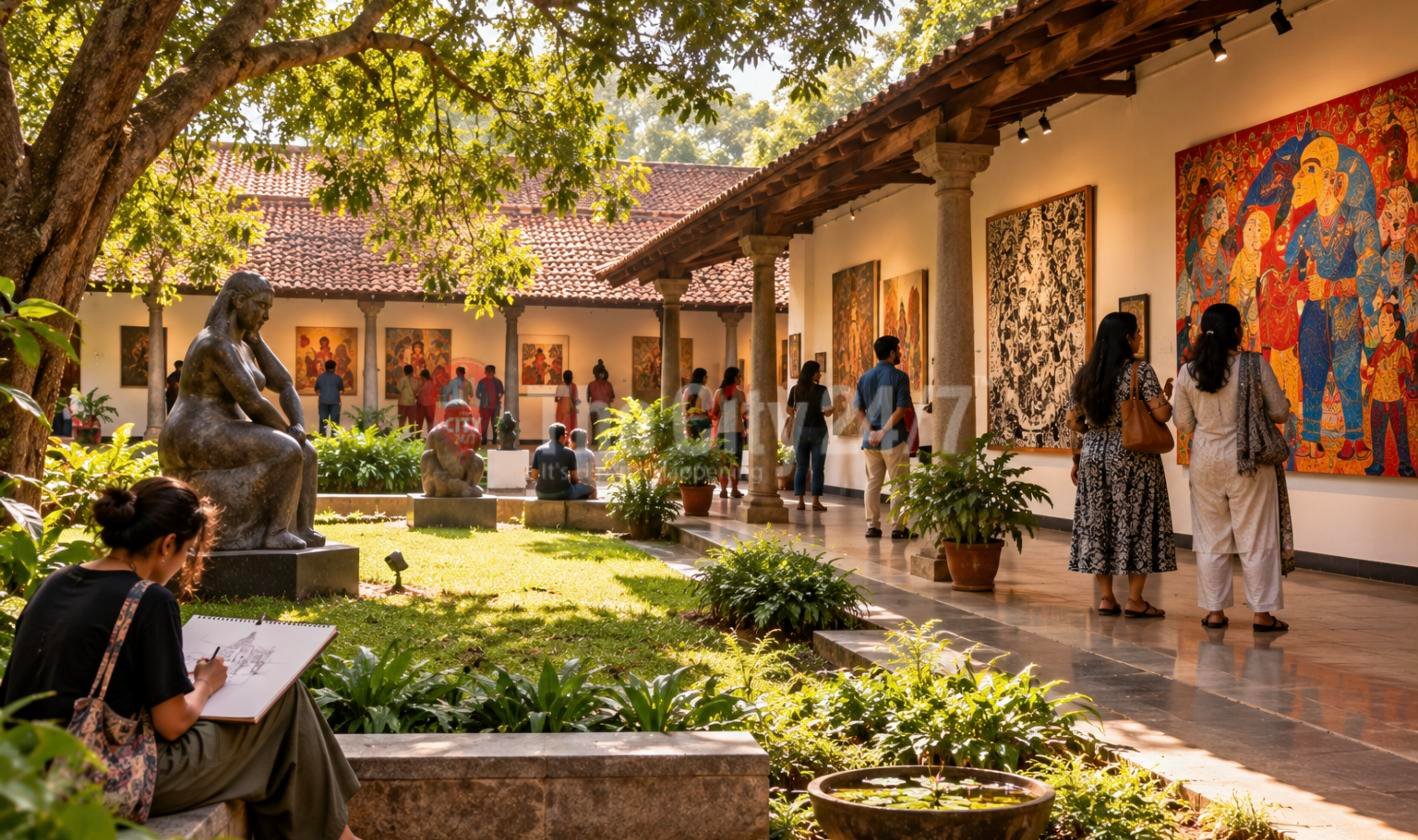
“Once a year, a thousand artists line a road in Bengaluru and sell directly to whoever walks past. No gallery, no commission, no gatekeeping. It is the best day in this city's cultural calendar.”
• On Chitra Santhe
Karnataka Chitrakala Parishath is open roughly 10 AM to 5.30 PM with a modest entry fee, on Kumara Krupa Road near Malleshwaram and the High Grounds. It houses multiple galleries, a significant folk and traditional art collection, and a working art college. Chitra Santhe, its street art fair, is held every January.
It was founded by Professor M S Nanjunda Rao and grew out of the Kannada cultural movement of the mid-twentieth century, and it remains an unusual institution: simultaneously a museum, a set of exhibition galleries, a college of fine arts and an active cultural organisation. That combination is why it feels alive in a way that most galleries in this city do not.
The permanent collection is genuinely worth your time, particularly the Mysore traditional painting, the leather puppets and the folk art holdings. But the reason the whole city knows the name is Chitra Santhe. This guide covers both, plus the classes and how to plan a visit.
Quick Information
An art school, a museum and a street fair, sharing one address. Here is how to use each of them.
What Is Chitra Santhe and When Is It Held?
Chitra Santhe is an annual open-air art fair held on Kumara Krupa Road outside Chitrakala Parishath, usually on the first Sunday of January, where around a thousand artists set up along the street and sell their work directly to the public. Entry is free and it draws very large crowds.
- When. Usually the first Sunday of January. Dates are announced a few weeks in advance.
- The scale. Roughly a kilometre of road, around a thousand participating artists, and attendance in the hundreds of thousands.
- What is sold. Paintings, sketches, prints, sculpture, pottery, photography, and work by students, professionals and folk artists side by side.
- Prices. Genuinely accessible. Small works and prints start from a few hundred rupees, with serious pieces up to lakhs. No gallery commission.
- Go early. Arrive by 8 AM. By midday the street is shoulder to shoulder and you cannot look at anything properly.
- Practical. Take the metro. Carry cash as well as UPI, carry a bag for what you buy, and wear shoes you can stand in for four hours.
- Why it matters. It removes every barrier between an artist and a buyer for one day. For many participating artists it is a significant share of annual income.
If you have ever thought about buying original art and been intimidated by galleries, go to Chitra Santhe at eight in the morning in January. You will talk directly to the person who made the thing, and a good small piece will cost you less than dinner.
What Is in the Chitrakala Parishath Collection?
Mysore traditional painting, leather shadow puppets, folk and tribal art from across Karnataka and India, Nanjunda Rao's own collection, and works by modern Indian artists. The folk art holdings are the strongest part and the least expected.
- Mysore traditional painting. The gesso and gold-leaf tradition of the Mysore court, distinct from Tanjore work, and well represented here.
- Leather shadow puppets. Togalu gombeyaata puppets, large, translucent and painted. A genuinely remarkable collection and the thing most visitors remember.
- Folk and tribal art. Work from across Karnataka and India, including Madhubani, Warli and regional traditions.
- The Nanjunda Rao collection. Assembled by the founder, and the core around which the institution grew.
- Modern Indian art. Works by twentieth-century Indian artists, including regional names not widely shown elsewhere.
- Temporary exhibitions. The galleries host a steady programme of shows by working artists, students and visiting exhibitions. Frequently the most interesting thing on site.
“The leather shadow puppets are the thing to see. Two metres tall, translucent, hand-painted, and made for a performance tradition most people in this city have never watched.”
• On the collection
Can You Take Art Classes at Chitrakala Parishath?
Yes. The College of Fine Arts on the campus offers degree programmes in painting, sculpture, graphics, applied art and art history, and the institution also runs short courses, workshops and children's programmes at various points in the year.
- Degree programmes. Bachelor's and master's level fine arts education, with admission through the college's own process.
- Short courses and workshops. Run periodically, covering drawing, painting, printmaking and traditional techniques. Announced on site and online.
- Children's programmes. Art classes and summer workshops for children, which are well regarded and fill quickly.
- Why this matters for visitors. A working college means student exhibitions, degree shows and an atmosphere that a pure museum does not have. Time a visit to a degree show if you can.
- How to enquire. The institution's own website and the campus office. Programmes and dates change annually.
How Does It Compare With NGMA and the Venkatappa Gallery?
Chitrakala Parishath is the working institution, NGMA is the national collection in a restored mansion, and the Venkatappa Art Gallery is the state collection attached to the Government Museum. Chitrakala Parishath is where you buy art and see students working; the other two are where you look.
- Chitrakala Parishath. Folk and traditional collections, student and professional exhibitions, an art college, and Chitra Santhe. The most active.
- NGMA, Palace Road. The national modern art collection in Manikyavelu Mansion, with a serious curated exhibition programme. The quietest and most formal.
- Venkatappa Art Gallery, Cubbon Park. The state collection, with frequent temporary shows by local artists. Attached to the Government Museum.
- Commercial galleries. Lavelle Road, Richmond Town, Domlur and Sadashivanagar. Free, contemporary, and selling.
- If you do one. Chitrakala Parishath, for the puppets and the folk collection. If you do two, add NGMA.
How Do You Get to Chitrakala Parishath?
It is on Kumara Krupa Road, between Malleshwaram and the High Grounds, and the closest metro options are Sir M Visvesvaraya Station, Central College, on the Purple Line and Mantri Square Sampige Road on the Green Line, both a short auto ride away.
- Metro. Sir M Visvesvaraya Station, Central College, on the Purple Line, or Mantri Square Sampige Road on the Green Line. Short auto ride from either.
- Bus. Good BMTC coverage to Malleshwaram, High Grounds and Shivajinagar.
- Car. Limited parking, and effectively impossible during Chitra Santhe when the road itself is the venue.
- During Chitra Santhe. Metro and walk, without exception. Kumara Krupa Road is closed and the surrounding area is gridlocked.
- Combine with. The planetarium, NGMA, Sankey Tank and Malleshwaram 8th Cross. All within a couple of kilometres.
How Should You Plan a Visit?
For the galleries, a weekday morning, ninety minutes, and ask at the desk what temporary exhibitions are on. For Chitra Santhe, the first Sunday of January, arrive by 8 AM, bring cash and a bag, and allow four hours.
- Ordinary visit. Weekday morning. Galleries, the folk collection, the puppets and whatever is showing. Ninety minutes.
- Degree show season. Worth timing for, usually towards the end of the academic year. Student work, and often for sale cheaply.
- Chitra Santhe. First Sunday of January, 8 AM, cash, bag, comfortable shoes, four hours.
- With children. The puppets and the folk art work well. The children's art programmes are worth investigating separately.
- If you want to buy. Chitra Santhe for range and price, gallery exhibitions for specific artists. Both are more accessible than people assume.
FAQs
What are Chitrakala Parishath timings?
Roughly 10 AM to 5.30 PM with a modest entry fee, typically under Rs 50 for the galleries. Confirm closure days locally, and weekday mornings are the quietest time to see the collection properly.
When is Chitra Santhe?
Usually the first Sunday of January, with dates announced a few weeks in advance. It is a free open-air art fair along Kumara Krupa Road outside Chitrakala Parishath, with around a thousand artists selling directly to the public.
Can you buy art at Chitra Santhe?
Yes, and that is the point. Paintings, sketches, prints, sculpture, pottery and photography are sold directly by the artists with no gallery commission. Small works and prints start from a few hundred rupees. Carry cash as well as UPI, and a bag.
What time should I go to Chitra Santhe?
By 8 AM. The fair draws attendance in the hundreds of thousands and by midday the street is shoulder to shoulder, which makes it impossible to look at work properly or talk to artists. Take the metro, since Kumara Krupa Road is closed.
What is in the Chitrakala Parishath collection?
Mysore traditional painting in the gesso and gold-leaf style, a remarkable collection of large leather shadow puppets from the togalu gombeyaata tradition, folk and tribal art from across Karnataka and India, the founder's own collection and works by modern Indian artists.
Does Chitrakala Parishath offer art classes?
Yes. The College of Fine Arts on the campus offers degree programmes in painting, sculpture, graphics, applied art and art history, and the institution also runs short courses, workshops and children's art programmes at various points in the year.
Which metro station is closest to Chitrakala Parishath?
Sir M Visvesvaraya Station, Central College, on the Purple Line, or Mantri Square Sampige Road on the Green Line, both a short auto ride away. During Chitra Santhe the metro is the only sensible option.
Is Chitrakala Parishath better than NGMA?
They serve different purposes. Chitrakala Parishath is a working institution with folk and traditional collections, student and professional exhibitions, an art college and Chitra Santhe. NGMA on Palace Road holds the national modern art collection in a restored mansion with a formal curated programme. Do both.
Contact Details
Official sources for gallery timings, exhibition programmes and the Chitra Santhe date each year.
Do You Go to Chitra Santhe?
If you are an artist who exhibits there, or you have bought something you love at Chitra Santhe, click the WhatsApp icon at the bottom right of your screen and tell me. I would like to cover the fair properly in January. That is also the easiest way to reach The City 24/7 about anything at all.
And if you want city guides, weekend plans and neighbourhood notes landing in your inbox, join our ever growing community at thecity247.kit.com/join-the-community. Free, and about ten seconds of your life.
Same city, new stories, always.

Related Stories
 CITY GUIDE
NGMA Bengaluru: The Best Gallery in the City Is in a Mansion Nobody Visits
September 3, 2026
 CITY GUIDE
Aquarium Paradise, Palace Road: India's Longest Underwater Tunnel Is in Bengaluru
September 24, 2026
 CITY GUIDE
Fun World, Palace Road: The Amusement Park in the Middle of the City
September 23, 2026
 CITY GUIDE
Pyramid Valley, Kanakapura Road: Inside the World's Largest Meditation Pyramid
September 20, 2026
 CITY GUIDE
Shivoham Shiva Temple: Bengaluru's 65 Foot Shiva, and the Cave Walk Under It
September 20, 2026
 CITY GUIDE
Dodda Ganapathi, Basavanagudi: The 18 Foot Ganesha They Cover in Butter
September 24, 2026
