


“Remember, your work may be only to sweep a railway crossing, but it is your duty to keep it so clean that no other crossing in the world is as clean as yours.”
• A line widely attributed to Sir M Visvesvaraya
Sir Mokshagundam Visvesvaraya was an engineer and administrator from a village near Chikkaballapur who became Diwan of Mysore between 1912 and 1918 and set up many of the institutions Bengaluru still depends on. He designed the Krishna Raja Sagara dam, founded the University of Mysore, the Bank of Mysore and the Government Engineering College in Bengaluru, and received the Bharat Ratna in 1955. He was born on September 15, 1861, which is why India marks Engineers' Day on that date.
I think of him every time I am on Kasturba Road, because the museum named after him is one of the best afternoons in the city, and every time I hear somebody say Bengaluru is a city built on engineering. It is, and he is a large part of why. The software came later. The idea that this region should educate engineers, bank its own money and manufacture its own products came from him.
His life was long and extremely well documented, so this is not an attempt to list every dam and committee. It is his Bangalore story: the institutions he started here, the habits of mind he left behind, and where you can still see them.
Quick Information
A hundred years, several dams, one university and a soap factory. The most productive CV in Karnataka, and he wrote most of it by hand.
Who Was Sir M Visvesvaraya?
He was a civil engineer who became one of the most effective administrators in Indian history. Born into a modest family in Muddenahalli, he studied in Bengaluru and then engineering in Pune, joined the Bombay Public Works Department, and built a national reputation for irrigation and flood work before returning to serve the Mysore state.
- Education. Schooling in Chikkaballapur and Bengaluru, a BA from Central College in Bengaluru, then engineering at the College of Science in Pune, finishing in 1883.
- Early career. Assistant engineer in the Bombay Public Works Department, working on irrigation and water supply across the Deccan.
- The sluice gates. He designed automatic sluice gates, first installed at the Khadakwasla reservoir near Pune in 1903, which were later used at other dams.
- Hyderabad. After the Musi river flood of 1908, he designed flood protection for Hyderabad city.
- Mysore. He joined the Mysore state as Chief Engineer in 1909 and became Diwan in 1912.
What Did Visvesvaraya Build for Bengaluru?
He built institutions more than buildings. As Diwan he pushed for an engineering college, a bank, industries and education in the Mysore state, and Bengaluru, as its commercial capital, received a large share. Several of these still operate under their original purpose.
- Government Engineering College, 1917. Now University Visvesvaraya College of Engineering (UVCE), one of the oldest engineering colleges in India, still in the heart of the city.
- The Government Soap Factory, 1916. Set up in Bengaluru to use Mysore's sandalwood. It became Karnataka Soaps and Detergents Limited, and still makes Mysore Sandal Soap from its Rajajinagar factory.
- The Bank of Mysore, 1913. Later the State Bank of Mysore, which merged into the State Bank of India in 2017.
- The Kannada Sahitya Parishat, 1915. He supported its founding in Bengaluru to promote the Kannada language and literature.
- Industrial and technical training. He championed technical education and industrialisation as the route out of poverty, long before either was fashionable.
“Industrialise or perish.”
• The slogan most associated with his economic thinking
What Is the Krishna Raja Sagara Dam and Why Does It Matter to Bengaluru?
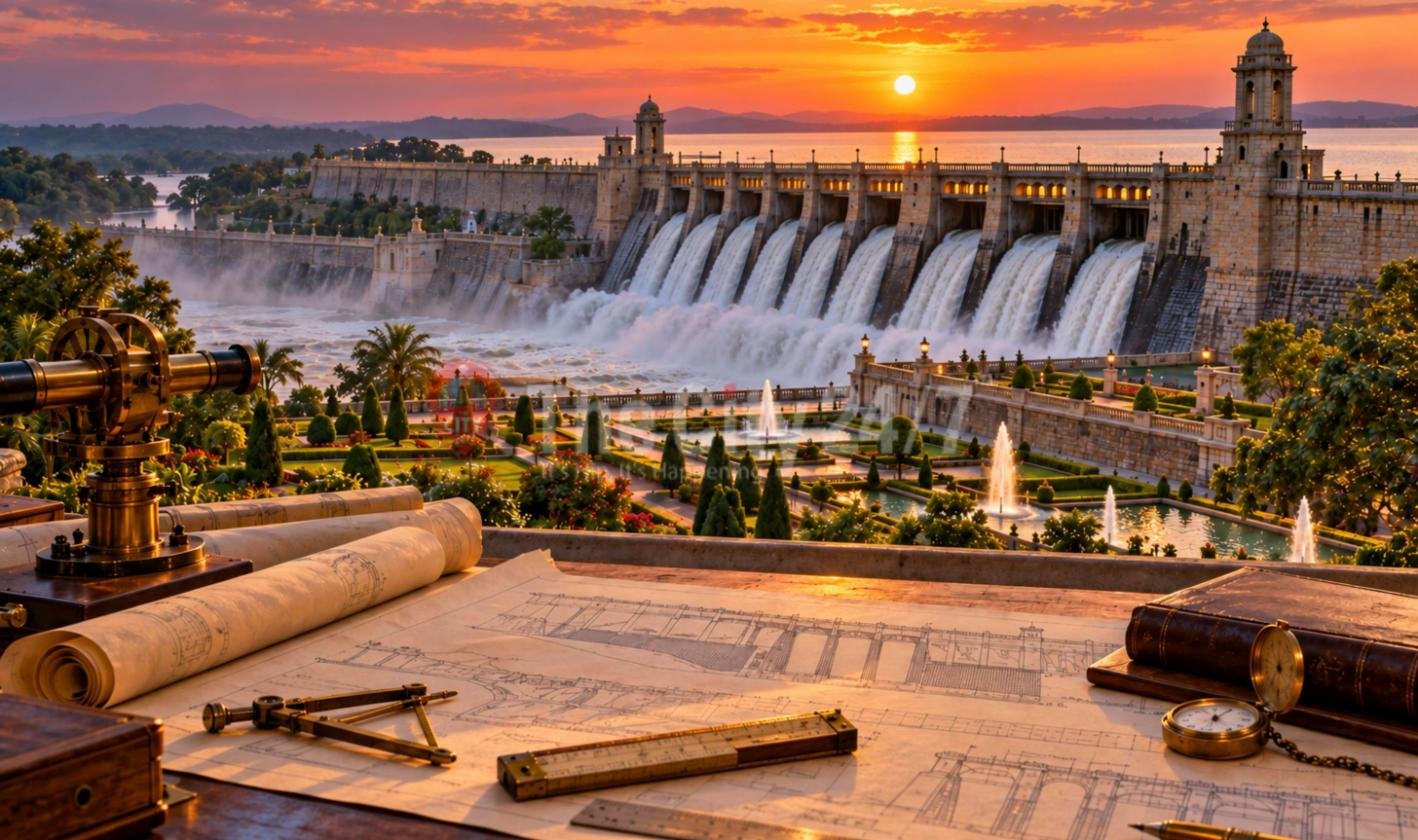
KRS is the dam on the Kaveri near Mysuru that he designed and oversaw as Chief Engineer, and it matters because Kaveri water eventually became Bengaluru's lifeline. The dam turned the Mandya region into irrigated farmland, powered industry and, decades later, the Kaveri became the main source of the city's piped water.
Bengaluru does not draw its water directly from KRS, but the logic of storing the Kaveri and moving it where it is needed is his. The Brindavan Gardens beneath the dam, with the musical fountain that generations of Bangaloreans have driven out to see, are the pleasant side effect.
Did Visvesvaraya Live in Bengaluru?
Yes, for long stretches of his life, including much of his retirement. He studied here, served the state from here, and remained a fixture of the city's public life for decades after leaving office, working on committees, writing on economic planning and advising governments well into his nineties.
He was famously disciplined. Contemporaries describe punctual, carefully dressed, plain-living habits, a man who prepared thoroughly for everything and expected others to do the same. Stories of him arriving at events exactly on time, and of him refusing favours for relatives, are part of the city's affectionate folklore about him.
The Visvesvaraya Industrial and Technological Museum on Kasturba Road opened in 1962, the year he died. The city named a science museum after him in his lifetime, which feels exactly right for a man who thought children should see how machines work.
Where Can You See Visvesvaraya's Legacy in Bengaluru Today?
In at least six places, most of them easy to reach by metro. The museum on Kasturba Road is the obvious start, but his name is also on a metro station, the city's newest railway terminal and one of its oldest colleges.
- Visvesvaraya Industrial and Technological Museum. Kasturba Road, next to Cubbon Park. Hands-on science galleries, an engine hall and a replica of the Wright Flyer. One of the best three hours in the city with children.
- Sir M Visvesvaraya metro station. On the Purple Line near Central College, the college where he studied.
- SMVT, Baiyappanahalli. The Sir M Visvesvaraya Terminal, a new railway terminal on the east side that opened in 2022.
- UVCE. The engineering college he founded, on KR Circle, still producing engineers.
- Mysore Sandal Soap. Pick up a bar at any supermarket. It is the most affordable piece of his legacy.
- Engineers' Day. September 15 each year, when engineering colleges and professional bodies across the city mark his birthday.
What Can Bangaloreans Learn From Visvesvaraya?
That building a city is mostly about institutions, and that institutions outlast the people who start them. A college, a bank and a factory he pushed for more than a century ago are still running. It is also a lesson in planning for a future you will not see. He argued for industry and technical education when Mysore was largely agricultural, and the region became exactly the kind of place he described.
And, less grandly, it is a lesson in turning up on time. Of all his habits, it is the one Bengaluru's traffic makes hardest to copy.
Why Does Visvesvaraya Belong in People of Bangalore?
He studied here, governed from here, founded institutions here and lived here for decades. The idea of Bengaluru as a city of engineers, colleges and industry is, in large part, his idea. The software parks came later, but they grew in ground he prepared.
FAQs
Who was Sir M Visvesvaraya?
Sir Mokshagundam Visvesvaraya was an Indian civil engineer and statesman who served as Diwan of Mysore from 1912 to 1918. He designed the KRS dam, founded or backed institutions including the University of Mysore and the Government Engineering College in Bengaluru, and received the Bharat Ratna in 1955.
Why is Engineers' Day celebrated on September 15?
India celebrates Engineers' Day on September 15 because it is the birthday of Sir M Visvesvaraya, born on that date in 1861. It honours his contribution to engineering and nation building.
Where was Visvesvaraya born?
He was born in Muddenahalli, a village near Chikkaballapur, north of Bengaluru, on September 15, 1861. His birthplace now has a memorial and is a short drive from the city.
What did Visvesvaraya found in Bengaluru?
He founded or championed the Government Engineering College (now UVCE) in 1917 and the Government Soap Factory in 1916, which still makes Mysore Sandal Soap. He also supported the founding of the Kannada Sahitya Parishat in 1915.
How old was Visvesvaraya when he died?
He died on April 14, 1962, aged 100. He remained active in public life, writing and advising on planning and industry, into his nineties.
What is the Visvesvaraya Museum in Bengaluru?
The Visvesvaraya Industrial and Technological Museum on Kasturba Road is a hands-on science museum opened in 1962. It has engine, space, electronics and science galleries and is one of the most popular family outings in the city.
Did Visvesvaraya build the KRS dam?
Yes. As Chief Engineer of the Mysore state he designed and oversaw the Krishna Raja Sagara dam on the Kaveri near Mysuru, which transformed irrigation in the region. The Brindavan Gardens sit below it.
Which metro station is named after Visvesvaraya?
Sir M Visvesvaraya station on the Purple Line, near Central College, is named after him. The SMVT railway terminal in Baiyappanahalli also carries his name.
Contact Details
The places in and around Bengaluru that carry his name and his work.
Studied at UVCE, or Grew Up on Sir MV Stories?
If you have a family story about Sir MV, or you studied at one of the institutions he founded, Click the WhatsApp icon at the bottom right of your screen and tell me. That is also the easiest way to reach The City 24/7 about anything at all, including nominating someone for People of Bangalore.
And if you want one story about the people who make this city, every Sunday, join our ever growing community at thecity247.kit.com/join-the-community. Free, and about ten seconds of your life.
Same city, new stories, always.

Related Stories
 CITY BUILDERS
M H Marigowda: The Man Who Made Lalbagh Bloom Again
September 23, 2026
 CITY BUILDERS
Kempe Gowda: The Man Who Built Bengaluru From a Mud Fort in 1537
September 23, 2026
 CITY BUILDERS
R K Baliga: The Man Who Dreamed Up Electronics City
September 23, 2026
 SCIENCE
Sir C V Raman: The Nobel Laureate Who Chose Bengaluru and Stayed
September 23, 2026
 FOUNDERS
Byju Raveendran: The Rise and Fall of an Edtech Giant From Bengaluru
September 23, 2026
 SCIENCE
C N R Rao: The Basavanagudi Boy Who Became India's Great Chemist
September 23, 2026
