


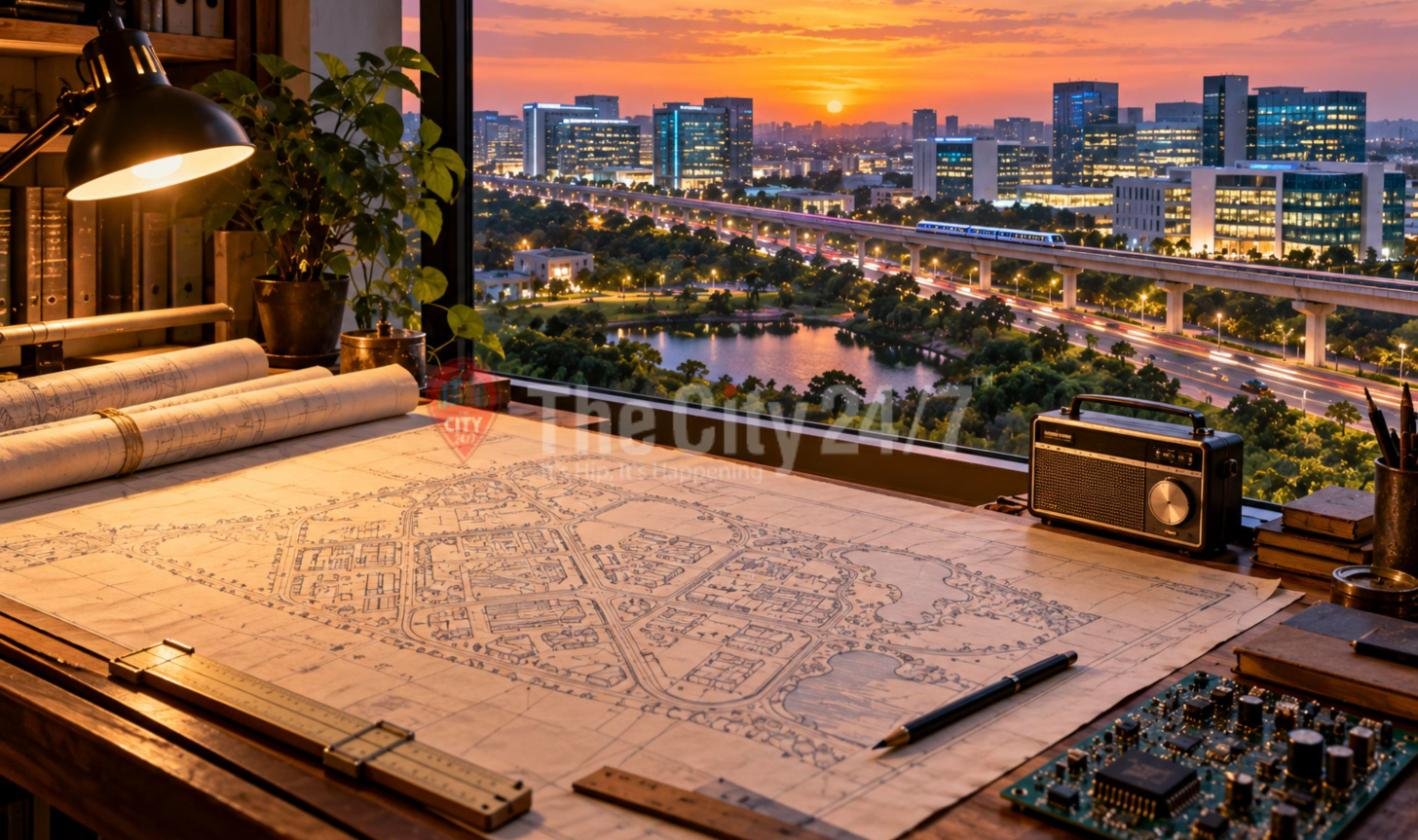
“He wanted Bengaluru to be India's Silicon Valley before most people in India had heard of Silicon Valley.”
• On R K Baliga
R K Baliga was the first chairman of KEONICS, the Karnataka State Electronics Development Corporation, and the man who conceived Electronics City, the industrial township on Hosur Road set up in 1978. His idea was to create a dedicated electronics and technology zone on the edge of Bengaluru, and it became the home of Infosys, Wipro and many other companies. He is remembered as one of the key architects of Bengaluru's technology economy.
Every weekday morning, a very large number of people make the trip down Hosur Road to Electronics City, many of them muttering about the traffic. Very few of them know the name of the man who put their office there. That feels like an oversight worth correcting, because few individual decisions have shaped modern Bengaluru more than his.
Detailed biographical records about Baliga are thinner than for many people in this series, so this profile focuses on what is well established: KEONICS, Electronics City and what grew from them.
Quick Information
One man, one state corporation and some farmland south of the city. He imagined an electronics hub; he got an IT capital and a very long commute.
Who Was R K Baliga?
He was an engineer and administrator who led KEONICS, the Karnataka government's electronics development corporation, from its founding in 1976. At a time when electronics in India was dominated by a handful of public sector firms, he pushed for Karnataka, and Bengaluru in particular, to become a centre for the industry.
What Is Electronics City and Why Did Baliga Create It?
Electronics City is an industrial township on Hosur Road, set up by KEONICS in 1978 on roughly 330 acres south of Bengaluru. Baliga's idea was to give electronics companies a single place with land, power and support, rather than leaving them scattered across the city. It was a bold bet in an era of heavy licensing and limited private industry.
“In 1978 it was farmland and a plan. Twenty years later it was the most famous office address in India.”
• On Electronics City
How Did Electronics City Become an IT Hub?
Gradually, and then very quickly. The early tenants were electronics manufacturers. When Indian software companies began to grow in the 1980s and 1990s, Electronics City offered exactly what they needed: land, a location near Bengaluru's talent, and a government that wanted them there. Infosys built its landmark campus there, Wipro and others followed, and by the 2000s it was one of the best-known technology addresses in the world.
- Infosys. Its Electronics City campus became a symbol of Indian IT.
- Wipro. Another major presence in the area.
- Many others. HCL, TCS and a long list of global firms set up offices in and around the township.
- Biocon. Kiran Mazumdar-Shaw's biotech company built its campus nearby on Hosur Road.
- ELCITA. In 1997 the township got its own management authority, which still runs much of its infrastructure.
Electronics City has its own industrial township authority, ELCITA, which manages roads, lighting and services within the area. It is one of the few parts of Bengaluru governed partly by its own corporate township body.
How Do You Get to Electronics City Today?
By the Hosur Road elevated expressway, which opened in 2010, or by the Namma Metro Yellow Line, which opened in 2025 and connects the area to RV Road and the rest of the network. Both have changed the commute considerably, though peak hours are still peak hours.
Where Can You See R K Baliga's Legacy in Bengaluru?
In Electronics City itself, and in the technology economy that grew out of it. There are few monuments to him, which is a pity, but the township is his memorial in the most practical sense.
- Electronics City Phase 1 and 2. The township off Hosur Road.
- The Infosys campus. The best-known building in the area.
- The Yellow Line. The metro now serving the township.
- KEONICS. The state electronics corporation he led, still operating.
What Can Bangaloreans Learn From R K Baliga?
That cities are shaped by people who make bets long before the evidence arrives. In 1978, very few people imagined Bengaluru as a global technology centre. Baliga did, and he acted on it. The traffic we complain about is, in its way, proof that he was right.
Why Does R K Baliga Belong in People of Bangalore?
He conceived and built Electronics City, the township that became the backbone of Bengaluru's technology economy. Much of modern Bengaluru, its jobs, its migration and its reputation, runs through a decision he made in the 1970s.
FAQs
Who was R K Baliga?
R K Baliga was the first chairman of KEONICS, the Karnataka State Electronics Development Corporation, and the man who conceived Electronics City in Bengaluru.
When was Electronics City set up?
Electronics City was set up by KEONICS in 1978 on land off Hosur Road, south of Bengaluru.
What is KEONICS?
KEONICS is the Karnataka State Electronics Development Corporation, a state government body founded in 1976 to promote the electronics industry in Karnataka.
Which companies are in Electronics City?
Electronics City is home to Infosys, Wipro, HCL, TCS and many other technology and manufacturing companies.
What is ELCITA?
ELCITA is the Electronics City Industrial Township Authority, formed in 1997 to manage infrastructure and services in Electronics City.
How do I get to Electronics City by metro?
The Namma Metro Yellow Line, which opened in 2025, serves Electronics City and connects to RV Road.
How far is Electronics City from the city centre?
Electronics City is about 18 km south of central Bengaluru, off Hosur Road.
Why is Bengaluru called the Silicon Valley of India?
Because of its large technology industry, which grew in places like Electronics City from the 1970s onwards. R K Baliga is widely credited with first imagining Bengaluru in that role.
Contact Details
The organisations connected to his work.
Worked in Electronics City in the Early Days?
If you worked in Electronics City in the 1980s, or knew R K Baliga, Click the WhatsApp icon at the bottom right of your screen and tell me. That is also the easiest way to reach The City 24/7 about anything at all, including nominating someone for People of Bangalore.
And if you want one story about the people who make this city, every Sunday, join our ever growing community at thecity247.kit.com/join-the-community. Free, and about ten seconds of your life.
Same city, new stories, always.

Related Stories
 CITY BUILDERS
Kempe Gowda: The Man Who Built Bengaluru From a Mud Fort in 1537
September 23, 2026
 CITY BUILDERS
M H Marigowda: The Man Who Made Lalbagh Bloom Again
September 23, 2026
 CITY BUILDERS
Sir M Visvesvaraya: The Engineer Who Wired Bengaluru for the Future
September 23, 2026
 MEDIA
Ramjee Chandran: The Man Who Gave Bangalore Its First Free Magazine
September 24, 2026
 TECHNOLOGY
Sabeer Bhatia: The Bangalore Schoolboy Who Sold Hotmail for $400 Million
September 24, 2026
 MEDICINE
Dr Sudarshan Ballal: The Nephrologist Who Came Home to Build Manipal Bangalore
September 24, 2026
