


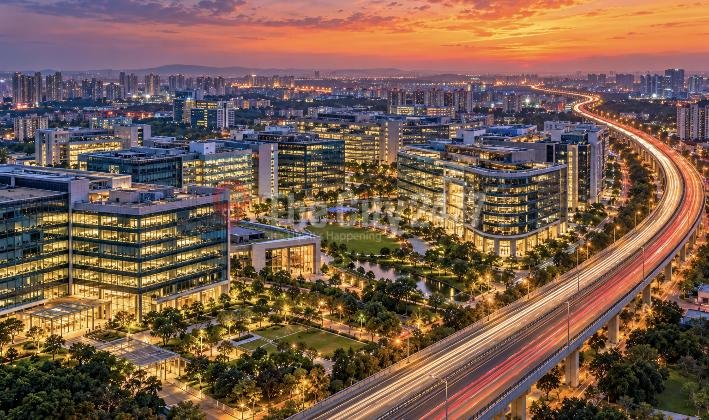
“Electronic City spent three decades being where the work was and nowhere anyone wanted to live. One metro line rewrote that sentence.”
• On the Yellow Line
Electronic City was established in the late 1970s as one of India's first dedicated electronics and technology parks, on land well south of Bangalore along the Hosur Road. It grew into one of the country's largest employment clusters, home to some of the biggest names in Indian IT and several hundred thousand daily workers, and for most of its life it was famous for exactly two things: the jobs, and the commute.
The commute was genuinely brutal. Hosur Road carried the entire corridor with no rail alternative, the elevated expressway helped only those who could pay the toll and only in one direction, and living in Electronic City meant accepting that the rest of Bangalore was effectively far away. That ended in August 2025, when the Yellow Line metro opened along the corridor and connected several hundred thousand commuters to the rest of the network for the first time.
This guide covers Phase 1 and Phase 2, what the metro actually changed, rents in 2026, the food and amenities, the schools and hospitals, and an honest verdict on living in the far south.
Quick Information
Electronic City in one table. Note the metro row, then note how many of the other rows only make sense because of it.
Where Is Electronic City and How Is It Laid Out?
Electronic City sits about 18 to 20 kilometres south of central Bangalore along the Hosur Road, and it splits into two phases with a residential belt wrapped around them. Phase 1 is the older and larger, holding most of the big campuses. Phase 2 sits to the east and is a mix of offices and newer development.
- Phase 1. The original core and the largest employment concentration, with the biggest IT campuses, hotels, banks and food courts.
- Phase 2. East of Phase 1, a mix of offices, newer buildings and residential projects, generally quieter.
- Neeladri Nagar and Doddathoguru. The nearest residential pockets, dense with PGs, co-living and small apartments serving the workforce. Cheapest rents on the corridor.
- Konappana Agrahara and Hebbagodi. Older village-turned-suburb areas with independent houses, local markets and good value.
- Bommasandra and Chandapura. The southern end, industrial and residential, now with the Yellow Line terminus at Bommasandra and Narayana Health City nearby.
- Attibele and the Hosur stretch. Beyond the city limit toward Tamil Nadu. Cheap, industrial, and increasingly part of the corridor's housing market.
What Did the Yellow Line Metro Actually Change?
It made Electronic City part of Bangalore again. The Yellow Line opened in August 2025, running from Rashtreeya Vidyalaya Road in the south of the city through Jayadeva Hospital and Central Silk Board and down the Hosur Road corridor to Bommasandra, with stations serving the Electronic City campuses directly.
The practical consequences are large. A commute that was unpredictable by an hour is now predictable within minutes. The interchange at Central Silk Board connects the corridor toward the ORR and, when the Blue Line opens, to the airport. Jayadeva Hospital interchange links to the Green Line for Jayanagar, Majestic and the north.
- For workers. You can now live in Jayanagar, JP Nagar or the Green Line corridor and work in Electronic City without a car. That was not viable before.
- For residents. Living here no longer cuts you off from the rest of the city, which is the biggest change in this neighbourhood's history.
- For rents. Metro-adjacent addresses have already repriced upward, and the gap between them and the outer pockets is widening.
- What it did not fix. The last mile. Electronic City is spread out and many campuses and complexes still need a shuttle, auto or bike from the station.
- Hosur Road itself. Still heavy, particularly at the Silk Board end and around the expressway ramps, though noticeably less so than before the metro.
The Electronic City elevated expressway is a tolled flyover above Hosur Road that bypasses the surface traffic between Silk Board and Electronic City. It is worth the toll in peak hours, and largely pointless off-peak now that the metro exists.
What Is It Like to Work in Electronic City?
It is the most self-contained work environment in Bangalore. The large campuses here were built as walled ecosystems with their own food courts, gyms, clinics, banks, transport fleets and in some cases accommodation, because for decades nothing outside them existed. That has produced a working day that is genuinely convenient once you are inside the gate.
It has also produced a neighbourhood that empties out. Electronic City's population is heavily weighted toward young technology workers, many in shared housing, and the social life happens in food courts, malls, apartment clubhouses and a modest cluster of restaurants and bars rather than on any street. Our jobs guide covers the corridor's employment market, and the coworking guide covers desk options for anyone here on their own.
How Much Does It Cost to Live in Electronic City?
This is the cheapest major corridor in Bangalore, and by a wide margin. In 2026, expect roughly Rs 9,000 to Rs 18,000 a month for a 1BHK, Rs 15,000 to Rs 32,000 for a 2BHK and Rs 26,000 upward for a 3BHK, with metro-adjacent and premium gated projects at the top and the Doddathoguru, Chandapura and Attibele stretches at the bottom.
The PG and co-living market here is the largest in the city, built around the workforce, and it makes Electronic City the easiest and cheapest place in Bangalore to land in on a first salary. Fully furnished shared rooms with food included are widely available and priced accordingly.
For buyers, the corridor has been one of the more affordable entry points into Bangalore property, and the Yellow Line has begun to change that. Our cost of living, renting and buying guides cover the numbers and the paperwork in detail.
Where Should I Eat and Drink in Electronic City?
Better than it was, and honest about what it is. Electronic City's food scene grew from campus food courts outward, and the strongest category by some distance is affordable regional Indian cooking serving a workforce from all over the country.
- Regional Indian. Excellent Andhra, Tamil, Kerala, Bengali and north Indian restaurants across Neeladri Nagar and the Phase 1 fringes, mostly Rs 150 to Rs 350 a head. The corridor's real strength.
- Breakfast. Dense darshini and Udupi coverage from 6:30 AM, geared to shift timings. Under Rs 150 a head.
- Breweries and bars. A modest but real cluster around Phase 1, the malls and the hotels, serving the after-work crowd. 1 AM close.
- Malls and multiplexes. The Electronic City retail and cinema clusters carry the mainstream brands, and they function as the neighbourhood's default weekend social space.
- Street food. The evening carts around Neeladri Nagar, Doddathoguru and the campus gates. Rs 50 to Rs 150, and where most of the corridor actually eats dinner.
Are There Good Schools and Hospitals in Electronic City?
Yes, and both have improved substantially as the residential population has grown. The corridor now has a solid run of CBSE, ICSE and state-board schools plus a smaller number of international options, mostly serving the surrounding apartment communities with bus routes into the gated projects.
On healthcare, the corridor's headline asset is Narayana Health City at Bommasandra, a large multi-specialty campus with a serious cardiac reputation, alongside Sparsh, Springleaf and a good spread of clinics and diagnostic centres. The Jayanagar and JP Nagar hospital clusters are also now a straightforward metro ride north. Our schools guide and healthcare guide cover both in detail.
Is Electronic City a Good Place to Live? An Honest Verdict
Yes, for the first time since it was built. That is the fair summary. Before the Yellow Line, my advice on Electronic City was to live here only if you worked here and to accept the isolation. Now it is a well-priced, well-serviced part of Bangalore with a working rail connection to the rest of the city, and the value on offer is the best of any major corridor.
- Move here if. You work in the corridor, you are on a first or second salary, or you want the most space and the lowest rent of any well-connected part of Bangalore.
- Move here with a family if. You want affordable space with schools, hospitals and clubhouse amenities nearby, and you can accept a quieter social life.
- Think twice if. You work in the north, the east or Whitefield. The metro does not help you and Hosur Road will.
- Think twice if you want city life. There is no walkable high street here and there will not be one soon. Weekends in the centre mean a planned trip.
- Choose metro-adjacent. The difference between a ten minute walk to a Yellow Line station and a fifteen minute auto is the single biggest quality-of-life variable on this corridor.
What Is There to Do in and Around Electronic City?
The corridor's best asset is what lies south of it. Electronic City is the closest part of Bangalore to the Hosur and Tamil Nadu side, which puts a large number of the city's best day trips within an easy morning's drive: the Bannerghatta side, the reservoirs, the hill routes toward Krishnagiri and the Kanakapura Road trails a short distance west.
In the neighbourhood itself, life runs on clubhouses, malls, multiplexes, a strong gym and cycling culture, and campus sports facilities. The cycling out toward Attibele and the Hosur road stretches at dawn is a genuine local institution, and the Bannerghatta Biological Park is close enough for a Sunday morning.
Our day trips, trekking and things to do guides all cover the southern routes, and the events calendar has what is on across the city this week.
Electronic City: Frequently Asked Questions
Is Electronic City a good place to live in 2026?
Yes, and much more so than before. The Yellow Line metro, which opened in August 2025, connected the corridor to the rest of the city, and rents here remain the lowest of any well-connected part of Bangalore.
Does Electronic City have a metro station?
Yes. The Yellow Line runs along the Hosur Road corridor from Rashtreeya Vidyalaya Road through Central Silk Board to Bommasandra, with stations serving the Electronic City campuses directly.
How much is rent in Electronic City in 2026?
Roughly Rs 9,000 to Rs 18,000 a month for a 1BHK, Rs 15,000 to Rs 32,000 for a 2BHK and Rs 26,000 upward for a 3BHK, making it the most affordable major corridor in the city.
What is the Electronic City elevated expressway?
A tolled flyover above Hosur Road that bypasses the surface traffic between the Silk Board area and Electronic City. It is worth the toll at peak hours and less relevant now that the metro runs.
How far is Electronic City from central Bangalore?
Roughly 18 to 20 km. By metro on the Yellow Line the journey is predictable; by road on Hosur Road it can vary by an hour depending on the time of day.
Which companies are in Electronic City?
It is one of India's largest technology clusters, with major IT campuses including the headquarters area of some of the country's biggest software companies, alongside electronics, hardware and services firms across Phase 1 and Phase 2.
Is Electronic City good for families?
Increasingly yes. There is a solid run of CBSE, ICSE and international schools, Narayana Health City at Bommasandra, affordable space and clubhouse amenities, though the social scene is quieter than central Bangalore.
Electronic City or Whitefield: which should I pick?
Whichever matches your office. Both now have working metro lines and self-contained amenities. Whitefield has more established retail and schools; Electronic City is markedly cheaper.
Is there a PG and co-living market in Electronic City?
The largest in Bangalore, built around the corridor's young workforce. Furnished shared rooms with food included are widely available and cheap, which makes this the easiest place to land on a first salary.
How far is Electronic City from the airport?
Roughly 60 km north, typically 100 minutes to two hours by road. It is the longest airport run from any major Bangalore corridor.
Useful Contacts and Links for Electronic City
Worth saving if you live in or work on the Hosur Road corridor.
Has the Metro Changed Your Commute?
If you commute on the Yellow Line I would genuinely like to know what it has done to your day, and which restaurant, school or complex on this corridor deserves a mention here. Click the WhatsApp icon at the bottom right of your screen and tell me. That is also the fastest way to reach The City 24/7 about anything at all.
And if you want the city explained one useful thing at a time, join our ever growing community. One weekly email, free, and a lot more reliable than the algorithm.
Same city, new stories, always.

Related Stories
 CITY GUIDE
Marathahalli: The Complete Guide to East Bangalore's Cheapest Good Idea
July 20, 2026
 CITY GUIDE
Namma Metro: The Complete Guide to Lines, Fares, Timings and Not Getting It Wrong
July 19, 2026
 CITY GUIDE
Whitefield: The Complete Guide to the City Bangalore Grew Into
July 11, 2026
 CITY GUIDE
The Ultimate Guide to Bangalore: Everything You Need to Know
November 1, 2026
 CITY GUIDE
KSR Bengaluru City Station: How to Use India's Busiest Confusing Railway Station
September 22, 2026
 CITY GUIDE
Jayanagar: The Complete Guide to the Best-Planned Neighbourhood in Bangalore
July 21, 2026
