


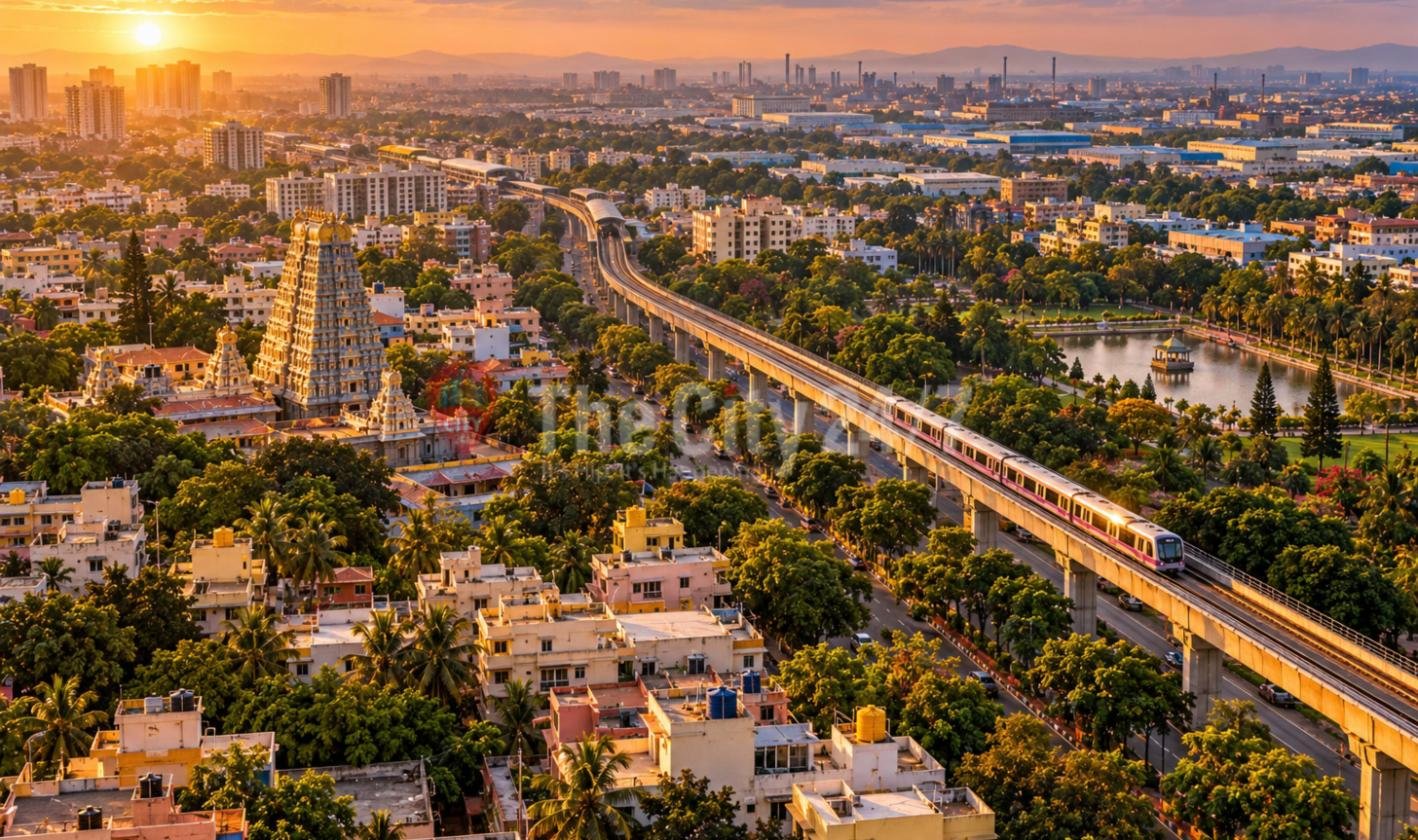
“Every conversation about where to live in this city happens between the south and the east. The west just quietly gets on with having a metro line and cheaper rent.”
• On being overlooked
West Bangalore is the most underrated part of the city, and the numbers make the case without any help from me. The Purple Line runs straight through it from Majestic out to Challaghatta. Rents are commonly a third below equivalent housing in the east. The neighbourhoods are established, planned, walkable and full of markets. And almost nobody moving to Bengaluru puts it on their shortlist.
The reason is employment. The tech corridors are all east and south, so if your office is in Whitefield or on the Outer Ring Road, the west is not for you. But an enormous number of people in this city work centrally, work remotely, or work in the west's own manufacturing, retail, government and healthcare economy, and for them this side of Bengaluru is simply better value than anywhere else with a metro station.
This guide covers Rajajinagar, Vijayanagar, Basaveshwaranagar, Nagarbhavi, Kengeri and the surrounding areas: what each is like, what rent costs in 2026, the transport, the food, and an honest verdict.
Quick Information
The whole western half in one table. Compare the rent rows against any east Bangalore guide and then read the commute row before you get excited.
What Counts as West Bangalore, and How Is It Laid Out?
West Bangalore runs from the older extensions immediately west of the city centre out along the Mysore Road and Magadi Road axes to the city edge at Kengeri. It is best understood in three bands: the old planned extensions, the mid-century layouts, and the outer edge.
- Rajajinagar. The anchor. A large planned extension of numbered blocks laid out in the 1950s, with wide roads, dense retail on Dr Rajkumar Road, good tree cover and a Purple Line station. The best all-round choice in the west.
- Basaveshwaranagar. Adjacent and quieter, largely residential, popular with families and long-settled Kannada-speaking households. Excellent value for the space.
- Vijayanagar. Dense, busy and extremely well connected, with its own metro station and a strong local market and restaurant scene. The most affordable well-connected neighbourhood in the city.
- Nandini Layout and Mahalakshmi Layout. The northern side toward Yeshwanthpur. Mixed housing, good Green Line access, solid value.
- Nagarbhavi and the university belt. Around Bangalore University's Jnanabharathi campus. Student housing, quieter roads, and a lot of green.
- Kengeri and Challaghatta. The western terminus of the Purple Line and the city's edge. Cheapest housing with a metro station anywhere in Bengaluru, and a genuine bet on the direction of growth.
Why Is West Bangalore so Much Cheaper Than the East?
Because the tech industry built itself on the other side of the city. Rents in Bengaluru track proximity to technology employment more than anything else, and the west has almost none of it. What the west has instead is manufacturing, engineering, retail, wholesale, government offices, healthcare and education, which employ enormous numbers of people at salaries that do not bid rents to Indiranagar levels.
The practical result is a genuine arbitrage. In 2026 a 2BHK in Vijayanagar or Kengeri, on a metro line, costs roughly what a single room in a Koramangala co-living costs. For a remote worker, a central-office worker, a student or a family on one income, that difference compounds into something serious over a few years.
If your office is east of Majestic, the west will cost you an hour each way and no rent saving is worth that. If your work is central, remote, or in the west's own economy, this is the best value in Bengaluru and it is not close.
How Good Is the Transport in West Bangalore?
Better than most people assume, and the Purple Line is the reason. The line runs from Challaghatta and Kengeri in the far west through Mysore Road, Deepanjali Nagar, Attiguppe, Vijayanagar and Rajajinagar to Majestic and onward east, which puts the whole western band on a single ride to the city centre.
- Purple Line. Stations at Challaghatta, Kengeri, Mysore Road, Deepanjali Nagar, Attiguppe, Vijayanagar, Rajajinagar and onward. Majestic in fifteen to twenty-five minutes from most of the west.
- Green Line. Serves the northern edge at Yeshwanthpur, Nandini Layout and Madavara, useful for the Malleshwaram and north-city direction.
- Rail. Yeshwanthpur Junction and the Kengeri and Mysore Road corridors give the west decent long-distance rail access.
- Bus. Dense BMTC coverage on Dr Rajkumar Road, Magadi Road, Mysore Road and the Outer Ring Road west, plus the Kengeri and Vijayanagar bus terminals.
- Road. Mysore Road, Magadi Road and the western ORR. Traffic is real but considerably lighter than the eastern and southern corridors.
- Out of town. The Bengaluru Mysuru expressway starts here, which makes Mysuru, Srirangapatna and the whole south-west of Karnataka the easiest weekend escape from any part of the city.
Where Should I Eat in West Bangalore?
This is old Bengaluru food territory and the strength is traditional Karnataka cooking at prices the rest of the city has forgotten. Rajajinagar, Vijayanagar and Basaveshwaranagar between them hold a deep run of darshinis, Udupi hotels, military hotels and sweet shops, several of them decades old and none of them interested in a rebrand.
- Breakfast. Dense darshini coverage across every layout from 6:30 AM. Idli, vada, dosa, rava idli and filter coffee, under Rs 150 a head and consistently excellent.
- Military hotels. West and old Bangalore is the heartland of the Bangalore military hotel: donne biryani, mutton chops, ragi mudde and pepper fry. Cheap, fast, and one of the city's genuine food traditions.
- Meals and thalis. Excellent midday plate meals throughout, Rs 100 to Rs 220. This is where the west actually eats lunch.
- Street food. The Vijayanagar, Rajajinagar market and Magadi Road evening stretches. Chaat, gobi, masala puri and dosa carts at Rs 50 to Rs 120.
- Malls and newer places. Orion Mall at Brigade Gateway carries the mainstream restaurant brands, cinemas and a growing cluster of cafes and breweries nearby.
- Sweet shops. A strong run through Rajajinagar and Basaveshwaranagar, busiest during festival season.
Our breakfast, biryani and street food guides all cover this side of the city, and the west features more heavily in each than most people expect.
How Much Does It Cost to Live in West Bangalore?
The lowest rents of any well-connected part of the city. In 2026, expect roughly Rs 9,000 to Rs 18,000 a month for a 1BHK, Rs 16,000 to Rs 34,000 for a 2BHK and Rs 28,000 upward for a 3BHK, with the Rajajinagar and Basaveshwaranagar core at the top and the Kengeri, Nagarbhavi and Magadi Road stretches at the bottom.
Housing here is mostly older independent houses and small owner-built apartment blocks, with newer gated projects concentrated around Kengeri, Nagarbhavi and the Mysore Road corridor. That mix means more negotiation and more variation than in the east's standardised gated market, and a good deal is genuinely available if you look on foot.
For buyers the west has been one of the quieter appreciation stories in Bengaluru, driven by the Purple Line extension and the Mysuru expressway. Our buying property and renting guides cover the checks, and the cost of living guide has the full monthly picture.
What Are the Schools and Colleges Like in West Bangalore?
Strong on established CBSE, ICSE and state-board schools, and light on the international tier. The west has a long history of good, reasonably priced schooling, with a dense run of schools across Rajajinagar, Basaveshwaranagar and Vijayanagar that families have used for generations, at fees a fraction of what the eastern international schools charge.
On higher education the west is a genuine centre: Bangalore University's Jnanabharathi campus at Nagarbhavi, several engineering and medical colleges along the Mysore Road and Magadi Road corridors, and a large student population that shapes the character of Nagarbhavi and Kengeri. Our schools guide and colleges guide cover both in detail.
Is West Bangalore a Good Place to Live? An Honest Verdict
Yes, and it is the most obvious unexploited value in this city, with one hard condition attached. If your commute does not go east, west Bangalore gives you an established neighbourhood on a metro line with real markets, good schools, excellent cheap food and rents a third below the east. If your commute does go east, none of that survives contact with the Outer Ring Road.
- Move here if. You work centrally, work remotely, work in the west's own economy, or are a student. Also if you are on one income and want space.
- Move here with a family. Established schools, good hospitals, quiet planned layouts, markets within walking distance and a metro line. Very strong family value.
- Buy here if. You want an entry point into Bengaluru property with existing metro infrastructure rather than a promised line.
- Do not move here if. Your office is in Whitefield, on the ORR corridor, or in Electronic City. The commute is the whole argument and it loses.
- Pick your area. Rajajinagar for the best all-round balance, Vijayanagar for value with connectivity, Basaveshwaranagar for quiet, and Kengeri for the cheapest metro-served housing in the city.
What Is There to Do in West Bangalore?
More than the west gets credit for, starting with the ISKCON temple at Rajajinagar, which is one of the most visited places in Bengaluru and worth an early morning visit rather than a weekend one. Orion Mall at Brigade Gateway is among the better malls in the city, with a lake, cinemas and event space, and it functions as the west's default social centre.
Beyond that, the Jnanabharathi campus and the Turahalli forest to the south-west give the west more accessible open green than most of the city, and Turahalli in particular is a genuine local institution for mountain biking, trail running and early-morning walks. Kanteerava Studios and the Kannada film industry's home base sit here, giving this side of Bengaluru a cultural identity the east has never had, and the Vidyapeeta and Rajajinagar market areas are excellent aimless-walk territory.
The other advantage is escape. The Bengaluru Mysuru expressway starts on this side, which makes Mysuru, Srirangapatna, the Kabini side and the whole south-west of Karnataka the easiest weekend trip from anywhere in the city. Our weekend getaways and day trips guides cover the western routes in full.
West Bangalore: Frequently Asked Questions
Is west Bangalore a good place to live?
Yes, if your commute does not go east. It offers established neighbourhoods, Purple Line metro access, real markets, good schools and rents roughly a third below the eastern corridors.
Why is rent cheaper in west Bangalore?
Because the technology industry built itself in the east and south. Rents here track proximity to tech employment, and the west's economy is manufacturing, retail, government, healthcare and education instead.
Which is the best area in west Bangalore?
Rajajinagar for the best all-round balance of metro, retail and housing, Vijayanagar for value with connectivity, Basaveshwaranagar for quiet family living, and Kengeri for the cheapest metro-served housing in the city.
Does west Bangalore have metro connectivity?
Yes. The Purple Line runs through it with stations at Rajajinagar, Vijayanagar, Attiguppe, Deepanjali Nagar, Mysore Road, Kengeri and Challaghatta, plus Green Line access at Yeshwanthpur and Nandini Layout.
How much is rent in west Bangalore in 2026?
Roughly Rs 9,000 to Rs 18,000 a month for a 1BHK, Rs 16,000 to Rs 34,000 for a 2BHK and Rs 28,000 upward for a 3BHK, with Kengeri and Nagarbhavi the cheapest.
Is Rajajinagar a good area?
It is the strongest neighbourhood in west Bangalore: a planned 1950s extension with wide roads, tree cover, dense retail on Dr Rajkumar Road, a Purple Line station and rents well below the city's east.
What is there to do in west Bangalore?
The ISKCON temple at Rajajinagar, Orion Mall at Brigade Gateway, the Jnanabharathi campus, Turahalli forest for trails and cycling, Kanteerava Studios, and the markets across Rajajinagar and Vijayanagar.
Is west Bangalore good for families?
Very. Established CBSE and ICSE schools at reasonable fees, good hospitals, quiet planned layouts, walkable markets and metro access make it strong family value.
How far is west Bangalore from the tech parks?
Far. Rajajinagar or Vijayanagar to Whitefield or the Outer Ring Road corridor is among the longest regular commutes in the city, typically 90 minutes or more each way in peak hours.
Is Kengeri worth considering?
Yes if budget is the priority. It is the western terminus of the Purple Line, so it offers the cheapest metro-served housing in Bengaluru, with the Mysuru expressway on the doorstep.
Useful Contacts and Links for West Bangalore
The official sources worth keeping if you live in or are moving to the western half of the city.
The West Deserves More Coverage. Help Me Give It Some
If you live on this side of the city, I want your recommendations: the military hotel, the darshini, the market stall, the layout I have underrated. Click the WhatsApp icon at the bottom right of your screen and tell me. That is also the fastest way to reach The City 24/7 about anything at all.
And if you want the city explained one useful thing at a time, join our ever growing community. One weekly email, free, and a lot more reliable than the algorithm.
Same city, new stories, always.

Related Stories
 CITY GUIDE
The Cost of Living in Bangalore: What It Actually Takes Each Month
September 9, 2026
 CITY GUIDE
Electronic City: The Complete Guide to the Tech Hub That Finally Got a Metro
September 9, 2026
 CITY GUIDE
Jayanagar: The Complete Guide to the Best-Planned Neighbourhood in Bangalore
September 9, 2026
 CITY GUIDE
Koramangala: A Complete Guide to the Neighbourhood That Built Indian Startups
September 9, 2026
 CITY GUIDE
Marathahalli: The Complete Guide to East Bangalore's Cheapest Good Idea
September 9, 2026
 CITY GUIDE
North Bengaluru: The Complete Guide to the Half of the City Being Built Right Now
September 9, 2026
