


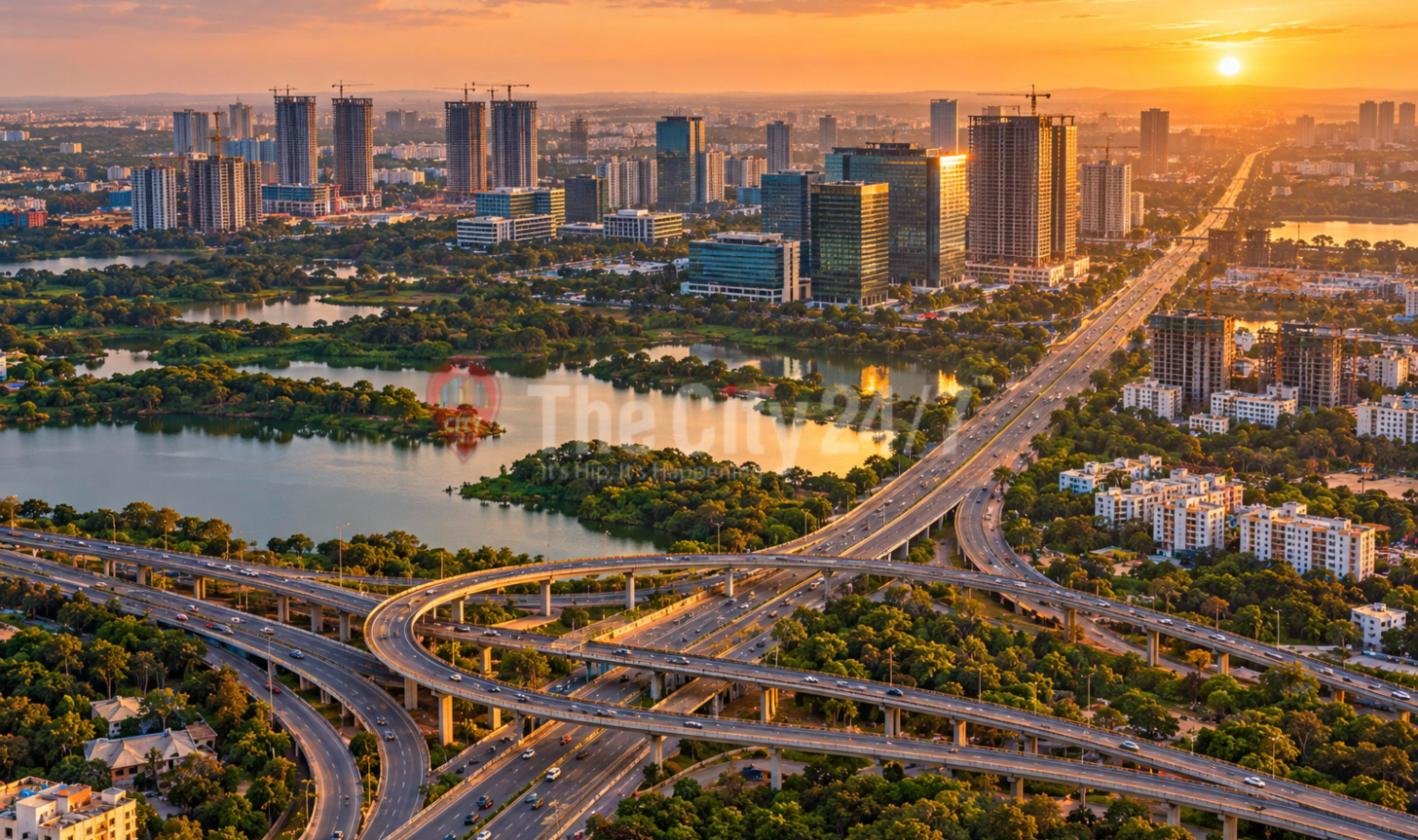
“South Bangalore tells you what the city was. North Bengaluru tells you what it is about to be, usually while a cement mixer goes past.”
• On the direction of travel
North Bengaluru is the fastest changing part of the city and the least understood. For decades it was where you drove through on the way to the airport: Hebbal, then farmland, then Yelahanka, then nothing much. Then the airport opened at Devanahalli in 2008, the Manyata tech corridor filled up, the big concert grounds arrived, and the whole northern arc became the city's main direction of growth.
Today it holds the largest supply of new apartment stock in Bengaluru, the closest access to the airport, a growing employment base, some excellent schools, and a metro line under construction that will change its economics permanently. What it does not yet have is the settled texture of the older city. This is a part of Bengaluru still under construction, in the literal sense.
This guide covers Hebbal, Yelahanka, Jakkur, Thanisandra, Hennur, the Manyata corridor and the Devanahalli stretch: what each is like, what rent costs in 2026, the transport picture, and an honest verdict.
Quick Information
North Bengaluru in one table. Read the airport row first, because it is the reason for almost everything else in this table.
What Counts as North Bengaluru, and How Is It Laid Out?
North Bengaluru is best understood as a series of rings moving out from the Hebbal flyover toward the airport. The inner ring is established, the middle ring is where most of the new apartment supply sits, and the outer ring around Devanahalli is where the aerospace parks, the airport city projects and the largest land bets are.
- Hebbal and Sahakar Nagar. The established inner north. Good hospitals, older housing alongside new towers, excellent connectivity in every direction, and permanent congestion at the flyover.
- Thanisandra, Nagawara and Hennur. The apartment belt. Enormous new supply, the Manyata corridor next door, and improving retail and restaurant density.
- Jakkur and Yelahanka. Quieter, greener, still relatively affordable, with lakes, the GKVK and agricultural university campuses, and a slower pace.
- The Manyata corridor. North Bengaluru's employment engine, with a large technology and services workforce and its own hotels and retail.
- Bagalur, Doddaballapur Road and Devanahalli. The outer north. Aerospace and hardware parks, large integrated townships, and the properties most exposed to the airport metro's arrival.
Why Is Everyone Buying Property in North Bengaluru?
Because the airport is here, the metro is coming, and there is still land. That combination does not exist anywhere else in the city. The southern and eastern corridors are built out and jammed; the north still has room, and the infrastructure arriving in it is the most significant in Bengaluru.
- The airport metro. The Blue Line from Central Silk Board along the ORR through KR Puram and up to the airport is the single biggest factor. Addresses near its alignment are the ones to watch.
- Employment. Manyata, the aerospace and defence cluster around Devanahalli, and the hardware and electronics parks give the north a genuine local job base.
- Supply. The largest pipeline of new apartments in the city, which keeps prices more reasonable here than on the ORR corridor.
- Road infrastructure. The airport expressway, the Hennur and Thanisandra widening and the ongoing peripheral road work all serve this side.
- The catch. Much of this is still promised rather than delivered, and some projects sit a long way from anything. Check what exists today, not what the brochure shows.
Our buying property in Bangalore guide covers the checks, approvals and paperwork that matter most in exactly this kind of growth market.
Drive to the address at 9 AM on a weekday and then again at 9 PM. Check for water supply, a working approach road and a school within ten kilometres. Brochures in this part of the city are written about 2032.
How Is the Airport Connectivity From North Bengaluru?
The best in the city by a wide margin, and it is north Bengaluru's clearest everyday advantage. From Hebbal the airport is roughly 30 km on the expressway, typically 40 to 55 minutes, and from Yelahanka or Jakkur it is closer still. Compare that with 90 minutes to two hours from Koramangala or Sarjapur Road and the appeal is obvious for anyone who flies regularly.
The airport itself has grown into a substantial second hub, with Terminal 2 handling a large share of traffic and a growing cluster of hotels, business parks and convention space around it. The Blue Line metro extension to the airport is under construction and will make the journey predictable rather than merely quick, which matters in a city where road times swing by an hour. Our airport guide covers terminals, transport options and the Vayu Vajra network in detail.
Why Do All the Big Concerts Happen in North Bengaluru?
Because the space is there, and the airport is next door. The large open grounds along the airport road and around the northern outskirts can hold crowds that no venue inside the city can, which is why the major international tours, festivals and multi-day music events now land in this part of Bengaluru almost by default.
For residents of the north that is a straightforward benefit: a twenty minute ride instead of a two hour crawl from the south. For everyone else it means an early start and a long journey home, and on big event nights the airport road traffic is worth planning around. Our events calendar lists what is coming and where, with venue and travel notes for each.
How Much Does It Cost to Live in North Bengaluru?
Less than the south-east for more space, and that gap is the north's main selling point. In 2026, expect roughly Rs 12,000 to Rs 24,000 a month for a 1BHK, Rs 20,000 to Rs 45,000 for a 2BHK and Rs 35,000 upward for a 3BHK, with Hebbal and premium Thanisandra projects at the top and the Yelahanka, Jakkur and outer Doddaballapur Road stretches at the bottom.
Housing here is dominated by large gated projects, so maintenance charges are a real monthly item, buying you amenities and, importantly, managed water supply. Water is the thing to check hardest in the north: several outer pockets still depend on tankers and borewells rather than a BWSSB connection, and that changes both your monthly cost and your summer.
Our cost of living guide has the full monthly breakdown across neighbourhoods, and the setting up a home guide covers connections, deposits and the utilities paperwork.
Is North Bengaluru a Good Place to Live? An Honest Verdict
Yes, if you are early rather than late. North Bengaluru today gives you space, newer housing, reasonable rents, unmatched airport access and good hospitals and schools, at the cost of a still-thin social layer and a lot of construction. In five years, once the airport metro is running, the same addresses will cost considerably more.
- Move here if. You work at Manyata or in the Devanahalli aerospace and hardware cluster, you fly frequently, or you want space and a newer home for the money.
- Buy here if. You are taking a five to ten year view and your address is close to the Blue Line alignment or an existing employment centre.
- Think twice if. You work in the south or east. Hebbal to Whitefield or the ORR corridor is among the longest regular commutes in Bengaluru.
- Think twice if you want texture. The north has almost no walkable established high street. There is no Malleshwaram or Jayanagar equivalent here yet.
- Check the basics. Water source, approach road, school distance and hospital distance. In the outer north these vary enormously between projects a kilometre apart.
What Is There to Do in North Bengaluru?
More outdoors than the rest of the city, and that is the underrated part. Hebbal Lake, Jakkur Lake and Yelahanka Lake all have walking loops and serious birdlife, and the GKVK agricultural university campus is one of the largest green spaces in Bengaluru. Beyond the outskirts, the routes north toward Nandi Hills, Devanahalli fort, Skandagiri and the Chikkaballapur side start closer from here than from anywhere else in the city.
In-city, the north has the concert grounds, a growing run of malls and multiplexes around Hebbal and Thanisandra, brewery and restaurant clusters that have improved sharply in the last few years, and clubhouse sports inside the larger gated communities. Cycling out toward Doddaballapur and Nandi Hills at dawn is a well-established local ritual and the roads are far better than the city's.
Our day trips and trekking guides cover the northern routes in detail, and the events calendar has the concert and festival listings.
North Bengaluru: Frequently Asked Questions
Is north Bengaluru a good place to live?
Yes, particularly if you fly often, work at Manyata or Devanahalli, or want newer housing with more space for the rent. The trade-offs are a thinner social layer, ongoing construction and long commutes to the south and east.
Is north Bengaluru a good property investment?
It is the city's most-watched growth corridor, driven by the airport, the Blue Line metro under construction, the aerospace and hardware cluster and a large land supply. Check what infrastructure actually exists at the address today before buying the brochure's version.
How far is the airport from Hebbal?
Roughly 30 km on the expressway, typically 40 to 55 minutes by road, which is the shortest airport run from any established part of the city.
Is the airport metro line open?
Not yet. The Blue Line, running from Central Silk Board along the ORR through KR Puram to the airport, is under construction, and it is the single biggest factor in north Bengaluru's outlook.
How much is rent in north Bengaluru in 2026?
Roughly Rs 12,000 to Rs 24,000 a month for a 1BHK, Rs 20,000 to Rs 45,000 for a 2BHK and Rs 35,000 upward for a 3BHK, with Hebbal at the top and Yelahanka and the outer stretches at the bottom.
Which area in north Bengaluru is best?
Hebbal and Sahakar Nagar for connectivity and hospitals, Thanisandra and Hennur for new apartments near Manyata, Jakkur and Yelahanka for quiet and green, and Devanahalli for the long-term bet.
Why are big concerts held in north Bengaluru?
The large open grounds along the airport road can hold crowds no in-city venue can, and the airport is next door, which makes the north the default choice for major international tours and festivals.
Is water a problem in north Bengaluru?
In several outer pockets, yes. Some projects still rely on borewells and tanker supply rather than a BWSSB connection, so confirm the water source before you rent or buy.
Are there good schools in north Bengaluru?
Yes, with a strong and growing cluster of international, CBSE and ICSE schools around Hebbal, Yelahanka, Jakkur and Thanisandra, serving the area's fast-growing family population.
Hebbal or Whitefield: which is better?
Hebbal for airport access, hospitals and central connectivity. Whitefield for a working metro, more established retail and a bigger school cluster. Your office decides it.
Useful Contacts and Links for North Bengaluru
Worth saving if you live in, are moving to, or are buying in the northern corridor.
Building a Life up North? Tell Me How It Is Going
The north changes faster than I can write about it, so if your project, lake, school or restaurant deserves a mention, or if something here is already out of date, click the WhatsApp icon at the bottom right of your screen and let me know. That is also the fastest way to reach The City 24/7 about anything at all.
And if you want the city explained one useful thing at a time, join our ever growing community. One weekly email, free, and a lot more reliable than the algorithm.
Same city, new stories, always.

Related Stories
 CITY GUIDE
The Bengaluru Festival Calendar: Every Annual Event Worth Planning Your Year Around
September 18, 2026
 CITY GUIDE
Bengaluru's Theatres and Cultural Venues: Where to Actually See Something Live
September 18, 2026
 CITY GUIDE
The Cost of Living in Bangalore: What It Actually Takes Each Month
September 9, 2026
 CITY GUIDE
Electronic City: The Complete Guide to the Tech Hub That Finally Got a Metro
September 9, 2026
 CITY GUIDE
Jayanagar: The Complete Guide to the Best-Planned Neighbourhood in Bangalore
September 9, 2026
 CITY GUIDE
Koramangala: A Complete Guide to the Neighbourhood That Built Indian Startups
September 9, 2026
