


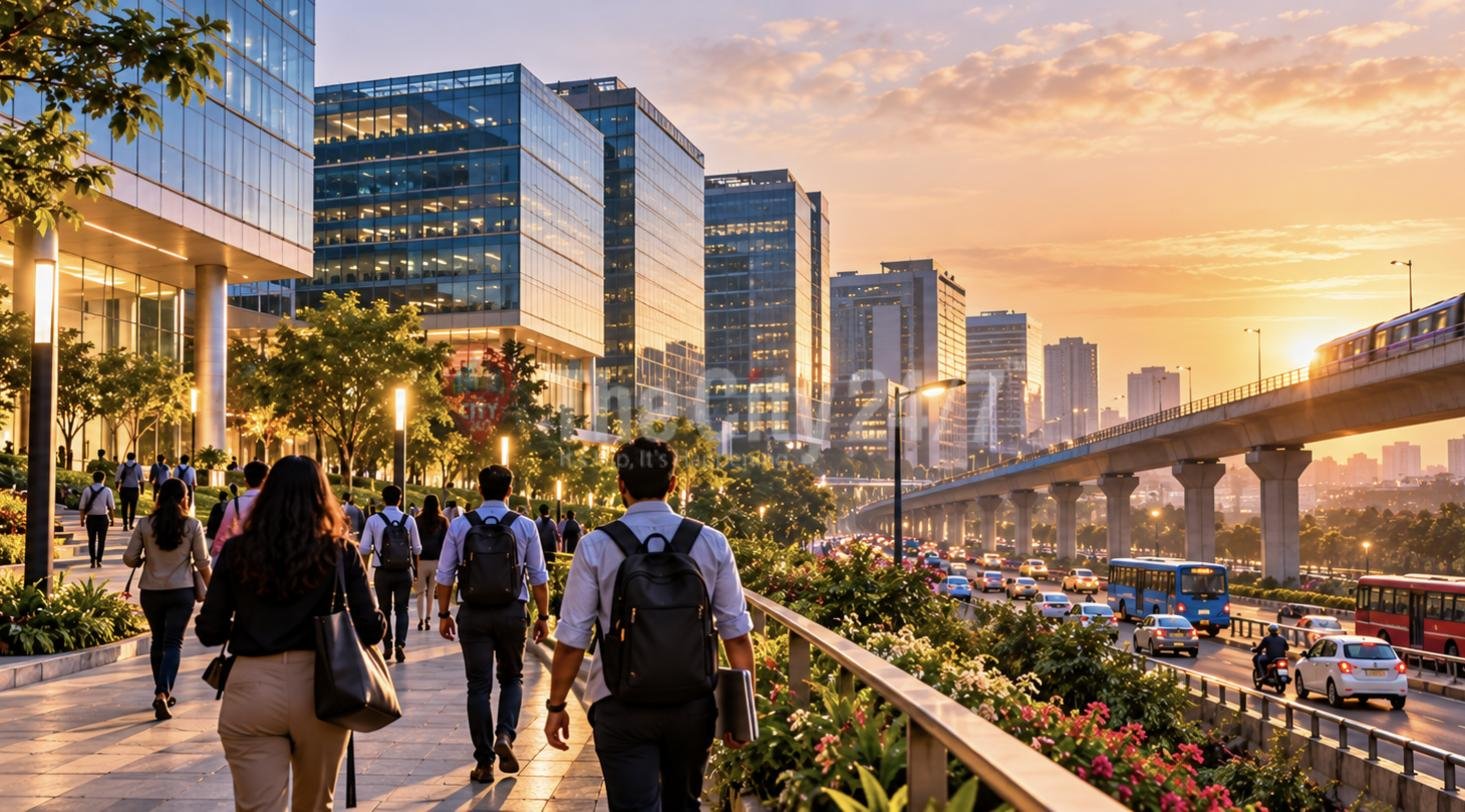
“Calling Bengaluru an IT city is like calling London a banking city. Accurate, and it flattens five distinct industries into one word.”
• On the most misdescribed economy in India
There are at least five technology industries in this city and they behave completely differently. The IT services firms that built the reputation. The global capability centres that now employ the largest share of engineers. The product companies and startups. The deep technology cluster in semiconductors, hardware and AI research. And the aerospace, defence and space sector, which is older than all of them and gets the least attention.
Understanding which of these you are dealing with matters practically. They hire differently, pay differently, sit in different districts, and want completely different things from suppliers, landlords and service providers. A recruiter who understands services firms will misread a product company badly.
In this guide I cover each layer, where they are located, the talent pipeline that feeds all of them, and the pressures on the whole system. Our startup ecosystem guide covers founding a company here and our districts guide covers office geography.
Quick Information
Five industries, one city, one very crowded ring road. Worth knowing which one is on the other end of the call.
How Did Bangalore Become India's Technology Capital?
Through state industrial policy in the 1940s and 1950s, not through software. Hindustan Aircraft, BEL, HMT and ITI built an engineering workforce here decades before the IT industry arrived to use it.
The sequence matters. Princely Mysore made this a technocratic place early, with hydroelectric power in 1905 and the Indian Institute of Science in 1909. Hindustan Aircraft followed in 1940. After independence, the Indian state deliberately located aerospace, electronics, machine tools and telecom manufacturing in Bengaluru, partly for its distance from contested borders and partly because the institutional base already existed.
That created a large, technically educated, salaried middle class and an engineering college system built to feed the factories. When Texas Instruments opened a design centre in 1985 and liberalisation arrived in 1991, the software industry did not create that talent pool. It inherited it. Electronic City and then ITPL in Whitefield gave the new industry somewhere to sit, and within a decade Bangalore became global shorthand for software.
What Are Global Capability Centres and Why Do They Dominate?
A global capability centre is a company's own offshore engineering, product or operations arm, rather than an outsourcing vendor. They are now the largest technology employer group in Bengaluru and the fastest growing.
The distinction from services is important. A services firm sells your project to you. A GCC is you, operating here. The multinational banks, retailers, insurers, carmakers and technology firms that once outsourced now run their own centres in this city, employing thousands each and doing core product engineering, research and analytics rather than support work.
They cluster along the Outer Ring Road, which is why that corridor holds more technology floorplate than most Indian cities hold in total, and why its traffic is what it is. For anyone hiring, this is the single most important fact about the Bengaluru labour market: GCCs compete for the same three to six year engineers as every startup in the city, and they compete with stability, scale and often better cash. Competing against them on salary alone is a losing strategy.
“The city's biggest technology employers are no longer companies that sell software. They are the engineering departments of companies that sell something else entirely.”
• On the GCC shift of the last fifteen years
Where Are Bangalore's Technology Parks and Clusters?
Electronic City in the south, ITPL and EPIP in Whitefield, the ORR belt and Manyata in the north hold most of it, with aerospace growing toward Devanahalli. Here is how the map breaks down.
- Electronic City, south. The original, developed from the late 1970s onward on Hosur Road, and still the largest single concentration of IT services campuses. Yellow Line metro and the elevated expressway both serve it.
- ITPL and EPIP, Whitefield. The 1990s generation of technology park, and the anchor of east Bengaluru's growth. Purple Line metro now runs through, which changed its hiring position materially.
- The ORR belt. Bellandur, Kadubeesanahalli and Marathahalli, holding the large business park clusters where most GCCs sit. Highest concentration, highest rents outside the CBD, worst commute.
- Manyata and the north. Around Hebbal and Thanisandra, the newest major cluster, with easier roads and airport proximity. The strongest case for a new large campus today.
- Devanahalli aerospace corridor. North beyond the airport, for aerospace, hardware and precision manufacturing, with specific incentive zones.
- The startup belt. Koramangala, HSR, Indiranagar and Domlur, in smaller fragmented floorplates and coworking rather than parks.
- Research institutions. IISc in Malleshwaram, IIIT-B in Electronic City, plus NCBS, the Raman Research Institute and CSIR labs, which anchor the deep tech and research layer.
What Is Bangalore's Deep Tech and Hardware Scene Like?
Real, growing and less visible than software. Semiconductor design, hardware, robotics, space and AI research, anchored by the research institutions and the aerospace legacy rather than by venture capital.
This is the layer most coverage misses. Bengaluru has semiconductor design centres operated by the large global chip firms, a hardware and robotics startup community, and a space sector that is genuinely unusual: ISRO is headquartered here, India's lunar and Mars missions were commanded from this city, and a private space industry has grown up around that institutional base.
Aerospace and defence sit alongside it, with HAL building and maintaining military aircraft here since 1940 and a supplier ecosystem around it, extending into the Devanahalli corridor. These businesses run on longer cycles, harder engineering and different funding structures than software, and they are where a meaningful share of the city's most interesting technical work happens.
Where Does the Talent Come From?
From an unusually deep pipeline: the Indian Institute of Science, IIIT-B and the NITs at the top, a very large private engineering college output across Karnataka, and substantial in migration from the rest of India.
The volume is the point. Karnataka produces a very large number of engineering graduates annually, and Bengaluru absorbs both its own output and a continuous inflow from across the country and, increasingly, returning senior talent from abroad. That is what allows a single GCC to hire several thousand engineers in a year without the market seizing up.
The quality distribution is wide, which is the honest caveat, and employers filter heavily. What Bengaluru genuinely offers that other Indian cities do not is depth at the senior end: people who have actually scaled systems, teams and products, in numbers. For a company that needs someone who has done the thing before, this is the only Indian city where you have real choice, and that is the single strongest argument for locating here.
What Pressures Is the Ecosystem Under?
Commute times, the concentration of offices along a single ring road, water supply in the eastern corridors and housing costs. None are existential and all are now material to hiring.
- Commute times. Peak hour journeys at Silk Board, Agara and the ORR are among the worst anywhere, and they show up in declined offers and attrition rather than in any official statistic.
- Office concentration. Putting an enormous share of the city's technology employment along one ring road was efficient for developers and is a structural liability. The Blue Line metro is the main mitigation and is still under construction.
- Water. A city with no river, dependent on Kaveri water pumped uphill and on falling borewells. The eastern corridors run heavily on tankers in summer, which affects campuses as well as homes.
- Housing costs. Rents near the employment corridors have risen faster than infrastructure, which pushes staff further out and lengthens commutes, compounding the first problem.
- Competition from other cities. Hyderabad, Pune, Chennai and the NCR compete actively on cost and infrastructure, and some GCC expansion now goes there. Bengaluru's defence is senior talent depth.
- What is genuinely improving. Metro expansion, the north as an alternative office geography, hybrid work spreading peak load, and a deep tech and space sector growing off a strong institutional base.
Bangalore's IT Ecosystem: Frequently Asked Questions
Why is Bangalore called India's Silicon Valley?
Because the software and technology industry concentrated here from the mid 1980s onward, after Texas Instruments arrived in 1985 and liberalisation in 1991, with Infosys and Wipro scaling from the city. The foundation was the engineering workforce built by public sector industries from the 1940s.
What is a global capability centre?
A multinational's own offshore engineering, product or operations arm, as distinct from an outsourcing vendor. GCCs are now the largest technology employer group in Bengaluru, cluster along the Outer Ring Road, and individually employ thousands of people doing core engineering and research.
Where are Bangalore's main IT parks?
Electronic City in the south, the original and largest services cluster; ITPL and EPIP in Whitefield; the business park clusters along the Outer Ring Road at Bellandur and Kadubeesanahalli; and Manyata and the northern cluster around Hebbal and Thanisandra.
Which companies are the biggest tech employers in Bangalore?
The large Indian IT services firms including Infosys and Wipro, alongside the global capability centres of multinational technology, banking, retail and automotive companies, several of which employ over ten thousand people in the city each.
Does Bangalore have a hardware and deep tech industry?
Yes, and it is less visible than software. Semiconductor design centres, hardware and robotics startups, AI research linked to the Indian Institute of Science and IIIT-B, and a space sector anchored by ISRO's headquarters, from which India's lunar and Mars missions were commanded.
What is Bangalore's connection to aerospace and space?
Hindustan Aircraft was founded here in 1940 and HAL still builds and maintains military aircraft in the city, with a supplier ecosystem extending to the Devanahalli aerospace corridor. ISRO is headquartered here, and a private space industry has grown around that base.
Where does Bangalore's tech talent come from?
The Indian Institute of Science, IIIT-B and the NITs at the top end, a very large private engineering college output across Karnataka, continuous in migration from across India, and increasingly senior talent returning from abroad. Depth at the senior end is the city's real advantage.
Is Bangalore losing tech jobs to other Indian cities?
Hyderabad, Pune, Chennai and the NCR compete actively on cost and infrastructure and some expansion does go to them. Bengaluru's defence is the depth of its senior talent pool, which remains the deepest in India and is the hardest thing for another city to replicate quickly.
What are the biggest problems facing Bangalore's tech industry?
Peak hour commute times, especially at Silk Board, Agara and along the ORR; the concentration of office space on a single ring road; water supply in the eastern corridors, which run on tankers in summer; and housing costs near employment centres rising faster than infrastructure.
What are STPI and SEZ registrations?
Software Technology Parks of India registration and Special Economic Zone status are compliance and tax frameworks that shape where technology firms locate and how they are taxed. They differ meaningfully, so confirm a building's status with your CA before committing to space.
Useful Links
Institutions, registrations and state bodies across the technology sector.
Working in Bengaluru's Technology Sector?
This sector changes faster than any guide can track, and the people who correct me most usefully are the ones inside it. If something here is out of date, or your corner of the industry works differently from how I have described it, click the WhatsApp icon at the bottom right of your screen and tell me. That is also the fastest way to reach The City 24/7 about anything at all.
If you run a technology business or service firm here, list it on our directory so clients and candidates can find you. And if you want the city explained one useful thing at a time, join our ever growing community at thecity247.com/newsletter. One weekly email, free.
Same city, new stories, always.

Related Stories
 BUSINESS
Why Bangalore Is India's Startup Capital, and What Could Change That
July 1, 2026
 BUSINESS
Bangalore's Business Districts Explained: Who Is Where, and What It Costs
July 31, 2026
 BUSINESS
Bangalore's Most Successful Homegrown Businesses, and What They Teach
July 29, 2026
 BUSINESS
Bangalore's Startup Ecosystem: A Complete Guide to Plugging Into It
July 28, 2026
 BUSINESS
The Best Cafes for Working in Bangalore, and When to Stop Using Them
July 25, 2026
 BUSINESS
Jobs in Bangalore: Who Is Hiring, Where They Are, and How to Get In
July 21, 2026
