


“In most cities you pick an office by rent. In Bengaluru you pick it by whose commute you are prepared to ruin, because that is what decides whether people accept your offer.”
• On the only real constraint here
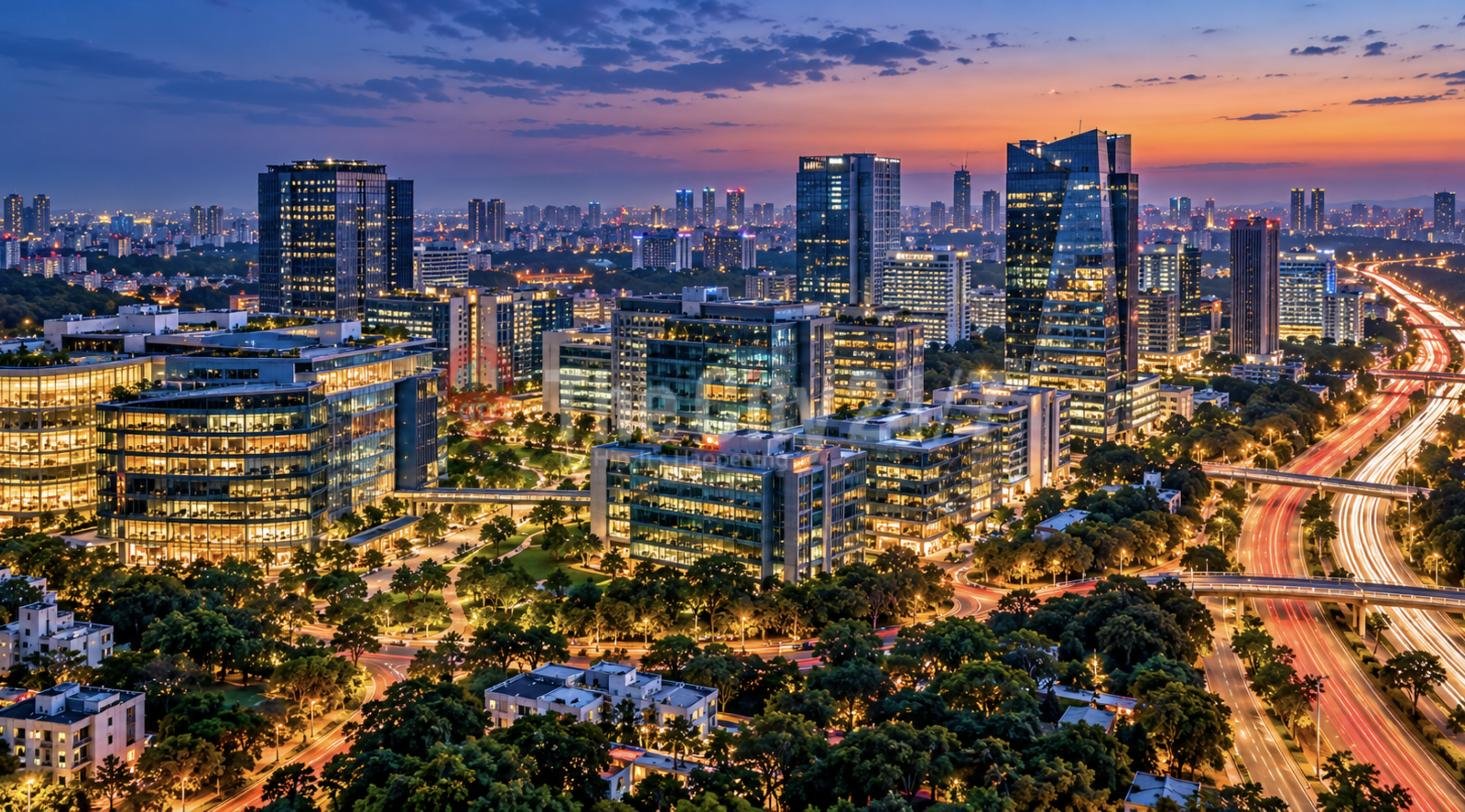
Bengaluru does not have a single business district. It has six, spread across a city roughly forty kilometres wide, and they are not interchangeable. The central business district is the old commercial and administrative core. The Outer Ring Road belt holds the largest concentration of technology floorplate in India. Whitefield is the east's campus district. Electronic City was the first purpose built technology park. Koramangala and HSR are where startups sit. And the north, around Hebbal and the airport corridor, is the newest and least crowded.
The difference between them is not just rent. It is who you can hire, how long your staff will spend commuting, whether clients will visit you, and whether you will still be able to expand in three years. Getting this wrong is expensive in a way that is easy to miss, because the cost shows up in attrition and declined offers rather than on the lease.
This guide covers each district with its rent range, tenant profile, transport position and honest trade offs, then a framework for choosing. It sits under our guide to doing business in Bangalore and pairs with our coworking guide for smaller teams.
Quick Information
Six districts, with the numbers a landlord will eventually quote you. Rents are indicative and move with the market.
What Is Bangalore's Central Business District?
The area around MG Road, Richmond Road, Residency Road, Vittal Mallya Road and Lavelle Road. It is the oldest commercial core, the most expensive, and the only district where clients can walk between you, a hotel and lunch.
Rents here run roughly a hundred and twenty to two hundred and fifty rupees per square foot per month for grade A space, which is the top of the Bengaluru market. What you get for that is location rather than floorplate: buildings are older and smaller, expansion room is limited, and parking is genuinely difficult.
The case for it is specific and strong. Consulates, government offices, banks, law firms, the High Court and most of the city's better hotels are here. Metro access on both the Purple and Green lines is excellent. If your business is client facing, professional services, legal, financial, government facing or requires people to visit you and be impressed, the CBD is worth its premium and nowhere else in the city substitutes for it.
What Is the Outer Ring Road Business Belt?
The stretch from Marathahalli through Kadubeesanahalli and Bellandur down toward Sarjapur, plus the northern arc at Nagawara. It holds the largest concentration of technology office space in India, and the worst traffic.
This is where the global capability centres are: the engineering and operations arms of multinational technology, banking and consulting firms, many of them employing thousands of people in a single campus. Rents run roughly seventy five to a hundred and forty rupees per square foot per month, and the buildings are large, modern and well serviced.
The problem is well documented and unresolved. The ORR is a single artery serving an enormous amount of office space, feeding into junctions at Silk Board, Agara and Iblur that are among the most congested in India, and eight kilometres at peak hour can take forty five to sixty minutes. The Blue Line metro along the ORR is under construction and will materially change this, but not on a timeline you should assume when signing a lease now. If you take space here, your staff will either live in HSR, Sarjapur Road, Bellandur or Whitefield, or they will leave.
“The ORR is simultaneously the best address in Indian technology and the worst commute in Indian technology. Both facts are load bearing.”
• Any founder who has run an office there
Which District Suits a Large Campus or Back Office?
Whitefield or Electronic City. Both have the floorplates, the expansion room and the lower rents that large headcount operations need, and both now have metro connections.
- Whitefield: ITPL, EPIP, Brookefield, Hoodi. Roughly fifty five to a hundred rupees per square foot a month, with large campuses, strong social infrastructure and the Purple Line running through. The metro extension changed the hiring case out here substantially.
- Electronic City: Phase 1 and 2. The original technology park and still the cheapest major district, at roughly forty five to eighty rupees per square foot a month. The Yellow Line and the elevated expressway on Hosur Road both help. Best for scale operations where cost per seat matters.
- North: Manyata, Hebbal, Thanisandra. Roughly sixty to a hundred and ten rupees, with newer buildings, easier roads and the airport corridor. The least crowded of the major districts and the strongest case for a new large office today.
- Devanahalli and the aerospace corridor. Beyond the airport, with aerospace, hardware and manufacturing clusters and specific incentive zones. Only for businesses that genuinely need to be there.
- Peenya and the western industrial belt. Bengaluru's older industrial and manufacturing area, for light engineering, warehousing and workshops rather than offices.
- SEZ and STPI status. Several parks in Whitefield, Electronic City and the ORR belt sit inside special zones with specific tax and compliance implications. Worth checking before you choose a building, not after.
Where Should a Startup Take Office Space?
Koramangala or HSR Layout for anything under about thirty people, and increasingly Indiranagar and Domlur. These are where the talent, the investors and the coworking supply are densest.
Rents run roughly eighty to a hundred and fifty rupees per square foot per month, but most early stage companies do not take conventional space here at all. They take coworking desks at roughly six thousand to eighteen thousand rupees a desk a month, or a managed office, which avoids a six to twelve month deposit, a three year lease and a fit out bill.
The argument for this belt is not rent, it is density. The investors are here, the operators you want to hire are here, the cafes function as meeting rooms, and a candidate can interview with you at lunch without taking a half day. Against that, neither Koramangala nor HSR has a metro station inside it, floorplates are small and fragmented, and growing past fifty people usually means moving. Plan for that move rather than being surprised by it.
How Do I Choose a Business District in Bangalore?
Map where your existing and target staff live, then pick the district that minimises their commute. That map should outrank rent, building quality and everything else on the shortlist.
- Start with a staff postcode map. Plot where your team actually lives. In a city this wide, an office that adds forty minutes each way to half your staff will cost you people, and it will cost you the ones with options first.
- Check the metro position, not just today's. Purple, Green and Yellow lines are running and the ORR Blue Line is under construction. Proximity to a station is now a real hiring advantage and will be a bigger one.
- Test the commute yourself, twice. 9.15 AM and 6.30 PM on a weekday, on the actual route. Map estimates for Bengaluru are optimistic in a way that matters.
- Decide whether clients visit. If they do, the CBD is worth the premium. If they never do, paying CBD rents for an engineering team is money spent on nothing.
- Model your three year headcount. Fragmented small floorplates in the startup belt do not scale. If you expect to triple, either take expandable space or accept a move.
- Compare total cost per seat, not rent. Rent plus maintenance plus fit out amortised plus parking plus transport allowances. Coworking frequently wins under thirty people even at a higher headline rate.
- Check zone status and compliance. SEZ, STPI and standard commercial buildings carry different tax and reporting implications. Confirm with your CA before you commit to a building.
- Ask about power, water and backup. Full generator backup is standard in grade A buildings and variable elsewhere, and water supply in the eastern districts depends on tankers. Both affect operations.
What Does Office Space Actually Cost in Bangalore?
Between roughly forty five and two hundred and fifty rupees per square foot per month depending on district and grade, plus maintenance, plus a six to twelve month deposit and a fit out at eighteen hundred to four thousand rupees per square foot.
The headline rent is the smallest part of the decision. Conventional leases here typically run three to nine years with escalation every three years, a lock in period, and a deposit that ties up a substantial amount of working capital. The fit out is yours to pay for and yours to leave behind. For a company under thirty people, the arithmetic almost always favours coworking or a managed office, which converts all of that into a single monthly per desk cost.
Where conventional space wins is scale and control: above roughly fifty people, per seat costs fall, and you get to build the office you want. Negotiate the escalation clause and the lock in as hard as the rent, because over a six year term those two clauses are worth more than a few rupees per square foot. And get a commercial property lawyer to read the lease. That is genuinely the highest return spend in the whole exercise.
Bangalore's Business Districts: Frequently Asked Questions
What is Bangalore's main business district?
The central business district around MG Road, Richmond Road, Residency Road, Vittal Mallya Road and Lavelle Road is the traditional core and the most expensive, at roughly Rs 120 to 250 per square foot a month. The Outer Ring Road belt holds far more technology office space but is not a walkable district.
Which area has the most offices in Bangalore?
The Outer Ring Road belt, running from Marathahalli through Kadubeesanahalli and Bellandur, which holds the largest concentration of technology office space in India, including most of the global capability centres. It also has the city's worst peak hour traffic.
How much does office space cost in Bangalore?
Roughly Rs 45 to 80 per square foot a month in Electronic City, Rs 55 to 100 in Whitefield, Rs 60 to 110 in the north, Rs 75 to 140 on the ORR, Rs 80 to 150 in the startup belt and Rs 120 to 250 in the CBD, plus maintenance, a six to twelve month deposit and fit out at Rs 1800 to 4000 per square foot.
Where should a startup set up office in Bangalore?
Koramangala or HSR Layout for teams under about thirty people, for talent density, investor proximity and coworking supply at roughly Rs 6000 to 18000 a desk a month. Indiranagar and Domlur are increasingly used for the same reasons. Expect to move once you pass fifty people.
Is Whitefield or Electronic City better for a large office?
Both work for scale. Whitefield is slightly more expensive at Rs 55 to 100 per square foot with better social infrastructure and Purple Line metro access. Electronic City is the cheapest major district at Rs 45 to 80 with Yellow Line access and the Hosur Road elevated expressway.
How do I choose where to locate an office in Bangalore?
Map where your existing and target staff live and pick the district that minimises their commute, because in a city forty kilometres wide an office that adds forty minutes each way will cost you people. Then test the commute yourself at 9.15 AM and 6.30 PM before signing.
Does the metro matter when choosing an office in Bangalore?
Increasingly yes. The Purple, Green and Yellow lines are operating and the Blue Line along the Outer Ring Road is under construction. Proximity to a station is now a genuine hiring advantage, and the ORR line will materially change that district when it opens.
What is a typical office lease term in Bangalore?
Three to nine years for conventional space, with rent escalation every three years, a lock in period and a security deposit commonly equal to six to twelve months of rent. Negotiate the escalation and lock in as hard as the rent, and have a commercial property lawyer read the lease.
Is coworking cheaper than an office in Bangalore?
For teams under about thirty people, usually yes in total cost, because it avoids a large deposit, a multi year lease and a fit out bill of Rs 1800 to 4000 per square foot. Above roughly fifty people, conventional space typically wins on cost per seat.
What is a global capability centre and why does Bangalore have so many?
A captive offshore centre running engineering, operations or analytics for a multinational parent rather than an outsourcing vendor. Bengaluru holds the largest concentration in India because of its engineering talent pipeline, built up over decades from the public sector industries and the city's colleges.
Useful Links
Registration, incentives and the agencies you will deal with when taking space.
Taking Space in Bengaluru?
Office rents and district conditions move faster than any guide can track, and the sharpest numbers I get are from founders and operations heads who have just signed something. If a figure here is off, or your district has changed, click the WhatsApp icon at the bottom right of your screen and tell me. That is also the fastest way to reach The City 24/7 about anything at all.
If you run a business in Bengaluru, list it on our directory so the people looking for what you do can find you. And if you want the city explained one useful thing at a time, join our ever growing community. One weekly email, free.
Same city, new stories, always.

Related Stories
 BUSINESS
Bangalore's IT and Technology Ecosystem: How It Works and Why It Is Here
July 30, 2026
 BUSINESS
How Much Does It Cost to Run a Business in Bangalore? Three Worked Budgets
July 27, 2026
 BUSINESS
Accountants, Recruiters, Consultants and Printers in Bangalore: What to Pay and How to Choose
July 31, 2026
 BUSINESS
Bangalore's Startup Ecosystem: A Complete Guide to Plugging Into It
July 28, 2026
 BUSINESS
Business Networking in Bangalore: Which Rooms Are Worth Your Time
July 27, 2026
 BUSINESS
How to Register a Business in Bangalore: Every Step, Cost and Licence
July 27, 2026
