


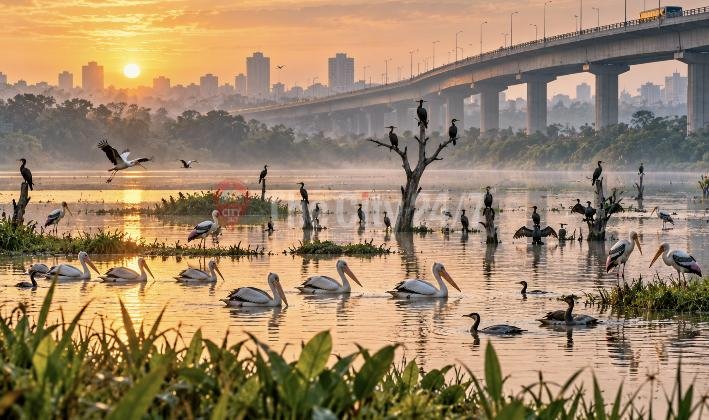
“There is a lake at the foot of the Hebbal flyover with pelicans on it. The contrast tells you almost everything about how this city has developed.”
• On Hebbal Lake
Hebbal Lake is open roughly 6 AM to 6 PM with a nominal entry fee, in north Bengaluru beside the Hebbal flyover on the airport road. It is one of the city's older tanks, traced to the Kempe Gowda period, with a walking track and genuinely good birdlife. Go between 6.30 and 8 AM.
It was one of the three large tanks built to serve the growing settlement, alongside Ulsoor and Sankey, and it sits on the Hebbal valley drainage that runs north. What it has now is an awkward but functional arrangement: a fenced and maintained lake with a walking path, immediately adjacent to one of the busiest interchanges in the city.
The birdlife is the reason to go, and it is better than the setting suggests. Pelicans, cormorants, egrets, herons and a range of waterfowl use the lake, and on a still morning before the traffic builds you can forget where you are. This guide covers timings, what you will see and the honest condition of the place.
Quick Information
A historic tank at the foot of a flyover. The morning hour is everything here.
What Are Hebbal Lake Timings and the Entry Fee?
Open roughly 6 AM to 6 PM with a nominal entry fee, typically somewhere between Rs 10 and Rs 30. Arrangements at the lake have changed over the years with successive rounds of development and restoration, so treat this as the working position.
- 6.30 to 8 AM. The window that matters. Birds are active, the water is still, and the flyover traffic has not yet reached full volume.
- Mid-morning onwards. Hot, and the traffic noise becomes the dominant feature. Not much reason to be here.
- Evening. Pleasant enough, with birds coming in to roost, though the peak-hour traffic is at its worst.
- Entry. Nominal. Carry small change.
- Time needed. Forty-five minutes to an hour for the perimeter and some patient watching.
Hebbal Lake has one good hour a day. Between 6.30 and 8 AM it is a genuinely lovely place with pelicans on the water. Outside that window the flyover wins, and there is no point pretending otherwise.
What Birds Can You See at Hebbal Lake?
Spot-billed pelicans, cormorants, egrets, herons, spot-billed ducks, coots, purple moorhens and kingfishers, with migrant waterfowl arriving through the winter. It is one of the better birding lakes in north Bengaluru, and the counts are higher than the setting would lead you to expect.
- Pelicans. Spot-billed pelicans use the lake and are the headline sighting. Large, unmistakable and improbable against the flyover backdrop.
- Regulars. Little and great cormorants, little egrets, purple and grey herons, spot-billed ducks, coots and purple moorhens.
- Kingfishers. White-throated, pied and common kingfishers along the edges.
- Winter migrants. October to February brings additional waterfowl and the highest species counts of the year.
- In the trees. Barbets, parakeets, mynas and the occasional raptor overhead on the planted stretches.
- Compared with Madiwala. Madiwala in BTM Layout is the better birding lake overall, with bamboo nesting islands. Hebbal is the equivalent for the north of the city.
“Pelicans at the foot of the Hebbal flyover at half past six in the morning. It should not work and it does.”
• On the improbability of it
What Is the Actual Condition of Hebbal Lake?
Mixed, and honestly reported it has been poor at times. Hebbal Lake sits in a valley that receives substantial urban runoff and has suffered from sewage inflow, froth and weed growth, and it has been through repeated rounds of restoration work involving BBMP and other agencies.
- The problems. Untreated sewage inflow, froth, weed growth and periodic fish deaths. These have been documented over many years.
- The restoration. Desilting, fencing, wetland creation and sewage diversion have been attempted in phases, with varying persistence of results.
- The Hebbal valley. This lake sits in one of the city's three main drainage valleys, which means whatever happens upstream ends up here.
- What it means for a visit. The walking path and the birdwatching are genuinely good in the morning. Do not enter the water, and expect odour on a bad week.
- The wider point. Hebbal, like Bellandur and Varthur, shows what happens when a lake is at the receiving end of a drainage valley in a city that has not solved its sewage problem.
- Why go anyway. Because a lake with problems and pelicans is better than a lake that has been built over, and there are many of those.
How Do You Get to Hebbal Lake?
It is beside the Hebbal flyover on the airport road in north Bengaluru. The Blue Line metro corridor towards the airport serves this area, and BMTC coverage along the airport road and to Hebbal is extensive. Driving is possible, with the caveat that the Hebbal junction is one of the city's worst.
- Metro. The Blue Line airport corridor serves this part of the city. Check the current station list, since the northern network has been expanding.
- Bus. Very good BMTC coverage along the airport road and to Hebbal, including Vayu Vajra airport services passing nearby.
- Car. Parking available, but the Hebbal junction and flyover approaches are among the most congested in the city. Arrive before 7 AM.
- From the airport. Hebbal is on the route into the city, which makes the lake a possible stop if you have an early arrival and time to spare.
- Combine with. Jakkur Lake further north, Sankey Tank and Malleshwaram to the west, and the Manyata Tech Park area.
Which Other Lakes Are Worth Visiting in North Bangalore?
Jakkur Lake is the other significant one nearby, with an active citizen group and a constructed wetland that has made it one of the better restoration stories in the city. Hesaraghatta further west is grassland rather than a functioning lake, and is excellent for birding.
- Jakkur Lake. North of Hebbal, with a sewage treatment plant and constructed wetland feeding it, and an active citizen group. One of the better-managed large lakes in the city.
- Hesaraghatta. North-west, and effectively grassland now rather than a full reservoir. Superb for open-country birding and very quiet.
- Rachenahalli and Nagavara. Both in the northern belt, both with walking paths, both worth a morning if you live nearby.
- Sankey Tank. West, in Malleshwaram, and the best-maintained lake in the city. A twenty-minute drive.
- The pattern. North Bengaluru has more surviving lakes than the centre, largely because development arrived later. Several have active citizen groups.
Is Hebbal Lake Worth Visiting?
Yes, if you live in north Bengaluru and you go at half past six in the morning. It is not a destination worth crossing the city for when Sankey Tank, Madiwala and Lalbagh exist, but as a local morning walk with genuinely good birdlife it earns its place.
- Go if. You live in Hebbal, Yelahanka, Sanjaynagar, Jakkur or along the airport road. Or you birdwatch and want the northern species list.
- Do not cross the city for it. Sankey Tank is better maintained, Madiwala has better birding, and Lalbagh is a different order of place.
- Best with. Binoculars, and patience at the quieter stretches of the perimeter.
- Manage expectations. This is an urban lake with real problems next to a major flyover. Within that, it is good.
- If it disappoints. Try Jakkur, which is the better managed lake in the same part of the city.
FAQs
What are Hebbal Lake timings?
Roughly 6 AM to 6 PM with a nominal entry fee of about Rs 10 to 30. The window that matters is 6.30 to 8 AM, when the birds are active, the water is still and the flyover traffic has not reached full volume.
Is Hebbal Lake good for birdwatching?
Yes, better than the setting suggests. Spot-billed pelicans, cormorants, egrets, herons, spot-billed ducks, coots, purple moorhens and kingfishers are all regular, and October to February brings winter migrants and the highest species counts.
Is Hebbal Lake clean?
Not consistently. It sits at the receiving end of one of the city's main drainage valleys and has suffered from sewage inflow, froth and weed growth over many years, with repeated rounds of restoration. The walking path and birdwatching are good in the morning, but do not enter the water.
Is there boating at Hebbal Lake?
Boating has operated at times but arrangements have changed with successive rounds of development and restoration. Check the current status locally rather than travelling across the city specifically for it.
How do I get to Hebbal Lake?
It is beside the Hebbal flyover on the airport road in north Bengaluru. The Blue Line metro corridor towards the airport serves this area, and BMTC coverage is extensive. If driving, arrive before 7 AM, because the Hebbal junction is among the most congested in the city.
Is Hebbal Lake worth visiting?
Yes if you live in north Bengaluru and go early. It is a good local morning walk with genuinely good birdlife. It is not worth crossing the city for when Sankey Tank, Madiwala Lake and Lalbagh are all better options.
How old is Hebbal Lake?
It is one of Bengaluru's older tanks, traced to the Kempe Gowda period, and was one of the large tanks serving the growing settlement alongside Ulsoor and Sankey. The city had no river, so its water came from a cascade of man-made tanks like this one.
Which other lakes are near Hebbal?
Jakkur Lake to the north, which has a constructed wetland and an active citizen group and is one of the better-managed large lakes in the city, plus Rachenahalli and Nagavara nearby. Hesaraghatta further west is now effectively grassland and is superb for open-country birding.
Contact Details
Civic contacts, which matter more than tourism ones for a lake in this condition.
How Is the Lake This Month?
Hebbal changes with the season and with whatever restoration work is underway. If the water is better or worse than this guide suggests, or if the boating and timings have changed, click the WhatsApp icon at the bottom right of your screen and tell me. That is also the easiest way to reach The City 24/7 about anything at all.
And if you want city guides, weekend plans and neighbourhood notes landing in your inbox, join our ever growing community at thecity247.kit.com/join-the-community. Free, and about ten seconds of your life.
Same city, new stories, always.

Related Stories
 CITY GUIDE
Madiwala Lake: The Best Birdwatching in Bangalore Is in BTM Layout
September 3, 2026
 CITY GUIDE
Ulsoor Lake: Timings, Boating and the Honest State of Bangalore's Oldest City Lake
August 30, 2026
 CITY GUIDE
Agara Lake: HSR Layout's Morning Walk, and One of the City's Better Restorations
September 9, 2026
 CITY GUIDE
Puttenahalli Lake: How a JP Nagar Residents' Group Brought a Dead Lake Back
September 3, 2026
 CITY GUIDE
Aquarium Paradise, Palace Road: India's Longest Underwater Tunnel Is in Bengaluru
September 24, 2026
 CITY GUIDE
Dodda Ganapathi, Basavanagudi: The 18 Foot Ganesha They Cover in Butter
September 24, 2026
