


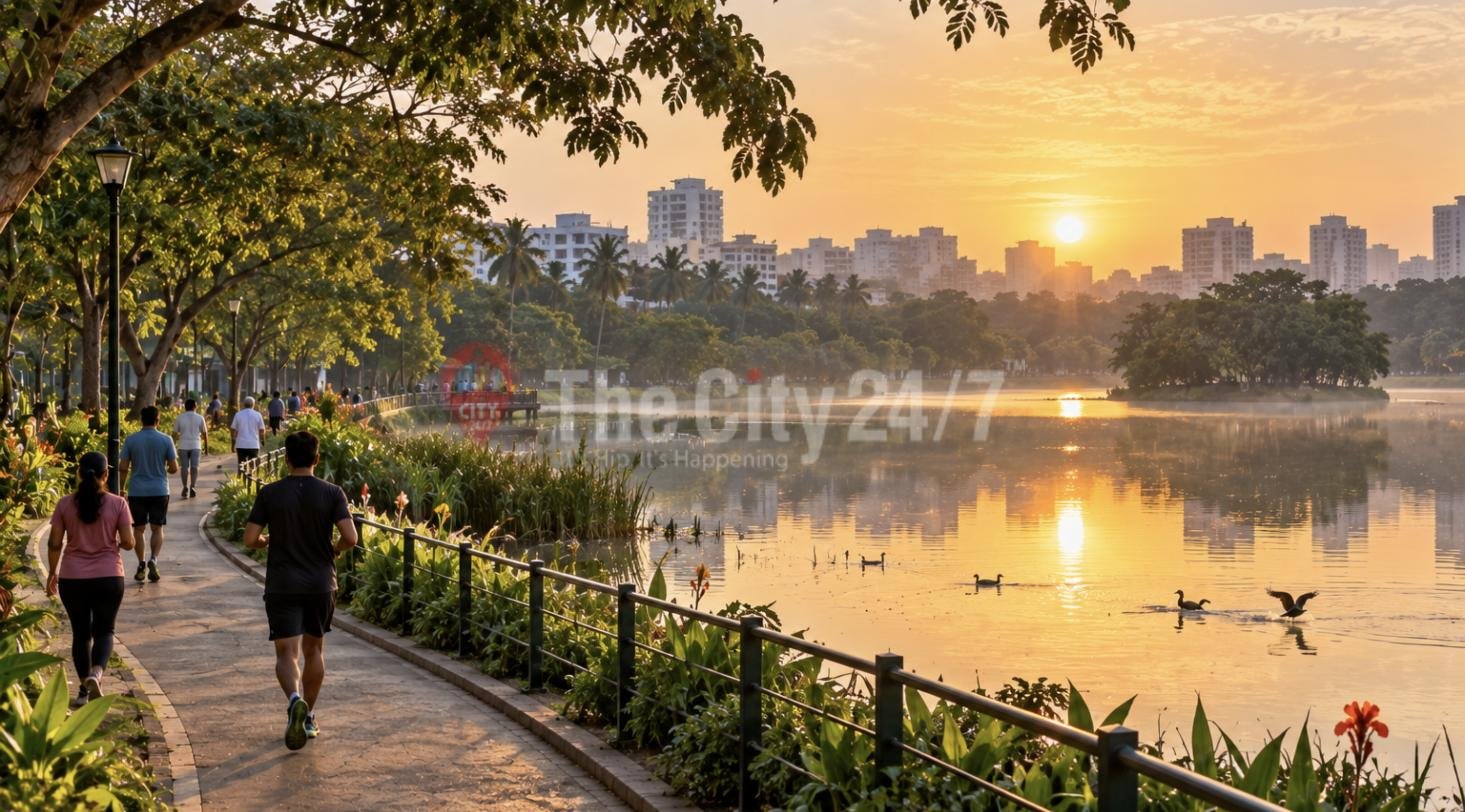
“The lakes that survived in this city are almost all the ones with a residents' group behind them. Agara is on that list, which is why you can walk around it.”
• The pattern in Bengaluru's lakes
Agara Lake is free to enter and commonly listed as open 5.30 to 11 AM and 4 to 6.30 PM from Monday to Saturday, and until 6.30 PM on Sundays, between HSR Layout and Sarjapur Road in south-east Bengaluru. It covers around eighty acres, has a paved walking and jogging track, and holds genuinely good birdlife. The best time is 6 to 8 AM, and it forms a cluster with Kaikondrahalli and Kasavanahalli lakes nearby.
It is one of the old tanks in the city's south-eastern chain, and like most of them it went through a difficult period of encroachment, sewage inflow and neglect before restoration work and sustained citizen pressure improved it. What exists now is a fenced, planted lake with a track that a very large number of people in HSR Layout use every morning.
The reason it deserves its own guide rather than a line in a list is that this part of the city has almost no other public open space. HSR Layout, Sarjapur Road and Bellandur are among the fastest-developed areas in Bengaluru, and Agara plus Kaikondrahalli are effectively the entire green provision for several hundred thousand people.
Quick Information
An eighty-acre lake serving one of the most densely developed corners of the city. Here is the practical detail.
What Are Agara Lake Timings and Is Entry Free?
Entry is free, and the lake is commonly listed as open 5.30 to 11 AM and 4 to 6.30 PM from Monday to Saturday, and 5.30 AM to 6.30 PM on Sundays, so do not plan a midday weekday visit. It functions primarily as a neighbourhood walking and running lake, so the early morning and early evening are when it is busiest and at its best.
- 6 to 8 AM. The best window. Cool, active with walkers and runners, and the birds are out on the water.
- 5 to 6.30 PM. Busy and social, with families and the after-work crowd.
- Midday. Hot and exposed in stretches. Little reason to be here.
- Free. No ticket. Which, for a well-maintained eighty-acre lake, is worth appreciating.
- Time needed. Forty-five minutes to an hour for a loop or two of the perimeter.
Agara, Kaikondrahalli and Kasavanahalli are within a few kilometres of each other and together they are essentially the entire public open space for HSR Layout, Sarjapur Road and the surrounding corridor. That is a lot of people per acre of lake, and it is why the citizen groups around them matter.
What Is the Agara Lake Walking Track Like?
A paved perimeter path around an eighty-acre lake, with benches, planting and views across the water. It is used seriously by a large regular community of walkers and runners, and it is the main thing the lake offers.
- The loop. A full circuit of the perimeter, which makes a substantial walk. Two loops is a proper morning.
- Surface. Paved for most of the route, with benches at intervals. Manageable with a stroller.
- Running. Works well before 7 AM. Busy at peak walking hours.
- Shade. Partial. The planting has matured in places and is thin in others, so the exposed stretches are warm by mid-morning.
- The view. Across the water, with the development of Sarjapur Road and HSR Layout on the horizon. An honest picture of this part of the city.
- The community. Regulars, walking groups and a strong sense of local ownership. This is a neighbourhood asset and it is treated as one.
“Two loops of Agara before seven in the morning is the best thing available to anyone living in HSR Layout, and it is free.”
• On what the lake is actually for
What Birds Can You See at Agara Lake?
Egrets, herons, cormorants, spot-billed ducks, coots, purple moorhens and kingfishers reliably, with pelicans appearing at times and additional waterfowl through the winter. It is not the equal of Madiwala, but it is genuinely productive for a lake this hemmed in by development.
- On the water. Little and great cormorants, little egrets, purple and grey herons, spot-billed ducks, coots and purple moorhens.
- Pelicans. Spot-billed pelicans appear at times, particularly in the winter months.
- Kingfishers. White-throated, pied and common kingfishers along the edges.
- Winter. October to February brings migrants and the highest counts of the year.
- In the planting. Barbets, prinias, warblers, mynas and parakeets on the vegetated stretches.
- Best approach. Walk the quieter stretch away from the main gate, stand still, and wait. Bring binoculars if you have them.
How Was Agara Lake Restored?
Through a combination of BBMP rehabilitation work and sustained pressure from local residents and citizen groups, after a period in which the lake suffered from encroachment, sewage inflow, dumping and neglect. The pattern is the one seen across this part of the city: the lakes that recovered are the ones with organised residents behind them.
- The problems. Encroachment at the edges, sewage and construction runoff, dumping and weed growth. Standard for this belt through the 2000s.
- The response. Desilting, fencing, bund work, planting and sewage diversion, driven partly by citizen litigation and campaigning.
- Citizen groups. Local residents and organised groups have been central, monitoring the lake, raising issues and keeping pressure on the agencies.
- Kaikondrahalli as the model. Nearby Kaikondrahalli is one of the best-known lake restoration successes in the city, run with substantial community involvement.
- What remains. Inflow quality and encroachment pressure are ongoing issues across this belt. Restoration here is maintenance, not a finished job.
- Puttenahalli. The other well-documented community restoration in south Bengaluru, in JP Nagar, and the template a lot of these groups follow.
How Does Agara Compare With Kaikondrahalli and Kasavanahalli?
Kaikondrahalli is the better-known restoration and arguably the better habitat, Agara is the bigger walking lake, and Kasavanahalli is the quietest. All three are within a few kilometres and anyone in this part of the city should know all of them.
- Agara. Around eighty acres, the largest of the three, with the best walking and running track. The default morning lake for HSR Layout.
- Kaikondrahalli. On Sarjapur Road, and one of the city's flagship community restorations, with strong habitat management and an active trust. Excellent for birds and amphibians.
- Kasavanahalli. Smaller and quieter, also community-managed, and a good walk if you want fewer people.
- Do all three. They are close enough to visit in one morning, and seeing them together tells you a great deal about how lake restoration works in this city.
- Compared with Madiwala. Madiwala in BTM Layout is the serious birding lake in south Bengaluru, with bamboo nesting islands. These three are better for walking.
How Do You Get to Agara Lake?
It sits between HSR Layout and Sarjapur Road, and for most visitors it is a local trip by auto, cab or on foot. BMTC coverage in HSR Layout and along Sarjapur Road is good, and the southern and eastern metro corridors serve this general belt.
- Local. Most people who use Agara walk or ride ten minutes from HSR Layout, Sarjapur Road or the Bellandur side.
- Bus. Good BMTC coverage to HSR Layout, Agara and Sarjapur Road.
- Metro. The southern and eastern corridors serve this part of the city. Check the current station list, since the network here has been expanding.
- Car. Street parking near the entrance. The Silk Board and Agara junctions are the difficulty, not the parking.
- Timing your arrival. Before 7 AM if you are coming from elsewhere in the city, because the Silk Board junction is one of the worst in India after that.
- Combine with. Kaikondrahalli and Kasavanahalli lakes, and HSR Layout for breakfast afterwards.
FAQs
What are Agara Lake timings?
Commonly listed as 5.30 to 11 AM and 4 to 6.30 PM from Monday to Saturday, and 5.30 AM to 6.30 PM on Sundays, with free entry. The best windows are 6 to 8 AM for a quiet walk and active birdlife, and 5 to 6.30 PM for the busier, more social evening.
Is there an entry fee for Agara Lake?
No, entry is free. For a well-maintained eighty-acre lake with a paved walking track in one of the most densely developed parts of Bengaluru, that is worth appreciating.
How big is Agara Lake?
Around eighty acres, which makes it the largest of the cluster of lakes serving HSR Layout and Sarjapur Road, ahead of nearby Kaikondrahalli and Kasavanahalli.
Is Agara Lake good for walking and running?
Yes, and it is the main reason people go. The paved perimeter path makes a substantial loop, with benches at intervals, and it is used seriously by a large community of regular walkers and runners. Go before 7 AM if you want to run without weaving.
Can you see birds at Agara Lake?
Yes. Egrets, herons, cormorants, spot-billed ducks, coots, purple moorhens and kingfishers are reliable, spot-billed pelicans appear at times, and October to February brings migrants and the highest counts. Walk the quieter stretch away from the main gate.
How was Agara Lake restored?
Through BBMP rehabilitation work combined with sustained pressure from local residents and citizen groups, after a period of encroachment, sewage inflow, dumping and neglect. Inflow quality and encroachment pressure remain ongoing issues across this belt.
Is Agara or Kaikondrahalli Lake better?
Agara is larger with the better walking and running track. Kaikondrahalli on Sarjapur Road is one of the city's flagship community restorations with stronger habitat management, and is better for birds and amphibians. They are a few kilometres apart, so do both.
How do I get to Agara Lake?
It sits between HSR Layout and Sarjapur Road, and most visitors arrive locally on foot or by auto. BMTC coverage is good and the southern and eastern metro corridors serve this belt. If coming from elsewhere in the city, arrive before 7 AM to avoid the Silk Board junction.
Contact Details
Civic contacts, and the citizen groups that are genuinely the most useful point of contact for lakes in this belt.
Do You Walk at Agara?
If you are part of a lake group in this belt, or you know how the condition and facilities at Agara have changed, click the WhatsApp icon at the bottom right of your screen and tell me. The lakes in this corner of the city deserve proper coverage. That is also the easiest way to reach The City 24/7 about anything at all.
And if you want city guides, weekend plans and neighbourhood notes landing in your inbox, join our ever growing community at thecity247.kit.com/join-the-community. Free, and about ten seconds of your life.
Same city, new stories, always.

Related Stories
 CITY GUIDE
Madiwala Lake: The Best Birdwatching in Bangalore Is in BTM Layout
September 18, 2026
 CITY GUIDE
Morning Walks in Bangalore: The Best Route in Every Part of the City
September 18, 2026
 CITY GUIDE
Hebbal Lake: Birdwatching Under a Flyover, and It Works Better Than You Would Think
September 18, 2026
 CITY GUIDE
Puttenahalli Lake: How a JP Nagar Residents' Group Brought a Dead Lake Back
September 18, 2026
 CITY GUIDE
Ulsoor Lake: Timings, Boating and the Honest State of Bangalore's Oldest City Lake
September 18, 2026
 CITY GUIDE
HSR Layout: The Complete Guide to Bangalore's Most Liveable Compromise
September 9, 2026
