


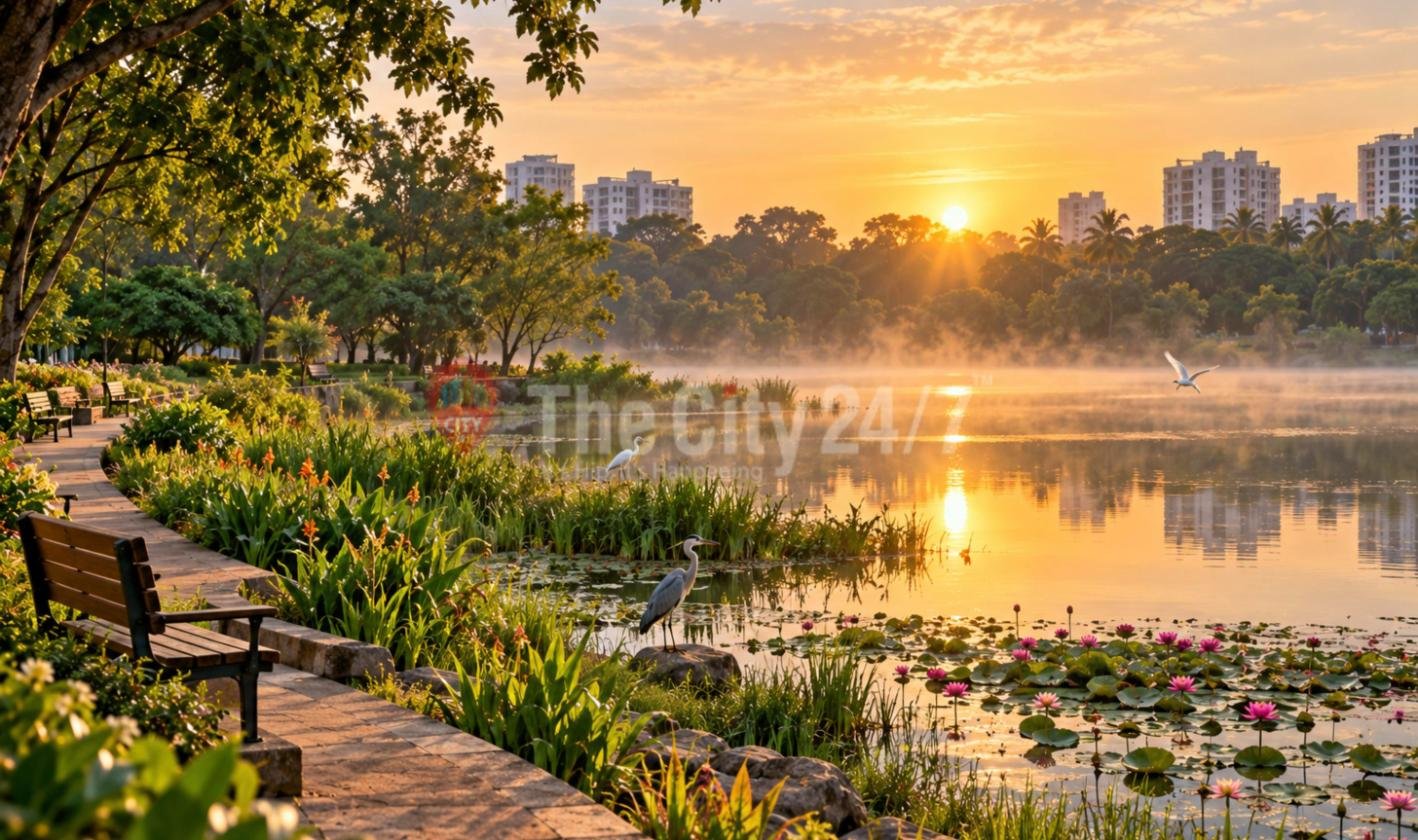
“Bengaluru lost most of its lakes to negligence. Puttenahalli is the one that a group of neighbours refused to let go, and it is now the template.”
• Why this small lake matters more than the big ones
Puttenahalli Lake is a roughly 13-acre restored lake in JP Nagar 7th Phase, open approximately 6 AM to 6 PM with free entry. It is managed in partnership between the city corporation under the Greater Bengaluru Authority and the Puttenahalli Neighbourhood Lake Improvement Trust, and over 80 bird species have been recorded here. The best time to visit is 6.30 to 8 AM.
The reason to write about a thirteen-acre lake at the same length as a three-hundred-acre park is that Puttenahalli is the most instructive place in Bengaluru. In the late 2000s it was close to gone: dry, encroached, used as a dumping ground, and slated for the sort of quiet disappearance that has taken hundreds of this city's tanks. A group of residents in the surrounding apartments objected, organised, and then, crucially, kept going.
What exists now is a fenced, planted, watered lake with a walking path, an island, reed beds and a genuine bird population, maintained through a formal public-private arrangement. This guide covers visiting it, and the story, because the two are not separable.
Quick Information
Thirteen acres, free entry, eighty-plus bird species and one very determined residents' trust.
What Are Puttenahalli Lake Timings and Is Entry Free?
Entry is free and the gates are generally open from about 6 AM to 6 PM, though hours at a community-managed lake can vary and it is worth checking the trust's own updates if you are travelling across the city. It is a walking and watching lake, so there is nothing to buy a ticket for.
- 6.30 to 8 AM. The best window. Birds are active, the lake is quiet and the light is good.
- Early evening. Pleasant for a walk, and roosting birds come in. Gates close earlier than the big parks.
- Midday. Little reason to be here. Exposed in stretches and the birds are inactive.
- Weekends. Busier with local residents, still quiet by any city standard.
- No fee. Free entry. If you want to contribute, the trust takes donations and volunteers, which is more useful than a ticket would be.
This is a neighbourhood lake that a neighbourhood maintains. Treat it accordingly: no litter, no loud music, no feeding the birds, and keep to the paths. The reason it is pleasant is that people who live around it enforce all of that socially.
How Was Puttenahalli Lake Restored?
Through sustained pressure and then sustained work by local residents, formalised as the Puttenahalli Neighbourhood Lake Improvement Trust, in partnership with BBMP. The lake had dried and degraded, and residents in the surrounding apartments campaigned to stop its loss and then took on responsibility for maintaining it.
- The problem. By the late 2000s the lake was effectively dying: dry for long periods, silted, encroached at the edges and used for dumping.
- The campaign. Residents organised, petitioned and pushed BBMP to rehabilitate rather than lose the lake. This is the part that usually does not happen.
- The trust. PNLIT was set up to formalise the effort, allowing residents to raise funds, employ gardeners and take on day-to-day upkeep.
- The work. Desilting, fencing, sewage diversion, planting of trees and reeds, and the creation of habitat features including an island.
- Keeping water in it. The hardest part. Treated water inflow and rainwater management have been central to keeping the lake from drying again.
- The result. Over eighty bird species recorded, a functioning walking path, and a lake that is now an amenity rather than a liability.
“The lesson of Puttenahalli is not that a lake was saved. It is that saving it required someone to keep showing up for fifteen years.”
• On civic persistence
What Birds Can You See at Puttenahalli Lake?
Over eighty species have been recorded, and on a normal morning you can expect herons, egrets, cormorants, spot-billed ducks, coots, purple moorhens and kingfishers, with a range of garden and tree birds around the perimeter.
- On the water. Little and great cormorants, little egrets, purple and grey herons, spot-billed ducks, coots, purple moorhens and grebes.
- Kingfishers. White-throated, pied and common kingfishers all occur along the edges.
- In the reeds. Waterhens, warblers and prinias. Stand still near a reed bed and wait.
- Overhead. Black kites, shikras and occasionally a marsh harrier.
- Seasonality. Winter brings migrants and the highest counts. The monsoon brings breeding activity.
- Compared with Madiwala. Madiwala is bigger and has the nesting islands and the large waterbirds. Puttenahalli is smaller, quieter and better for close, patient watching.
What Is It Like to Visit Puttenahalli Lake?
Small, quiet and pleasant, with a perimeter path of about a kilometre, benches, planting and views across the water to the island. It is a forty-five minute visit rather than a morning, and it is best combined with something else in JP Nagar.
- The walk. About a kilometre around. Two or three loops is a reasonable morning walk.
- The island. A habitat feature created during restoration, and the focus of the birdlife.
- Benches and viewing points. Several, positioned deliberately. Sit and wait rather than walk and look.
- Planting. Extensive tree and reed planting since restoration. Several species are labelled, which is a nice touch.
- Facilities. Minimal, and deliberately so. No canteen, no boating, no play equipment beyond the basics.
- What it is not. Not a day out. It is a neighbourhood lake, and going expecting Lalbagh will disappoint you.
How Do You Get to Puttenahalli Lake?
It is in JP Nagar 7th Phase, reachable by Green Line metro to the southern stations followed by an auto, or directly by bus or cab. Note that there is a separate Puttenahalli near Yelahanka in north Bengaluru, which causes confusion, so make sure your map is pointing at JP Nagar.
- Metro. Yelachenahalli or the nearby southern Green Line stations, then a short auto ride.
- Bus. BMTC services to JP Nagar 7th Phase and the Puttenahalli area are frequent.
- Car. Street parking around the lake in a residential area. Be considerate, since residents live there.
- The name confusion. There is another Puttenahalli near Yelahanka in the north of the city with its own lake. This guide is about the JP Nagar one.
- Combine with. JP Nagar for food, Ranga Shankara theatre nearby, or Madiwala Lake for a two-lake morning.
Can You Volunteer at or Support Puttenahalli Lake?
Yes, and this is the most useful section of this guide. PNLIT runs on volunteers and donations, and it needs both. Bird surveys, planting, cleanup drives and simply funding a gardener's wages are all things the trust organises.
- Volunteering. Cleanups, planting drives, bird counts and awareness work. Contact the trust through its website.
- Donations. The trust funds day-to-day maintenance, including gardening staff, which is the unglamorous cost that keeps a lake alive.
- Bird surveys. Regular counts contribute to the recorded species list. Useful if you already birdwatch.
- Learn the model. If you want to do this for a lake in your own area, PNLIT is the case study everyone in the city's lake movement points to.
- Other lake groups. Similar citizen groups now work on lakes across Bengaluru, including Kaikondrahalli, Jakkur and Kasavanahalli.
Why Does the Puttenahalli Story Matter for the Rest of Bangalore?
Because Bengaluru was built on man-made lakes and has lost most of them. The city had hundreds of interconnected tanks, and the great majority were encroached, built over or reduced to sewage holding. Puttenahalli demonstrates that the process can be reversed at neighbourhood scale.
- The scale of the loss. This city has no river. Its water came from a cascade of tanks, and most of those are now bus stands, stadiums and layouts.
- Why lakes still matter. Groundwater recharge, flood buffering during the monsoon, local cooling and habitat. These are not decorative functions.
- The model. Public ownership with community maintenance, formalised through a trust. It works where a department alone has not.
- What it needs. Sewage diverted out, water flowing in, a fence, and someone who cares continuously for years.
- The wider movement. Puttenahalli, Kaikondrahalli, Jakkur and others have collectively changed how this city talks about its lakes.
- The unresolved part. Bellandur and Varthur, at the bottom of the chain, remain the city's most visible failure. Scale defeats the neighbourhood model there.
FAQs
What are Puttenahalli Lake timings?
The gates are generally open from about 6 AM to 6 PM and entry is free. Hours at a community-managed lake can vary, so check the trust's updates if you are coming from across the city. The best window is 6.30 to 8 AM.
Where is Puttenahalli Lake?
In JP Nagar 7th Phase in south Bengaluru. Note that there is a separate Puttenahalli near Yelahanka in north Bengaluru with its own lake, which causes regular confusion, so confirm your map is pointing at the JP Nagar one.
Who manages Puttenahalli Lake?
It is managed in partnership between the city corporation under the Greater Bengaluru Authority and the Puttenahalli Neighbourhood Lake Improvement Trust, known as PNLIT, a residents' trust that took on day-to-day upkeep after campaigning to save the lake from being lost.
How was Puttenahalli Lake restored?
Residents organised in the late 2000s to stop the lake being lost, pushed BBMP to rehabilitate it, and then formed a trust to fund and carry out maintenance. The work involved desilting, fencing, sewage diversion, planting of trees and reeds, and creating habitat features including an island.
What birds can you see at Puttenahalli Lake?
Over eighty species have been recorded. On a normal morning expect herons, egrets, cormorants, spot-billed ducks, coots, purple moorhens and kingfishers, with raptors overhead. Winter brings migrants and the highest counts.
Is there boating at Puttenahalli Lake?
No. It is a conservation lake rather than a recreation lake, with a perimeter walking path and viewing points but no boating or large facilities. For boating, Sankey Tank or Madiwala Lake are the options.
Can I volunteer at Puttenahalli Lake?
Yes. PNLIT runs on volunteers and donations, organising cleanups, planting drives and bird counts, and funding gardening staff. Contact the trust through its website. It is also the case study to study if you want to do the same for a lake in your own area.
Why is Puttenahalli Lake significant?
Because Bengaluru was built on hundreds of man-made tanks and lost most of them to encroachment and neglect. Puttenahalli shows that the loss can be reversed at neighbourhood scale through public ownership combined with sustained community maintenance, and it has become the model other lake groups in the city follow.
Contact Details
Worth having, because this is a lake where contacting the people who run it is a genuinely useful action.
Is There a Lake in Your Neighbourhood?
If you are part of a lake group anywhere in this city, or you want to start one and do not know where to begin, click the WhatsApp icon at the bottom right of your screen and get in touch. I would like to write about more of these properly. That is also the easiest way to reach The City 24/7 about anything at all.
And if you want city guides, weekend plans and neighbourhood notes landing in your inbox, join our ever growing community at thecity247.kit.com/join-the-community. Free, and about ten seconds of your life.
Same city, new stories, always.

Related Stories
 CITY GUIDE
Shrungagiri Shanmukha Temple: The Six Faced Hill Temple West Bengaluru Keeps to Itself
September 22, 2026
 CITY GUIDE
Aquarium Paradise, Palace Road: India's Longest Underwater Tunnel Is in Bengaluru
September 22, 2026
 CITY GUIDE
Dodda Ganapathi, Basavanagudi: The 18 Foot Ganesha They Cover in Butter
September 22, 2026
 CITY GUIDE
Dwadasha Jyotirlinga, Omkar Hills: All Twelve Jyotirlingas Without Leaving Bengaluru
September 22, 2026
 CITY GUIDE
Fun World, Palace Road: The Amusement Park in the Middle of the City
September 22, 2026
 CITY GUIDE
Ghati Subramanya: The Snake God Temple an Hour North of Bengaluru
September 22, 2026
