


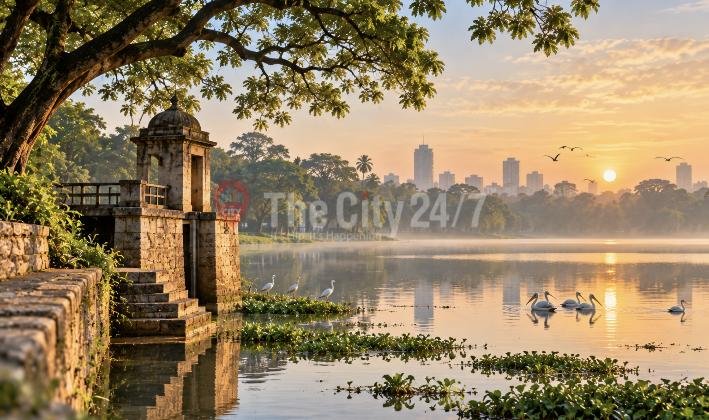
“Bengaluru has no river. Everything about this city, its founding, its water bills, its floods and its politics, follows from that one fact.”
• The starting point for understanding the lakes
Almost every major Indian city sits on a river. Bengaluru does not. It sits at about nine hundred metres on a ridge, and the water that falls on it runs away in three directions. So the people who settled here did the only thing available: they built tanks, hundreds of them, arranged down the natural gradients so that the overflow from one fed the next, and they made a city work on stored rainwater for four centuries.
That system was then largely dismantled in the twentieth century. Tanks were filled in for bus stands, stadiums, golf courses and layouts, sewage was diverted into the ones that remained, and by the 1990s Bengaluru's lakes were a byword for urban environmental failure, with Bellandur's foam making international news.
The part that gets less coverage is the reversal. Kaikondrahalli, Puttenahalli, Jakkur and others were brought back, mostly by residents who organised, raised money, fought in court and then stayed involved. Those lakes are genuinely better now than they were twenty years ago. This guide covers which lakes to visit, what to see, and the honest state of the system.
Quick Information
Which lake for what, with timings. As with everything outdoors in this city, mornings.
Which Is the Best Lake to Visit in Bangalore?
Sankey Tank in Malleshwaram. An 1880s tank with a proper walking track roughly a kilometre and a half around, mature trees, a park attached and the most genuine local crowd of any lake in the city.
Sankey was built in 1882 under Richard Sankey, then Chief Engineer of Mysore, to supply water to the growing city, and it has been a neighbourhood institution ever since. What makes it the best is not scenery but use: at six thirty in the morning it is full of walkers on their fixed routes, yoga groups, swimmers, children, and retired people who have occupied the same bench for twenty years and will tell you about the railing.
Go early, before eight. It is free, the Green Line puts you within reach via Malleshwaram, and it combines perfectly with 8th Cross for breakfast and sweets afterwards. If you want to understand why Bengaluru residents defend their lakes so fiercely, an hour at Sankey Tank on a weekday morning explains it better than any article.
Which Lakes Are Best for Birdwatching?
Hebbal Lake in the north for the biggest species count, then Kaikondrahalli, Puttenahalli and Jakkur. Go in the first two hours after sunrise, between October and January if you can.
- Hebbal Lake, north. The best birding within the city, with a substantial water body, good early light and regular sightings of pelicans, storks, cormorants and a long list of waders. Worth the trip north if birds interest you at all.
- Kaikondrahalli Lake, Sarjapur Road. The restoration success story, with wetland zones deliberately designed for biodiversity rather than just a walking path. Real species diversity and an active volunteer community.
- Puttenahalli Lake, JP Nagar. Small, calm and dense with birds, brought back by residents. A good illustration of what one neighbourhood can do with a neglected tank.
- Jakkur Lake, north. Larger, with a functioning treatment and wetland system, and one of the better examples of restoration paired with sewage management.
- Lalbagh Lake. Inside the garden, on the main walking circuit, and busy with birds at dawn. The easiest birding in the city to combine with everything else.
- Agara and Madiwala Lakes. Both south east with walking paths, convenient if you live in HSR, Koramangala or BTM, and both decent for common water birds early in the morning.
- Hesaraghatta, on the northern edge. Grassland and reservoir rather than a city lake, and one of the best places near Bengaluru for open country birds. Check current access.
“Kaikondrahalli was not saved by a government scheme. It was saved by people who lived near it, went to court, raised money and then kept showing up for a decade.”
• The actual mechanism behind most of Bengaluru's lake revivals
How Did Bangalore's Tank System Actually Work?
As a cascade. Tanks were built in series down the natural valleys, so rain filled the highest, its overflow fed the next, and so on down the chain, with each tank serving the settlement and fields around it.
The genius of the system is that it treated the whole terrain as one piece of infrastructure. Kempe Gowda built tanks in the sixteenth century, and successive rulers, including the Wadiyars and later the British administration, added to them. Kempambudhi, Dharmambudhi, Sampangi and Halasuru were among the major ones, and the connecting channels, the raja kaluves, carried water between them.
That is the part that was lost most completely. You can restore a lake and still have a broken system, because without the channels a tank cannot receive or discharge properly, and instead of stormwater it receives sewage. Dharmambudhi tank is now the Majestic bus station, Sampangi is the Kanteerava stadium, and several large layouts sit on tank beds, which is precisely why those areas flood in a heavy monsoon. Water still remembers where it used to go.
What Happened to Bellandur and Varthur Lakes?
They became the endpoints of the city's sewage. Both received largely untreated wastewater for decades, which produced the foam and, on occasions, fire that made international news.
Bellandur is the largest lake in the city and sits at the bottom of one of the main valleys, which means it receives what the catchment above it discharges. As the eastern and south eastern city grew faster than its sewage treatment capacity, that inflow became overwhelmingly untreated wastewater carrying detergents and industrial effluent. The foam at the outflow, and the fires, were the visible symptom of a straightforward infrastructure failure.
There has been sustained legal pressure, court directed action, treatment plant construction and remediation work, with improvement in parts of the chain and a long way still to go. Neither Bellandur nor Varthur is a lake to visit. They are worth knowing about because they explain why lake activism in this city is as organised and as angry as it is, and why anyone renting on the Sarjapur corridor should ask residents about the lake situation in their specific location and season.
What Are the Timings and Rules at Bangalore's Lakes?
Most lake parks are free or nominal and open roughly 5.30 or 6 to 10 in the morning and 4 to 8 in the evening, closed in the middle of the day. Plastic is generally prohibited and some have cycling and dog restrictions.
The midday closure is worth planning around, because turning up at two in the afternoon will find gates locked. October to January is the best window overall: water levels are high after the monsoon, the air is cool and dry, and migratory birds are present. Carry water, carry binoculars if birds interest you, and expect the better lakes to have volunteer groups running walks and cleanups you can join.
One practical note on the restored lakes: the rules there tend to be stricter and enforced by residents rather than staff, because they fought for the place. Respect the no plastic rules, stay on the paths through wetland zones and do not feed the birds. It is their lake in every meaningful sense.
How Can I Help Bangalore's Lakes?
- Find the lake group nearest you. Most restored lakes in Bengaluru have an active volunteer trust or residents group running cleanups, birdwalks and monitoring. They are the reason those lakes exist.
- Learn which valley you live in. Your area drains into a specific lake chain. Knowing which one makes local sewage, stormwater and construction debris issues much easier to act on.
- Report sewage inflow and debris dumping. To your city corporation under the Greater Bengaluru Authority and the pollution control board, with photographs and location. Construction debris dumped in a tank bed is both common and actionable.
- Watch for encroachment notices. Tank beds and buffer zones are legally protected and still get built on. Neighbourhood groups are usually the first to spot it.
- Join a birdwalk. The easiest entry point, and the volunteer birders in this city are generous with beginners. It also builds the species records that support protection.
- Do not dump anything at all. Idol immersion, food waste, plastic and garden debris all end up in the same water. Most lakes now have designated arrangements during festivals, and using them matters.
Bangalore's Lakes: Frequently Asked Questions
Why does Bangalore have so many lakes?
Because it has no river. Sitting at about 900 metres on a ridge, the city was built around an interconnected cascading system of rainwater tanks, where overflow from the highest fed the next down the valley. Several hundred existed, and many were built over in the twentieth century.
Which is the best lake to visit in Bangalore?
Sankey Tank in Malleshwaram, built in 1882, with a proper walking track roughly 1.5 km around, mature trees and a genuine neighbourhood crowd. Go before eight in the morning and combine it with breakfast on 8th Cross.
Where can I go birdwatching at Bangalore's lakes?
Hebbal Lake in the north has the best species count, with pelicans, storks, cormorants and waders. Kaikondrahalli, Puttenahalli and Jakkur are all good restored lakes with real biodiversity, and Lalbagh Lake is the easiest to combine with other sightseeing.
What are the timings of Bangalore's lakes?
Most lake parks open roughly 5.30 or 6 to 10 in the morning and again from about 4 to 8 in the evening, and are closed in the middle of the day. Entry is free or nominal at almost all of them.
What happened to Bellandur Lake?
It received largely untreated sewage for decades, as the eastern city grew faster than its treatment capacity, producing the foam and occasional fires that made international news. Sustained legal pressure and treatment plant construction have brought partial improvement, but it is not a lake to visit.
Which Bangalore lakes were restored by residents?
Kaikondrahalli on Sarjapur Road is the best known, along with Puttenahalli in JP Nagar and Jakkur in the north. All were revived largely through residents organising, raising funds, using the courts and then staying involved for years afterwards.
What was the raja kaluve system?
The network of channels that carried water between Bengaluru's tanks, making the cascade work. Their loss is why restoring an individual lake is not sufficient: without functioning channels a tank cannot receive stormwater or discharge properly, and often receives sewage instead.
Which Bangalore landmarks are built on former lakes?
The Majestic bus station sits on the former Dharmambudhi tank and the Kanteerava stadium on Sampangi tank, among others, along with several large residential layouts. It is why those areas flood in heavy monsoon, since water still drains where it always did.
When is the best time to visit Bangalore's lakes?
October to January, after the monsoon, when water levels are high, the air is cool and dry and migratory birds are present. Within the day, the first two hours after sunrise are comfortably the best, both for birds and for light.
How can I help protect Bangalore's lakes?
Join the volunteer trust or residents group at your nearest lake, learn which valley and lake chain your area drains into, report sewage inflow and construction debris dumping with photographs, watch for encroachment on tank beds and buffer zones, and join a birdwalk as an easy starting point.
Useful Links
Authorities and data sources for lake conditions, pollution and complaints.
Involved With a Lake?
The volunteer groups around Bengaluru's lakes know more about the state of this city's water than anyone, and they are the reason several of these places still exist. If your lake deserves to be on this page, or something here is out of date, click the WhatsApp icon at the bottom right of your screen and tell me. Encroachment and dumping reports are worth sending too. That is also the fastest way to reach The City 24/7 about anything at all.
And if you want the city explained one useful thing at a time, join our ever growing community. One weekly email, free, and often about water.
Same city, new stories, always.

Related Stories
 LIFESTYLE
Where to Hang Out in Bangalore, Especially on a Sunday
August 4, 2026
 LIFESTYLE
The Best Places to Visit in Bangalore With Family, by the Age of Your Kids
July 14, 2026
 LIFESTYLE
The Best Places in Bangalore With Friends, and How to Get Eight People There
July 14, 2026
 LIFESTYLE
How to Spend a Weekend in Bangalore Without Leaving the City
July 6, 2026
 LIFESTYLE
Bangalore at Night: Live Music, Late Food and the 1 AM Problem
August 12, 2026
 LIFESTYLE
Bangalore for Introverts and Extroverts: Alone, or in a Crowd
August 11, 2026
