


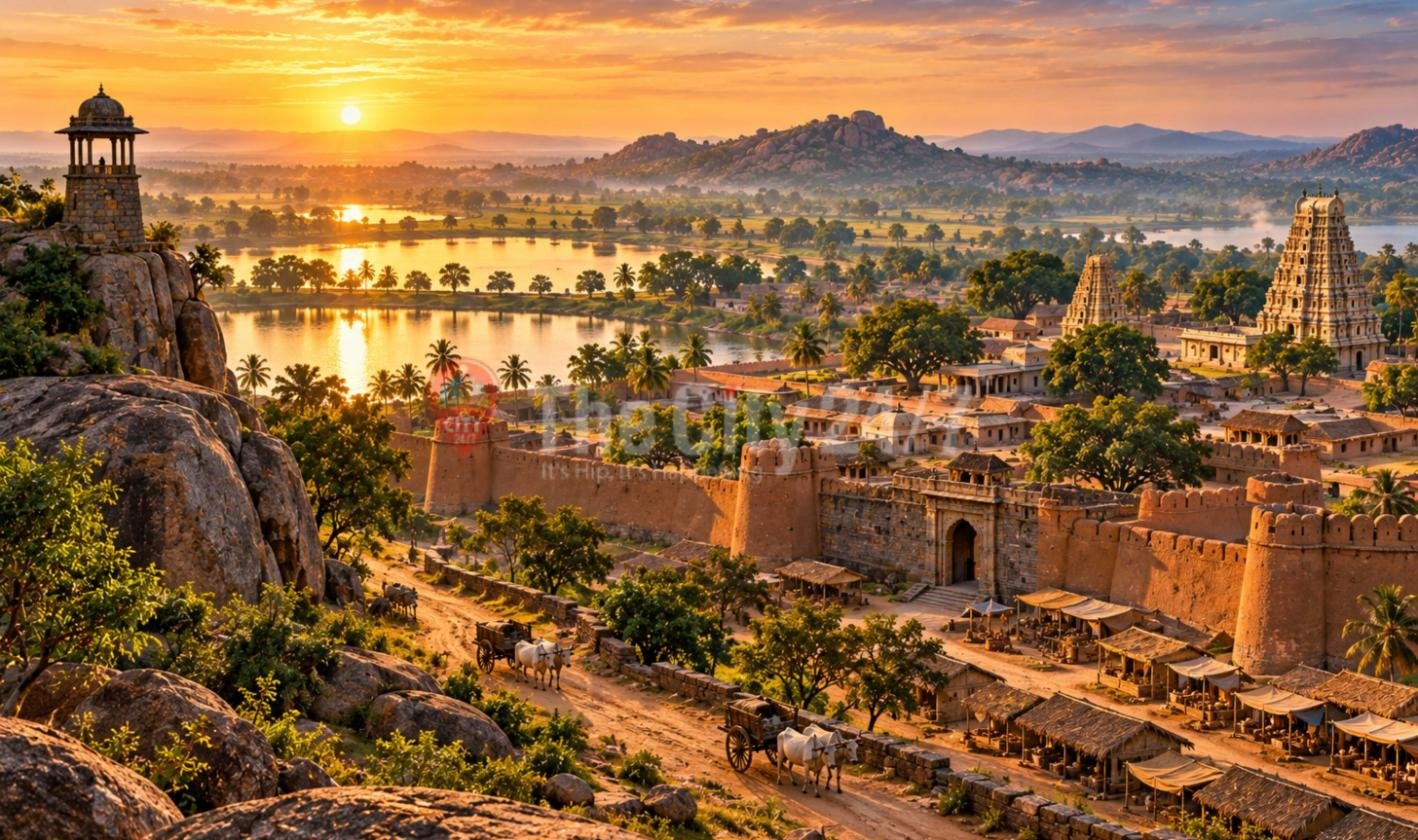
“Every time you haggle in Chickpet, catch a bus at Majestic or land at the airport, you are standing inside a plan one man drew in 1537.”
• On the founder of Bengaluru
Kempe Gowda I was the chieftain who founded Bengaluru in 1537. He built a mud fort, laid out market streets called petes around it, and dug a network of tanks to keep the new town supplied with water. He is remembered as Nadaprabhu, lord of the land, and his name is on the city's airport, its main bus station and its biggest annual civic celebration.
I have lived in this city long enough to complain about every road in it, and I still find it slightly astonishing that the old core of Bengaluru is recognisably one person's idea. The streets around Avenue Road, Chickpet and Balepete are crowded, loud and permanently under repair, but they sit where Kempe Gowda put them. Each pete was built around a trade, and a surprising number of them still sell what they were named for.
This is not a Wikipedia biography. The records from the sixteenth century are thin, some of the famous stories are legend, and historians argue over dates. What is not in dispute is the part that matters to anyone who lives here: Bengaluru exists as a city because a Yelahanka chieftain decided it should, and drew the shape of it himself. So this is his Bangalore story, and where you can still walk through it.
Quick Information
The short version of the man who founded the city you are stuck in traffic in. He planned the petes; the traffic is our contribution.
Who Was Kempe Gowda?
Kempe Gowda I was a sixteenth century chieftain of Yelahanka who ruled as a feudatory under the Vijayanagara Empire and founded Bengaluru in 1537. He belonged to a line of local rulers, the Yelahanka Nadaprabhus, who controlled territory north of the present city. His achievement was not a battle or a conquest. It was a town plan.
The Vijayanagara period was a time of expanding trade across the Deccan, and a well-placed market town was a serious asset. Kempe Gowda chose high, open ground with reliable rainfall and good routes in several directions. He then built the things a trading town needs: defences, streets, water and temples. Historians generally credit him with obtaining permission from the Vijayanagara rulers and the grant of surrounding villages to support the new settlement.
- The family. The Yelahanka Nadaprabhus ruled the area for several generations. His son and successors, including Kempe Gowda II, extended the town.
- The era. Bengaluru was founded while Vijayanagara was near its height, a few decades before the empire's defeat in 1565.
- The name. Accounts of how Bengaluru got its name vary, and an inscription found near Begur suggests the name existed well before 1537. Kempe Gowda built the city; he did not invent the word.
What Did Kempe Gowda Actually Build?
He built a mud fort, a grid of trading streets around it, temples, and a ring of tanks for water. That combination turned a patch of scrubland into a functioning market town, and it is the reason the old centre of Bengaluru looks the way it does.
- The fort. A mud fort, later rebuilt in stone by subsequent rulers. The surviving stone section near KR Market is from a later period, but it stands on the site of the original settlement.
- The petes. Market streets organised by trade. Chickpet and Balepete for general trade, Akkipete for rice, Cottonpete for cotton, Tharagupet for grain. The area is still the city's wholesale engine.
- The tanks. A network of reservoirs to catch rainwater, because Bengaluru has no river worth the name. Several later tanks, including Dharmambudhi and Sampangi, are associated with the Kempe Gowda period.
- The temples. Gavi Gangadhareshwara, the cave temple in Gavipuram, and the Bull Temple in Basavanagudi are both linked to him or his era.
- The watchtowers. The four Kempe Gowda towers, in Lalbagh, Ulsoor, Mekhri Circle and near Kempambudhi, are traditionally said to mark the limits the city was expected to grow to. They are generally attributed to Kempe Gowda II.
“He did not build a monument. He built a working town, and then trusted it to keep working.”
• On the petes, still trading
How Did Kempe Gowda Plan the City?
He planned it around trade and water. Two main streets crossed at right angles, the petes spread out along them, each trade had its own quarter, and the tanks sat on lower ground where rain naturally collected. It was practical, and it worked well enough that the city grew for centuries without anybody needing to redraw it.
A popular account says the city's limits were marked by bullocks ploughing furrows in four directions from the centre, with gates on the main routes. Like a lot of founding stories it is probably part history and part legend, but the idea it captures is accurate. This was a planned town with a centre, a defined edge and a purpose.
- Trade quarters. Grouping traders by commodity made the market easy to use and easy to tax. Walk down Chickpet today and the silk and saree trade still clusters together.
- Water first. The tanks were not decoration. On a plateau with no big river, stored rainwater was the only way a town this size could survive.
- Room to grow. The towers, whoever built them, reflect a family that expected the city to expand. It did, rather more than anyone expected.
Where Can You See Kempe Gowda's Bengaluru Today?
In the old city, mostly on foot. The petes around Avenue Road, the fort remains near KR Market, the Gavi Gangadhareshwara and Bull temples, and the four towers are the most direct links. His name is also on the airport, Majestic and the metro interchange, which is how most Bangaloreans meet him every day without thinking about it.
- Chickpet and Avenue Road. The heart of his plan. Go on a weekday morning, before the lanes jam, and notice how the trades still cluster.
- Bangalore Fort. The surviving stone section near KR Market. Small, but it marks the original site.
- Gavi Gangadhareshwara Temple. The cave temple in Gavipuram, famous for the sunlight that falls on the linga around Makara Sankranti.
- The Bull Temple. Basavanagudi's giant Nandi, a short walk from Bugle Rock, where one of the towers once stood nearby.
- The Lalbagh tower. The easiest of the four towers to visit, on the rock in Lalbagh. Combine it with a morning walk in the garden.
- Kempegowda International Airport. Where the 108 foot Statue of Prosperity now greets anyone who lands in the city.
Start at the fort near KR Market at 7 AM, walk up through Avenue Road and Chickpet while the shutters go up, and finish with breakfast. You will have covered the founder's entire original city before most of Bengaluru has left home.
Is the Story of Lakshamma True?
Nobody can say for certain. The legend of Lakshamma, a woman of the Kempe Gowda family said to have sacrificed herself so a fort gate would stand, is part of local tradition rather than documented history. A small shrine to her in Koramangala is still visited. It is worth knowing the story, and worth knowing it is a story.
Founding myths gather around every old city, and Bengaluru has its share. The honest approach is to separate what is recorded, the fort, the petes, the tanks and the grants, from what is told. Both tell you something. The records tell you what he built. The legends tell you how much the city cared about it.
Why Does Kempe Gowda Still Matter to Bengaluru?
Because the city still depends on the two things he got right: trade and water. The petes are still the wholesale backbone of Bengaluru, and the lakes that survive from his network are now the city's most fought-over public spaces. When residents campaign to save a lake, they are defending an idea that dates from 1537.
He also matters as a symbol. Kempegowda Jayanti is celebrated by the state every year, his statue stands at the airport, and his name is used by nearly every political party. You can take or leave the politics. The underlying point holds: before the pensioners, the cantonment, the public sector and the software, there was a chieftain who decided a city should exist here.
- The lakes. Many of Bengaluru's lakes began as tanks built by him, his successors or the rulers who followed his model. Losing them has been the city's great modern mistake.
- The markets. KR Market, Chickpet and Avenue Road are still where the city buys in bulk.
- The identity. For many Kannadigas, Kempe Gowda is the founding figure of the city's own history, distinct from its colonial and corporate chapters.
What Can Bangaloreans Learn From Kempe Gowda?
That planning outlasts everything else. A handful of decisions made in 1537 about where water should sit and where trade should happen still shape daily life here. The parts of Bengaluru that work best are the parts somebody thought about carefully. The parts that flood are, very often, the old tanks we built over.
Why Does Kempe Gowda Belong in People of Bangalore?
He is the connection. Kempe Gowda did not move to Bengaluru or make his name here. He made the place. Every other person in this series lives, works or plays in a city whose first streets, first tanks and first shape came from him.
FAQs
Who founded Bengaluru?
Kempe Gowda I, a Yelahanka chieftain ruling under the Vijayanagara Empire, founded Bengaluru in 1537. He built a mud fort, market streets called petes, temples and a network of water tanks, which together formed the core of the city.
When was Bengaluru founded?
In 1537, when Kempe Gowda I built his fort and laid out the town. The name Bengaluru is older, and an inscription near Begur suggests it was in use centuries earlier, but the city as a planned town dates from 1537.
What are the petes of Bengaluru?
The petes are the old market streets Kempe Gowda laid out around his fort, each organised around a trade. Chickpet, Balepete, Cottonpete, Akkipete and Tharagupet are the best known, and the area is still Bengaluru's busiest wholesale district.
Did Kempe Gowda build the Kempe Gowda towers?
The four towers in Lalbagh, Ulsoor, Mekhri Circle and near Kempambudhi are generally attributed to his successor, Kempe Gowda II. They are traditionally said to mark the limits the city was expected to grow to.
Why is the Bengaluru airport named after Kempe Gowda?
Kempegowda International Airport is named after the city's founder to honour his role in creating Bengaluru. The 108 foot Statue of Prosperity, a bronze of Kempe Gowda, was unveiled at the airport in 2022.
When is Kempegowda Jayanti celebrated?
Kempegowda Jayanti is celebrated by the Karnataka government around June 27 each year, with official events across Bengaluru and the state.
Which temples did Kempe Gowda build in Bengaluru?
The Gavi Gangadhareshwara cave temple in Gavipuram and the Bull Temple in Basavanagudi are both associated with him or his era. Both are still active temples and easy to visit in a single morning.
Where can I see what is left of Kempe Gowda's Bengaluru?
Walk the petes around Avenue Road and Chickpet, visit the fort remains near KR Market, the Gavi Gangadhareshwara and Bull temples, and the tower on the rock in Lalbagh. Go early on a weekday to avoid the worst of the crowds.
Contact Details
Places where the founder's city is easiest to see, and who runs them.
Know More About Old Bengaluru?
If you know a detail about Kempe Gowda's city that I have missed, or a family story tied to the old petes, Click the WhatsApp icon at the bottom right of your screen and tell me. That is also the easiest way to reach The City 24/7 about anything at all, including nominating someone for People of Bangalore.
And if you want one story about the people who make this city, every Sunday, join our ever growing community at thecity247.kit.com/join-the-community. Free, and about ten seconds of your life.
Same city, new stories, always.

Related Stories
 CITY BUILDERS
R K Baliga: The Man Who Dreamed Up Electronics City
September 23, 2026
 CITY BUILDERS
M H Marigowda: The Man Who Made Lalbagh Bloom Again
September 23, 2026
 CITY BUILDERS
Sir M Visvesvaraya: The Engineer Who Wired Bengaluru for the Future
September 23, 2026
 TECHNOLOGY
Sabeer Bhatia: The Bangalore Schoolboy Who Sold Hotmail for $400 Million
September 24, 2026
 MEDIA
Ramjee Chandran: The Man Who Gave Bangalore Its First Free Magazine
September 24, 2026
 LITERATURE
Anita Nair: Ladies Coupé, Inspector Gowda and a Bengaluru Writing Life
September 23, 2026
