


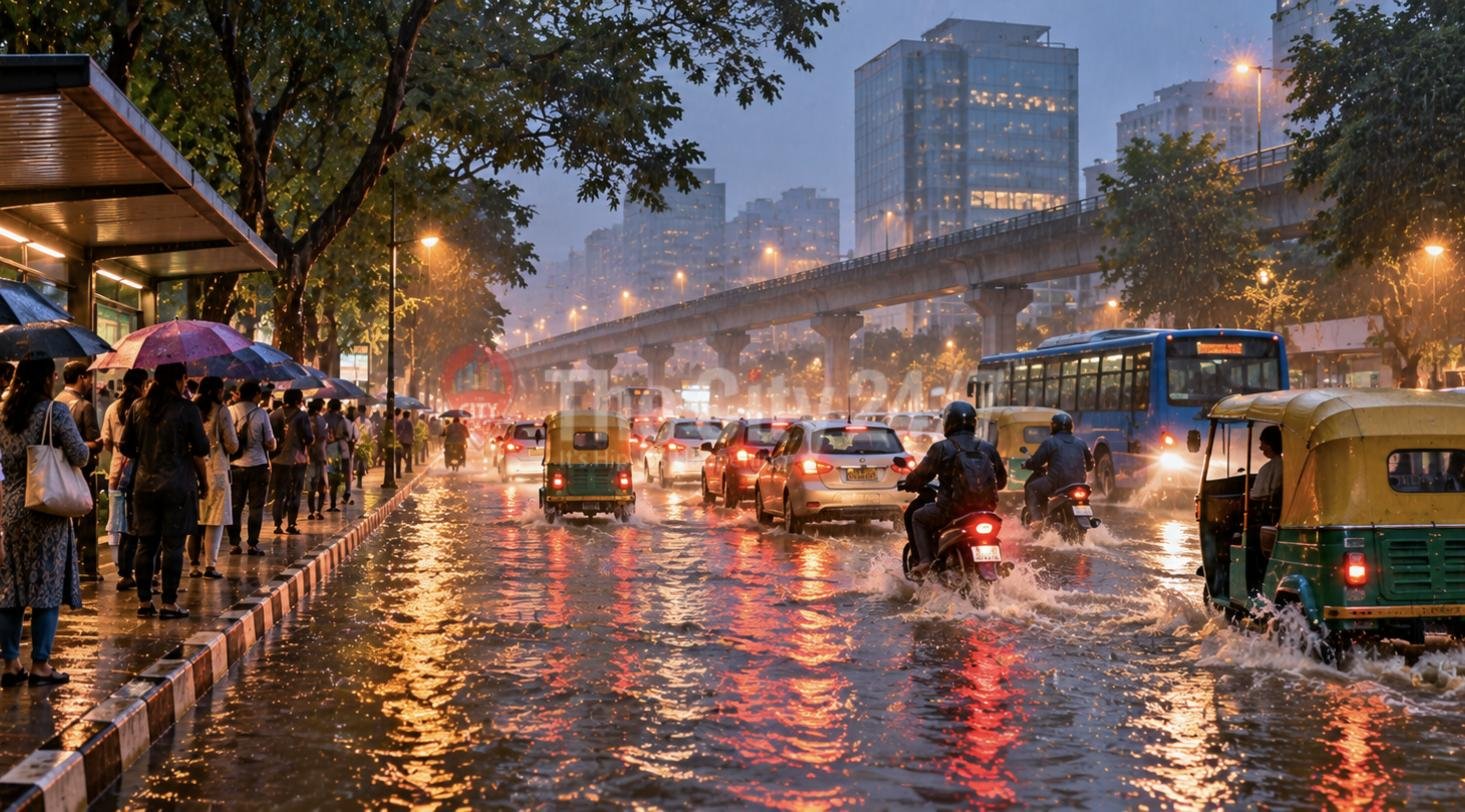
“Bengaluru's rain is not heavy by Indian standards. It simply arrives at 6:15 PM with immaculate comic timing, roughly four times a week.”
• On the scheduling
Bengaluru gets rain from both monsoons, and that is the thing newcomers do not expect. The south-west monsoon brings steady rain from June through September, and the north-east monsoon delivers the more dramatic evening thunderstorms from October into November. Between them the city sees rain across a large part of the year, and the annual total is not extreme, which is exactly why the flooding surprises people.
The problem is not the volume of water, it is where it goes. Bengaluru sits on a ridge with a network of storm water drains that follow the old lake system, and decades of construction have narrowed, blocked and built over a great deal of it. So thirty minutes of moderate rain produces knee-deep water at specific, predictable, well-known points, and the whole city's traffic reorganises itself around them.
This guide covers when the rain comes, which points flood and why, how to plan a commute around it, what to keep at home, what to do about power and water, and the official numbers worth saving before you need them.
Quick Information
The Bengaluru monsoon in one table. Screenshot the flooding row in June and thank yourself in October.
When Is the Monsoon in Bangalore?
Bengaluru has two monsoons and rain across much of the year, which is unusual for an Indian city. The south-west monsoon runs June to September and brings steady, cool, often all-day rain. The north-east monsoon follows through October and November with shorter, sharper evening thunderstorms, and it is this second season that causes most of the flooding and most of the traffic misery.
Add the pre-monsoon thunderstorms of April and May, which arrive as a relief after the summer, and you get a city where an umbrella is a year-round item rather than a seasonal one. September and October are typically the wettest months. January to March is the reliably dry window. Our weather guide has the month-by-month picture and what to wear in each.
Why Does Bangalore Flood so Easily?
Because the water has nowhere to go. Bengaluru was built around a system of interconnected lakes and tanks, with storm water drains, the rajakaluves, following the natural valleys between them. Over decades a great deal of that drainage has been narrowed, encroached on, blocked with debris or built over entirely, and lake beds have been developed.
- Lost drainage. The old lake-to-lake channels that carried runoff have been reduced in width or built across in many places, so water backs up rather than moving through.
- Hard surfaces. Enormous areas of the city that once absorbed water are now concrete and tarmac, so runoff volumes at any given point are far higher than the drains were sized for.
- Low points. Underpasses, valley roads and the areas that were literally lake beds flood first, every single time, in the same places.
- Silt and debris. Drains that are not cleared before the season carry a fraction of their capacity, which is why the pre-monsoon desilting work gets so much attention each year.
- The consequence. Moderate rain in the wrong place produces severe local flooding, while the city as a whole receives a fairly ordinary amount of water.
Which Roads and Areas Flood in Bangalore?
The same ones, every year, and knowing them is the single most useful monsoon skill in this city. These are the points where locals reroute before the rain even stops.
- Silk Board and the Hosur Road junction. The most reliably affected major junction in the south-east. Avoid entirely in heavy rain and use the Yellow Line metro instead.
- The Outer Ring Road, Bellandur to Kadubeesanahalli. Sections flood and the whole tech corridor stops. This is the stretch that produces the photographs every October.
- KR Puram and the Old Madras Road side. Persistent flooding around the junction and the low stretches toward Whitefield.
- Hebbal and the northern underpasses. Underpasses at Hebbal, Okalipuram and around Yeshwanthpur fill quickly and are closed when they do.
- Sarjapur Road and Whitefield Main Road. Both carry water at multiple low points, and both have limited alternative routes.
- KR Market, Shivajinagar and the old city. Dense, old drainage and narrow roads mean localised flooding that clears slowly.
- Low-lying residential pockets. Areas built on or beside former lake beds, particularly in the south-east and around Bellandur and Varthur, see repeated apartment and basement flooding.
Never ride or drive into water of unknown depth, however shallow it looks. Open manholes, washed-out road edges and submerged debris are the real hazard, not the water. Turn around, wait it out with a coffee, and lose twenty minutes instead of a vehicle.
How Do I Plan a Commute in the Bengaluru Monsoon?
Take the metro, leave earlier, and assume double the time. Those three habits handle almost everything. The rain arrives most often between about 4 PM and 8 PM, which is precisely the evening peak, and that overlap is the whole problem.
- Use the metro. Namma Metro runs largely unaffected by rain, and in monsoon it is not merely cheaper than a cab, it is dramatically faster. This is the season it justifies itself.
- Shift your timing. Leaving thirty minutes before the evening peak, or waiting ninety minutes after it, routinely saves more time than any route choice.
- Check before you leave. The traffic police and mainstream map apps both reflect flooding and closures quickly. Two minutes of checking saves an hour.
- Cab availability. Collapses the moment it rains hard, with long waits and surge pricing. Assume you will not get one easily at 6:30 PM in October.
- If you ride. A proper rain jacket rather than a poncho, a waterproof phone pouch, and a hard rule about standing water. Visibility is the real risk in evening rain.
- Have a fallback. Know which cafe or restaurant near your route you would happily sit in for an hour. Waiting out a Bengaluru downpour is usually the fastest option available.
What Should I Keep at Home for the Monsoon?
Very little, but the few things matter. Bengaluru's monsoon problems at home are power cuts, damp and the occasional water ingress, rather than anything dramatic.
- Power backup. Thunderstorm outages are common and usually short. Keep a charged power bank, a torch and a charged laptop from mid-afternoon in October and November.
- Damp management. Bengaluru's monsoon is cool and humid, which is ideal for mould. Keep bathrooms and wardrobes ventilated, and use a dehumidifier or moisture absorbers in a north-facing flat.
- Drying clothes. Nothing dries outside for weeks at a stretch. Either budget for a dryer, use a laundry service or accept a permanently occupied indoor rack.
- Waterproofing check. Before June, check your balcony drain, window seals and any terrace access. Blocked balcony drains are the most common cause of water in Bengaluru flats.
- Ground floor and basement. If you live on a ground floor or park in a basement in a low-lying area, know your building's history. Ask neighbours what happened in the last big rain.
- Mosquitoes. The real monsoon health issue here. Clear standing water on balconies and in plant trays, and use screens or repellent. Dengue cases rise through and after the season.
What About Power Cuts, Water Supply and Internet?
Expect short power cuts during thunderstorms and largely reliable water. BESCOM outages during heavy rain are common, generally last minutes to a couple of hours, and are restored faster than most Indian cities manage. Gated apartment projects almost all run backup generators.
Water supply is usually the least of your monsoon problems, and in fact this is the season the city's borewells and lakes recover. Internet is the more irritating one: fibre cuts and outages happen during heavy rain and road work, so a mobile hotspot as a fallback is worth having if you work from home. Our setting up a home guide covers connections, providers and what to arrange when you move in.
What Is Bengaluru Actually Like in the Monsoon?
Genuinely lovely, and this is the part the flooding coverage buries. The city is cool, green and washed clean, the lakes fill, Lalbagh and Cubbon Park are at their best, and the temperature sits between 20 and 26 degrees for weeks at a time. For anyone arriving from a north Indian summer, a Bengaluru monsoon evening is the entire reason people move here.
It is also the best season within reach of the city. The Western Ghats a few hours west, the Coorg and Chikmagalur coffee country, the Sakleshpur and Agumbe side and the waterfalls along that belt are all at their peak from July through September. Locals who plan well spend monsoon weekends out of the city, and it is the single best use of the season.
In the city, the monsoon is brewery, cafe and cinema season, and the food improves in the way food always does when it is cold outside. Our weekend getaways, day trips and things to do guides all cover the monsoon options, and the events calendar has what is on this week.
The Bengaluru Monsoon: Frequently Asked Questions
When is the monsoon in Bangalore?
There are two. The south-west monsoon runs June to September with steady rain, and the north-east monsoon follows in October and November with sharper evening thunderstorms. September and October are typically wettest.
Why does Bangalore flood after only a little rain?
Because the storm water drains that followed the old lake system have been narrowed, blocked or built over in many places, and large areas that once absorbed water are now concrete. Moderate rain therefore produces severe local flooding at specific low points.
Which roads flood most in Bangalore?
Silk Board and the Hosur Road junction, the Outer Ring Road between Bellandur and Kadubeesanahalli, KR Puram, the Hebbal and Okalipuram underpasses, Sarjapur Road, Whitefield Main Road and the KR Market area.
Does the metro work in the rain?
Yes, and it is the most reliable way to travel in the Bengaluru monsoon. Road journeys can double or triple in time while metro journeys stay broadly the same.
How much longer does a commute take in the monsoon?
Assume double your usual road journey time, and triple it if you are travelling in the evening peak between about 5 PM and 8 PM, which is when the rain most often arrives.
What should I carry in the Bangalore monsoon?
A compact umbrella year-round, a light waterproof rather than a heavy one given the mild temperatures, and a waterproof phone pouch if you ride a two wheeler.
Are power cuts common in the Bangalore monsoon?
Short outages during thunderstorms are common and usually restored within minutes to a couple of hours. Most gated apartment projects run backup generators.
Is dengue a risk in the Bangalore monsoon?
Yes, and cases rise during and after the season. Clear standing water on balconies and in plant trays, and use screens or repellent.
Is the monsoon a bad time to visit Bangalore?
No. The city is cool, green and pleasant at 20 to 26 degrees, and the Western Ghats, Coorg and Chikmagalur are at their best. Plan around evening rain and use the metro.
Should I avoid renting a ground floor flat in Bangalore?
In low-lying areas, particularly in the south-east and near former lake beds, ask neighbours what happened in the last heavy rain before you sign. Basement parking in those areas carries the same question.
Numbers and Links to Save Before the Season
Worth having in your phone before you need them, because looking them up during a flood is not the moment.
Which Junction Near You Floods First?
Local flooding knowledge is the most useful thing in this city and it lives entirely in people's heads. If there is a spot near you that goes under before anywhere else, click the WhatsApp icon at the bottom right of your screen and tell me, and I will add it. That is also the fastest way to reach The City 24/7 about anything at all.
And if you want the city explained one useful thing at a time, join our ever growing community. One weekly email, free, and a lot more reliable than the algorithm.
Same city, new stories, always.

Related Stories
 CITY GUIDE
The Ultimate Guide to Bangalore: Everything You Need to Know
November 1, 2026
 CITY GUIDE
The Bengaluru Festival Calendar: Every Annual Event Worth Planning Your Year Around
September 2, 2026
 CITY GUIDE
Bangalore's Neighbourhoods: A Complete Guide to the Cities Inside This City
July 9, 2026
 CITY GUIDE
The Best Areas to Live in Bangalore: An Honest Comparison
July 3, 2026
 CITY GUIDE
The History of Bangalore: From a Mud Fort in 1537 to India's Tech Capital
November 1, 2026
 CITY GUIDE
KSR Bengaluru City Station: How to Use India's Busiest Confusing Railway Station
September 22, 2026
