


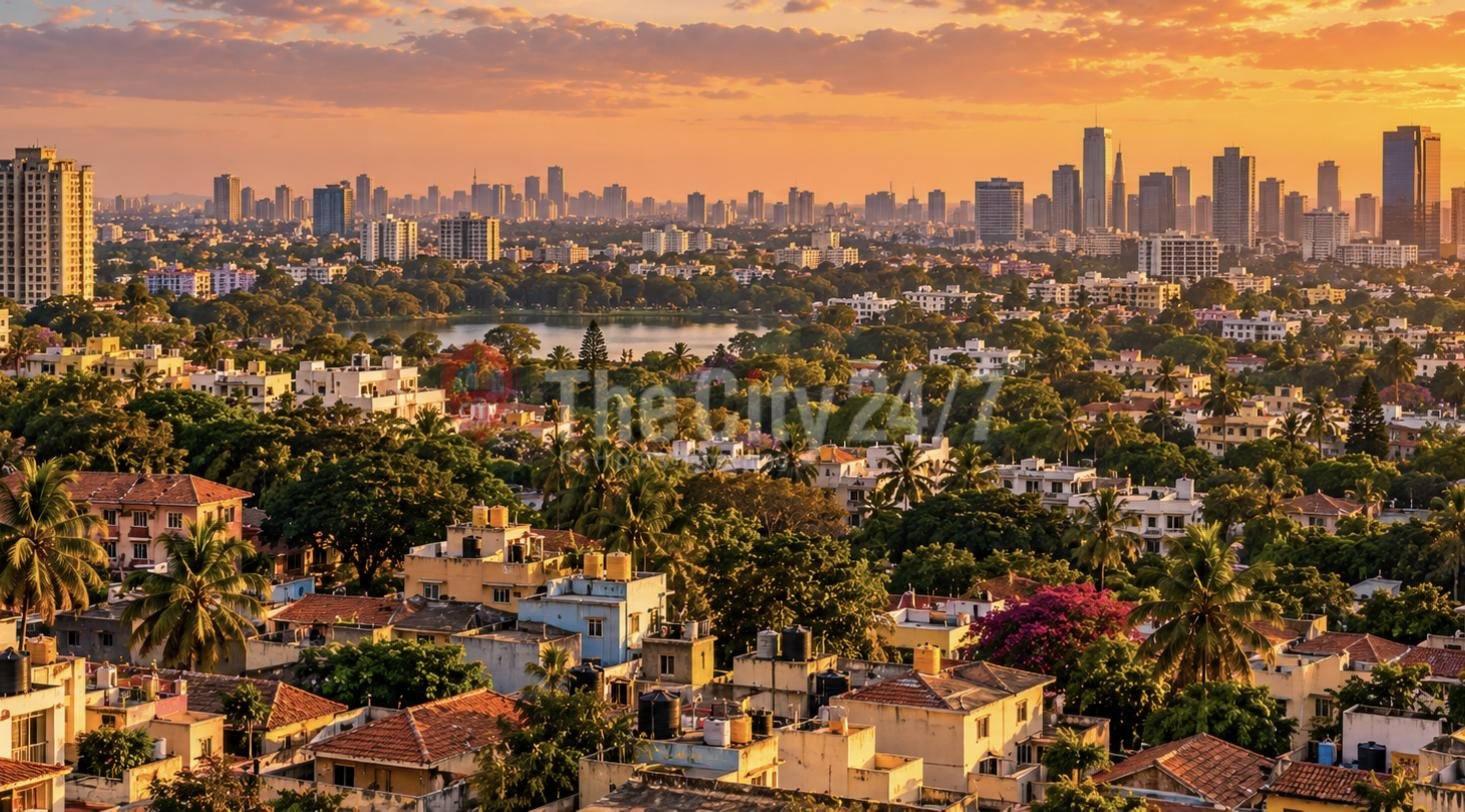
“Ask someone in this city where they live and they will not say Bangalore. They will say Jayanagar, and they will say it like a nationality.”
• On local patriotism
Bangalore is best understood as a dozen small cities that share a name. The distance from Malleshwaram to Whitefield is about twenty kilometres and roughly forty years of urban history, and the two places have almost nothing in common besides the traffic between them.
This guide walks through the city's main neighbourhoods, what each is actually like, who it suits, and what it costs you in convenience or in rent. I have lived in three of them and worked in five, and I have opinions, which I will label as opinions.
If you are moving here, use this to shortlist two or three areas and then go and stand in each of them on a weekday evening. That twenty minute test will tell you more than any list, including this one.
Quick Information
A quirky truth about this city: people choose neighbourhoods the way they choose football clubs. Here is the table version, without the shouting.
Which Bangalore Neighbourhood Should I Live In?
Pick the neighbourhood closest to where you will work, then optimise for everything else. In a city where a twelve kilometre commute can take ninety minutes, proximity to your office beats every other factor, and it is not close.
After that, the honest questions are: do you want to be able to walk to things, do you want quiet, and what are you willing to pay. Almost every neighbourhood in Bangalore is good at two of those three.
Before you sign anything, stand on the street outside the house at 7 PM on a weekday. Listen to it, look at the traffic, see whether you can walk to buy milk. Twenty minutes there beats twenty listings online.
Indiranagar: What Is It Like to Live There?
Central, walkable, expensive and permanently busy. Indiranagar is the neighbourhood the rest of India pictures when it pictures Bangalore: tree-lined residential streets, 12th Main and 100 Feet Road lined with restaurants and bars, and a metro station on the Purple Line that makes the whole city reachable.
It suits people who want to be able to leave the house and find something to do on foot. It does not suit anyone who wants quiet, and rents here are among the highest in the city. My own view: the best neighbourhood in Bangalore for a certain few years of your life, and exhausting after that.
Koramangala and HSR Layout: The Startup Belt
Koramangala is where a very large share of India's startup story physically happened, and it still feels like it: cafes full of laptops, blocks numbered in a way nobody finds intuitive, and food at every price point. HSR Layout, just south, is its calmer sibling, laid out in sectors with wider roads and more space.
- Koramangala. Central, dense, extremely well served for food and nightlife. Traffic on the 80 Feet Road and Sony World junction is a daily fact.
- HSR Layout. Quieter, greener, popular with people who liked Koramangala and then wanted to sleep. Good for young families.
- Bellandur and Sarjapur Road. Newer apartment stock, close to the Outer Ring Road tech parks, and the worst peak-hour traffic in the city.
- Who it suits. Anyone working on the ORR corridor or in the startup ecosystem, and anyone who would rather be near their colleagues than near a park.
Whitefield and the East: Is It Worth the Distance?
If you work there, absolutely. If you do not, be very careful. Whitefield began as a small settlement well outside Bangalore and is now a city in its own right, with the ITPL corridor, large gated communities, several of the city's best international schools and its own malls, hospitals and restaurants.
The Purple Line's extension changed the equation here permanently. What used to be an unthinkable commute is now a metro ride, and that has made east Bangalore viable for people who work in the centre. Marathahalli, Brookefield and KR Puram sit along the same axis with cheaper rents and rougher roads.
Electronic City and the South: What Changed in 2025
The Yellow Line changed it. Electronic City has been one of the country's largest technology clusters for decades while being effectively unreachable by public transport, and the metro line that opened in August 2025 along Hosur Road finally connected several hundred thousand daily commuters to the rest of the network.
The result is that the Hosur Road corridor, from Bommasandra up through the Silk Board area, is now a genuinely reasonable place to live even if you do not work in Electronic City. That was not true two years ago.
Jayanagar, JP Nagar and the Old South
The best combination of quiet, greenery and walkability in the city. Jayanagar is a planned mid-century neighbourhood of numbered blocks, wide shaded roads, an excellent market complex and one of the most pleasant high streets in Bangalore. JP Nagar continues the pattern further south with more apartment stock and slightly lower rents.
- Jayanagar. Green, established, well served by the metro, and full of families who have been there for three generations.
- JP Nagar. Similar character, newer buildings, better value, and close to the Bannerghatta Road corridor.
- Basavanagudi. The oldest part of south Bangalore. Temples, filter coffee, Sajjan Rao Circle, and the quietest streets in the city.
- Who it suits. Families, anyone who cooks, and anyone who thinks a neighbourhood should have a market rather than a mall.
Malleshwaram, Rajajinagar and the West
Old Bangalore, still functioning as itself. Malleshwaram is the city's finest surviving example of an early 20th century neighbourhood: 8th Cross, Sampige Road, the Sunday market, a dense concentration of temples, sweet shops and small businesses that have been there for fifty years.
Rajajinagar and Vijayanagar continue west with good metro access on the Purple Line, solid mid-range housing and considerably better value than the centre. Kengeri, further out, is the end of the line and the beginning of the countryside.
Hebbal, Yelahanka and the North
The fastest changing part of Bangalore, and the closest to the airport. North Bengaluru has absorbed the Manyata tech corridor, a run of large apartment developments through Thanisandra and Jakkur, and the venues that now host most of the city's biggest concerts.
Yelahanka and Jakkur are quiet, green and still relatively affordable. Hebbal is well connected and permanently congested at its flyover. The whole area's future turns on the Blue Line metro to the airport, which is under construction and will change property values along it when it opens.
Which Areas Are Best for Families, and Which for Young Professionals?
- Families. Jayanagar, JP Nagar, Malleshwaram, Whitefield and Hebbal. Schools, parks, hospitals and quieter streets.
- Young professionals. Koramangala, HSR Layout, Indiranagar, Bellandur. Walkable food, short commutes to the tech corridors.
- Students. Basavanagudi, Vijayanagar, parts of Jayanagar and the areas around the big campuses. Cheap rent and bus access.
- Couples. Indiranagar, Richmond Town, Vasanth Nagar, HSR. Central, and enough to do without a car.
- Anyone who wants space. Sarjapur Road, Yelahanka, Jakkur and the outer east. More square feet per rupee, longer commutes.
Bangalore's Neighbourhoods: Frequently Asked Questions
Which is the best area to live in Bangalore?
There is no single answer, and the honest rule is to live close to where you work. Jayanagar and JP Nagar are the best for families, Indiranagar and Koramangala for people who want walkable city life, and Whitefield or Electronic City if you work in those corridors.
Which Bangalore neighbourhoods are the most walkable?
Malleshwaram, Basavanagudi, Jayanagar and Indiranagar. All four have proper high streets, markets and footpaths that go somewhere.
Is Whitefield too far from the city?
Not since the Purple Line extension. If you work in east Bangalore it is an obvious choice, and the metro has made living there viable even for people working centrally.
What changed for Electronic City?
The Yellow Line metro opened in August 2025 along Hosur Road, finally connecting the Electronic City corridor to the rest of the network and changing how liveable the whole southern stretch is.
Which are the most expensive areas in Bangalore?
Indiranagar, Koramangala, the central Cantonment neighbourhoods, and prime pockets of Whitefield and Hebbal.
Which areas are best value for money?
Vijayanagar, Rajajinagar, JP Nagar's outer blocks, Thanisandra, Yelahanka and the stretches beyond Marathahalli. Lower rents, longer commutes.
Which part of Bangalore is quietest?
Basavanagudi, Yelahanka, Jakkur and the inner residential streets of JP Nagar.
Which area is best for families with school-going children?
Whitefield and north Bengaluru for international schools, Jayanagar, JP Nagar and Malleshwaram for established CBSE and ICSE options within a short drive.
How much does the commute really matter here?
More than anything else. A twelve kilometre commute in peak hours can take ninety minutes, so proximity to work outranks every other factor when choosing a neighbourhood.
Contact Details and Useful Links
For area-level civic information, these are the official sources worth bookmarking.
Which Neighbourhood Are You In?
If you live somewhere I have been unfair to, or somewhere I have missed entirely, click the WhatsApp icon at the bottom right of your screen and set me straight. I would genuinely rather be corrected than wrong. That is also the easiest way to reach The City 24/7 about anything at all.
And if you want the city explained one useful thing at a time, join our ever growing community. A weekly email, free, and a lot more reliable than the algorithm.
Same city, new stories, always.

Related Stories
 CITY GUIDE
A Guide to Bangalore's Markets: Go at Six, Leave by Nine
August 1, 2026
 CITY GUIDE
Bangalore's Oldest Neighbourhoods, and How to Walk Each One
July 29, 2026
 CITY GUIDE
Bangalore's Most Interesting Streets, and What Each One Is For
July 29, 2026
 CITY GUIDE
The Best Areas to Live in Bangalore: An Honest Comparison
July 3, 2026
 CITY GUIDE
The Ultimate Guide to Bangalore: Everything You Need to Know
November 1, 2026
 CITY GUIDE
Bengaluru's Theatres and Cultural Venues: Where to Actually See Something Live
September 8, 2026
