


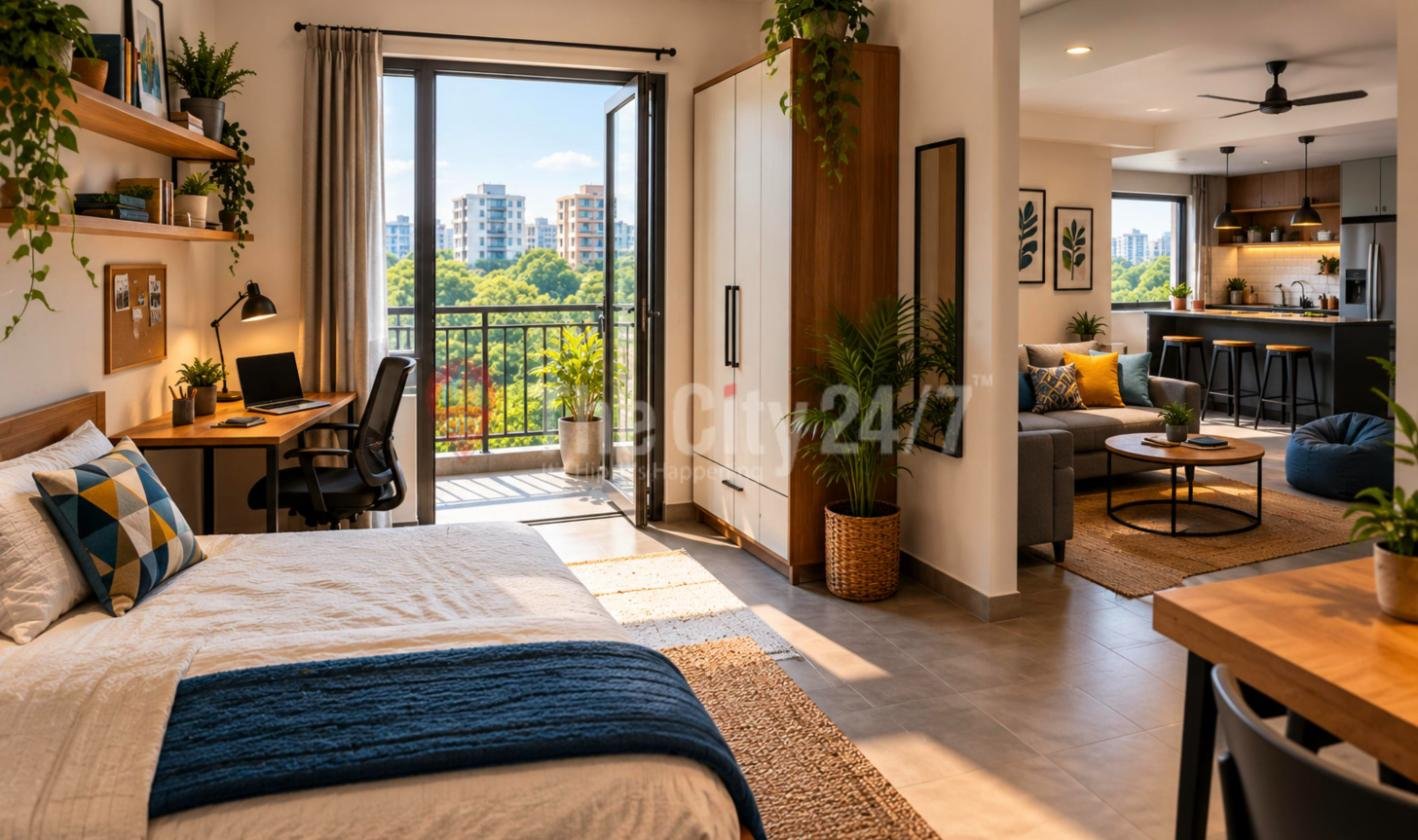
“Nobody in Bengaluru talks about their first PG with affection. Everybody talks about it, though, which tells you it is a rite of passage worth surviving well.”
• On landing here
Bengaluru has the largest paying guest and co-living market in India, and it exists for a simple reason: several hundred thousand people arrive here every year for a first job or a course, and almost none of them can front six months of rent as a deposit on an unfurnished flat. A PG or co-living room solves that in one payment, with furniture, wifi, cleaning and usually food included.
The market splits roughly in two. Traditional PGs are owner-run houses and small buildings, cheaper, more local, with home-style food and more rules. Branded co-living operators run larger managed properties with app-based payments, standardised rooms, community events and higher prices. Both are legitimate choices and the right one depends on your budget and your tolerance for other people's systems.
This guide covers what each costs in 2026, which areas suit which situation, what is actually included, the deposit and notice terms that catch people out, and the specific questions to ask on a visit. I have been through this and so has almost everyone I know here.
Quick Information
Everything you need before you go and look at rooms. The deposit row is the one that saves people money, so start there.
What Is the Difference Between a PG and Co-Living in Bangalore?
A PG is usually owner-run with food included and more rules; co-living is professionally managed, more expensive and more flexible. Both give you a furnished room without a large deposit, and the difference is in who runs it and what that feels like day to day.
- Traditional PG. Owner or warden managed, in a converted house or small building. Food usually included and often genuinely good. Cheaper, more local, and more likely to have a curfew and a guest policy.
- Branded co-living. Operator managed at scale, app-based rent and complaints, standardised rooms, community events, cleaning schedules. Food is often a paid add-on. More expensive and more predictable.
- Managed shared flats. A middle option: an operator rents a normal apartment and lets rooms individually. More privacy than a PG, less institutional than co-living.
- Hostels for students. College-run or private hostels near campuses, cheapest of all, with the strictest rules and the least flexibility.
- Which to pick. If food and cost matter most, a PG. If privacy, flexibility and predictable service matter most, co-living. If you are here for under six months, co-living's shorter lock-ins usually win.
How Much Does a PG or Co-Living Room Cost in Bangalore in 2026?
From about Rs 7,000 a month for a shared PG room with food to about Rs 35,000 for a private co-living room in a central location. The single biggest variable is not the property, it is how many people are in the room and where the building is.
- Triple or four-sharing PG. Rs 7,000 to Rs 11,000 a month with food. Cheapest option in the city, and the standard first landing for a fresher.
- Double-sharing PG. Rs 9,000 to Rs 14,000 with food. The most common choice and usually the best value per rupee.
- Single room PG. Rs 11,000 to Rs 20,000 with food. Worth the jump if you value sleep and can afford it.
- Co-living shared. Rs 11,000 to Rs 20,000, food typically extra at Rs 3,000 to Rs 6,000 a month.
- Co-living private. Rs 18,000 to Rs 35,000 depending on area and property tier.
- Premium studios. Rs 30,000 to Rs 55,000 in Indiranagar, Koramangala, HSR and the ORR corridor. At this level, compare against renting a 1BHK.
Once you are paying over about Rs 25,000 a month for a private room, price a 1BHK against it. In Electronic City, Marathahalli or the outer north, that money rents a whole flat, and after the deposit you keep the difference every month.
Which Areas of Bangalore Are Best for PG and Co-Living?
Choose by commute first, because Bengaluru punishes a bad one harder than a small room does. After that, the supply and character vary considerably by area.
- Koramangala and HSR Layout. The deepest supply for startup and tech workers, huge variety, walkable food, and prices at the higher end. The default choice for a first job in the ecosystem.
- Electronic City and the Hosur Road corridor. The largest and cheapest PG market in the city, built around the IT campuses, and now on the Yellow Line metro. Best value anywhere.
- Marathahalli, Whitefield and Kadugodi. Dense supply for the eastern tech parks, cheaper than the south-east, with Purple Line access at the Whitefield end.
- Bellandur and the ORR belt. Walkable to the tech parks, priced accordingly, and the traffic is somebody else's problem if you never leave.
- Basavanagudi, Jayanagar and Vijayanagar. The student and exam-prep belt. Cheaper, quieter, with excellent cheap food and good metro access.
- Yelahanka and the north. Serves the northern campuses and Manyata, generally affordable with newer buildings.
Our neighbourhood guides to Koramangala, HSR Layout, Electronic City and Whitefield cover each of these areas in full, including what daily life there actually costs.
What Is Included in the Rent, and What Is Not?
Assume nothing and ask for the list in writing. The headline number in a listing is frequently not the number you will pay, and the gap is usually food, electricity and laundry.
- Almost always included. Furnished room with bed, mattress, wardrobe and desk, wifi, housekeeping of common areas, water and security.
- Usually included in PGs. Two or three meals a day, sometimes laundry, often power backup. Food is the PG's main advantage and its main variable.
- Usually extra in co-living. Food as a monthly plan, laundry, deep cleaning of your own room, parking and guest charges.
- Electricity. Frequently included only up to a cap, with usage above it billed. If you run an air conditioner, ask what the cap is.
- Watch for. One-time onboarding or maintenance fees, mandatory food plans you cannot opt out of, and charges for changing rooms.
What Should I Check Before Paying a Deposit?
Visit in person, at night if you can, and work through this list. Every item here comes from something that went wrong for someone I know.
- Water supply. Ask whether it is BWSSB, borewell or tanker. In the outer corridors this is the single most important question, especially between February and May.
- Power backup. Ask what the backup covers: whole building, common areas only, or nothing. Ask about the fan and socket in your specific room.
- Food, tasted not described. Ask to see the week's menu and, if possible, eat a meal. Food quality is the difference between a good PG and a miserable one.
- Notice period and deposit refund. Get both in writing: how much notice, how much is refunded, and how many days after you leave. Deposit disputes are the most common complaint in this market.
- Curfew and guest policy. Many PGs have a gate closing time and restrict visitors, including family. Ask directly rather than discovering it at 11:30 PM.
- Bathroom ratio. Ask how many people share each bathroom on your floor. This matters more at 8:30 AM than any other feature of the building.
- Commute test. Travel from the property to your office or campus at the actual time you will do it daily. Not on a Sunday afternoon.
- The written agreement. Insist on one, even in a small PG, listing rent, what is included, deposit, notice and refund terms. Photograph the room's condition when you move in.
Where Do I Find PGs and Co-Living in Bangalore?
The best options are still found on foot and by asking, and the online listings are a starting point rather than the market. In practice a combination works best.
- Walk the area. Almost every PG in Bengaluru has a board outside with a phone number. The good owner-run ones often never advertise online because they do not need to.
- Rental and listing platforms. Useful for co-living operators and for price benchmarking. Treat photographs and the headline rent with scepticism.
- Co-living operators directly. The branded operators list availability on their own sites and apps, usually with accurate pricing and short lock-ins.
- Colleague and college networks. The single best source. Somebody at your office or campus is moving out of a good room this month.
- Local brokers. Fine for shared flats and larger properties. Expect a fee, usually a month's rent, and negotiate it.
If you are moving up to a full flat instead, our renting a home in Bangalore guide covers agreements, deposits and registration, and the setting up a home guide covers utilities and connections.
Is a PG the Right Choice, or Should I Just Rent a Flat?
Start in a PG or co-living, then move to a flat once you know the city. That is the honest sequence for almost everyone arriving here. The reason is not money, it is information: after two months you will know which corridor your commute actually works from, which is not knowledge you can get from a listing site.
- Choose a PG or co-living if. You are new, you are here for under a year, you cannot front a large deposit, or you do not want to buy furniture and appliances yet.
- Choose a flat if. You are staying, you have a deposit ready, you want to cook, or you are paying over Rs 25,000 a month for a room anyway.
- Consider a shared flat. Two or three people splitting a 2BHK or 3BHK is usually the cheapest per-person option in Bengaluru after PGs, with none of the rules.
- Keep the first commitment short. Six months maximum, one month notice, deposit terms in writing. Flexibility is worth more than a slightly better room.
- Budget properly. Our cost of living guide breaks down what a full month in Bengaluru costs beyond the rent, which is where most first-year budgets go wrong.
PG and Co-Living in Bangalore: Frequently Asked Questions
How much does a PG cost in Bangalore?
Roughly Rs 7,000 to Rs 13,000 a month for a shared room including food, and Rs 11,000 to Rs 20,000 for a single room with food. Branded co-living runs higher, from about Rs 11,000 shared to Rs 35,000 for a private room.
What is the difference between a PG and co-living?
A PG is usually owner-run with food included, cheaper and with more rules such as curfews. Co-living is professionally managed with standardised rooms, app-based payments and more flexibility, at a higher price and with food often charged separately.
Which area is best for a PG in Bangalore?
Koramangala and HSR Layout for startup and tech jobs, Electronic City and Marathahalli for the best value near the tech parks, Whitefield for the east, and Basavanagudi, Jayanagar or Vijayanagar for students.
How much deposit does a PG in Bangalore ask for?
Usually one to two months' rent, and branded co-living often asks one month or a fixed amount. That is far lower than an unfurnished flat, where six to ten months is still common in independent houses.
Is food included in Bangalore PGs?
Usually yes, with two or three meals a day, and it is a PG's main advantage. In branded co-living, food is normally a separate monthly plan of about Rs 3,000 to Rs 6,000.
What should I check before booking a PG?
Water source, power backup, food quality, bathroom sharing ratio, curfew and guest policy, notice period and exactly how and when the deposit is refunded. Get all of it in writing.
Do PGs in Bangalore have curfews?
Many traditional PGs do, with a gate closing time and restrictions on visitors. Branded co-living properties generally do not. Ask directly before you pay anything.
Is co-living worth the extra money?
It is if you value privacy, predictable service and short lock-ins. If food and cost are your priorities, a well-run traditional PG gives you more for less.
Can I get a PG for a short stay of one or two months?
Yes. Branded co-living operators and some PGs offer short stays, though the monthly rate is higher. Serviced apartments become competitive for stays under a month.
When should I move from a PG to a flat?
Once you know which corridor your commute works from, and definitely once you are paying more than about Rs 25,000 a month for a room. At that level a 1BHK in many parts of the city costs less.
Useful Contacts and Links
For the official side of renting in Bengaluru, and for problems that go beyond a conversation with your owner.
Just Moved Into One? Tell Me How It Went
If you have recently found a good PG or co-living property, or been burned by a bad one, click the WhatsApp icon at the bottom right of your screen and tell me. Real numbers and real experiences make this guide far more useful to the next person arriving. That is also the fastest way to reach The City 24/7 about anything at all.
And if you want the city explained one useful thing at a time, join our ever growing community. One weekly email, free, and a lot more reliable than the algorithm.
Same city, new stories, always.

Related Stories
 PROPERTY
Living in Jayanagar and Basavanagudi: Old Bengaluru, and Why Families Stay
July 20, 2026
 PROPERTY
Gated Communities and Builders in Bangalore: How to Choose Both Well
August 9, 2026
 PROPERTY
20 Top Builders in Bangalore: Who Actually Delivers, and Who Just Advertises
September 11, 2026
 PROPERTY
Bangalore's Emerging Corridors: Where the City Grows Next
August 11, 2026
 PROPERTY
East vs North vs South Bangalore: Where Should You Buy?
August 9, 2026
 PROPERTY
The Best Areas for Families in Bangalore: Schools, Parks and Everyday Life
August 5, 2026
