


“There is no best quadrant in Bengaluru. There is the quadrant that matches where you work, what you can spend and how you want to live, and those three answers make the decision for you.”
• On the question I am asked most
Buying in Bengaluru is really choosing a quadrant, because everything else follows from it: your commute for the next decade, your children's schools, the water situation you will live with, and how your money performs. The differences between east, north, south and west are substantial and they are not obvious from a listings site.
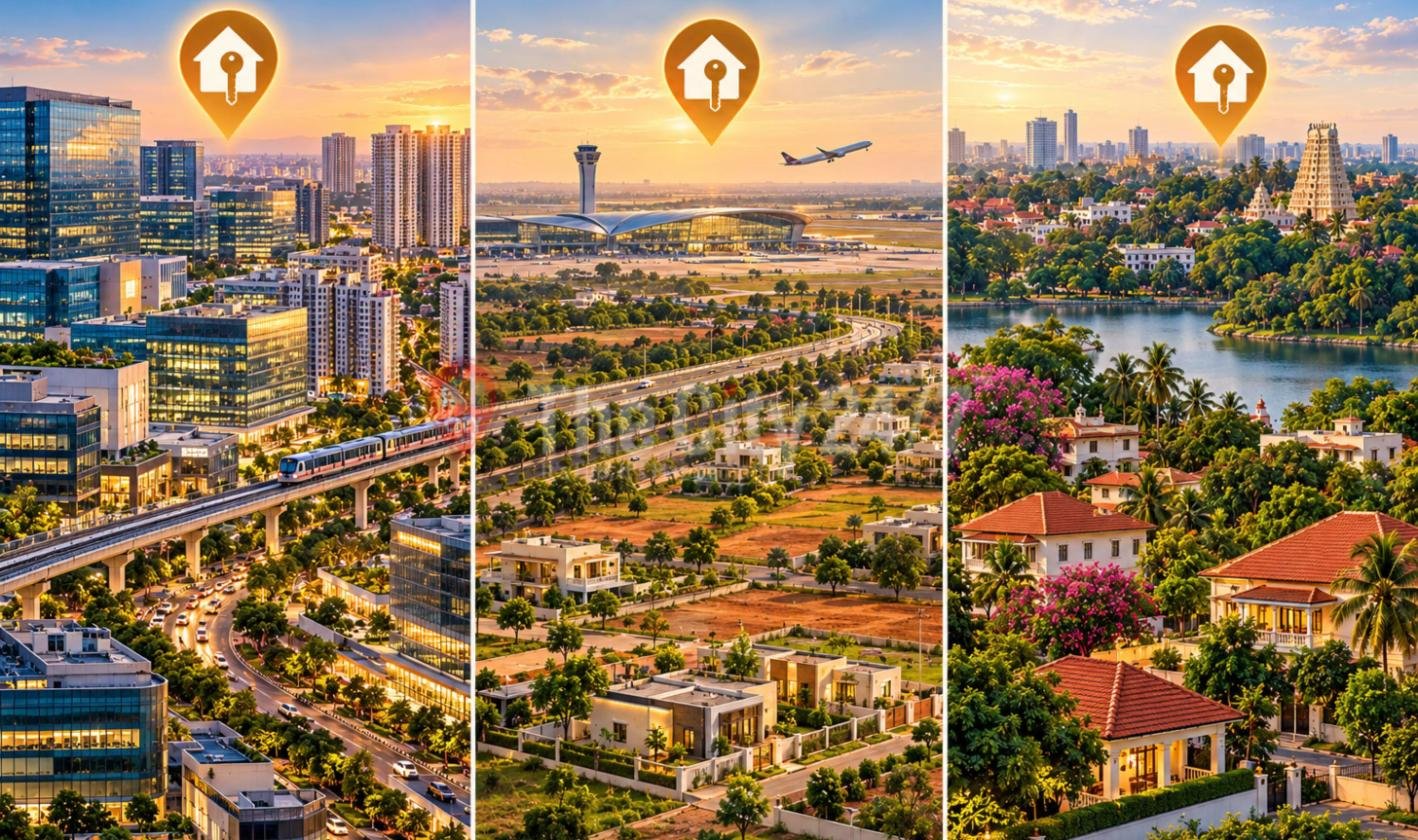
The east has the jobs and the worst traffic. The north has the airport, newer stock and easier roads. The south has the best quality of life and the least new supply. The west is the most affordable and the least discussed. Each one suits a specific kind of buyer and is a mistake for the others.
This guide compares them on price, commute, water, infrastructure, schools and resale, then gives a decision framework. Our market guide explains the underlying mechanics and our areas to live guide covers the neighbourhoods within each quadrant.
Quick Information
Four quadrants compared. Prices are indicative apartment rates and move with the market.
Should I Buy in East Bangalore?
Yes if you work in the eastern tech corridor or along the ORR, and probably not otherwise. Roughly six and a half to twelve thousand rupees per square foot, with the largest supply and the worst traffic in the city.
The east is where Bengaluru built its technology employment, and the housing followed. Whitefield, Marathahalli, Bellandur, Sarjapur Road and the ORR belt hold the largest concentration of apartment supply in the city, a deep rental market, and the best resale liquidity because the buyer pool is enormous. The Purple Line extension to Whitefield materially improved its position.
The costs are equally real. Peak hour traffic at Silk Board, Agara and along the ORR is among the worst anywhere in India. Water supply in parts of the belt depends on borewells and tankers through summer. And the Sarjapur corridor in particular has had documented lake and infrastructure issues. Buy here for the commute, verify the water building by building, and treat the ORR metro line as upside rather than as your plan.
“Buy in the quadrant you work in. Everything else in this comparison is a second order consideration next to two hours a day for a decade.”
• The decision rule that resolves most cases
What Is the Case for North Bangalore?
Newer stock, easier roads than the east, the airport, and genuine space to grow. Roughly six to eleven thousand rupees per square foot around Hebbal, Thanisandra, Yelahanka and out toward Devanahalli.
- The road advantage is real. North Bengaluru traffic, while not good, is materially better than the ORR and Whitefield. That is the strongest practical argument for buying here.
- Employment is growing. Manyata and the northern office clusters, plus the airport, aerospace and manufacturing corridor around Devanahalli. Less concentrated than the east and expanding.
- Newer housing stock. Development here is recent, which means better designed buildings, more amenities and fewer of the maintenance problems that come with 2000s construction.
- Airport proximity. Genuinely valuable if you travel frequently for work, and one of the clearest quality of life differences between quadrants for that specific buyer.
- Schools have followed. A good spread of CBSE and international schools around Hennur, Yelahanka and Thanisandra, covered in our schools by area guide.
- The caveats. Distance from the centre and the south, and infrastructure still catching up in the outer pockets. Check water and road access specifically for the exact location rather than the corridor.
Is South Bangalore Worth the Premium?
For quality of life, yes. Jayanagar, JP Nagar, Banashankari and the older south offer trees, markets, short commutes and established neighbourhoods at roughly seven to fourteen thousand rupees per square foot.
What you buy here is a neighbourhood rather than a building. These are 1940s and later planned layouts with mature canopy, walkable markets, generations of the same families, excellent schools and the best food in the city. Our greenest places and Jayanagar guides cover why the daily experience is different. Commutes within the south are short, and Electronic City is reachable via the Yellow Line and Hosur Road.
The constraint is supply. Very little new construction happens in the established south, so the stock is older apartments, independent houses and redevelopment, and buyers frequently budget for renovation. If you work in the east, the south is a poor choice regardless of how pleasant it is, because you will spend the decade in traffic. West Bengaluru, around Rajajinagar and Vijayanagar, offers a similar neighbourhood character at roughly five and a half to ten thousand per square foot and is the most overlooked quadrant in the city.
How Do I Decide?
- Start with your workplace, and your partner's. Map both. If they are in different quadrants, pick the one with the worse commute to optimise, or the one with better metro access for the other.
- Test the commute yourself, twice. 9.15 AM and 6.30 PM on a weekday, on the actual route, before making an offer. Map estimates in this city are optimistic in ways that matter.
- Ask where the water comes from. Cauvery connection or borewell, and whether the building uses tankers in summer. Ask residents rather than the builder or agent, and ask about April specifically.
- Check the school position if relevant. Schools are a ten year commitment and moving them is disruptive. Our schools by area guide covers what each quadrant offers.
- Think about resale before you buy. East and central have the deepest buyer pools and therefore the best liquidity. Outer corridors can be slow to sell when you need to.
- Separate what exists from what is announced. Buy on today's roads, metro and water. Treat announced infrastructure as upside, since timelines here have historically slipped considerably.
- Consider renting in the area first. A year renting in a quadrant tells you more than any amount of research, and it is cheap insurance on a decision of this size.
Where to Buy in Bangalore: Frequently Asked Questions
Which is the best area to buy property in Bangalore?
There is no single best area. Buy in the quadrant you work in: east for the tech corridor and ORR, north for Manyata and the airport corridor, south for quality of life and Electronic City access, and west for affordability with central access.
What are property prices in east Bangalore?
Roughly Rs 6,500 to 12,000 per sq ft across Whitefield, Marathahalli, Bellandur and Sarjapur Road. It holds the largest apartment supply in the city and the deepest resale market, along with the worst peak hour traffic.
Is north Bangalore a good place to buy?
It has the strongest structural case for new purchases: newer stock, materially easier roads than the east, growing employment at Manyata and the Devanahalli corridor, and airport proximity, at roughly Rs 6,000 to 11,000 per sq ft. Check water and road access for the exact location.
Why is south Bangalore more expensive?
Scarcity and quality of life. Jayanagar, JP Nagar and Banashankari are established planned layouts with mature tree canopy, walkable markets, excellent schools and short internal commutes, and very little new supply is built there, so values hold at roughly Rs 7,000 to 14,000 per sq ft.
Is west Bangalore worth considering?
Yes, and it is the most overlooked quadrant. Rajajinagar, Vijayanagar and Basaveshwaranagar offer established neighbourhood character and central access at roughly Rs 5,500 to 10,000 per sq ft, with the trade off of fewer new projects and less tech corridor access.
Should I buy near my office or in a nicer area?
Near your office. A pleasant area with a two hour daily commute costs you roughly five hundred hours a year, and it is the decision buyers in this city most consistently regret. Everything else in the comparison is second order.
How do I check water supply before buying?
Ask whether the building has a Cauvery connection or depends on borewells, and whether tankers are used in summer. Ask current residents rather than the builder or agent, and ask about April specifically, since that is when the position is worst.
Which area of Bangalore has the best resale value?
East and central, where the buyer pool is deepest and liquidity is best. Outer corridors can be slow to sell when you need to exit, which is worth weighing if there is any chance you will move within a few years.
Should I buy based on an announced metro line?
Treat announced infrastructure as upside rather than as the basis for the decision. The Blue Line along the Outer Ring Road will materially change the east when it opens, and timelines in Bengaluru have historically slipped considerably.
Should I rent in an area before buying there?
If you can, yes. A year renting in a quadrant tells you about the commute, the water, the noise and the neighbourhood in a way no amount of research will, and it is cheap insurance on a decision of this size.
Deciding Where to Buy?
Quadrant conditions change as infrastructure lands, and residents know the real picture on water, traffic and builders long before it appears anywhere. If you are weighing up areas, or you live in one and the description here does not match your experience, click the WhatsApp icon at the bottom right of your screen and tell me. That is also the fastest way to reach The City 24/7 about anything at all.
And if you want the city explained one useful thing at a time, join our ever growing community. One weekly email, free.
Same city, new stories, always.

Related Stories
 PROPERTY
Bangalore's Emerging Corridors: Where the City Grows Next
August 11, 2026
 PROPERTY
What It Costs to Buy or Rent in Bangalore: The Full Breakdown
August 5, 2026
 PROPERTY
Buying Property in Bangalore: The Documents, the Costs and the Checks That Matter
July 23, 2026
 PROPERTY
The Bangalore Property Guide: Rent, Buy, Khata and Where to Live
July 16, 2026
 PROPERTY
Bangalore's Property Market Explained: What Drives It and Where It Goes Next
August 11, 2026
 PROPERTY
Gated Communities and Builders in Bangalore: How to Choose Both Well
August 9, 2026
