


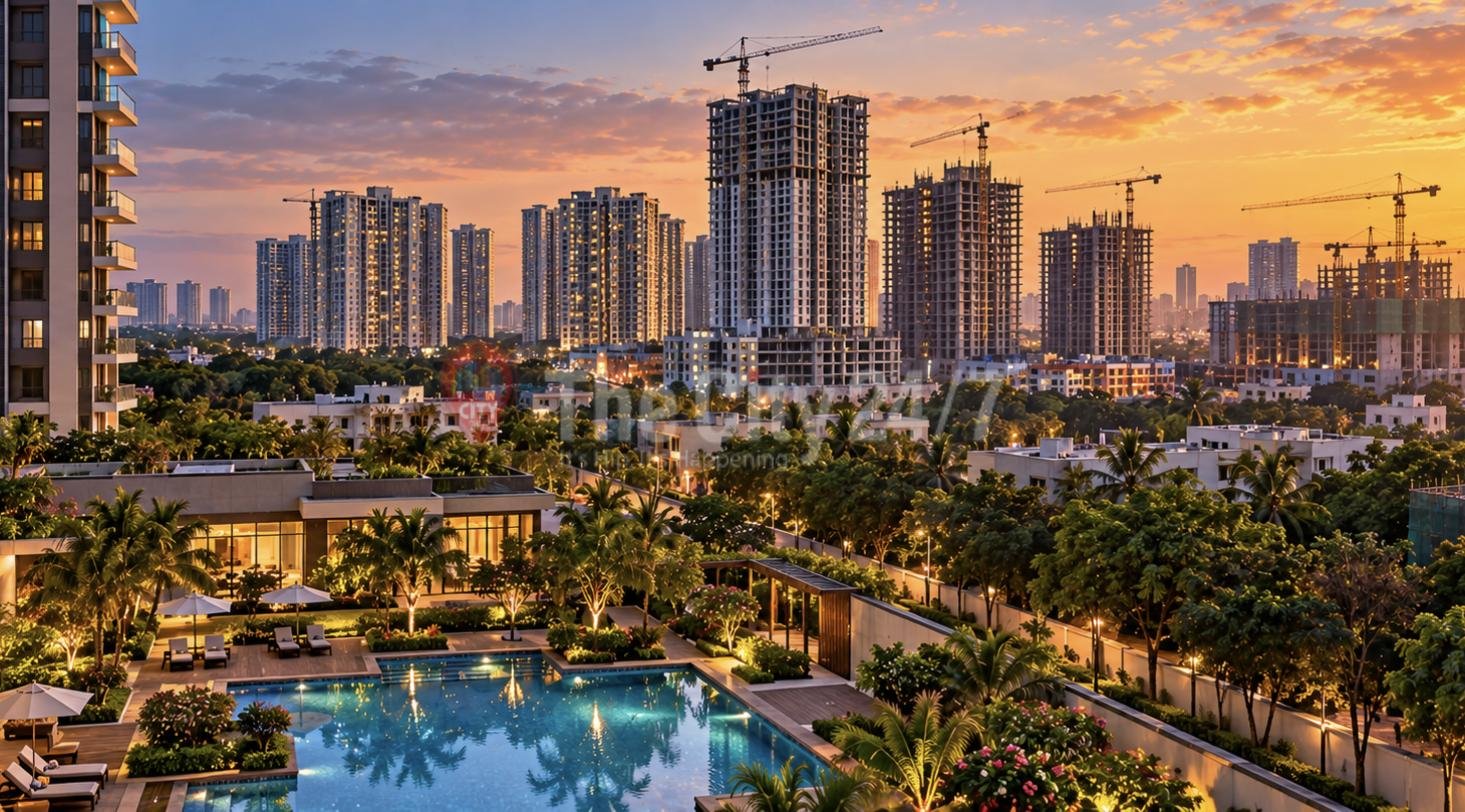
“Bengaluru's property market is an employment map with prices attached. Work out where the jobs are going and you have worked out most of the rest.”
• On the single organising principle
Almost everything about this market follows from one fact: Bengaluru's population and its employment have grown faster than its infrastructure for thirty years. Housing gets built where employment goes, prices rise on the expectation of infrastructure, the infrastructure arrives late, and the cycle repeats one corridor further out.
That produces a market with unusual characteristics. Prices are driven by commute time rather than distance. A metro announcement moves values more than any amenity. Rental yields are low relative to capital values. And the difference between two apartments three kilometres apart can be substantial because one is on the right side of a junction.
In this guide I explain the mechanics: what sets prices, how the corridors developed, what yields look like, the regulatory layer buyers must understand, and the honest picture on where things go next. Our buying and renting guides cover the transactions themselves.
Quick Information
The market in one screen. Prices are indicative, opinions about your neighbour's flat are free.
What Actually Drives Property Prices in Bangalore?
Commute time to employment, above everything else. Then metro connectivity, water supply, school access and builder reputation, roughly in that order.
The commute point is specific to this city's geography. Bengaluru is roughly forty kilometres across with employment concentrated in a handful of corridors, and its road network cannot move people across it quickly. So a property is valued on how long it takes to reach the ORR, Whitefield, Electronic City or the CBD at nine in the morning, and two properties equidistant on a map can differ substantially in price because one sits on the wrong side of a junction.
Metro is the most powerful single variable. A line announcement lifts values along a corridor, a line completion lifts them again, and the Purple Line extension to Whitefield demonstrated both effects clearly. That is why the Blue Line along the Outer Ring Road, currently under construction, is the most consequential thing happening in this market. Water supply is the underrated one: a Cauvery connection versus borewell dependence is a genuine value difference that buyers frequently fail to check.
“Ask two questions before anything else: how long is this commute at nine on a Tuesday, and where does the water come from in April. Most buyer regret in this city traces to one of those.”
• The two checks that matter most
How Did the Corridors Develop?
Outward in waves, each one following employment: the old core first, then the south east, the east with the technology corridor, and now the north toward the airport. Here is the sequence.
- The old core, pre 1990s. Jayanagar, Basavanagudi, Malleshwaram, Rajajinagar and the Cantonment. Planned layouts, independent houses, mature trees, and the highest quality of life in the city. Limited new supply, so values hold on scarcity.
- The south east, 1990s onward. Koramangala, HSR and BTM grew with the first technology wave and the startup economy. Central enough to stay expensive, and now largely built out.
- The east, 2000s. Whitefield, Marathahalli and the ORR belt, built for the technology corridor. The largest concentration of supply and the worst traffic, transformed by the Purple Line reaching Whitefield.
- The south east extension, 2010s. Sarjapur Road and Bellandur, absorbing the overflow. Rapid development, serious infrastructure lag, and the area where water and lake issues are most acute.
- The north, 2010s onward. Hebbal, Thanisandra, Yelahanka and the airport corridor. Newer, easier roads than the east, and the strongest case for new development today.
- Electronic City and the south. The original technology district, served by the elevated expressway and the Yellow Line, and the most affordable of the major employment corridors.
- The emerging outer belts. Devanahalli and the aerospace corridor, the far north, and the outer reaches beyond Whitefield and Sarjapur. Lower prices, longer horizons, higher risk.
What Are Rental Yields Like?
Roughly two and a half to four percent gross, which is low relative to capital values and typical of Indian metros. Bengaluru's rental market is strong in volume and the yield maths still rarely favours pure investment.
The reason is that capital values have risen faster than rents over the long run, driven by end user demand rather than rental returns. A property worth one and a half crore might rent for forty five to sixty thousand a month, which before maintenance, tax and vacancy is a modest return. Yields are generally better at the lower end of the market and in the employment corridors, where tenant demand is deepest.
What Bengaluru does offer landlords is occupancy. The city's continuous inflow of working professionals means rental demand near the employment corridors is reliable in a way it is not in many Indian cities, and vacancy periods are typically short. Our renting guide covers the tenant side, including the deposit norms, which in this city are unusually high at several months of rent.
What Is the Regulatory Layer Buyers Must Understand?
RERA registration, A khata versus B khata, the governing authority, plan sanction and occupancy certificate, title, land conversion and property tax. Check all seven before you pay a rupee.
- RERA registration. Under the Real Estate Regulation Act, projects above a threshold must be registered with Karnataka RERA, which publishes approvals, timelines and complaints. Check the registration before paying anything.
- A khata versus B khata. The single most consequential distinction in this market. A khata property is fully regularised with the municipal authority; B khata indicates deviations or incomplete regularisation, and it affects loans, approvals and resale value materially.
- Which authority governs the land. A Greater Bengaluru Authority city corporation, which took over from BBMP in September 2025, or BDA, BMRDA or a panchayat, depending on location. Properties on the city's edges frequently sit under panchayat jurisdiction with different approval regimes.
- Plan sanction and occupancy certificate. Verify that the approved plan matches what was built and that an occupancy certificate exists. Deviations are common and become the buyer's problem.
- Title and encumbrance. A title search covering several decades and an encumbrance certificate are standard due diligence. Use a property lawyer rather than relying on the builder's documentation.
- Conversion for agricultural land. Land converted from agricultural use requires a formal conversion order. This is the central issue in plot and farm land purchases, covered in our plots guide.
- Property tax status. Confirm that tax has been paid up to date and in whose name. Arrears transfer with the property and are a common unpleasant surprise.
What Are the Real Risks in This Market?
Water supply, infrastructure lag, project delivery delays, and title or approval problems. All four are manageable with due diligence and all four catch buyers who skip it.
Water is the structural one. Bengaluru has no river, depends on Cauvery water pumped roughly a hundred kilometres uphill plus borewells with falling tables, and the eastern and south eastern corridors run heavily on tankers through summer. That is a genuine cost and a genuine quality of life issue, and it varies building by building. Our lakes guide covers why the city's water position is what it is.
The others are transactional. Project delays remain common despite RERA, which is why buying from a builder with a delivery record matters more than the brochure. Title and approval problems are avoidable with a property lawyer, which is the single highest return spend in any purchase here. And infrastructure lag means buying on a promised road or metro line carries timing risk, since announced projects in this city have historically taken considerably longer than announced.
Where Is the Market Heading?
North toward the airport, east beyond the current Whitefield boundary, and along the metro lines under construction. The Blue Line on the Outer Ring Road is the most consequential single project.
The northern corridor has the strongest structural case: newer development, easier road access than the east, the airport, and the aerospace and manufacturing employment around Devanahalli. It also has the space that the east no longer does, and the water position in parts of the north is better than in the south east, though this varies considerably.
The east remains the largest employment concentration and the Purple Line extension changed its economics materially. When the ORR metro line opens it will do the same for Bellandur, Marathahalli and the Sarjapur corridor, which is why those areas price partly on that expectation already. The honest caveat on all of this: infrastructure timelines in Bengaluru slip, and a buyer who needs the metro to arrive on schedule for the purchase to make sense is taking a risk that history does not support. Buy on what exists, and treat what is announced as upside.
Bangalore's Property Market: Frequently Asked Questions
What drives property prices in Bangalore?
Commute time to employment centres above everything else, then metro connectivity, water supply, school access and builder reputation. Two properties equidistant on a map can differ substantially in price because one is on the wrong side of a junction.
What are property prices in Bangalore?
Roughly Rs 12,000 to 25,000 and above per sq ft in the CBD and prime central areas, Rs 7,000 to 14,000 in the older south, Rs 6,500 to 12,000 in the eastern corridors, Rs 6,000 to 11,000 in the north, and Rs 4,500 to 8,000 on the emerging outer belts.
What is the rental yield on Bangalore property?
Roughly 2.5 to 4 percent gross, which is low relative to capital values and typical of Indian metros. What the city does offer landlords is reliable occupancy, since the continuous inflow of working professionals keeps vacancy periods short near employment corridors.
What is the difference between A khata and B khata?
A khata means the property is fully regularised with the municipal authority. B khata indicates deviations or incomplete regularisation, and it materially affects home loan eligibility, building approvals and resale value. Verify khata status before committing to any purchase.
Does the metro affect property prices in Bangalore?
Substantially, and it is the most powerful single variable in this market. Values lift on a line announcement and again on completion, as the Purple Line extension to Whitefield demonstrated. The Blue Line along the Outer Ring Road is the most consequential project currently under construction.
What is the biggest risk when buying property in Bangalore?
Water supply, infrastructure lag, project delivery delays and title or approval problems. Water is the structural one, since the city has no river and the eastern corridors run heavily on tankers in summer, and it varies building by building.
Where is Bangalore's property market growing?
North toward the airport and the Devanahalli aerospace corridor, east beyond the current Whitefield boundary, and along the metro lines under construction. The north has newer development, easier roads than the east and more available space.
Should I buy property on a promised metro line or road?
Treat announced infrastructure as upside rather than as the basis for the purchase. Timelines in Bengaluru have historically slipped considerably, so a purchase that only makes sense if a project completes on schedule is taking a risk the city's record does not support.
Is Bangalore property driven by investors or end users?
Predominantly end users, which tends to stabilise the market compared with more speculative markets. That is also part of why rental yields are modest, since capital values are set by people buying homes to live in rather than by rental return calculations.
What approvals should I check before buying in Bangalore?
RERA registration for the project, khata type, which authority governs the land whether a Greater Bengaluru Authority city corporation, BDA, BMRDA or panchayat, plan sanction and occupancy certificate, title and encumbrance history, conversion order for former agricultural land, and property tax status.
Official Portals
Verify registrations and approvals directly rather than relying on a seller's documentation.
Buying or Selling in Bengaluru?
Property prices and corridor conditions in this city move constantly, and the sharpest numbers come from people who have just transacted. If your area's picture differs from what I have described, or you have just bought or sold and learned something, click the WhatsApp icon at the bottom right of your screen and tell me. That is also the fastest way to reach The City 24/7 about anything at all.
And if you want the city explained one useful thing at a time, join our ever growing community at thecity247.com/newsletter. One weekly email, free.
Same city, new stories, always.

Related Stories
 PROPERTY
Bangalore's Emerging Corridors: Where the City Grows Next
August 11, 2026
 PROPERTY
What It Costs to Buy or Rent in Bangalore: The Full Breakdown
August 5, 2026
 PROPERTY
East vs North vs South Bangalore: Where Should You Buy?
August 9, 2026
 PROPERTY
Buying Property in Bangalore: The Documents, the Costs and the Checks That Matter
July 23, 2026
 PROPERTY
The Bangalore Property Guide: Rent, Buy, Khata and Where to Live
July 16, 2026
 PROPERTY
Assetz in Bangalore: The Design-Led Builder for People Tired of Beige Towers
September 11, 2026
