


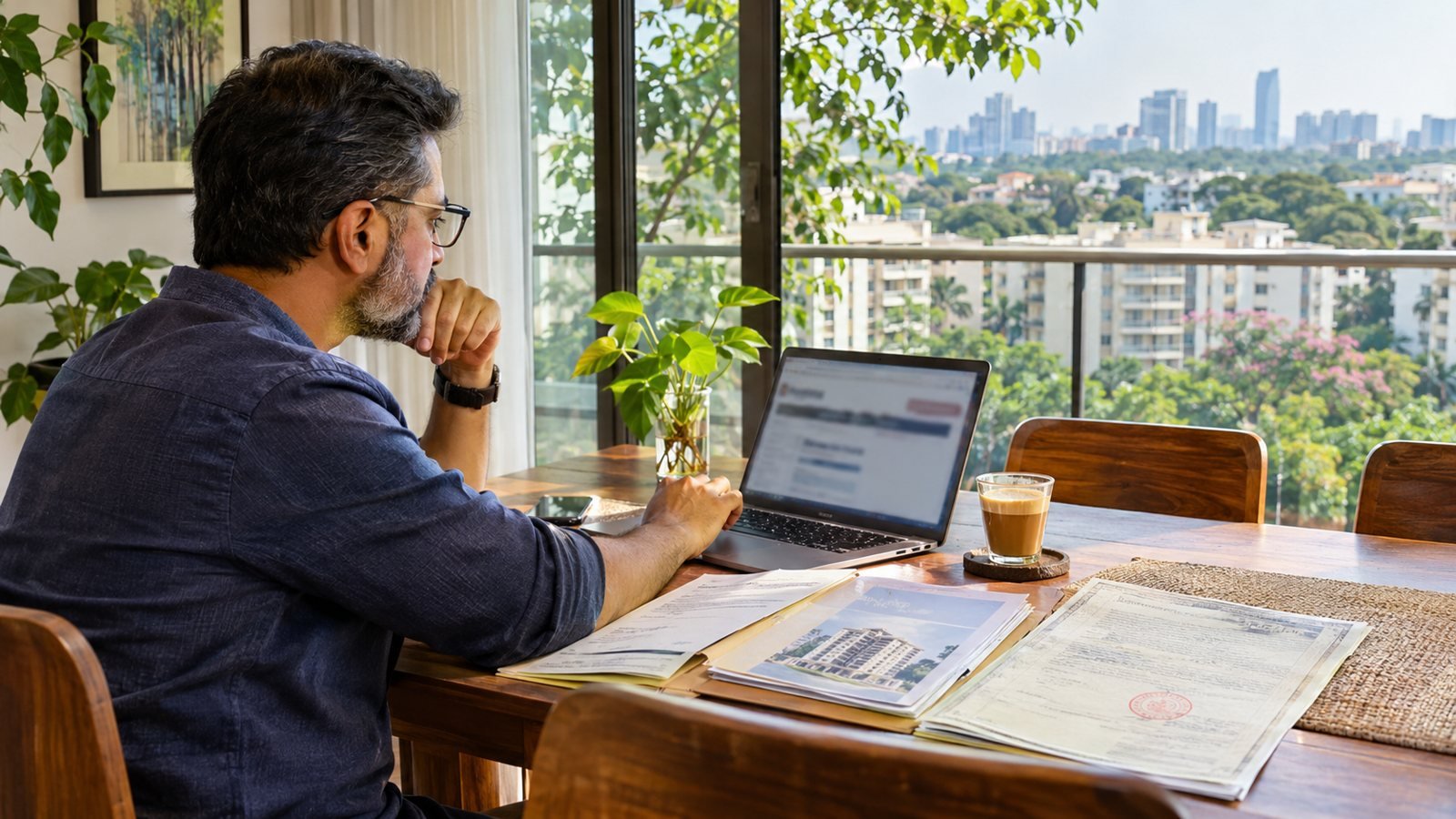
“Your sale deed says you own the house. Your e-Khata says the city agrees. In Bengaluru, you need both on speaking terms.”
• Tariq Sallam, on the document nobody thinks about until a buyer asks for it
I have lost count of the number of people who have told me, with total confidence, that they "already have the e-Khata". Then they open the PDF and it says DRAFT across the top. A draft e-Khata is the city's rough guess at your property, generated from old tax records. It is not the thing your buyer's lawyer, your bank or the sub-registrar will accept. The final e-Khata is.
And the plumbing changed underneath all of us. BBMP is gone, the Greater Bengaluru Authority (GBA) sits on top, five city corporations (Central, North, South, East and West) do the daily khata work, and in September 2026 the portal itself was upgraded to e-Aasthi 2.0. So the guides you bookmarked in 2025 are now slightly wrong in annoying ways.
This is the version I wish I had: what the e-Khata is today, exactly how to get the final one online without paying an agent five figures, what it really costs, how long it takes, and the boring little mistakes that get files kicked back. Grab a coffee. Grab your sale deed too, you will need it.
Quick Information
Everything you need on one screen. Draft means nothing, final means everything. Get the final, and check the portal before you pay anyone a rupee.
What Is an e-Khata in Bangalore?
An e-Khata is the digital version of your khata, the municipal record that says which property exists, where it is, how big it is, who is liable to pay property tax on it, and whether it sits in the A or B register. Each one carries a unique electronic Property ID (ePID), a QR code, location coordinates and your tax history, so anyone can verify it is genuine.
The old paper khata was a handwritten register entry plus a certificate. Lovely calligraphy, very easy to tamper with. The digital version was introduced in October 2024 precisely because lakhs of properties were running on manual records that nobody could cross-check. Since then the state's registration system, Kaveri 2.0, pulls the e-Khata straight from the e-Aasthi database before it lets a sale go through.
An e-Khata is a revenue record, not a title document. It does not prove you own the property; your registered sale deed and title chain do that. But without a final e-Khata, you will struggle to sell, mortgage, get a building plan or transfer the property to your kids.
What Is the Difference Between a Draft and a Final e-Khata?
A draft e-Khata is auto-generated from the old tax database and has not been checked by anyone; a final e-Khata is issued after you upload documents and a revenue officer verifies them, and only the final one works for registration.
- Draft e-Khata. Downloadable by searching your ward and property. Free to view. May have the wrong owner name, wrong area or a missing floor. Treat it as a starting point and a checklist of what to correct.
- Final e-Khata. Digitally signed, with QR code and ePID, issued after verification and payment of the fee. This is what Kaveri, banks and buyers' lawyers ask for.
- The trap. Plenty of owners downloaded the draft in 2024, filed it with their papers and stopped there. If that is you, your property is not sale-ready. Fix it before you need it, not the week your buyer's loan is sanctioned.
What Changed With the Greater Bengaluru Authority and e-Aasthi 2.0?
The short answer: your existing khata is still valid, but the office that handles it and the portal you use have both changed.
Who handles your khata now?
The GBA was constituted in May 2025 and took over from BBMP in September 2025. Property tax, khata and building plan work is now done by five city corporations: Bengaluru Central, North, South, East and West. Corporation elections are still pending, so appointed officials run them for now. Khatas, A or B, issued under BBMP remain valid. Nobody needs to re-apply just because the logo changed.
What does e-Aasthi 2.0 actually add?
The GBA switched on e-Aasthi 2.0 in late September 2026, and Greater Bengaluru Development Minister Krishna Byre Gowda formally launched it a few days later. The useful bits for ordinary owners:
- Draft to final conversion online, with real-time tracking of your application instead of refreshing a page and praying.
- Final e-Khata with mutation, linked to Kaveri, so a registered sale can flow into the khata record with less running around.
- B Khata to A Khata applications can be filed online, for eligible properties.
- Corrections after issue (name spellings, change of name, previous owner details, extent mismatches) through a structured workflow with an approval trail.
- Multiple and older deeds for one property, including deeds from before 2004, which matters for old Jayanagar and Malleshwaram families.
- NRI access from outside Karnataka, subject to verification.
Still promised for later phases: a bulk khata facility for apartment buildings, new khata for properties never on record, and online division or merging of sites. If your case is one of those, expect to visit the ARO office or a mela for now.
“BBMP did not die. It just got split into five and sent to a better-designed website.”
• The cheeky summary
Which Documents Do You Need for a Final e-Khata?
You need your registered deed details, Aadhaar-based e-KYC for every owner, your property tax ID with dues cleared, a photo of the property and, for some properties, an encumbrance certificate and approvals. Keep scans ready as clear PDFs or JPGs before you log in; the portal times out faster than you think.
- Registered sale deed (or gift, partition, settlement deed). You need the registration number, which is printed on the back of the deed, in case the portal does not fetch it automatically from Kaveri.
- Aadhaar e-KYC of every owner. Each owner's Aadhaar is verified by OTP. Joint owners, coordinate who has which phone before you start.
- Property tax SAS application or PID number. From your latest tax receipt. Clear any arrears first; unpaid tax is the single most common reason files stall.
- A photograph of the property. For apartments, a photo of the whole tower from outside, not your living room.
- Encumbrance certificate. Downloadable through Kaveri. Not every application asks for it, but have a recent one ready.
- Electricity bill (BESCOM RR number). Used to tie the property to its utility connection.
- Optional but helpful: approved building plan, layout approval from BDA or the corporation, the DC conversion order for converted land, and the occupancy certificate for newer buildings.
- For apartments: the super built-up, built-up and carpet area and car parking details exactly as stated in your deed.
How Do You Apply for an e-Khata Online, Step by Step?
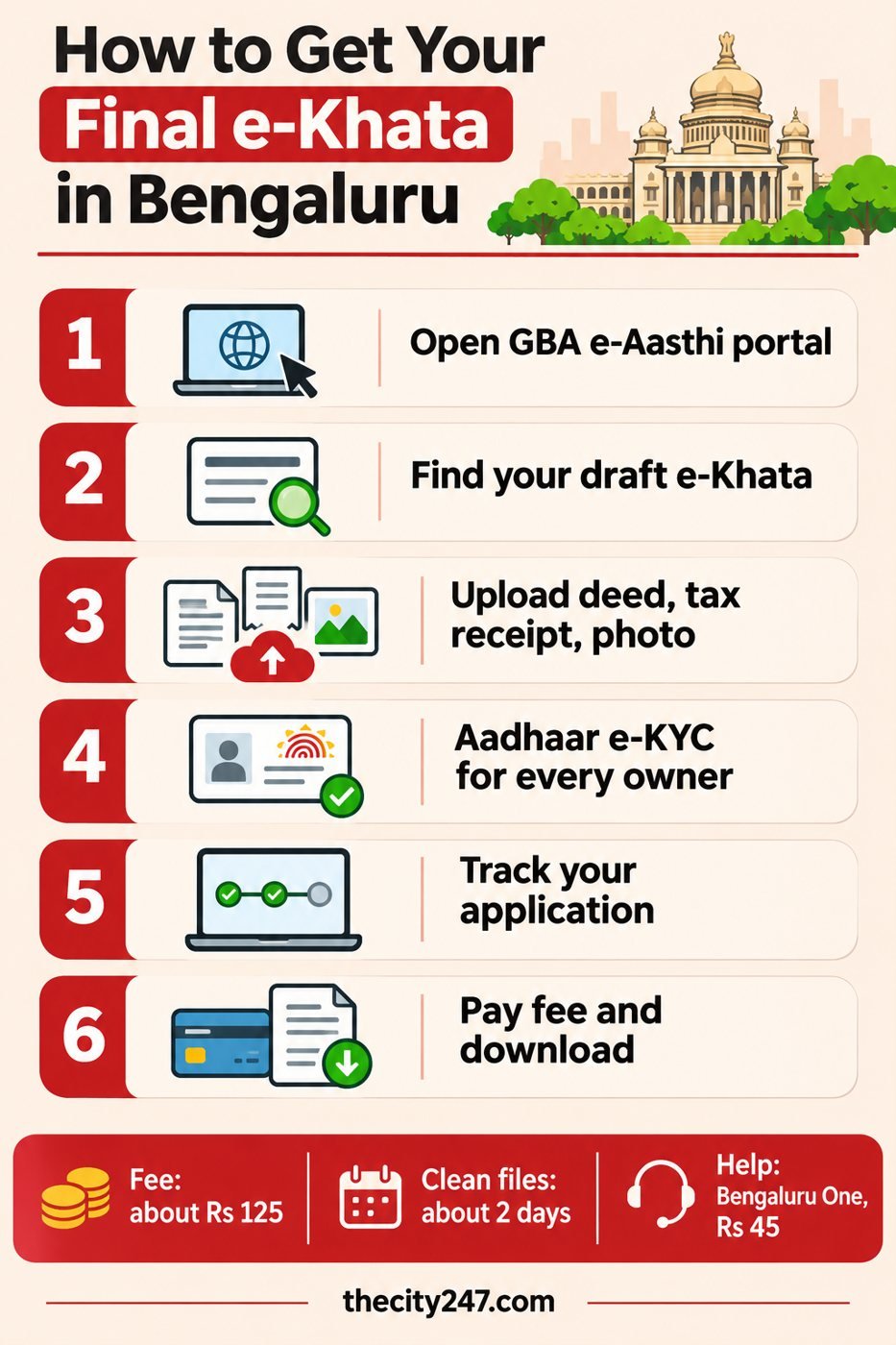
Log in to the GBA e-Aasthi portal with your mobile number, find your property's draft e-Khata, upload the missing documents, complete owner e-KYC, submit and pay the fee once it is approved. Here is the longer version, the way I would walk a friend through it.
- 1. Go to the official portal only. Go to gbaeaasthi.karnataka.gov.in, the GBA e-Aasthi portal. Ignore lookalike sites in search ads that charge you a 'processing fee'.
- 2. Log in with your mobile and OTP. Use a number you will still own next year. Status updates come to it.
- 3. Find your property. Select your corporation, ward and search by owner name, PID or SAS number. Open the draft e-Khata and read every line: owner names, area, floors, address, A or B register.
- 4. Start the draft to final application. Enter or confirm the deed registration number, upload the deed, tax receipt, photo and EC as asked.
- 5. Complete e-KYC for each owner. Aadhaar OTP for every name on the deed. One missing owner equals one stuck file.
- 6. Submit and note the acknowledgement number. Screenshot it. Email it to yourself. You will need it at the helpline or the mela.
- 7. Track, then pay. Track progress in the portal. Once approved, pay the final e-Khata fee online and download the digitally signed PDF.
Not tech-confident, or your parents own the property? Book Janasevaka doorstep help at janasevaka.karnataka.gov.in (or call 080-42474411), or walk into any Bengaluru One centre, where staff upload the file for you for Rs 45. That is the whole fee. Anyone quoting Rs 15,000 'for e-Khata' is charging you for something else, so ask what.
How Much Does an e-Khata Cost in Bangalore?
The official fee for issuing a final e-Khata is about Rs 125, and assisted filing at a Bengaluru One centre or with a registered local entrepreneur costs Rs 45 on top. That is it for a straightforward draft to final conversion.
- Final e-Khata issue: around Rs 125, paid online once the application is approved.
- Assisted upload: Rs 45 at Bengaluru One or through approved local service providers.
- Property tax arrears: whatever you owe, plus penalty. This is often the real cost hiding behind 'my e-Khata is stuck'.
- Mutation after a sale: charged separately and linked to the transaction, so check the amount on the portal at the time of applying.
- B Khata to A Khata conversion: a different beast entirely. From 24 August 2026 the conversion fee was reported at 5% of guidance value, up from 2% earlier in the year. On a property with a Rs 1 crore guidance value, that is Rs 5 lakh. Read our A Khata vs B Khata guide before you start.
How Long Does It Take to Get a Final e-Khata?
GBA says most applications are cleared within about two days of submission, and by January 2026 it reported processing over 99% of nearly nine lakh applications. Files that need a revenue officer to check a mismatch or a site visit can take 10 to 15 days, sometimes longer.
My honest rule of thumb: if your deed, tax record and draft e-Khata all say the same thing, it is quick. If they disagree on your name, your area or your number of floors, it is not, and no amount of refreshing will help. Fix the mismatch, then wait.
Why Do e-Khata Applications Get Rejected?
Most rejections come down to data that does not match: names, areas, floors or tax records that tell different stories. The rest are about unpaid tax, missing owners or construction the city never approved.
- Name mismatch. 'Mohammed' on the deed, 'Mohd' on the tax receipt, 'Mohamed' on Aadhaar. Fix it at the source or use the correction workflow.
- Area mismatch. Super built-up area under-declared for tax years ago. The corporation will want the difference sorted, sometimes with tax arrears.
- Unpaid property tax. Clear dues and penalties on the property tax portal before you apply, not after.
- Unauthorised construction. Extra floors beyond the sanctioned plan will be flagged. The e-Khata will record what is legal, not what you built.
- Missing e-KYC. A co-owner who never completed the Aadhaar OTP. Very common with siblings abroad.
- Wrong document uploaded. Blurry scans, the wrong page, a deed without the registration endorsement. Upload the full, legible deed.
- Disputed or reserved land. Properties in active court cases or on land earmarked for roads and parks will not move until that is resolved.
Rejected? Read the officer's remark in the portal, fix exactly that, and resubmit. If you do not understand the remark, take a printout to the Saturday mela or your ARO office and ask them to explain it in plain Kannada or English. They do, mostly.
What Are the Saturday e-Khata Melas?
They are weekly in-person help camps where corporation revenue staff sit with owners to sort e-Khata problems, held every Saturday from 31 October 2026 across all five city corporations, at ARO offices and other venues listed on the GBA website and social media.
If your file is stuck on a mismatch, a missing record or an inheritance, the mela is the fastest place to get a human to look at it. Carry originals and photocopies of your deed, Aadhaar of all owners, latest tax receipt, EC and your acknowledgement number. Go early. Bengaluru will also go early.
What If Your Property Is a B Khata, an Apartment or Inherited?
B Khata properties get their own e-Khata showing the B register; digitising does not convert them to A Khata. Conversion is a separate online application with its own fee and eligibility rules (on the B register by 30 September 2024, tax paid, no serious violations).
Apartments are recorded by postal address rather than a flat number in the PID. If your flat is missing, or the khata still sits in the builder's name, raise it with your ARO; the promised bulk apartment khata facility on e-Aasthi 2.0 is not live yet. For inheritance, mutation involves a death certificate, a family tree or succession document and a short public notice period before approval.
My own story of debt, collapse and the slow climb back, including the property mistakes I would never repeat.
menu_bookRead it on Amazonopen_in_newe-Khata Bangalore: Frequently Asked Questions
Is e-Khata mandatory in Bangalore?
Yes, for transactions. Since October 2024 a final e-Khata is required to register a sale, gift or mortgage of property within Bengaluru city limits. You can live in your home without one, but you cannot sell or borrow against it.
How do I download my e-Khata online?
Log in to the GBA e-Aasthi portal with your mobile number, search your property by corporation, ward and PID or owner name, and download the e-Khata. A final e-Khata is digitally signed with a QR code; if the document says draft, you still need to apply for the final one.
What is the fee for a final e-Khata?
The official fee to issue a final e-Khata is about Rs 125. If you file through a Bengaluru One centre or an approved local service provider, there is an extra Rs 45 assistance charge.
How many days does e-Khata take?
GBA says most clean applications are cleared in around two days. Files with mismatched names, areas or tax records, or that need a site visit, can take 10 to 15 days or more.
Is my old BBMP khata still valid under GBA?
Yes. A Khata, B Khata and e-Khata records issued by BBMP remain valid after the Greater Bengaluru Authority and its five city corporations took over. You do not need to re-apply.
Can NRIs apply for e-Khata from abroad?
Yes. e-Aasthi 2.0 supports owners outside Karnataka, including NRIs, subject to verification. Aadhaar-based e-KYC is the smoothest route; owners without Aadhaar can authorise someone locally.
Does e-Khata convert a B Khata to an A Khata?
No. Digitising only creates a B e-Khata. Conversion to A Khata is a separate application with eligibility rules and a fee based on guidance value.
What do I do if my e-Khata application is rejected?
Read the officer's remark on the portal, fix the specific issue, such as unpaid tax, a name mismatch or a missing owner e-KYC, and resubmit. For anything unclear, call the helpline on 9480683695 or take your papers to a Saturday e-Khata mela.
Official Contacts and Portals
Go direct. Every one of these is free to use, and none of them needs a middleman.
Is Your e-Khata Still a Draft?
Do not wait for a buyer, a bank or a family emergency to find out. Download yours today and check every line. If something looks wrong, or your application has been sitting in 'pending' longer than your patience, click the WhatsApp icon at the bottom right of your screen and tell me where it is stuck. That is also the quickest way to reach The City 24/7 about anything at all.
Want the next rule change before it bites? Join the newsletter at thecity247.com/newsletter and I will tell you what changed, in plain English, every week.
Same city, new stories, always.

Related Stories
 PROPERTY
Assetz in Bangalore: The Design-Led Builder for People Tired of Beige Towers
September 11, 2026
 PROPERTY
20 Top Builders in Bangalore: Who Actually Delivers, and Who Just Advertises
September 11, 2026
 PROPERTY
Brigade Group in Bangalore: The Township Builder, Reviewed Without the Brochure
September 10, 2026
 PROPERTY
Embassy Group in Bangalore: Luxury Built Around the Office You Work In
September 10, 2026
 PROPERTY
Godrej Properties in Bangalore: The Safe Pair of Hands, and What Safe Costs You
September 10, 2026
 PROPERTY
Prestige Group in Bangalore: The City's Biggest Builder, Honestly Reviewed
September 10, 2026
