


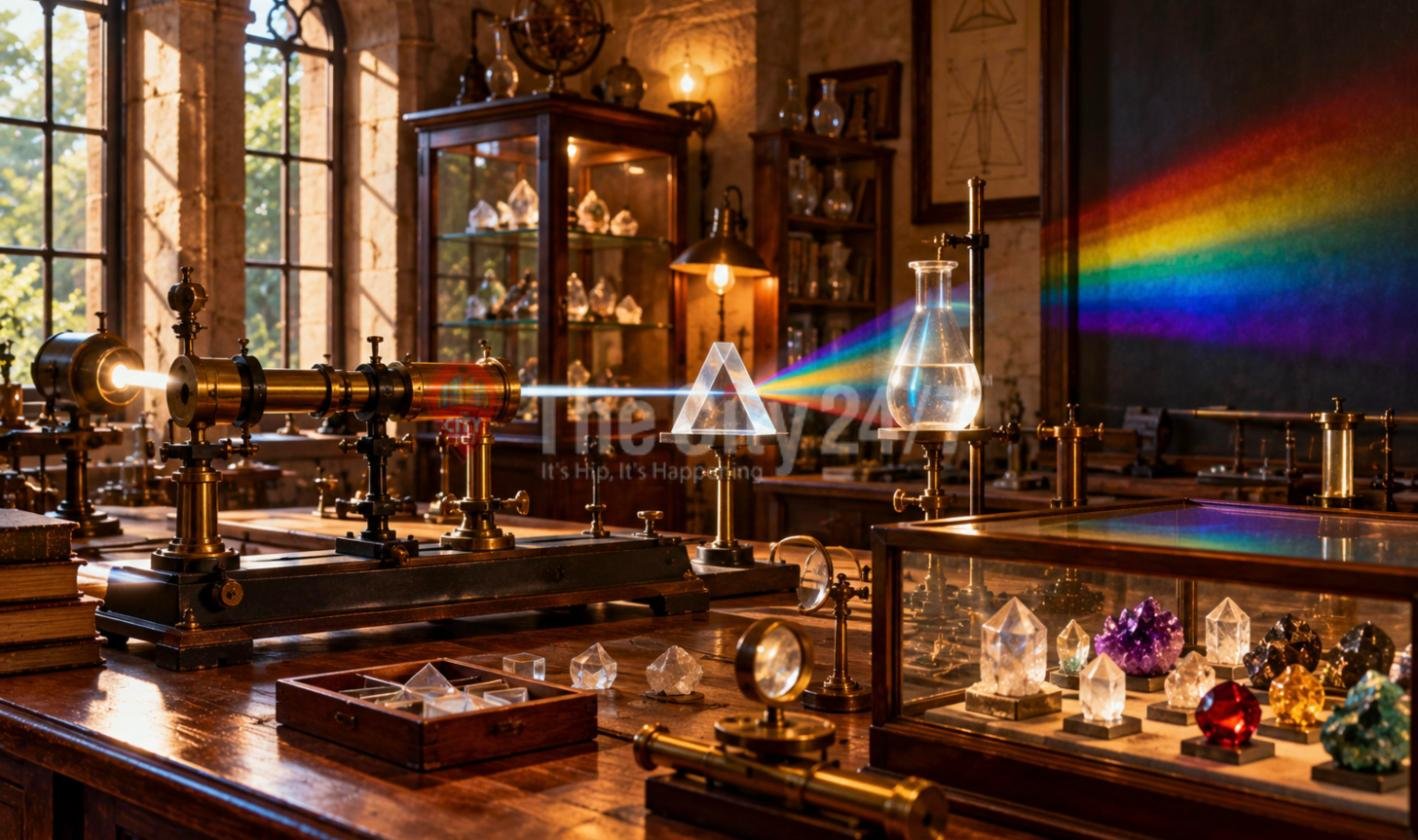
“Ask the right questions, and nature will open the doors to her secrets.”
• A line widely attributed to Sir C V Raman
Sir Chandrasekhara Venkata Raman was the physicist who won the 1930 Nobel Prize in Physics for discovering how light scatters, known ever since as the Raman effect. He moved to Bengaluru in 1933 as the first Indian director of the Indian Institute of Science, founded the Indian Academy of Sciences here in 1934 and the Raman Research Institute in 1948, and lived and worked in the city until his death in 1970.
Bengaluru likes to describe itself as a science city, and most people cite ISRO, IISc and the research labs. Very few mention that the story started with one very stubborn physicist who arrived from Calcutta, argued with nearly everybody, and then built his own institute when he was done arguing. I pass the Raman Research Institute in Sadashivanagar regularly, and the quiet, tree-filled campus still feels like the working garden of a man who never really retired.
His life has been written about in detail, and the physics is well beyond a city blog. What follows is his Bangalore story: why he came, what he built, and why a Nobel laureate spent his last years studying the colours of flowers in a north Bengaluru garden.
Quick Information
One Nobel Prize, two institutions, a diamond collection and a very firm view on how research should be run. Bengaluru got the version of Raman with nothing left to prove.
Who Was Sir C V Raman?
He was one of the most important physicists of the twentieth century and the first Asian to win a Nobel Prize in science. A prodigy who finished his master's degree in Madras in his teens, he joined the government finance service in Calcutta and did research in his spare time before becoming a professor of physics at the University of Calcutta.
- The discovery. On February 28, 1928, Raman and his colleague K S Krishnan announced that light changes wavelength when it scatters through a transparent material. It became the Raman effect.
- The instrument. The early experiments were done with remarkably simple equipment, a point he took pride in for the rest of his life.
- The Nobel. Awarded in 1930. He was so sure he would win that he reportedly booked his passage to Stockholm before the announcement.
- Before light. He also did serious work on the acoustics of Indian instruments, including the veena, the mridangam and the tabla.
Why Did C V Raman Move to Bengaluru?
He came in 1933 to become director of the Indian Institute of Science, the first Indian to hold the post. IISc had been founded in Bengaluru in 1909 with the support of Jamsetji Tata and the Maharaja of Mysore, and Raman arrived with plans to turn it into a world-class centre for physics.
His time as director was stormy. He was demanding, quick to take on colleagues and administrators, and determined to run the institute his way. He stepped down as director in 1937 but stayed on as professor of physics until 1948. The friction is part of the story, and Bangalore's science community still tells it with some affection.
“He left the directorship, not the city. That tells you what Bengaluru meant to him.”
• On why Raman stayed
What Did C V Raman Build in Bengaluru?
Two lasting institutions. The Indian Academy of Sciences, founded in 1934 to publish and promote Indian research, and the Raman Research Institute, founded in 1948 on land given to the Academy by the Mysore government. Both still operate from Bengaluru.
- Indian Academy of Sciences, 1934. Based in Sadashivanagar, it still publishes scientific journals and runs programmes for students and teachers.
- Raman Research Institute, 1948. He directed it himself until his death. Today it works on astronomy and astrophysics, light and matter physics, soft condensed matter and theoretical physics.
- A generation of scientists. Students and colleagues who trained with him at IISc and RRI went on to shape Indian physics.
- A science culture. His insistence that world-class research could be done in India, with Indian money and Indian scientists, set the tone for the city's later institutions.
What Did Raman Do in His Later Years in Bengaluru?
He kept doing research, largely on his own terms. At the Raman Research Institute he studied the optics of crystals, gemstones and diamonds, and later the physiology of colour and vision, including why flowers and butterflies look the way they do. He built up a large collection of minerals and diamonds for the purpose.
He also gave public lectures, famously direct ones, and was known for encouraging schoolchildren and young scientists while being far less patient with committees and bureaucracies. Stories of him walking the institute gardens, examining blooms, are part of the campus's history.
After his death on November 21, 1970, Raman was cremated in the gardens of the Raman Research Institute, in keeping with his wishes. He began and ended his Bengaluru life in the places he built.
Where Can You See C V Raman's Legacy in Bengaluru?
Mostly in north Bengaluru, and mostly from the outside. The Raman Research Institute and the Indian Academy of Sciences in Sadashivanagar, and the IISc campus in Malleshwaram, are working research institutions rather than museums, so visits usually depend on open days and events.
- Raman Research Institute. C V Raman Avenue, Sadashivanagar. A working research campus. Look out for open days, often held around National Science Day.
- Indian Academy of Sciences. Also in Sadashivanagar, with public lectures and programmes for students.
- IISc. The Malleshwaram campus holds an annual open day that is one of the best free days out in the city for anyone curious about science.
- Names on the map. C V Raman Road in north Bengaluru, and C V Raman Nagar in the east, along with the C V Raman General Hospital in Indiranagar.
- National Science Day. February 28 each year, marking the 1928 announcement, when science institutions across the city hold events.
If you want to feel the Raman connection, go to the IISc open day, then drive ten minutes to Sadashivanagar and look at the RRI gates. The idea that India's first science Nobel ended up in a garden near Sankey Tank is a very Bengaluru story.
What Can Bangaloreans Learn From C V Raman?
That curiosity does not have a retirement age, and that institutions are the way good ideas survive their founders. He could have rested on the Nobel. Instead he built an academy and an institute, kept working into his eighties and asked questions about flowers that most people never think to ask. In a city now full of research labs, his is the original model.
Why Does C V Raman Belong in People of Bangalore?
Raman chose Bengaluru. He came to lead IISc, stayed after he stepped down, founded two institutions that still work here, and spent the last 37 years of his life in the city. Bengaluru's reputation as India's science city starts, in a very real sense, with him.
I haven't interviewed Sir C V Raman for this piece. It's pieced together from online research: published interviews, news reports, books and official records, cross-checked against each other. If you know Sir C V Raman and spot something I've got wrong, tap the WhatsApp icon at the bottom right and tell me, and I'll fix it.
FAQs
Did C V Raman live in Bengaluru?
Yes. He moved to Bengaluru in 1933 to become director of the Indian Institute of Science and lived in the city until his death on November 21, 1970. He founded the Indian Academy of Sciences and the Raman Research Institute here.
What is the Raman effect?
The Raman effect is the change in wavelength that happens when light is scattered by molecules. Raman and K S Krishnan announced the discovery on February 28, 1928, and it earned Raman the Nobel Prize in Physics in 1930.
When did C V Raman win the Nobel Prize?
He won the Nobel Prize in Physics in 1930 for his work on the scattering of light. He was the first Asian to win a Nobel Prize in a science category.
What is the Raman Research Institute?
The Raman Research Institute in Sadashivanagar, Bengaluru, was founded by Raman in 1948. It is now an autonomous research institute working on astronomy and astrophysics, light and matter physics, soft condensed matter and theoretical physics.
Was C V Raman the director of IISc?
Yes. He became the first Indian director of the Indian Institute of Science in 1933. He stepped down as director in 1937 and continued as professor of physics until 1948.
Why is National Science Day celebrated on February 28?
India celebrates National Science Day on February 28 because that is the date in 1928 when Raman announced the discovery of the Raman effect.
Can you visit the Raman Research Institute?
It is a working research institute rather than a public museum, so general visits are limited. It holds open days and public events, often around National Science Day, and details are posted on its website.
Where is C V Raman buried?
Raman was cremated in the gardens of the Raman Research Institute in Bengaluru after his death in 1970, in keeping with his wishes.
Contact Details
The Bengaluru institutions most closely tied to Raman.
Studied at IISc or RRI?
If you worked with or studied under someone from Raman's school, or have a story about him in Bengaluru, Click the WhatsApp icon at the bottom right of your screen and tell me. That is also the easiest way to reach The City 24/7 about anything at all, including nominating someone for People of Bangalore.
And if you want one story about the people who make this city, every Sunday, join our ever growing community at thecity247.com/newsletter. Free, and about ten seconds of your life.
Same city, new stories, always.

Related Stories
 SCIENCE
Raja Ramanna: The Physicist Who Played the Piano and Founded NIAS
October 3, 2026
 SCIENCE
C N R Rao: The Basavanagudi Boy Who Became India's Great Chemist
October 18, 2026
 SCIENCE
K Kasturirangan: The Space Scientist Who Also Rewrote Indian Education
October 16, 2026
 SCIENCE
B. P. Radhakrishna: The Bengaluru Man Called the Doyen of Indian Geology
September 25, 2026
 SCIENCE
S K Shivakumar: The IISc Engineer Who Gave Bangalore a Line to the Moon
October 27, 2026
 SCIENCE
U R Rao: How India's First Satellite Was Built in a Bengaluru Industrial Shed
October 16, 2026
