


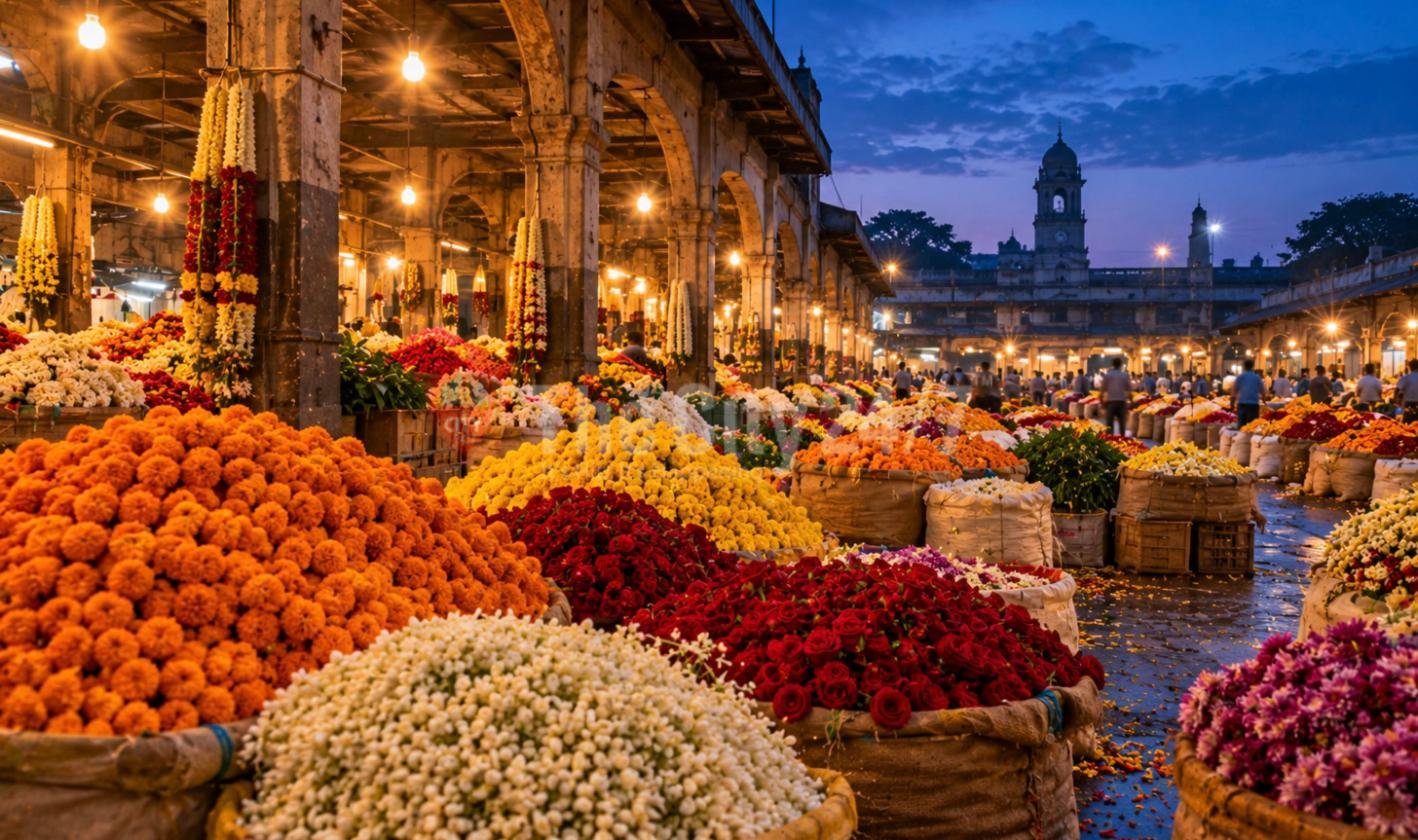
“At five in the morning KR Market is one of the great sights in India. At two in the afternoon it is a traffic jam that smells of yesterday's flowers. Same place, seven hours apart.”
• The only thing you need to know
Krishna Rajendra Market, universally called KR Market or City Market, is at its best between about 4 and 8 AM, particularly the flower section. It sits in the old city near Kalasipalya and Chickpet, entry is free, and it is a working wholesale market rather than a tourist site. Take the Green Line metro to Krishna Rajendra Market station.
This is the commercial centre of the Bengaluru that existed before the cantonment, before Malleshwaram, before any of it. The market sits roughly where Kempe Gowda's city had its main trading quarter, the Tipu Sultan palace and the fort remains are minutes away, and Chickpet's textile lanes run off the same junction.
The flower market is the reason people come. Marigold, jasmine, rose, chrysanthemum and tuberose arrive overnight from the surrounding districts in quantities that are hard to comprehend, and by mid-morning most of it has been sold. This guide covers when to go, what to buy, and how to manage a place that does not care whether you are there. I will be upfront: it is loud, wet underfoot and completely indifferent to you, and that is exactly why I think every Bengalurean should see it at dawn at least once.
Quick Information
A working wholesale market with one perfect hour and eleven difficult ones. Plan accordingly.
What Time Should You Go to KR Market?
Between 4 and 8 AM, and preferably before 6. The flower trade happens overnight and at dawn, the produce arrives in the same window, and the light in the flower section at first light is the reason photographers keep coming back. By eleven the wholesale is done and what remains is congestion.
- 4 to 6 AM. The peak. Lorries unloading, flowers being weighed and sold in bulk, the market at full volume with no tourists at all.
- 6 to 8 AM. Excellent, with daylight for photographs and the trade still active. The best compromise if 4 AM is unrealistic.
- 8 to 11 AM. Winding down. Retail buying still possible, atmosphere much reduced.
- After midday. Do not. Heat, congestion, refuse and none of the reason you came.
- Before festivals. Extraordinary volumes and prices, particularly before Varamahalakshmi, Ayudha Puja and Diwali. Chaotic and worth seeing.
Do not drive to KR Market. The surrounding area is among the most congested in India and there is no realistic parking. Take the Green Line to Krishna Rajendra Market station, or take an auto and have it drop you at the edge.
What Is the KR Market Flower Market Like?
One of the largest flower markets in Asia, operating mostly in the pre-dawn hours, with marigold, jasmine, rose, chrysanthemum, tuberose and crossandra arriving from the horticultural belts around Bengaluru and being sold by weight in bulk. Garland makers work through the night on site.
- The flowers. Marigold in orange and yellow by the sackful, jasmine measured in armlengths, roses in crates, tuberose, chrysanthemum and crossandra. Volume is the thing that registers.
- The garland makers. Working at speed on the floor, stringing jasmine and marigold. Watch rather than interrupt.
- Where it comes from. The horticultural districts around Bengaluru, Chikkaballapur, Kolar, Hosur and further, arriving overnight.
- Prices. Wholesale, and a fraction of what the same flowers cost outside a temple. Buying in retail quantity is possible and cheap.
- The photographs. This is the most photographed market in the city for good reason. Ask vendors before shooting them closely, and most will agree.
- Seasonality. Wedding season and festival weeks are peak. The days before Ayudha Puja and Varamahalakshmi are the most intense of the year.
“The flowers arrive overnight from Kolar and Chikkaballapur, change hands before sunrise, and are on temple doors across the city by breakfast. The whole cycle happens while most of Bengaluru sleeps.”
• On how the market works
What Else Can You Buy at KR Market?
Fruit and vegetables in wholesale quantities, spices, copper and brass vessels, plastic and household goods, festival items, and in the surrounding lanes almost anything else. Chickpet's textile and silk trade runs off the same junction, and Avenue Road's book and stationery shops are a short walk.
- Fruit and vegetables. Wholesale, in the main market building and surrounding lanes. Prices are a revelation if you normally buy retail.
- Copper and brass. Traditional vessels, lamps and puja items, in dedicated lanes. Good quality and negotiable.
- Spices and dry goods. By weight, and considerably cheaper than any supermarket.
- Festival goods. Everything required for any festival in the calendar, in season. This is where the city actually shops for Diwali and Ganesha Chaturthi.
- Chickpet, adjoining. Silk sarees, textiles, wedding wear and wholesale fabric. A separate guide in itself, and a separate set of hours.
- Avenue Road. Books, stationery, musical instruments. Ten minutes on foot and a completely different trade.
How Do You Handle the Density and Stay Safe?
Closed shoes, a bag you can hold in front of you, no valuables on display, and an awareness that handcarts and porters have right of way. This is a working market where large volumes of goods move through narrow spaces at speed, and you are the obstacle.
- Footwear. Closed shoes with grip. The ground is wet, uneven and covered in discarded plant matter.
- Belongings. A crossbody bag held in front. Phones in a front pocket. Crowded markets everywhere require this and so does this one.
- Handcarts and porters. They are carrying two hundred kilos and cannot stop. Listen for them and step aside.
- Photography courtesy. Ask. Most vendors are fine with it and a few are not, and the difference is whether you asked.
- Do not block trade. If you are standing where a transaction is happening, you are in the way. Move along and watch from the edges.
- Hygiene. Carry hand sanitiser. Eat at the established stalls rather than the improvised ones.
How Do You Get to KR Market?
Green Line metro to Krishna Rajendra Market station, which puts you at the edge of the market. Kalasipalya and KR Market are also major BMTC bus hubs. Under no circumstances drive.
- Metro. Krishna Rajendra Market station on the Green Line, with Chickpet station one stop away for the textile lanes. The only sensible way in.
- Metro timings versus market timings. The metro does not run at 4 AM. If you want the pre-dawn market, you need an auto or cab.
- Auto or cab. The answer for an early start. Have the driver drop you at the market edge rather than trying to get inside.
- Bus. KR Market and Kalasipalya are major BMTC hubs with service from everywhere in the city.
- Do not drive. Repeated because people try. There is no parking and the streets are wholesale loading areas.
What Is the Best Morning That Includes KR Market?
Flower market at 5 AM, Chickpet when the shops open at 9, Bangalore Fort and Tipu's Summer Palace at 10, and Gavi Gangadhareshwara or Basavanagudi by noon. It is the best heritage and commerce walk in the city and almost nobody does the whole thing.
- 5 AM, the flower market. Auto in. The market at its peak, before sunrise.
- 7 AM, breakfast. The old eating houses around Avenue Road and Balepet open early. Idli, vada, filter coffee.
- 9 AM, Chickpet. As the textile shops open. Silk, sarees and the narrow lanes of the old commercial quarter.
- 10 AM, Bangalore Fort and Tipu's Summer Palace. The surviving fort wall and Delhi Gate, then the teak palace at opening.
- 11.30 AM, Gavi Gangadhareshwara. The cave temple at Gavipuram, twenty minutes away.
- Total. Seven hours, one auto fare, one metro ticket, and the oldest part of this city covered properly.
FAQs
What time does KR Market open?
The flower market operates from roughly 4 AM, with the real wholesale trade happening before 8 AM. The general market runs through to around 2 PM, and Chickpet's textile shops nearby keep separate hours of roughly 9 AM to 9 PM.
What is the best time to visit KR Market?
Between 4 and 8 AM, and preferably before 6. That is when the flower trade is at full volume and the market is at its most extraordinary. After midday it is congestion, heat and refuse with none of the reason you came.
Is KR Market the largest flower market in Asia?
It is commonly described as one of the largest flower markets in Asia, handling marigold, jasmine, rose, chrysanthemum and tuberose arriving overnight from the horticultural districts around Bengaluru. Volume peaks before major festivals and during wedding season.
Can you buy flowers at KR Market in small quantities?
Yes. Although it is primarily a wholesale market, vendors will sell in retail quantities and prices remain a fraction of what the same flowers cost outside a temple or at a neighbourhood stall.
How do I get to KR Market?
Green Line metro to Krishna Rajendra Market station, with Chickpet station one stop away for the textile lanes. For a pre-dawn visit the metro is not running, so take an auto or cab and have it drop you at the market edge. Do not drive, as there is no realistic parking.
Is KR Market safe to visit?
Yes, with ordinary market precautions. Wear closed shoes because the ground is wet and uneven, carry a crossbody bag in front of you, keep your phone in a front pocket, and be alert to handcarts and porters who are carrying heavy loads and cannot stop for you.
Can you take photographs at KR Market?
Generally yes, and it is the most photographed market in the city. Ask individual vendors before photographing them closely, and most will agree. Do not stand where a transaction is happening, since you are blocking someone's livelihood.
What else can you buy at KR Market?
Wholesale fruit and vegetables, spices and dry goods by weight, copper and brass vessels and puja items, plastic and household goods, and everything required for any festival in the calendar. Chickpet's silk and textile trade and Avenue Road's book and stationery shops are both a short walk away.
Contact Details
Useful sources, mostly civic, since this is a municipal market rather than an attraction.
Have You Been at Five in the Morning?
If you shop here, trade here or have found the best hour and the best corner, click the WhatsApp icon at the bottom right of your screen and tell me. I would like to write about this market at much greater length. That is also the easiest way to reach The City 24/7 about anything at all.
And if you want city guides, weekend plans and neighbourhood notes landing in your inbox, join our ever growing community at thecity247.com/newsletter. Free, and about ten seconds of your life.
Same city, new stories, always.

Related Stories
 CITY GUIDE
A Guide to Bangalore's Markets: Go at Six, Leave by Nine
August 1, 2026
 CITY GUIDE
25 Things You Probably Didn't Know About Bangalore
November 1, 2026
 CITY GUIDE
Bangalore Metro: I Rode Every Metro Line, So You Don't Have To (You're Welcome)
October 30, 2026
 CITY GUIDE
Aquarium Paradise, Palace Road: India's Longest Underwater Tunnel Is in Bengaluru
September 24, 2026
 CITY GUIDE
Dodda Ganapathi, Basavanagudi: The 18 Foot Ganesha They Cover in Butter
September 24, 2026
 CITY GUIDE
Dwadasha Jyotirlinga, Omkar Hills: All Twelve Jyotirlingas Without Leaving Bengaluru
September 23, 2026
