


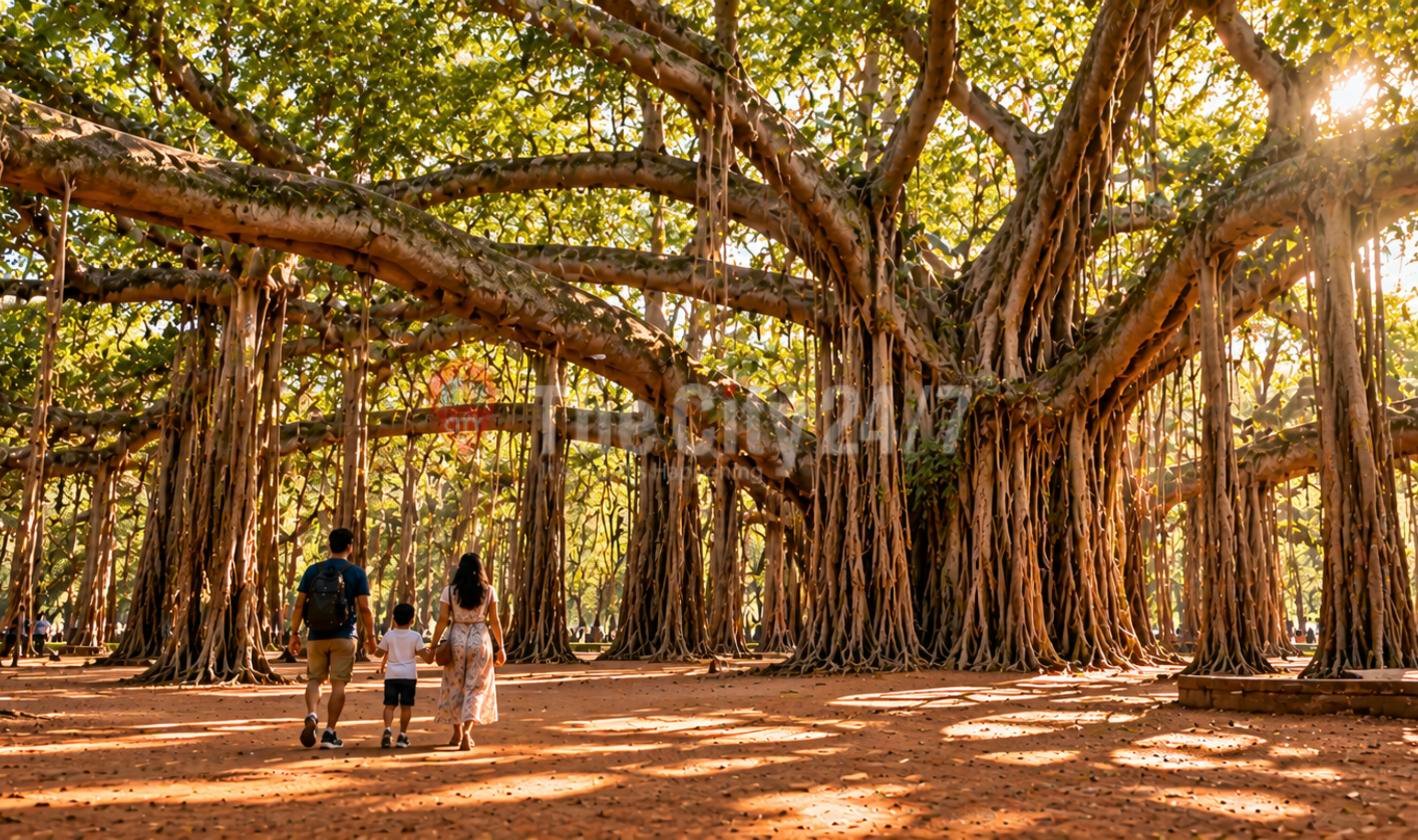
“The strangest thing about the Big Banyan Tree is that the tree itself died. What you walk through is its children, still attached.”
• On what you are actually looking at
Dodda Alada Mara, the Big Banyan Tree, is about 30 km west of Bangalore at Kethohalli near Tavarekere. It is open roughly 8 AM to 5 PM daily, entry is free or nominal, and the tree spreads across about three acres and is thought to be over 400 years old. Go early morning on a weekday, and budget an hour on site.
It is one of the largest banyans in India, and the interesting part is structural. The original main trunk succumbed to disease decades ago and was removed. What survives is the ring of prop roots that had grown down from its branches, each now a trunk in its own right, so you are walking through what is technically one organism pretending to be a small forest.
I will be honest with you about this trip, because a lot of writing about it is not. It is a forty-five minute drive to look at a tree for an hour. If you go expecting a day out you will be disappointed, and if you go at 8 AM on a Tuesday with a flask of coffee it is quietly wonderful. This guide covers the route, the timings, what to combine it with, and how to get the good version.
Quick Information
A very old tree with no facilities and one narrow road. Here is what you need before you set out.
Where Is the Big Banyan Tree and How Do You Get There?
At Kethohalli village near Tavarekere, about 30 km west of central Bengaluru. The usual route is out on Mysore Road and then right towards Tavarekere and Kethohalli, or via Magadi Road if you are coming from the north of the city. Forty-five minutes to ninety, depending entirely on when you leave.
- Via Mysore Road. The standard approach. Out past Kengeri, then the turn towards Tavarekere. Good road until the last few kilometres, which are narrow village lanes.
- Via Magadi Road. Better if you are starting from Rajajinagar, Malleshwaram or the north-west. Slightly rougher.
- When to leave. Before 7.30 AM. The Mysore Road approach through Kengeri backs up badly after that.
- By bus. BMTC services run towards Tavarekere and Kethohalli, though not frequently. Possible, slow, and worth checking current routes.
- By cab. Rs 700 to 1,200 each way. Arrange the return, since finding a cab at Kethohalli is not reliable.
- Parking. A small paid lot at the entrance. Fine on a weekday, chaotic on a Sunday.
The last three kilometres are narrow village road with two-way traffic and no verge. On a Sunday afternoon that road becomes a slow-moving queue of cars trying to pass each other. Go on a weekday and the problem does not exist.
What Is Actually There to See?
A grove of connected trunks covering about three acres, with paved and dirt paths running between them, a small temple, and a great many monkeys. The experience is walking slowly through a structure that behaves like architecture but is alive.
- The prop root trunks. The main sight. Dozens of aerial roots that reached the ground and thickened into trunks, all part of one tree. Some are enormous.
- The absent centre. Look for where the original trunk stood. Its removal is why the grove has a rough ring shape, and knowing this changes how you read the place.
- The Muneshwara temple. A small shrine at the site, which is why the tree has been protected for generations rather than cleared.
- The canopy. Best appreciated by standing still and looking up. The light through it in the early morning is the reason photographers come.
- Birds. Parakeets, mynas, barbets and a good deal of noise. Worth ten minutes of just listening.
- The monkeys. Bonnet macaques, numerous and confident. Keep food out of sight and do not feed them.
“It is one organism the size of a city block. Stand under it for ten minutes before you start photographing it, and that fact lands properly.”
• How to actually see the place
Is the Big Banyan Tree Worth Visiting?
Yes, on a weekday morning, and no as a weekend family outing on its own. The tree is genuinely remarkable and the site is small, unimproved and has almost no facilities. An hour there is satisfying. Three hours of driving for an hour of tree is only worth it if you pair it with something else.
- Go if. You like trees, geology, photography or quiet. You are leaving the city before 7.30 AM. You want a short morning rather than a day.
- Do not go if. You are expecting a park with facilities, a playground or food. Or if you are going on a Sunday afternoon with children in the car.
- The honest comparison. Lalbagh and Cubbon Park give you more for less effort. This gives you something neither can: a single 400-year-old organism you can walk inside.
- Best done as. A stop on a longer morning that includes Manchanabele or Savandurga, with breakfast on Mysore Road.
What Should You Combine It With?
Manchanabele reservoir, Savandurga or the Mysore Road breakfast belt. All three are within twenty-five kilometres, and any of them turns a one-hour stop into a proper half day.
- Manchanabele reservoir, about 15 km. The closest real water body to the city, with kayaking operators and a quiet shoreline. The natural pairing.
- Savandurga, about 25 km. One of Asia's largest monolithic hills and a hard 90-minute climb on bare rock. Start there at 6.30 AM, then the tree afterwards.
- Ramanagara, about 25 km. Granite, climbing routes and the silk town, on the Mysore Road side.
- Mysore Road breakfast. The Kamat Lokaruchi and Bidadi thatte idli belt. Genuinely one of the best reasons to drive out this way.
- Do not try to add Bannerghatta. It is in a different direction entirely, on the other side of the city's southern edge.
When Is the Best Time to Visit?
Between 8 and 10 AM on a weekday, in any month. The site has full shade so heat is less of a problem than elsewhere, but the crowd and the road are the constraints, and both are at their worst on weekend afternoons.
- Weekday mornings. Almost empty, cool, and the light through the canopy is at its best. This is the version worth driving for.
- Weekend mornings. Busier but manageable if you arrive by 8.30 AM.
- Weekend afternoons. A picnic ground with a traffic problem on the approach road. Avoid.
- Monsoon, June to September. Green, atmospheric and muddy underfoot. Bring shoes you do not mind.
- Summer, March to May. Fine, because the canopy is complete shade. One of the few outdoor sites near the city that works in April.
What Should You Carry and Know Before Going?
Water, closed shoes, cash for parking, and no visible food. There are no real facilities on site, the ground is uneven roots and dirt, and the monkeys are experienced at relieving visitors of snacks.
- Water. Carry your own. Vendors outside the gate are limited and inconsistent.
- Footwear. Closed shoes. You are walking on tree roots and uneven earth.
- Cash. For parking and the vendors outside. UPI is patchy.
- Monkeys. Do not carry food in your hands or in an open bag, and do not feed them. They are bold and fast.
- Do not carve or climb. It is a protected living monument managed by the forest department, and the roots are load-bearing.
- Carry your rubbish out. The site suffers badly from weekend litter, and this is the whole difference between it staying open and pleasant or not.
- Accessibility. Natural terrain with roots and uneven paths. Not suitable for wheelchairs or strollers.
FAQs
Where is the Big Banyan Tree in Bangalore?
At Kethohalli village near Tavarekere, about 30 km west of central Bengaluru, usually reached via Mysore Road or Magadi Road. The drive takes 45 minutes to an hour and a half depending on traffic, and the last few kilometres are narrow village lanes.
What are the Big Banyan Tree timings?
Roughly 8 AM to 5 PM daily. Entry is free or nominal, with a small parking charge at the gate. The best window is 8 to 10 AM on a weekday, when the site is almost empty and the light through the canopy is at its best.
How old is Dodda Alada Mara?
It is estimated to be over 400 years old and spreads across about three acres, making it one of the largest banyan trees in India. The original main trunk died of disease and was removed, so what you walk through is a grove grown from its own aerial prop roots.
Is the Big Banyan Tree worth visiting?
On a weekday morning, yes. It is a genuinely remarkable living structure and an hour there is satisfying. As a standalone weekend family outing it disappoints, because the site is small with almost no facilities. Pair it with Manchanabele or Savandurga for a proper half day.
Is there an entry fee for the Big Banyan Tree?
Entry is free or a nominal charge, with a small fee for parking at the gate. Carry cash, since UPI acceptance at the gate and with the vendors outside is unreliable.
What can I combine with a Big Banyan Tree visit?
Manchanabele reservoir about 15 km away for kayaking and a quiet shoreline, Savandurga about 25 km away for a hard rock climb, or Ramanagara on the Mysore Road side. The Mysore Road breakfast belt around Bidadi is worth planning into the drive.
Are there monkeys at the Big Banyan Tree?
Yes, bonnet macaques are numerous and confident. Keep food out of sight, do not carry snacks in an open bag, and do not feed them. This is the most common complaint visitors have and it is almost entirely avoidable.
How long does a visit to the Big Banyan Tree take?
Forty-five minutes to an hour on site is enough to walk the paths, look at the prop root trunks properly and visit the small Muneshwara temple. The drive is longer than the visit, which is why pairing it with something else is sensible.
Contact Details
Official sources, since access arrangements and timings at smaller forest department sites do change.
Been Out That Way?
If the timings or access have changed, or you have found a good pairing for this drive that I have missed, click the WhatsApp icon at the bottom right of your screen and tell me. I will go and check. That is also the easiest way to reach The City 24/7 about anything at all.
And if you want city guides, weekend plans and neighbourhood notes landing in your inbox, join our ever growing community at thecity247.kit.com/join-the-community. Free, and about ten seconds of your life.
Same city, new stories, always.

Related Stories
 CITY GUIDE
Dodda Ganapathi, Basavanagudi: The 18 Foot Ganesha They Cover in Butter
September 24, 2026
 CITY GUIDE
Ghati Subramanya: The Snake God Temple an Hour North of Bengaluru
September 23, 2026
 CITY GUIDE
Bull Temple, Basavanagudi: The Giant Nandi That Gave a Neighbourhood Its Name
September 7, 2026
 CITY GUIDE
Aquarium Paradise, Palace Road: India's Longest Underwater Tunnel Is in Bengaluru
September 24, 2026
 CITY GUIDE
Dwadasha Jyotirlinga, Omkar Hills: All Twelve Jyotirlingas Without Leaving Bengaluru
September 23, 2026
 CITY GUIDE
Fun World, Palace Road: The Amusement Park in the Middle of the City
September 23, 2026
