


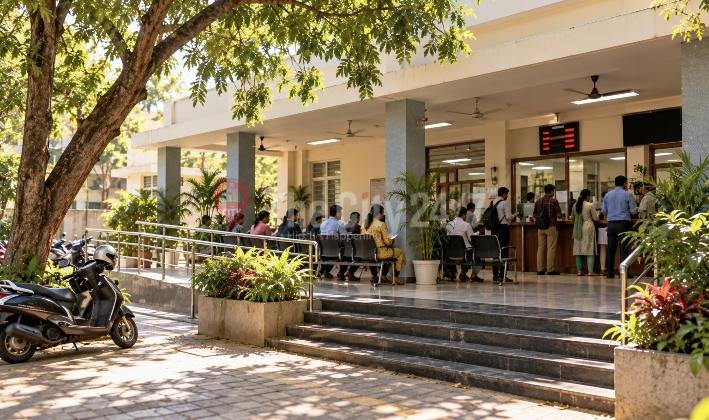
“Nobody thinks about an income certificate until a form asks for one, and by then the deadline is a week away. It takes up to 21 days. Apply before you need it.”
• On the single most common mistake
I have lost count of the number of people who have messaged me in a panic about this one. A scholarship portal closes on Friday, the college wants an income certificate, and the applicant discovers on Tuesday that it is not something you collect over a counter. It is an application, it goes through verification by a Revenue Inspector or Village Accountant, and Karnataka's own service guarantee allows the department up to 21 days to deliver it.
The good news is that the process itself is genuinely straightforward and genuinely cheap. Karnataka's Revenue Department moved certificate applications online under the Atalji Janasnehi Kendra project, which is the Nadakacheri portal you will be using. There is no separate account to create. Your Aadhaar linked mobile number is your login, an OTP is your password, and the fee is commonly cited at fifteen rupees.
What trips people up is not the form. It is the verification visit, the documents that do not match, and the fact that an income certificate in Karnataka is generally valid for one year only, which means the one you got for last year's scholarship is already useless for this year's. This guide covers the whole thing: who can apply, what to gather, the steps, the fees, the timeline, what happens during verification and how to download the digitally signed PDF at the end.
Quick Information
Everything that matters, in the time it takes to lose a document. Confirm current fees and requirements on the official portal before applying.
What Is an Income Certificate and Why Does Karnataka Ask for One?
It is an official Revenue Department statement of your family's total annual income, and it is the document that decides whether you qualify for income linked benefits. Scholarships, reserved seats, subsidised housing, fee concessions, welfare schemes and certain loans all use it as the gatekeeping proof.
The certificate does not state your salary. It states household income from every source: salaries, agricultural income, rental income, business income, pensions and interest. This is the part applicants most often get wrong. Declaring only your own salary when the household also has a father's pension and rent from a portion of the house is the kind of mismatch that verification is specifically designed to catch.
Karnataka issues it through the Revenue Department, with the Tahsildar as the signing authority and the Revenue Inspector or Village Accountant doing the ground verification. That two step structure is why it takes time. The form is instant. The check is not.
Who Can Apply for an Income Certificate in Karnataka?
Any resident of Karnataka can apply for themselves or as the head of the household. The applicant needs to be able to establish residence in the state and produce proof of the household income being declared.
- Residents of Karnataka. You apply in the taluk where you reside. Address proof establishes the jurisdiction, and applying in the wrong taluk is a straightforward way to have the file bounced.
- Students and their families. The most common use by a distance. Scholarship portals, college admissions under reserved categories and fee concession schemes all ask for a current certificate, usually one issued within the last year.
- Households applying for welfare schemes. Housing schemes, subsidy programmes and various state benefits are income linked, and the certificate is the standard proof of eligibility.
- Applicants for income linked loans and concessions. Some institutions accept an income certificate as supporting evidence alongside tax returns and bank statements.
- Families with no formal income proof. If nobody in the household has salary slips or Form 16, this does not disqualify you. A self declaration or affidavit of income is the standard route, and verification is what substantiates it.
“An income certificate is not a tax document and it is not a salary statement. It is a household figure, and the household includes everyone whose income the Revenue Inspector can see.”
• On what actually gets counted
What Documents Do I Need for an Income Certificate?
Aadhaar with a linked mobile number, proof of address, the ration card, and whatever income proof your household can produce. The income proof is the part that varies, and the part that decides how smoothly verification goes.
- Aadhaar, and a linked mobile number. The login is the Aadhaar linked mobile plus an OTP. If no OTP arrives, the usual cause is that the number is not linked to Aadhaar rather than a portal fault. Fix that first before assuming anything else.
- Ration card. Establishes household composition, which is what the income figure is measured against. A ration card listing four members and an application declaring a two person household is an immediate red flag.
- Address proof. Establishes residence in Karnataka and the taluk jurisdiction. A utility bill, rental agreement or Aadhaar with the current address all commonly serve.
- Salary slips or a salary certificate. For salaried households, recent slips or a certificate from the employer on letterhead. Three months is a reasonable amount to have ready.
- Form 16 or income tax returns. Where the household files returns, these are the cleanest possible proof and usually speed verification considerably.
- An affidavit or self declaration of income. For households with informal or irregular income, which is a very large number of applicants. This is a normal and accepted route, not a weakness in the application.
- Land records, where agricultural income applies. RTC or Pahani extracts, since agricultural income is part of the household figure and the Village Accountant has direct access to land records anyway.
- Pension documents, where applicable. Pension income counts and is easily verified, so leaving it out is a poor gamble.
- Clear scans within the portal's limits. Illegible or oversized uploads are a common cause of rejection. Prepare everything before you start rather than scrambling mid application.
What Are the Steps to Apply Online?
Open the Nadakacheri portal, log in with your Aadhaar linked mobile and an OTP, start a new request, choose the income certificate service, fill the details, upload documents, pay and save the RD number.
- 1. Open the official portal. At nadakacheri.karnataka.gov.in. Type the address rather than trusting a search result, because a number of unofficial guide sites rank alongside the real portal and cannot process an application.
- 2. Go to Online Application, then Apply Online. From the top menu. Choose your language, Kannada or English, at this stage.
- 3. Log in with your mobile number. Enter the Aadhaar linked mobile number, request the OTP and enter it. If it does not arrive, wait thirty seconds and use Resend before concluding anything is broken.
- 4. Select New Request, then Income Certificate. From the dashboard. Income and caste certificates are separate applications with separate RD numbers, even if you make both in the same session.
- 5. Fill in applicant and household details. Name, address, family members, and the annual income figure from all sources. Declare the real number. An understated figure that verification contradicts costs you the application and the time.
- 6. State the purpose. Scholarship, admission, a named scheme, or general purpose. Some institutions want the purpose stated specifically on the certificate, so ask before you submit if you are unsure.
- 7. Upload supporting documents. Aadhaar, ration card, address proof and income proof. Clear scans, within the size limits the portal states on the upload page.
- 8. Pay the fee. By UPI or QR code. The exact amount appears on the payment page before you confirm.
- 9. Save the RD number. Generated on successful submission and sent by SMS. This is how you track status, download the certificate and request a reprint later. Save it somewhere permanent rather than trusting an old message.
What Happens During Verification?
A Revenue Inspector or Village Accountant checks the declared income against records and local enquiry, and then the Tahsildar signs. This is the stage where applications sit, and it is the stage where your phone matters.
The verification is not adversarial. The officer is establishing that the declared household income is plausible against what is on record: land holdings, the ration card category, any salary documents, and in some cases a local enquiry or a phone call. Where the documentation is thin, the officer may visit or ask for further papers.
An unanswered phone is the most avoidable failure in the entire process. If the officer cannot reach you and cannot complete the check, the file does not advance, and in some cases it is closed. Use a number you actually answer, and answer calls from unknown Karnataka numbers while an application is pending.
“The form takes fifteen minutes. The verification takes up to three weeks. Everything you can do to make the verification easy, do before you submit.”
• On where the time actually goes
How Long Does an Income Certificate Take in Karnataka?
Up to 21 days under the Sakala service guarantee, though many applications clear in one to two weeks. Plan for the full period, not the optimistic one.
Karnataka's Sakala Act gives citizens a right to time bound service delivery, with a stipulated period for each notified service. If the department misses the stipulated period, you have a formal route: an appeal to the designated appellate authority, escalated through the Sakala helpline. This is a real mechanism and it does produce movement, but it starts only after the clock has run out, which is another reason to apply early.
In practice, an application with complete documents, a consistent income declaration and a reachable applicant tends to clear well inside the window. Applications that stall almost always have one of three things wrong: a document mismatch, an implausible income figure, or an applicant nobody could reach.
How Do I Check the Status and Download the Certificate?
Use your RD number in the status and print sections of the portal. The certificate arrives as a digitally signed PDF that needs no physical signature to be valid.
- Check status with the RD number. The status page shows the current stage and an Action Taken On date. That date tells you whether your file has moved recently or has been sitting untouched, which is the single most useful piece of information on the page.
- Download through Print Certificate. Enter the RD number in the Print Certificate section. Disable your browser's pop up blocker first, since the print action opens a new window.
- Use a desktop or laptop. The download flow is reported as noticeably easier on a computer than on a phone. If mobile is failing you, try a laptop before concluding the certificate is not ready.
- Save it to DigiLocker. Storing the issued certificate in DigiLocker means you have it when the next deadline appears, and DigiLocker copies are accepted widely.
- Request a reprint if needed. A reprint costs Rs 40 through SBI e-Pay, UPI or card, using the same RD number.
How Long Is an Income Certificate Valid?
Generally one year from the date of issue. Unlike a caste certificate, it expires, because income changes and the certificate is a snapshot.
This catches families out every single year. The certificate that worked for last year's scholarship application is not valid for this year's, and the renewal is a fresh application with a fresh verification and a fresh 21 day window. If your household applies for anything income linked on an annual cycle, put a reminder in the calendar eleven months after issue.
Institutions also set their own expectations. Some want a certificate issued within the current financial year, some within the last six months. Ask the institution what recency they require before you apply, because a technically valid certificate that the college considers too old is a wasted application.
Can I Apply at a Nadakacheri Centre Instead of Online?
Yes. Nadakacheri and AJSK centres accept walk in applications, Monday to Saturday, 10 AM to 5.30 PM, closed Sundays and Karnataka government holidays.
The centre route is worth using if your documents are complicated, if the household income is irregular and needs explaining, or if the portal keeps failing on you. The staff enter the application on the same system, so you still receive an RD number and the process from there is identical. Carry originals and photocopies of everything.
For anyone who finds the online route unmanageable, this is the answer rather than paying an agent a multiple of the fifteen rupee fee to press the same buttons.
What Should I Do If the Application Is Rejected or Stuck?
Read the status page for the stated reason, fix the specific defect, and reapply. Most rejections are documentary and most are fixable on a second attempt.
- An income figure verification contradicted. The commonest substantive rejection. Declare the honest household figure including every source, and have proof for each.
- Document mismatch. Name spelling differing across Aadhaar, ration card and school records, or addresses that do not agree. Reconcile the documents before reapplying.
- Unreachable applicant. Nothing to fix except the phone number. Reapply with a number you answer.
- Illegible uploads. Rescan at better quality and within the portal's size limits.
- No movement past the Sakala period. Escalate to the designated appellate authority, and use the Sakala helpline on 080 44554455 to register the complaint formally rather than informally chasing the office.
Frequently Asked Questions
How much does an income certificate cost in Karnataka?
The fee is commonly cited at fifteen rupees, paid on the portal by UPI or QR code, with the exact amount shown on the payment page before you confirm. A reprint of an issued certificate costs Rs 40 through SBI e-Pay, UPI or card. Anyone quoting you hundreds of rupees is charging for convenience, not for the certificate.
How many days does an income certificate take in Karnataka?
Up to 21 days under the Sakala service guarantee, though applications with clean documents frequently clear in one to two weeks. If the stipulated period passes with no movement, you can appeal to the designated appellate authority and register a complaint through the Sakala helpline.
What income is counted in a Karnataka income certificate?
Total household income from all sources, not just salary. That includes agricultural income, rental income, business income, pensions and interest. Declaring only one earner's salary when the household has other sources is the most common reason verification contradicts an application.
Is an income certificate valid for more than one year?
Generally no. Income certificates in Karnataka are typically valid for one year from the date of issue, and a renewal is a fresh application with fresh verification. Institutions may additionally require a certificate issued within the current financial year or the last six months, so check what recency they expect.
Can I apply for an income certificate without salary slips?
Yes. Households with informal or irregular income use a self declaration or an affidavit of income, which is a normal and accepted route. The Revenue Inspector's verification is what substantiates the declared figure, so the absence of salary slips is not a disqualification.
What is an RD number and why does it matter?
It is the reference number generated when your application is submitted successfully, and it is sent to you by SMS. You need it to track the application, download the certificate and request a reprint later, so save it permanently rather than relying on finding an old message.
Can I apply for income and caste certificates at the same time?
You can make both applications in the same portal session, but they are two separate applications with two separate RD numbers and two separate verifications. Track each one on its own reference number.
Is the downloaded PDF legally valid without a signature?
Yes. Certificates issued through Nadakacheri are digitally signed and are legally recognised for government services, scholarships, admissions and official submissions in Karnataka. No physical signature or attestation is required.
Official Portals and Helplines
Apply only on the official portal. Several unofficial guide sites rank alongside it in search results and cannot process an application.
Application Not Moving?
Income certificate applications stall for a short list of reasons and most of them are fixable within a day. If yours has been rejected or has sat untouched past the Sakala period, click the WhatsApp icon at the bottom right of your screen and tell me what the status page says, including the Action Taken On date. And if you have applied recently, the real timeline at your taluk would genuinely help other readers. That is also the fastest way to reach The City 24/7 about anything at all.
And if you want the city explained one useful thing at a time, join our ever growing community. One weekly email, free.
This guide is general information and not legal advice. Fees, documents, validity rules and timelines change, so verify the current position on the official Nadakacheri portal before applying. Same city, new stories, always.

Related Stories
 SERVICES
How to Apply for a Caste Certificate in Karnataka: The Complete Process
August 16, 2026
 SERVICES
How to Apply for a Birth Certificate in Bangalore: Online and Offline
August 16, 2026
 SERVICES
Domicile Certificate in Karnataka: The Seven Year Rule Nobody Explains
August 17, 2026
 SERVICES
How to Register a Death and Obtain a Death Certificate in Bangalore
August 15, 2026
 SERVICES
How to Apply for a Legal Heir Certificate in Bangalore After a Death
August 15, 2026
 SERVICES
Step-By-Step Guide to Registering Your Marriage in Bangalore
August 13, 2026
