


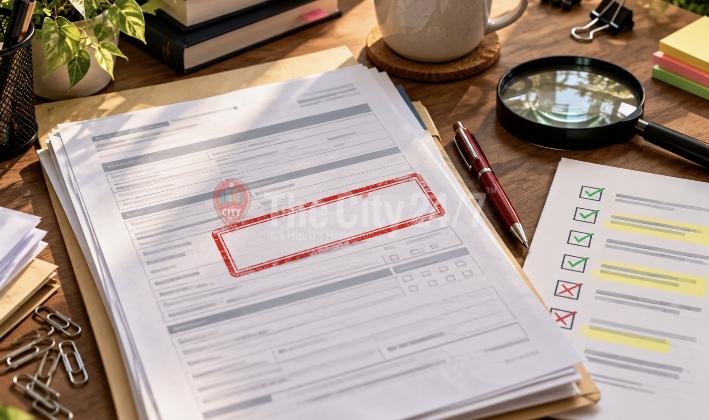
“Almost nobody is rejected because they were not eligible. They are rejected because a name was spelled differently on two documents, or because nobody answered the phone.”
• On what rejections are actually about
A rejected income certificate application feels like a verdict. It usually is not. In the overwhelming majority of cases it is a clerical problem, a documentary mismatch or a failed contact attempt, and the same application resubmitted with one thing fixed goes through without argument.
The frustrating part is that Karnataka's Nadakacheri portal is not always generous with the explanation. You get a status, sometimes a terse reason, and it is left to you to work out what it means in practice. Having walked through a lot of these with readers, the reasons fall into a short and fairly predictable list.
This guide covers how to read the status page properly, the specific rejection reasons and what each one actually means, how to fix them, when to reapply versus when to escalate, and how the Sakala service guarantee gives you a formal route when an application simply stops moving. For the application process itself, our full Nadakacheri guide covers the form step by step.
Quick Information
The diagnosis table. Find your symptom on the left, and the likely cause is on the right.
How Do I Find Out Why My Application Was Rejected?
Check the status page on Nadakacheri using your RD number. It shows the current stage, and where an application has been rejected it should carry a stated reason.
The single most useful field is the Action Taken On date. It tells you when your file last moved. An application at the same stage with a date from three weeks ago is stalled, and that is a different problem from an application that moved yesterday. People spend weeks refreshing the status word when the date is the information.
If the reason given is unhelpfully brief, the Nadakacheri helpline on 080 4455 4455 or the toll free 1800 425 1243 can often tell you more, and a visit to the Nadakacheri or AJSK centre with your RD number will usually get you a plain language explanation from the staff who can see the file.
Reason One: The Declared Income Did Not Match Verification
This is the substantive rejection, and the only one that is really about the merits. The Revenue Inspector or Village Accountant checked the declared household income against records and local enquiry, and the numbers did not agree.
The usual cause is not dishonesty. It is incompleteness. An income certificate covers total household income from all sources, and applicants routinely declare only the main earner's salary, forgetting a father's pension, rental income from a portion of the property, agricultural income from land the family still holds, or a second earner's business income. The officer has access to land records and the ration card, so these things surface.
The fix is to reapply with the honest full figure and documentation for each source. Being marginally over a scheme ceiling is a smaller problem than a rejection, because a rejection costs you the certificate and the three weeks, and being over a ceiling for one scheme rarely means being over it for all of them.
“The Village Accountant can see the land records before the officer knocks on the door. Declaring agricultural income is not a confession, it is just arithmetic.”
• On what verification already knows
Reason Two: Name or Address Mismatch Across Documents
The commonest rejection of all, and the most frustrating, because it has nothing to do with eligibility. Your name is spelled one way on Aadhaar, another on the ration card, and a third on the school record.
- Spelling and initials. An expanded surname on one document and an initial on another, or a transliteration difference between Kannada and English records. Reconcile them before reapplying, starting with Aadhaar since most systems treat it as the reference.
- Father's or husband's name variations. Often recorded differently across documents and a frequent trigger. Check the ration card against Aadhaar specifically.
- Address mismatch. An Aadhaar address at your old house and a current address on the application is a jurisdiction problem as well as a mismatch. Update Aadhaar, or supply a current address proof that clearly ties to the taluk you are applying in.
- Date of birth differences. Less common but equally fatal. School records and Aadhaar disagreeing is worth resolving once, because it will keep causing problems across every document you ever apply for.
- The fix takes time, so start it now. Aadhaar corrections are their own process with their own timeline. If a mismatch is the reason, budget for that correction before the reapplication, not after.
Reason Three: The Applicant Could Not Be Reached
An inactive or unanswered mobile number is a stated reason applications get rejected in Karnataka, and it is completely avoidable. If the officer cannot reach you to complete verification, the file does not advance.
Give a number somebody actually answers during working hours. If the application is in a parent's name and the parent does not use the phone much, that is a foreseeable problem. While an application is pending, answer calls from unknown Karnataka numbers instead of letting them ring out, and check for missed calls daily.
Remember the number also has to be Aadhaar linked to receive the login OTP in the first place, so there is a second reason to make sure the right number is on the file.
Reason Four: Document Uploads That Could Not Be Read
Blurred photographs of documents, cropped edges, oversized files that failed to upload properly, or pages missing from a multi page document. The officer cannot verify what they cannot read.
- Scan rather than photograph where you can. A phone photograph at an angle in bad light is the single most common bad upload. A flatbed scan or a document scanner app used properly is far better.
- Check the portal's size limits before uploading. They are stated on the upload page. A file over the limit may appear to upload and then not be there.
- Upload every page. Ration cards and land records run to multiple pages, and a partial upload reads as a missing document.
- Check the whole document is in frame. Cropped corners that cut off a number or a seal are treated as illegible.
- Open each file after uploading. Thirty seconds of checking your own uploads saves three weeks.
Reason Five: The Wrong Taluk or Jurisdiction
You apply in the taluk where you reside, and the address proof has to support it. An application filed in the wrong jurisdiction gets bounced regardless of how good the rest of it is.
This bites people who have moved within Bangalore, or who have moved to the city from elsewhere in Karnataka and still hold documents tied to their home district. If the ration card is registered at the old address and you are applying from the new one, that inconsistency is both a jurisdiction problem and a document mismatch at the same time.
Sort out which taluk your current residence falls under before reapplying, and make sure the address proof you upload clearly places you there.
Should I Reapply or Appeal?
Reapply when the application was rejected for a defect you can fix. Escalate when the application has not been rejected at all but has simply stopped moving past the Sakala period.
- Rejected with a stated reason you can fix: reapply. A fresh application with a fresh RD number and a fresh fee. The fee is small and the reapplication is faster than fighting the first one. Fix the specific defect first, because resubmitting an identical application produces an identical result.
- Rejected for a reason you believe is wrong: go to the centre. Take your RD number and the documents to the Nadakacheri or AJSK centre and ask the staff to look at the file. A human conversation resolves more of these than any online route.
- No movement past 21 days: escalate under Sakala. The Sakala Act gives citizens a right to time bound delivery of notified services, with an appeal to a designated appellate authority when the stipulated period is missed. Register the complaint formally on 080 44554455 rather than informally chasing the office.
- Register the complaint, do not just phone about it. A registered Sakala complaint creates a record and a tracking number. An informal enquiry creates nothing and is forgotten by the afternoon.
- Keep every RD number. If you end up with two or three applications over a season, the reference numbers are the only way anybody can reconstruct what happened.
“Reapplying costs fifteen rupees and three weeks. Arguing with a rejection you cannot substantiate costs three weeks and fifteen rupees, and you reapply anyway.”
• On picking your battles
How Do I Make the Second Attempt Succeed?
Fix the stated reason specifically, reconcile every document against Aadhaar before you start, declare the true household figure with proof for each source, and use a phone you answer.
- Lay every document out side by side first. Aadhaar, ration card, address proof, income proof. Check the name, father's name, address and date of birth read identically across all of them before you open the portal.
- List every income source in the household. Salary, pension, rent, agriculture, business, interest. Have a document or an affidavit for each one. A self declaration is a normal and accepted route for informal income.
- Apply at a centre if the case is complicated. Centres are open Monday to Saturday, 10 AM to 5.30 PM, and staff will tell you what is missing before the file goes in rather than three weeks after.
- Answer the phone. For the third time in this article, because it is the third most common reason.
- Check the Action Taken On date weekly. A stalled file spotted in week two can be escalated in week four. A stalled file spotted in week six has already cost you a deadline.
Frequently Asked Questions
Why was my income certificate application rejected in Karnataka?
The common reasons are a declared income that verification contradicted, a name or address mismatch across Aadhaar and other documents, an applicant the officer could not reach by phone, illegible or incomplete uploads, applying in the wrong taluk, or missing income proof with no affidavit supplied. Check the status page against your RD number for the stated reason.
Can I appeal an income certificate rejection?
Where the application was rejected on a stated defect, reapplying with the defect fixed is almost always faster and cheaper than appealing. Where the application has not been decided at all and has passed the stipulated Sakala period, you have a formal right to escalate to the designated appellate authority and should register the complaint on the Sakala helpline.
How do I know whether my application is stalled or just pending?
Look at the Action Taken On date on the status page rather than the status word. If the date is recent, the file is moving. If it has not changed in several weeks and the stipulated Sakala period has passed, treat it as stalled and escalate.
Do I pay the fee again when I reapply?
Yes. A reapplication is a fresh application with a fresh RD number and a fresh fee, commonly cited at fifteen rupees. A reprint of an already issued certificate is different and costs Rs 40 through the portal.
My name is spelled differently on Aadhaar and my ration card. What do I do?
Reconcile them before reapplying, treating Aadhaar as the reference since most systems check against it. Aadhaar corrections have their own process and timeline, so start that first and budget for it rather than reapplying into the same mismatch.
What happens if I declare a lower income than the household actually earns?
Verification checks the declared figure against land records, the ration card, salary documents and local enquiry, so an understated figure is likely to be contradicted and the application rejected. That costs you the certificate and the three weeks, which is a worse outcome than being slightly over a scheme ceiling.
Can I fix an application that is already submitted?
Generally no. The practical route is to wait for the decision and then reapply with the correction, or to visit the Nadakacheri or AJSK centre with your RD number and ask the staff what can be done with the existing file.
Is it worth paying an agent to get it approved?
An agent presses the same buttons on the same portal and cannot make a mismatched document match. If the process is the obstacle, a Nadakacheri centre will enter the application for you on the official fee. If a document is the obstacle, no agent can fix that either.
Where to Check and Who to Call
Use the official portal and the official helplines. Unofficial guide sites rank alongside the real portal in search results and cannot see your file.
Rejected and Not Sure Why?
Send me what the status page says, including the stated reason and the Action Taken On date, by clicking the WhatsApp icon at the bottom right of your screen. Most of these turn out to be one fixable thing, and it is usually quicker to work out which one with a second pair of eyes. If you have already had a rejection overturned or a resubmission approved, telling me what the reason was would help everybody reading this. That is also the fastest way to reach The City 24/7 about anything at all.
And if you want the city explained one useful thing at a time, join our ever growing community. One weekly email, free.
This guide is general information and not legal advice. Fees, documents, timelines and escalation routes change, so verify the current position on the official Nadakacheri portal and with the Sakala helpline before acting. Same city, new stories, always.

Related Stories
 SERVICES
Common Reasons Caste Certificate Applications Get Rejected, and How to Avoid Them
September 14, 2026
 SERVICES
How to Register a Death and Obtain a Death Certificate in Bangalore
September 14, 2026
 SERVICES
Lost or Delayed Birth Registration? How to Get One Issued Late
September 14, 2026
 SERVICES
Income Certificate in Karnataka: How to Apply, What It Costs, How Long It Takes
September 14, 2026
 SERVICES
How to File an RTI in Karnataka for Ten Rupees and Actually Get an Answer
September 14, 2026
 SERVICES
What Is an Encumbrance Certificate and Why You Need One Before Buying
September 13, 2026
