


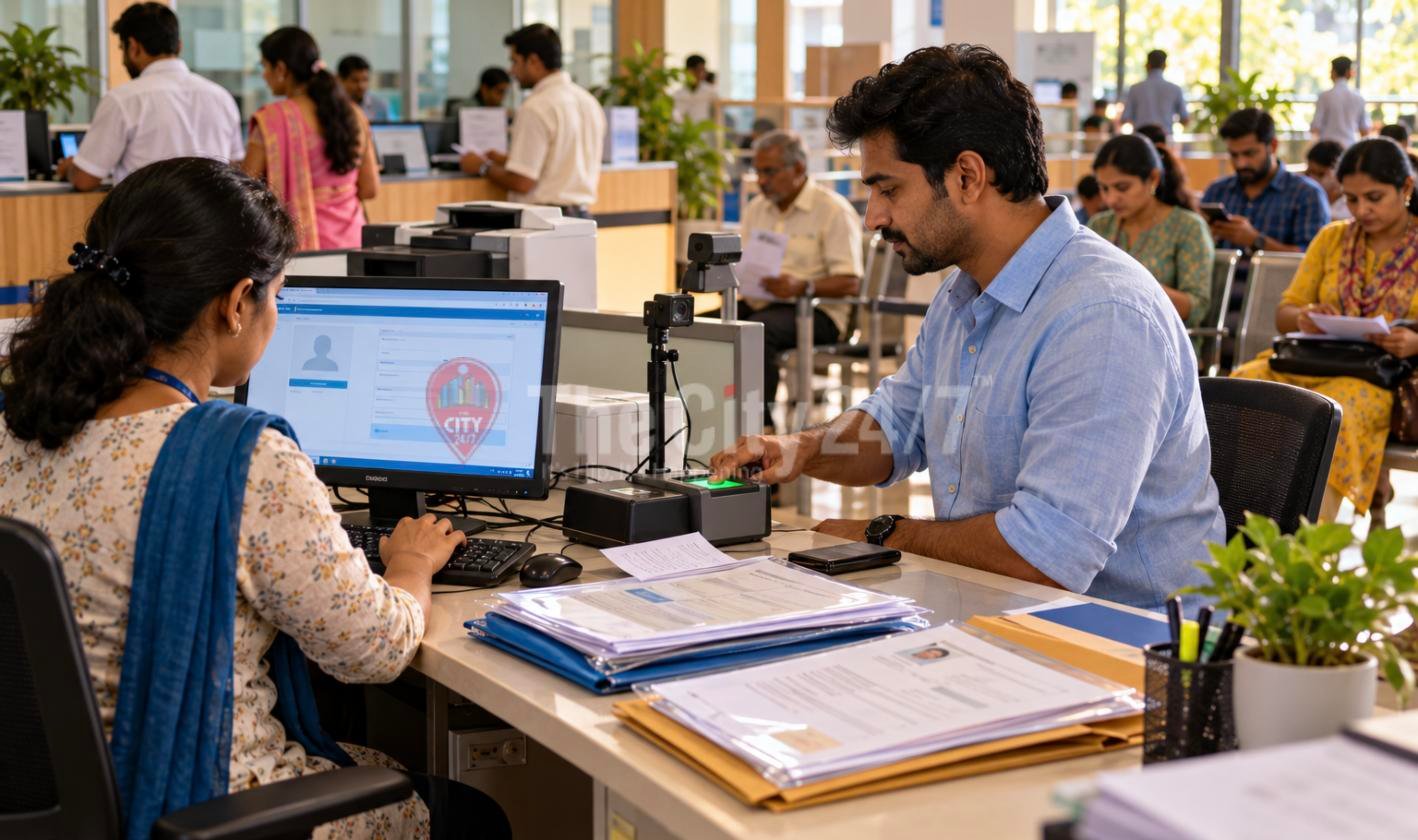
“The question is never whether you live in Karnataka. It is whether you can prove you have lived here long enough, and with the right paper trail.”
• On what a domicile certificate actually tests
Half the confusion around this document is naming. Domicile certificate, residence certificate, nativity certificate: in Karnataka these terms get used more or less interchangeably for the Revenue Department document that establishes you are a resident of the state. If a form asks you for one of them and the Nadakacheri portal lists another, you are almost certainly looking at the same thing.
The document matters at exactly the moments when it is hardest to get quickly. State quota seats in professional colleges, Karnataka government job applications, state welfare schemes and various reservations all test residence, and all of them have deadlines. The certificate, like its siblings on Nadakacheri, runs on a Sakala timeline rather than an over the counter one.
The other thing people get wrong is eligibility. Karnataka's rules around residence based benefits commonly reference a continuous residence period, frequently cited as seven years, and the exact requirement depends on the purpose you are claiming for. This guide covers who qualifies, what documents actually establish continuous residence, the application steps, fees, timelines, validity and what to do when the paper trail has gaps.
Quick Information
The document explained in the time it takes to realise you needed it last week. Confirm current requirements on the official portal.
What Is a Domicile Certificate and What Is It Used For?
It is the Revenue Department's official statement that you are a resident of Karnataka, and it is used wherever a benefit is reserved for state residents.
- State quota seats in professional colleges. Engineering, medical and other professional courses reserve a share of seats for Karnataka students, and residence is how that eligibility is established.
- Karnataka government job applications. State recruitment commonly requires proof of residence, and in some cases Kannada language requirements sit alongside it.
- State welfare and subsidy schemes. Housing, agricultural and social welfare schemes funded by the state are for state residents, and the certificate is the standard proof.
- Reservation benefits within Karnataka. A caste certificate establishes category. A residence certificate establishes that the category benefit applies to you in this state.
- Certain scholarships. State funded schemes on the State Scholarship Portal may test residence alongside income and category.
- Some licensing and registration processes. Occasionally requested as supporting proof of address and residence rather than as a primary eligibility test.
Who Is Eligible for a Karnataka Domicile Certificate?
Broadly, people who have resided in Karnataka continuously for the qualifying period, which is frequently cited as seven years, and who can document that continuity. The exact requirement depends on the purpose.
This is the part that catches out families who have moved to Bangalore for work. Living in the city for four years is living in Karnataka, but it may not satisfy a benefit that tests seven years of continuous residence. Before you apply, find out what the receiving institution or scheme actually requires, because the requirement lives in their rules rather than in the certificate itself.
Children are usually assessed through the family. Where the parents have the qualifying residence, a child born and schooled in Karnataka is generally in a straightforward position, and the school records typically supply the cleanest possible evidence of the years involved.
“A rental agreement from this year proves you live here. Ten years of school records prove you have lived here for ten years. Only one of those answers the question being asked.”
• On the difference between address proof and residence proof
What Documents Prove Continuous Residence?
Anything official, dated and spread across the years. Dated records beat strong records, because the certificate is testing duration rather than fact of residence.
- School and college records. The best evidence there is. Transfer certificates, bonafide certificates and marks cards carry both an address and a year, and a run of them across a decade settles the question immediately.
- Aadhaar with the Karnataka address. Essential, and also the login. If your Aadhaar still shows an out of state address, fix that before anything else, because it undermines the whole application.
- Ration card. Establishes household composition and a registered Karnataka address, and typically carries an issue date.
- Voter ID and the electoral roll. Electoral roll entries across successive years are strong dated evidence, and the roll is a public record the officer can check.
- Employment records. Appointment letters, salary certificates and employer letters across years, for adults whose continuity runs through work rather than schooling.
- Utility bills across years. Electricity and water bills in your name at a Karnataka address. Individually weak, collectively useful, particularly if you can supply one from each year.
- Property documents or a rental agreement history. Owned property with a Khata is strong. For renters, a chain of registered rental agreements across addresses is the equivalent.
- Birth certificate, where born in Karnataka. Helpful as a starting point for the timeline, particularly for nativity claims.
- A self declaration or affidavit. Where the paper trail has gaps, an affidavit setting out the residence history is commonly used, with verification substantiating it.
How Do I Apply for a Domicile Certificate Online?
Through Nadakacheri, with your Aadhaar linked mobile and an OTP. The flow is the same as for income and caste certificates, with a different service selected.
- 1. Open nadakacheri.karnataka.gov.in. Type the address rather than clicking a search result, since unofficial guide sites rank alongside the real portal and cannot process applications.
- 2. Go to Online Application, then Apply Online. Pick your language, Kannada or English, at this stage.
- 3. Log in with the Aadhaar linked mobile and OTP. If no OTP arrives, wait thirty seconds and use Resend, then check whether the number is actually Aadhaar linked before assuming a portal fault.
- 4. Select New Request, then the residence or domicile service. The service naming varies, so look for residence, domicile or nativity depending on what the portal lists. If unsure, the helpline will tell you which service matches your purpose.
- 5. Fill in the details. Applicant details, current address, the period of residence you are claiming, and the purpose the certificate is required for.
- 6. State the purpose precisely. Some receiving bodies want the purpose printed on the certificate. Ask before submitting, because a certificate issued for the wrong stated purpose may not be accepted.
- 7. Upload the documents. Aadhaar, address proof, and your dated continuity evidence. Clear scans, within the stated size limits, every page of multi page documents.
- 8. Pay the fee and save the RD number. UPI or QR code, with the exact amount shown before you confirm. The RD number arrives by SMS and is how you track, download and later reprint.
How Long Does It Take and How Much Does It Cost?
Commonly cited at fifteen rupees, and up to 21 days under the Sakala service guarantee. Most clean applications clear faster, but never plan on faster.
The Sakala Act gives citizens a right to time bound delivery of notified services, with a route to a designated appellate authority when the stipulated period is missed. That is a genuine mechanism, and registering a formal complaint on 080 44554455 produces more movement than informally chasing the office. But it only starts after the clock has run out, so it is a remedy rather than a plan.
If you are applying for a college admission or a recruitment deadline, work backwards: subtract 21 days, then subtract another two weeks as buffer for one rejection and resubmission. That is your apply by date, and it is usually a lot earlier than people assume.
How Long Is a Domicile Certificate Valid?
Commonly one year from issue for residence certificates in Karnataka, which surprises people who expect domicile to be permanent.
The logic is that residence can change, so the certificate is treated as a current statement rather than a permanent status. Institutions frequently reinforce this by asking for a certificate issued within the current year or the last six months, regardless of what the certificate itself says.
Practically: check what the receiving body expects before you apply, and if you are in a multi year process such as a degree with annual scheme renewals, assume you will be reapplying. Set a calendar reminder rather than discovering it at the next deadline.
What If I Moved to Karnataka Recently?
You can still apply, but check the qualifying period for your specific purpose first. A recent move may satisfy a scheme that only tests current residence and fail one that tests continuous residence over years.
- Separate the two questions. Do you need proof of current address, or proof of long residence? Many forms that say domicile actually only need the former, and finding that out saves an unnecessary battle.
- Update Aadhaar to the Karnataka address immediately. It is the reference document for almost every other check, and an out of state Aadhaar address will cause problems well beyond this certificate.
- Start building the dated trail now. Register the rental agreement, get on the electoral roll, put utilities in your own name. In three years those dated records are what an application will rest on.
- Get the ration card transferred. A Karnataka ration card with your current household is one of the most routinely relied on documents in the Revenue Department's own checks.
- Consider the family position. Where a spouse or parent has longer Karnataka residence, that history may be relevant depending on the scheme's rules. Ask the scheme rather than guessing.
“If you have just moved, the most valuable thing you can do is not apply. It is to start generating dated records, so that the application in three years is trivial.”
• On playing the long game
Can I Apply at a Nadakacheri Centre Instead?
Yes, and for residence certificates it is often the better route. Centres are open Monday to Saturday, 10 AM to 5.30 PM, closed Sundays and Karnataka government holidays.
Residence applications turn on the quality of the evidence more than most, and the staff at a centre can look at what you have before the file goes in and tell you whether it will hold. That conversation, before submission, is worth a great deal more than three weeks of waiting followed by a rejection. Carry originals and photocopies of everything, including anything dated you are unsure about.
You still receive an RD number and the process from that point is identical to the online route, including the digitally signed PDF at the end.
Frequently Asked Questions
Is a domicile certificate the same as a residence certificate in Karnataka?
In practice the terms domicile certificate, residence certificate and nativity certificate are used broadly interchangeably in Karnataka for the Revenue Department document establishing that you are a resident of the state. If a form asks for one name and the portal lists another, they are almost certainly the same thing, but check with the receiving body if the purpose is important.
How many years do I need to have lived in Karnataka?
A continuous residence requirement applies and is frequently cited as seven years, but the exact period depends on the purpose you are claiming for and is set by the scheme, institution or recruitment rules rather than by the certificate itself. Check the specific requirement before applying.
How much does a domicile certificate cost in Karnataka?
The fee is commonly cited at fifteen rupees, paid on the Nadakacheri portal by UPI or QR code, with the exact amount shown on the payment page. A reprint of an issued certificate costs Rs 40 through SBI e-Pay, UPI or card.
How long does a domicile certificate take?
Up to 21 days under the Sakala service guarantee, though clean applications frequently clear faster. If the stipulated period passes with no movement, you can escalate to the designated appellate authority and register a complaint on the Sakala helpline at 080 44554455.
What is the best proof of continuous residence?
School and college records, because they carry both an address and a year, and a run of them across successive years settles the duration question directly. Electoral roll entries, employment records, utility bills and registered rental agreements across years all serve the same purpose. Undated evidence proves you live here but not for how long.
Does a domicile certificate expire?
Residence certificates in Karnataka are commonly valid for one year from issue, and institutions frequently ask for one issued within the current year or the last six months. Domicile is not treated as a permanent status for these purposes, so assume you may need to reapply.
Can I get a domicile certificate if I rent rather than own?
Yes. Ownership is not the test, residence is. A chain of registered rental agreements, utility bills in your name, electoral roll entries and school or employment records across years establish residence just as well as property documents.
Is the downloaded certificate valid without a signature?
Yes. Certificates issued through Nadakacheri are digitally signed and legally recognised for government services, admissions and official submissions in Karnataka, with no physical signature or attestation required.
Official Portals and Helplines
Apply only on the official portal. Several unofficial sites rank alongside it in search and cannot process applications.
Not Sure Your Evidence Is Enough?
Residence applications live or die on dated documents, and it is genuinely hard to judge your own file. Click the WhatsApp icon at the bottom right of your screen, tell me what you have and what you are applying for, and I will tell you where I think the gaps are. If you have recently been issued one, what evidence your taluk accepted would be useful to everybody else reading this. That is also the fastest way to reach The City 24/7 about anything at all.
And if you want the city explained one useful thing at a time, join our ever growing community. One weekly email, free.
This guide is general information and not legal advice. Eligibility periods, fees, documents and validity rules change and vary by purpose, so verify the current position on the official Nadakacheri portal and with the receiving institution before applying. Same city, new stories, always.

Related Stories
 SERVICES
How to Apply for a Caste Certificate in Karnataka: The Complete Process
September 14, 2026
 SERVICES
How to Apply for a Legal Heir Certificate in Bangalore After a Death
September 14, 2026
 SERVICES
How to Apply for a Birth Certificate in Bangalore: Online and Offline
September 14, 2026
 SERVICES
Income Certificate in Karnataka: How to Apply, What It Costs, How Long It Takes
September 14, 2026
 SERVICES
How to Register a Death and Obtain a Death Certificate in Bangalore
September 14, 2026
 SERVICES
Step-By-Step Guide to Registering Your Marriage in Bangalore
September 14, 2026
