


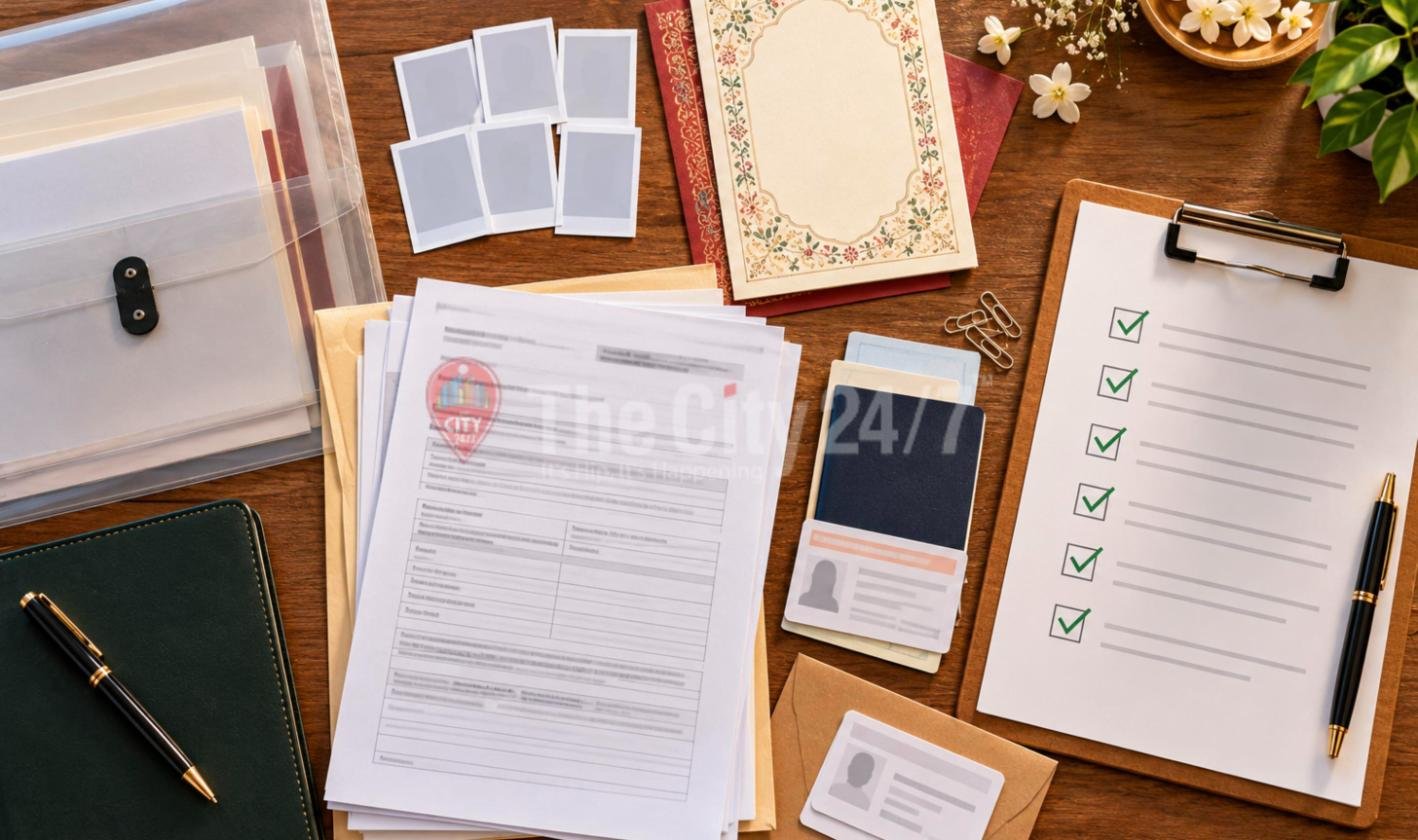
“Print this, tick it off the night before, and check that the name on every document matches the name on every other document. That is the whole job.”
• On the only preparation that matters
Marriage registration in Bengaluru happens at sub-registrar offices under the Karnataka Stamps and Registration Department. It is worth noting that this is not a municipal corporation function: births and deaths run through the corporations and e-Janma, while marriages run through the registration department, with Kaveri Online Services as the online portal.
The document set differs between the two routes. Under the Hindu Marriage Act you are proving that a marriage already happened, so proof of the ceremony matters. Under the Special Marriage Act the Marriage Officer is performing the marriage, so residence proof and affidavits of eligibility matter instead.
This is the checklist for both, including what each of the three witnesses must bring, which is where appointments most often fail. Our step by step guide covers the process and our which act applies guide covers choosing the route.
Quick Information
Requirements vary between offices, so confirm your office's checklist before the appointment.
What Do Both Parties Need, on Either Route?
Identity proof, age proof, address proof, passport sized photographs, a joint photograph, and notarised affidavits covering marital status, age and consent.
- Identity proof. Aadhaar, PAN or passport for each party. Aadhaar is the most widely accepted and is also the reference point institutions later check names against, which matters for consistency.
- Age proof. Aadhaar, passport, voter ID or birth certificate. Both parties must meet the statutory minimum age, and the document needs to establish it clearly.
- Address proof. Aadhaar, voter ID, a utility bill or passport. Under the Special Marriage Act this does double duty as evidence of the thirty day residence requirement.
- Passport sized photographs. Recent photographs of both parties. Take more than you think you need, since offices frequently require several across the forms.
- A joint photograph. A photograph of the couple together is commonly required. For an HMA registration this sits alongside the ceremony photographs.
- Notarised affidavits. Declaring marital status, age and consent to the marriage. These need notarising in advance rather than on the day.
- Previous marriage documents, if applicable. A decree of divorce where either party is divorced, or the death certificate of a former spouse where widowed. These are not optional.
- The application acknowledgement. Where you applied online through Kaveri, the acknowledgement slip with the temporary application number.
“Every witness needs identity and address proof, and every witness needs to know that a week before. This is the single most common reason an appointment is wasted.”
• Worth repeating in bold
What Do the Three Witnesses Need?
Each of the three witnesses needs their own identity proof and address proof. For a Hindu Marriage Act registration they should have been present at the wedding.
This is where appointments fail. Couples prepare their own documents meticulously and then arrive with a witness who has brought only a photograph on a phone, or no address proof, or who cannot confirm having attended the ceremony. The appointment cannot proceed and the slot is lost.
The fix is to brief them properly at least a week ahead: the date, the time, the office, and specifically that each of them must bring original identity and address proof. Aadhaar covers both for most people, which makes it the simplest instruction to give. Confirm the day before, and have a reserve witness identified in case somebody cannot attend, because three is a requirement rather than a target.
What Is Specific to the Hindu Marriage Act Route?
Proof that the marriage already took place: photographs of the religious ceremony, the wedding invitation card, and a certificate from the officiating priest.
Because this route registers rather than performs a marriage, the office needs to be satisfied that the ceremony occurred. Photographs of the ceremony itself are the core evidence, and the invitation card and priest's certificate corroborate it. Photographs alone are sometimes questioned, so bringing all three is sensible rather than optional.
This also applies to post facto registration. There is no strict time limit on registering a marriage under this route, so a couple married a year or more ago can still register, provided they can produce that proof. Where an old wedding has no surviving invitation or priest's certificate, take advice on what alternative evidence the office will accept before turning up.
What Is Specific to the Special Marriage Act Route?
Evidence that at least one party has resided in the district for at least thirty days, and the Notice of Intended Marriage filed with the Marriage Officer.
- Thirty day residence proof. Aadhaar, voter ID, a utility bill or passport establishing that at least one party has resided in the district for the required period before the notice is filed.
- The Notice of Intended Marriage. The written notice to the Marriage Officer under Section 5, which starts the thirty day public notice period. This is the first step rather than a document you bring later.
- Affidavits of eligibility. Notarised affidavits covering marital status, age and consent, and confirming the parties are not within a prohibited degree of relationship.
- Witness documents, as for HMA. Three witnesses with identity and address proof, present at solemnisation to sign the declaration under Section 11.
- For a foreign national. Passport and valid visa, plus evidence of single status, which may take the form of a no impediment certificate or equivalent from their own authorities. Requirements vary, so confirm with the office early.
- No proof of ceremony needed. Since the Marriage Officer performs the marriage, there is no prior ceremony to evidence. That is the fundamental difference in the document set.
- Allow time for the affidavits. Notarisation and, for a foreign national, obtaining documents from abroad both take time. These should be in hand before the notice period ends, not after.
What Mismatches Cause Problems?
- Name spellings differing across documents. Between Aadhaar, PAN, passport and the application. Aadhaar is the usual reference point, so align to it where possible, and flag any unavoidable difference at the outset.
- Initials versus expanded names. A recurring problem in Karnataka, where initials are common. Decide how the name will appear and use it consistently across the application and affidavits.
- Date of birth differences. Between the birth certificate, school records and Aadhaar. Where these differ, the discrepancy is better resolved before the marriage application than during it.
- Address not matching the residence claim. Particularly under the Special Marriage Act, where the thirty day residence requirement has to be evidenced by the address proof you produce.
- Affidavits not notarised. An unsworn affidavit is not an affidavit. Have them notarised in advance, and check that the details in them match the application exactly.
- Photographs too old or the wrong size. Trivial and it stops an appointment. Recent passport sized photographs, several of them, plus a joint photograph.
- Missing previous marriage documents. A divorce decree or a former spouse's death certificate where applicable. These are mandatory and their absence is not something an office can overlook.
- Expecting a surname change automatically. The certificate does not change a name. That needs a separate affidavit and newspaper publication, followed by individual updates to each identity document.
Marriage Registration Documents: Frequently Asked Questions
What documents are needed for marriage registration in Bangalore?
Identity proof, age proof, address proof, recent passport sized photographs and a joint photograph for both parties, notarised affidavits on marital status, age and consent, and three witnesses each with identity and address proof.
What extra documents does the Hindu Marriage Act route need?
Proof that the marriage already took place: photographs of the religious ceremony, the wedding invitation card and a certificate from the officiating priest. Bringing all three is sensible, since photographs alone are sometimes questioned.
What extra documents does the Special Marriage Act route need?
Evidence that at least one party has resided in the district for at least thirty days, the Notice of Intended Marriage filed with the Marriage Officer, and notarised affidavits of eligibility including that the parties are not within a prohibited degree of relationship.
What do witnesses need to bring?
Each of the three witnesses needs original identity proof and address proof, and for a Hindu Marriage Act registration they should have been present at the wedding. Aadhaar covers both requirements for most people.
How many witnesses are required?
Three. It is a requirement rather than a target, so identify a reserve witness in case somebody cannot attend, and brief all of them at least a week ahead about the documents they must bring.
What if I am divorced or widowed?
You must produce the decree of divorce, or the death certificate of your former spouse where widowed. These documents are mandatory and their absence is not something the office can overlook.
What documents does a foreign national partner need?
Passport and valid visa, plus evidence of single status, which may take the form of a no impediment certificate or equivalent from their own authorities. Requirements vary between offices, so confirm early since obtaining documents from abroad takes time.
Do name spelling differences matter?
Yes, considerably. Mismatches between Aadhaar, PAN, passport and the application cause problems, as do initials versus expanded names, which is a recurring issue in Karnataka. Align to Aadhaar where possible and flag unavoidable differences at the outset.
Do the affidavits need to be notarised?
Yes. Have them notarised in advance rather than attempting it on the day, and check that the details in them match the application exactly, since inconsistency between the two causes rejections.
Is marriage registration done at the city corporation, formerly BBMP, or the sub-registrar?
The sub-registrar office, under the Karnataka Stamps and Registration Department, with Kaveri Online Services as the online portal. Births and deaths run through the city corporations and e-Janma; marriages do not.
Official Portals
Confirm your specific office's checklist, since requirements vary.
Appointment Coming Up?
If you want a second pair of eyes on what you are taking, particularly where a name mismatch or a foreign national partner is involved, click the WhatsApp icon at the bottom right of your screen and tell me the situation. And if your office asked for something not on this list, that addition would help other couples considerably, since checklists do vary between offices. That is also the fastest way to reach The City 24/7 about anything at all.
And if you want the city explained one useful thing at a time, join our ever growing community. One weekly email, free.
This guide is general information and not legal advice. Document requirements vary between offices and change over time, so confirm your office's current checklist and take legal advice where your situation is not straightforward. Same city, new stories, always.

Related Stories
 SERVICES
How to Apply for a Caste Certificate in Karnataka: The Complete Process
August 16, 2026
 SERVICES
How to Apply for a Legal Heir Certificate in Bangalore After a Death
August 15, 2026
 SERVICES
Step-By-Step Guide to Registering Your Marriage in Bangalore
August 13, 2026
 SERVICES
Documents Required for Khata Registration: A First-Time Owner's Checklist
August 9, 2026
 SERVICES
Domicile Certificate in Karnataka: The Seven Year Rule Nobody Explains
August 17, 2026
 SERVICES
How to Apply for a Birth Certificate in Bangalore: Online and Offline
August 16, 2026
