


“Most Bengalureans know Puttanna Chetty as a bus stop announcement. He deserves to be known as one of the men who taught this city to run itself.”
• Tariq Sallam, on the name everyone says and nobody knows
Say "Town Hall" to any Bengaluru auto driver and he will take you to the white, column-fronted building on JC Road, the one with the steps that every protest, film festival and wedding photographer in the city has used at some point. What most of us never read is the name on it: Sir Puttanna Chetty Town Hall.
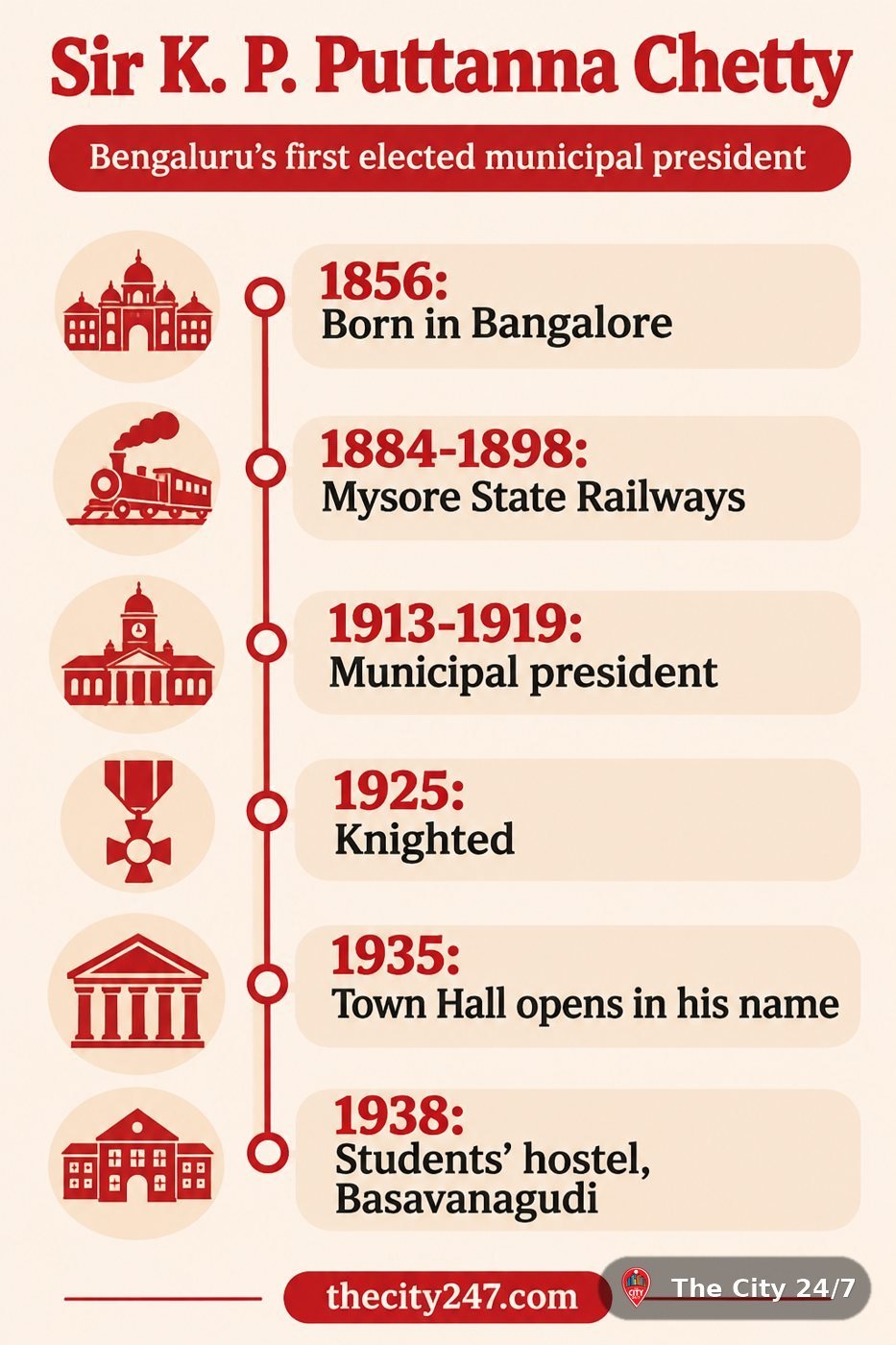
So who was he? A Bangalore boy, born in 1856, who started as a government clerk, ran the railways of the Mysore State, became the first elected president of the Bangalore municipality, chaired the state's own bank, and then quietly gave his money to poor students. He was knighted for it and then had a building named after him, which is roughly the Victorian-era version of going viral.
This is my People of Bangalore profile of Sir K. P. Puttanna Chetty: his career, what he did for the city, the hostel that still carries his name in Basavanagudi, and where you can still find him in Bengaluru today.
Quick Information
Clerk, railwayman, municipal boss, banker, knight, and finally a building. Not a bad LinkedIn headline for 1938.
Who Was Sir K. P. Puttanna Chetty?
Sir K. P. Puttanna Chetty was a Bangalore-born civil servant, railway administrator, municipal leader, banker and philanthropist who lived from 1856 to 1938. He is best remembered as the first elected president of the Bangalore municipality and as the man whose name is on the city's Town Hall.
He was born on 29 April 1856 into a Banajiga Lingayat family in Bangalore, at a time when the city was really two towns: the old pete (market town) of Kempe Gowda's era and the British Cantonment to the east. He studied at Central College, then one of the few places in the Mysore State where a young man could get a modern education.
What makes him interesting to me is that he was not a maharaja, a British officer or a famous freedom fighter. He was a local who worked his way up the government ladder, learned how a city's money, roads and services actually work, and then spent the second half of his life putting that knowledge, and his wealth, back into Bangalore.
What Did Puttanna Chetty Do Before Running the City?
He spent more than three decades in the Mysore government's service, most notably as traffic manager of the Mysore State Railways from 1884 to 1898. He joined the civil service in 1875, at 19, and later served as a Deputy Commissioner from 1898 to 1906.
- 1875: joins the Mysore civil service as a young man fresh out of Central College.
- 1884 to 1898: traffic manager of the Mysore State Railways, the network that connected Bangalore to Mysore and beyond.
- 1898 to 1906: Deputy Commissioner, one of the senior district-level posts in the state administration.
- 1906 to 1912: member of the Bangalore City Council, his first direct role in running the city.
A railway traffic manager in the 1880s is not a glamorous job title, but think about what it involves: timetables, freight, ticket revenue, staff and complaints. In other words, the exact skills you need to run a growing city. I like to imagine the Bangalore municipality got a man who already knew what it felt like when the trains were late.
What Did Puttanna Chetty Do as Municipal President?
He was elected president of the Bangalore municipality in 1913 and held the post until 1919, and he is widely recorded as its first elected, non-official president. Before this, the municipality was led by government officials appointed from above.
That shift matters more than it sounds. It was one of the early steps towards Bengalureans running Bengaluru, rather than simply being administered. His six years in office came in a period of big change for the city, after the plague years of the late 1890s had pushed Bangalore to build new, planned extensions like Basavanagudi and Malleswaram, and while the Mysore State under Diwan Sir M. Visvesvaraya was pushing hard on industry, education and banking.
Accounts of his presidency describe him as generous with his own money as well as public money, making many donations to civic causes during his term. The Victoria Hospital's outpatient department sits in a block named after him, where medicines are still given free to poor patients.
“He ran the city's municipality and also paid for things out of his own pocket. Imagine suggesting that to a modern corporator.”
• Tariq Sallam
Was Puttanna Chetty Involved in Banking and Business?
Yes. He chaired the Bank of Mysore, the Central Co-operative Bank in Bangalore and the Sri Krishnarajendra Mills, and he was a Fellow of Mysore University. He was also elected to the Mysore Legislative Council in 1925.
The Bank of Mysore, founded in 1913 with Visvesvaraya's backing, was a big deal: a home-grown bank for a princely state that wanted to fund its own industry. It later became the State Bank of Mysore and merged into the State Bank of India in 2017, so if you bank with SBI in Karnataka, a little bit of Puttanna Chetty's boardroom is in your passbook's family tree.
What Was Puttanna Chetty's Philanthropy?
His biggest legacy was education for poor students. He was president of the Rao Bahadur Dharmapravartha Gubbi Thotadappa Charities from 1910 to 1938, and in his final year he set up a free hostel for students in Bengaluru that still runs on Bull Temple Road in Basavanagudi.
- Gubbi Thotadappa Charities: founded by the merchant Gubbi Thotadappa, who left his property to a trust and appointed Puttanna Chetty as its first president. The trust's choultry near Bangalore City railway station, opened in 1903, offered cheap lodging to travellers and a free hostel to students. Puttanna Chetty led it for 28 years.
- The Basavanagudi hostel: the Free Veerashaiva Students Hostel, set up in 1938, today run by the Diwan Sir K P Puttannachetty Veerashaiva Educational Charities. It still houses engineering, nursing, science and physiotherapy students, and residents celebrate his birthday every year.
- Public donations: his years as municipal president are remembered for his personal giving to civic causes.
Thousands of students from small towns have studied in Bengaluru because someone paid for a bed and a meal. Before scholarships went online, hostels like these were the scholarship. If you went to college in this city on a shoestring, someone like Puttanna Chetty probably made that possible for somebody you know.
Why Is Bengaluru's Town Hall Named After Puttanna Chetty?
The Town Hall was named after him to honour his years as municipal president and his public generosity. Its foundation stone was laid by Maharaja Krishnaraja Wadiyar IV, construction ran from March 1933 to September 1935, and the building was opened by Yuvaraja Kanteerava Narasimharaja Wadiyar.
It was built during the time of Sir Mirza Ismail as Diwan of Mysore, the man who gave the state many of its most elegant public buildings. It cost about Rs 1.75 lakh at the time, which today would barely cover the sound system. The auditorium originally seated 1,038 people; after a long renovation that started in 1990, it now seats around 810.
He lived to see it. Puttanna Chetty died in 1938, three years after the hall bearing his name opened at the corner of JC Road, next to the old city and a short walk from Cubbon Park.
Where Can You Find Puttanna Chetty's Legacy in Bengaluru Today?
In three places you can visit in a single morning: the Town Hall on JC Road, the Victoria Hospital block in the old city, and the students' hostel on Bull Temple Road in Basavanagudi.
- Sir Puttanna Chetty Town Hall, JC Road: still the city's favourite venue for concerts, dance, theatre, public meetings and the Bengaluru International Film Festival. The steps outside are Bengaluru's unofficial protest stage.
- Victoria Hospital, near KR Market: the outpatient block that carries his name, with its free pharmacy for poor patients.
- The hostel on Bull Temple Road: in Basavanagudi, a short walk from the Bull Temple. Respect the residents' privacy; this is a working hostel, not a museum.
Here is my suggested Puttanna Chetty morning: metro to Majestic or KR Market, walk past Victoria Hospital, stop at the Town Hall steps for a photo, then head south to Basavanagudi for breakfast and a look at Bull Temple Road. If you time it with Kadalekai Parishe in December, you also get groundnuts.
Why Does Puttanna Chetty Belong in People of Bangalore?
He was born here, studied here, ran the city's municipality, built its banks and gave his wealth to its students. His name is on one of Bengaluru's best-known buildings, yet very few of us know his story. That gap is exactly what this series exists to close.
He also reminds me of something we forget in a city obsessed with founders and funding rounds. Long before start-ups, Bengaluru was built by careful administrators who knew how to run a railway timetable, balance a municipal budget and quietly pay for a stranger's education. We could do with a few more of them.
Sir K. P. Puttanna Chetty died in 1938, so this is not an interview. It is pieced together from online research: encyclopaedia entries, published histories of the Town Hall and Victoria Hospital, and the records of the charities he led. If your family has letters, photographs or stories about him, I would love to hear from you.
Sir K. P. Puttanna Chetty: Frequently Asked Questions
Who was Sir K. P. Puttanna Chetty?
A Bangalore-born civil servant, railway administrator, banker and philanthropist (1856 to 1938) who was the first elected president of the Bangalore municipality from 1913 to 1919. The Town Hall on JC Road is named after him.
Why is the Bangalore Town Hall called Puttanna Chetty Town Hall?
It honours Sir K. P. Puttanna Chetty, the city's first elected municipal president and a major philanthropist. The hall was built between 1933 and 1935.
When was Bengaluru Town Hall built?
Construction started on 6 March 1933 and was completed on 11 September 1935. The foundation stone was laid by Maharaja Krishnaraja Wadiyar IV and it was opened by Yuvaraja Kanteerava Narasimharaja Wadiyar.
Was Puttanna Chetty the first mayor of Bangalore?
Not exactly. Bangalore had a municipal president, not a mayor, in his time. He is recorded as the first elected (non-official) president of the Bangalore municipality, serving from 1913 to 1919. The post of mayor came much later.
When was Puttanna Chetty knighted?
He was made a Knight Bachelor in 1925. He had earlier been given the title Diwan Bahadur in 1911 and made a Companion of the Order of the Indian Empire in 1917.
Where is the Puttanna Chetty hostel in Bangalore?
The students' hostel run by the Diwan Sir K P Puttannachetty Veerashaiva Educational Charities is on Bull Temple Road in Basavanagudi.
What is Puttanna Chetty Town Hall used for today?
Concerts, classical dance, theatre, public meetings, award functions and the Bengaluru International Film Festival. It is a municipal building owned by the city corporation.
Is Puttanna Chetty Part of Your Family Story?
If your grandparents stayed in his hostel, your family knew him, or you have an old photograph of the Town Hall from the 1930s, click the WhatsApp icon at the bottom right of your screen and tell me. That is also the easiest way to reach The City 24/7 with a person we should profile next.
Want a new People of Bangalore story every week, plus the city's best guides? Join our ever growing community at thecity247.com/newsletter. Free, and it takes about ten seconds.
Same city, new stories, always.

Related Stories
 CITY BUILDERS
R K Baliga: The Man Who Dreamed Up Electronics City
October 18, 2026
 CITY BUILDERS
Kempe Gowda: The Man Who Built Bengaluru From a Mud Fort in 1537
November 1, 2026
 MEDIA
Ramjee Chandran: The Man Who Gave Bangalore Its First Free Magazine
October 31, 2026
 ARCHITECTURE
K Jaisim: The Architect Who Named His Bangalore Firm After The Fountainhead
October 27, 2026
 SCIENCE
Sir C V Raman: The Nobel Laureate Who Chose Bengaluru and Stayed
October 21, 2026
 CITY BUILDERS
Sir M Visvesvaraya: The Engineer Who Wired Bengaluru for the Future
October 21, 2026
