


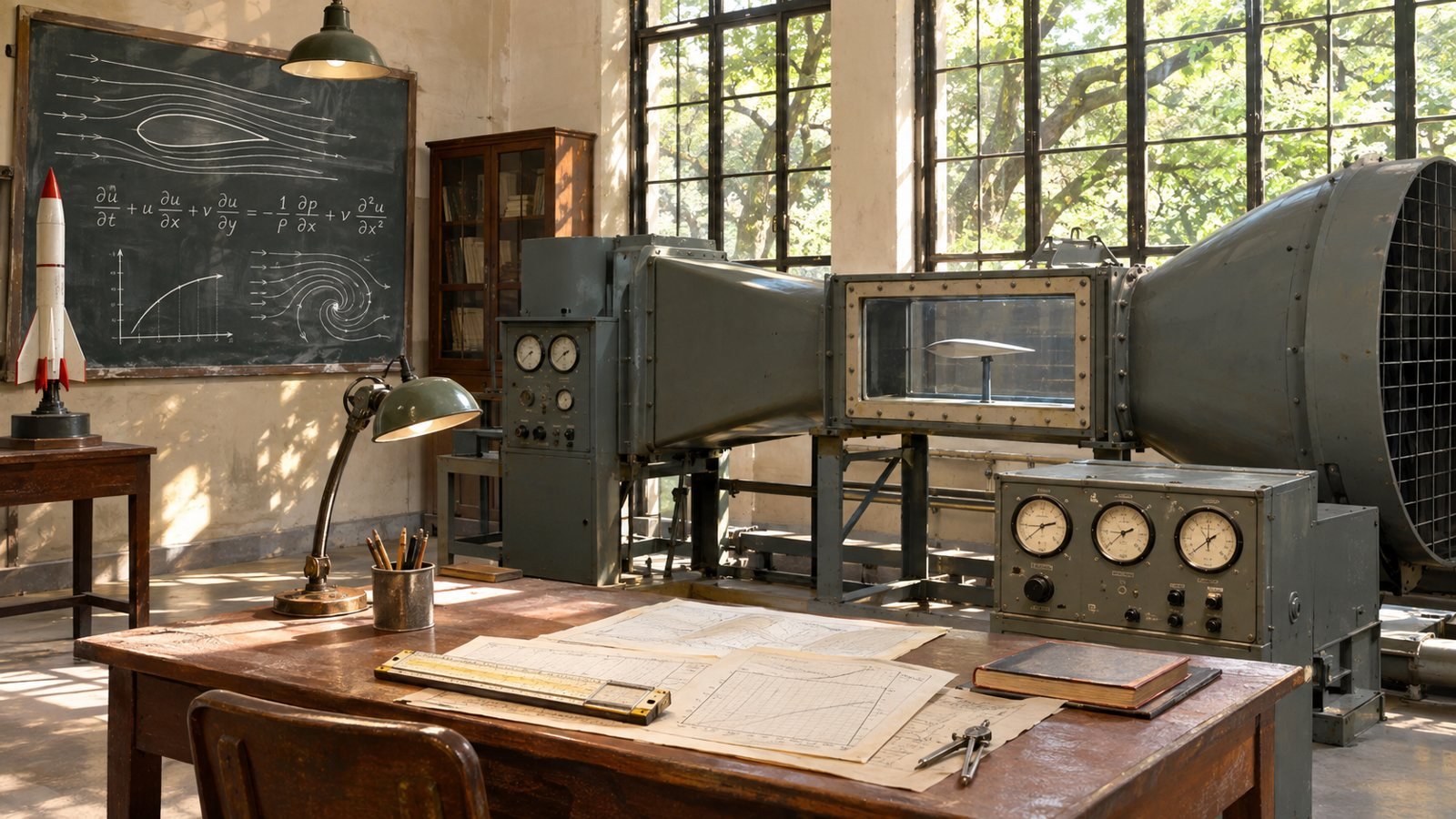
“Most bosses share the credit and outsource the blame. Satish Dhawan did the exact opposite, and Bengaluru got a space agency out of it.”
• Tariq Sallam
Satish Dhawan was the aerospace scientist who ran the Indian Institute of Science in Bengaluru for 19 years (1962 to 1981) and, from 1972 to 1984, the Indian Space Research Organisation at the same time. He set up India's first supersonic wind tunnel at IISc, laid the groundwork for INSAT, the IRS satellites and the PSLV, and is the reason ISRO's headquarters are in Bengaluru. He died in the city on 3 January 2002, and India's launch centre at Sriharikota now carries his name.
Ask most Bengalureans who Satish Dhawan was and you will get one of two answers: 'the launch pad guy' or a polite nod. That is a bit unfair to a man who quietly shaped two of the institutions this city brags about most, IISc and ISRO, without ever making a speech about himself. He wore colourful sports shirts instead of ties, drove a small red MG convertible between home and the lab, and kept his office lights on well past midnight.
I have put his story together from published records and interviews, with the Bengaluru bits up front: how he got here, what he built in Malleswaram's backyard at IISc, why he refused to leave, and the one leadership lesson every startup founder in this city should frame and hang above the coffee machine.
Quick Information
He studied English literature, then decided aeroplanes were more interesting. India's space programme has been grateful ever since.
Who Was Satish Dhawan?
Satish Dhawan was an Indian aerospace engineer and mathematician, often called the father of experimental fluid dynamics research in India, who led both IISc and ISRO from Bengaluru. He was born in Srinagar on 25 September 1920 and grew up between Srinagar and Lahore.
His education reads like someone who could not decide what to be and so became all of it. At the University of the Punjab in Lahore he took a BA in mathematics and physics, an MA in English literature and a BE in mechanical engineering, finishing in 1945. He then went to the United States, earning an MS in aeronautical engineering from the University of Minnesota in 1947, an aeronautical engineer's degree from Caltech in 1949, and a PhD in aeronautics and mathematics from Caltech in 1951, under the fluid dynamicist Hans W. Liepmann. His thesis was on measuring skin friction, which is exactly as niche as it sounds and exactly as important if you want to build anything that flies.
How Did Satish Dhawan Come to Bengaluru?
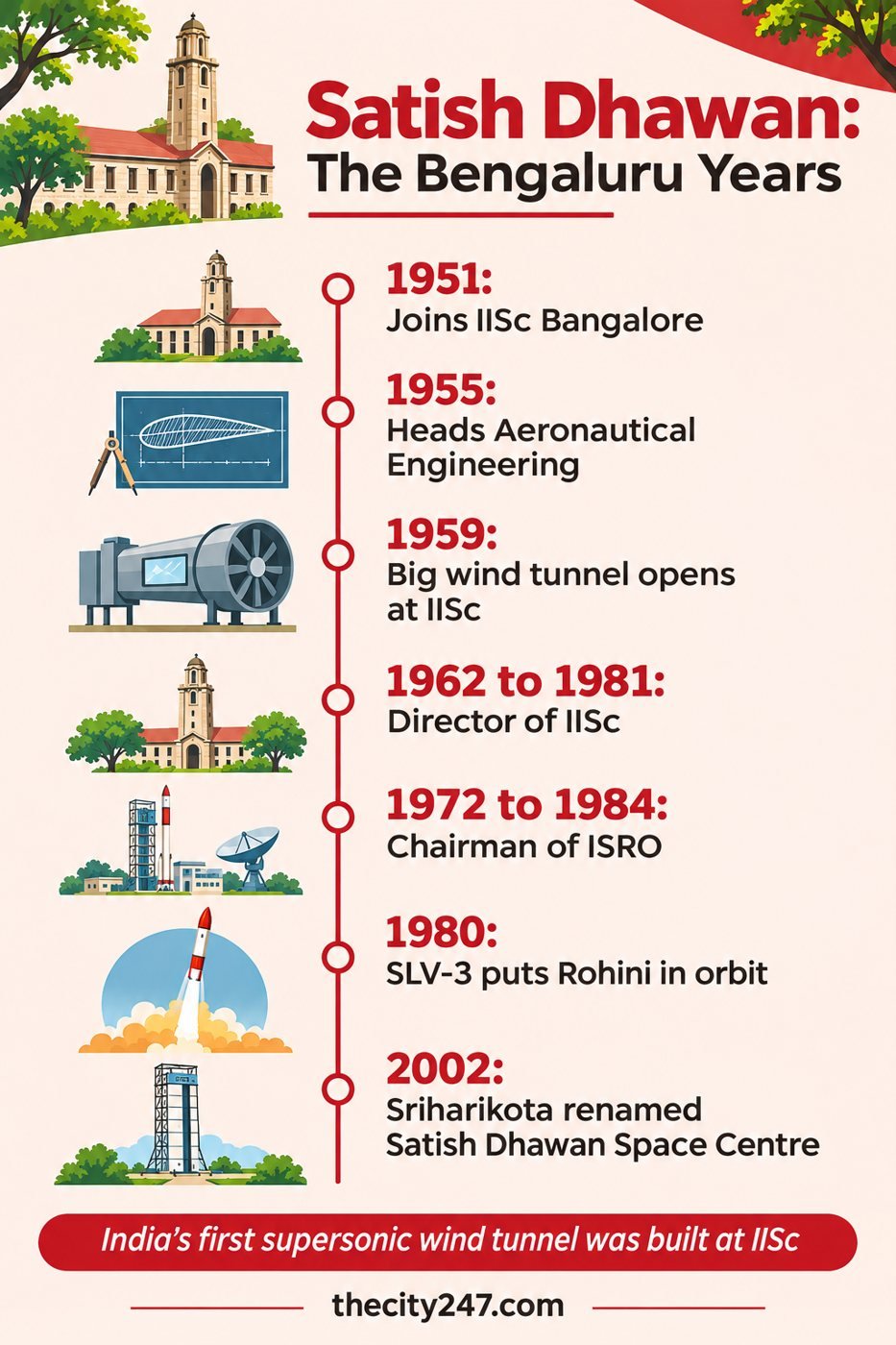
Satish Dhawan came to Bengaluru in 1951, straight after his Caltech PhD, to join the Indian Institute of Science as a senior scientific officer. Within four years, in 1955, he was professor and head of the Department of Aeronautical Engineering.
It was not a glamorous start. He set up high speed aerodynamics and boundary layer laboratories in the aeronautics department, built a small supersonic tunnel, and taught gas dynamics to students who would go on to run India's aerospace labs. One of them was Roddam Narasimha, who designed nozzles for that early tunnel as a student and later became one of the country's best known fluid dynamicists. Dhawan persuaded him to stay on for research; the rest of Indian aerospace science followed that kind of quiet persuasion.
Dhawan was famous for inviting students home for tea. In an era of very formal professors, that alone made him a campus legend.
What Did Satish Dhawan Build at IISc?
At IISc, Satish Dhawan built India's first supersonic wind tunnel and the country's first serious school of experimental fluid dynamics, then, as director, grew the institute into the broad research powerhouse it is today. His own research covered boundary layers, turbulence, relaminarization of flows and trisonic flows.
- Wind tunnels. A large open circuit wind tunnel opened at IISc in 1959 under his leadership, and was reported to have been inaugurated by the then Maharaja of Mysore. It was later used to refine the design of the LCA Tejas fighter before its first flight in 2001. India's first hypersonic wind tunnel followed at IISc in 1973.
- A record directorship. He became director in 1962 at 42 and held the post until 1981, a record run. By one count the institute grew from 11 departments to 40 in that time.
- Talent magnet. He brought in or backed scientists such as C N R Rao and G N Ramachandran, encouraged theoretical physics, and pushed IISc into new areas including ecology and atmospheric science.
- Culture change. Colleagues recalled that the campus had a reputation for a relaxed, club centred life before him. Dhawan's own late nights made work the new fashion.
“If you have ever driven past IISc and wondered why it feels like a forest with PhDs in it, part of the answer is one man who refused to let it become a club.”
• Tariq Sallam
Why Is ISRO's Headquarters in Bengaluru?
ISRO's headquarters are in Bengaluru largely because of Satish Dhawan: when Prime Minister Indira Gandhi asked him to lead India's space programme after Vikram Sarabhai's death in 1971, he agreed only if he could remain director of IISc, which meant ISRO would be run from Bengaluru.
He became Chairman of ISRO, Chairman of the Space Commission and Secretary to the Government of India's Department of Space in 1972, while still running IISc. According to Roddam Narasimha's account, he drew his salary only from IISc and took a token one rupee from the government for the space job. Today ISRO's headquarters, Antariksh Bhavan, sits on New BEL Road, and a whole ecosystem of space centres, suppliers and startups has grown around the city. If you work in Bengaluru's space tech scene, you are, in a very real sense, working in the neighbourhood Dhawan picked.
What Did Satish Dhawan Do as ISRO Chairman?
As ISRO chairman from 1972 to 1984, Satish Dhawan turned Sarabhai's vision into working programmes, overseeing a decade of rapid growth that laid the foundations for INSAT communication satellites, IRS remote sensing satellites and the PSLV rocket. He also ran early experiments in using satellites for rural education and communication.
- People first. He picked strong leaders for each centre and gave them room, including backing a young APJ Abdul Kalam to lead the SLV-3 rocket project when others had doubts.
- Open reviews. He set up project based teams with reviews that included outside experts. For SLV-3 he held a review with about 250 engineers in one auditorium so that everyone understood the mission, and made sure even a junior's question got a proper answer.
- Faith in local talent. His core belief, as colleagues described it, was that Indian scientists and engineers could do world class work at home if the system let them.
What Happened After the SLV-3 Failure in 1979?
After India's first SLV-3 launch failed in August 1979, Satish Dhawan faced the press himself and took the blame, saying the team had failed but that he trusted it completely. When the next SLV-3 put the Rohini satellite into orbit in July 1980, he stepped back and sent Kalam, the project director, to brief the press on the success.
Kalam told this story for the rest of his life as the most important lesson he learned about leadership. It is also, I think, the most Bengaluru lesson there is. This city runs on teams: labs, startups, garage bands, cricket clubs, apartment WhatsApp groups. The leader who absorbs the failure and passes on the applause is the one people will follow into the next launch.
My takeaway for every founder, manager and RWA president reading this: say 'we failed' in public and 'you did it' in public. Everything else can go in the one on one.
Did Satish Dhawan Study Bird Flight?
Yes. Satish Dhawan had a lifelong interest in how birds fly, and he wrote a monograph on bird flight that was published in 1991 by the Indian Academy of Sciences in its journal Sadhana, with a new edition in 2020. For a man who spent his career on wind tunnels and rockets, it is a lovely reminder that he started from the simplest question in aeronautics: how does that thing stay up?
He was also President of the Indian Academy of Sciences, headquartered in Bengaluru, from 1977 to 1979, and after leaving ISRO he chaired the Research Council of the National Aerospace Laboratories in the city from 1984 to 1993.
How Did Satish Dhawan Live in Bengaluru?
Satish Dhawan lived simply in Bengaluru: after retiring as IISc director, he built a modest home near the institute rather than holding on to a grand official house, and colleagues remembered him as cheerful, informal and hard working. He had a circle of socially minded friends in the city's science community and was, by every account, easy to talk to.
His wife, Nalini Dhawan, was a cytogeneticist, and their daughter Jyotsna Dhawan is a senior scientist at the Centre for Cellular and Molecular Biology. He died in Bengaluru on 3 January 2002, aged 81. Shortly afterwards the Sriharikota launch range was renamed the Satish Dhawan Space Centre, which is why his name appears on the news every time India launches a rocket.
Where Can You See Satish Dhawan's Legacy in Bengaluru?
You can see Satish Dhawan's legacy in Bengaluru at the IISc campus, where the aerospace department and wind tunnel tradition he started still run, and in the cluster of space institutions around the city led by ISRO's headquarters on New BEL Road.
- IISc campus. Labs are not open for casual visits, but the institute holds an annual Open Day when departments show off their work to the public. Check iisc.ac.in for the date.
- New BEL Road. Antariksh Bhavan, ISRO's headquarters, is not a visitor attraction, but it is the clearest sign of his decision to keep space in Bengaluru.
- The wider city. Every aerospace and space tech company that chose Bengaluru, from public sector giants to new satellite startups, is part of the ecosystem he anchored here.
Why Does Satish Dhawan Belong in People of Bangalore?
He lived and worked in Bengaluru for about five decades, led IISc for 19 years, ran ISRO from the city and insisted its headquarters stay here, and died in Bengaluru in 2002.
I never met Satish Dhawan, and this piece is not based on an interview. It is pieced together from online research: ISRO's official profile, published interviews with colleagues such as Roddam Narasimha, news reports and public records. If you knew him and have a story to add, I would love to hear it.
Satish Dhawan: Frequently Asked Questions
Who was Satish Dhawan?
An Indian aerospace scientist who was director of IISc Bangalore from 1962 to 1981 and chairman of ISRO from 1972 to 1984. He is regarded as the father of experimental fluid dynamics research in India.
Why is Sriharikota named after Satish Dhawan?
After his death in 2002, the launch centre at Sriharikota was renamed the Satish Dhawan Space Centre to honour his leadership of India's space programme.
What is Satish Dhawan known for?
Building India's first supersonic wind tunnel at IISc, leading IISc for 19 years, guiding ISRO through the SLV-3, INSAT, IRS and early PSLV years, and his leadership after the 1979 SLV-3 failure.
Why is ISRO headquartered in Bengaluru?
Because Satish Dhawan agreed to lead ISRO only if he could stay director of IISc, so the space programme was run from Bengaluru.
What happened between Satish Dhawan and Abdul Kalam?
Dhawan backed Kalam to lead SLV-3. When it failed in 1979, Dhawan took the blame publicly; when it succeeded in 1980, he let Kalam present the success to the press.
When did Satish Dhawan die?
On 3 January 2002 in Bengaluru, aged 81.
Who succeeded Satish Dhawan at ISRO?
U R Rao, another scientist with deep Bengaluru roots, succeeded him as ISRO chairman in 1984.
Contact Details
Want to see where his work lives on? These are the official places to start.
Know a Bengalurean Who Deserves This Page?
Scientists, teachers, shopkeepers, coaches: tell me about the person whose story this city should know. Click the WhatsApp icon at the bottom right of your screen to reach The City 24/7.
And for one People of Bangalore story every week, plus the city's news in one place, join the newsletter at thecity247.com/newsletter.
Look up, Bengaluru. Same city, new stories, always.

Related Stories
 CITY BUILDERS
Kempe Gowda: The Man Who Built Bengaluru From a Mud Fort in 1537
November 1, 2026
 TECHNOLOGY
Sabeer Bhatia: The Bangalore Schoolboy Who Sold Hotmail for $400 Million
October 29, 2026
 ENVIRONMENT
T V Ramachandra: The IISc Scientist Who Measures What Bangalore Lost
October 28, 2026
 CITY BUILDERS
R K Baliga: The Man Who Dreamed Up Electronics City
October 18, 2026
 SCIENCE
U R Rao: How India's First Satellite Was Built in a Bengaluru Industrial Shed
October 16, 2026
 WOMEN WHO MADE A DIFFERENCE
Nigar Shaji: The Bengaluru Scientist Who Sent India to the Sun
October 4, 2026
