


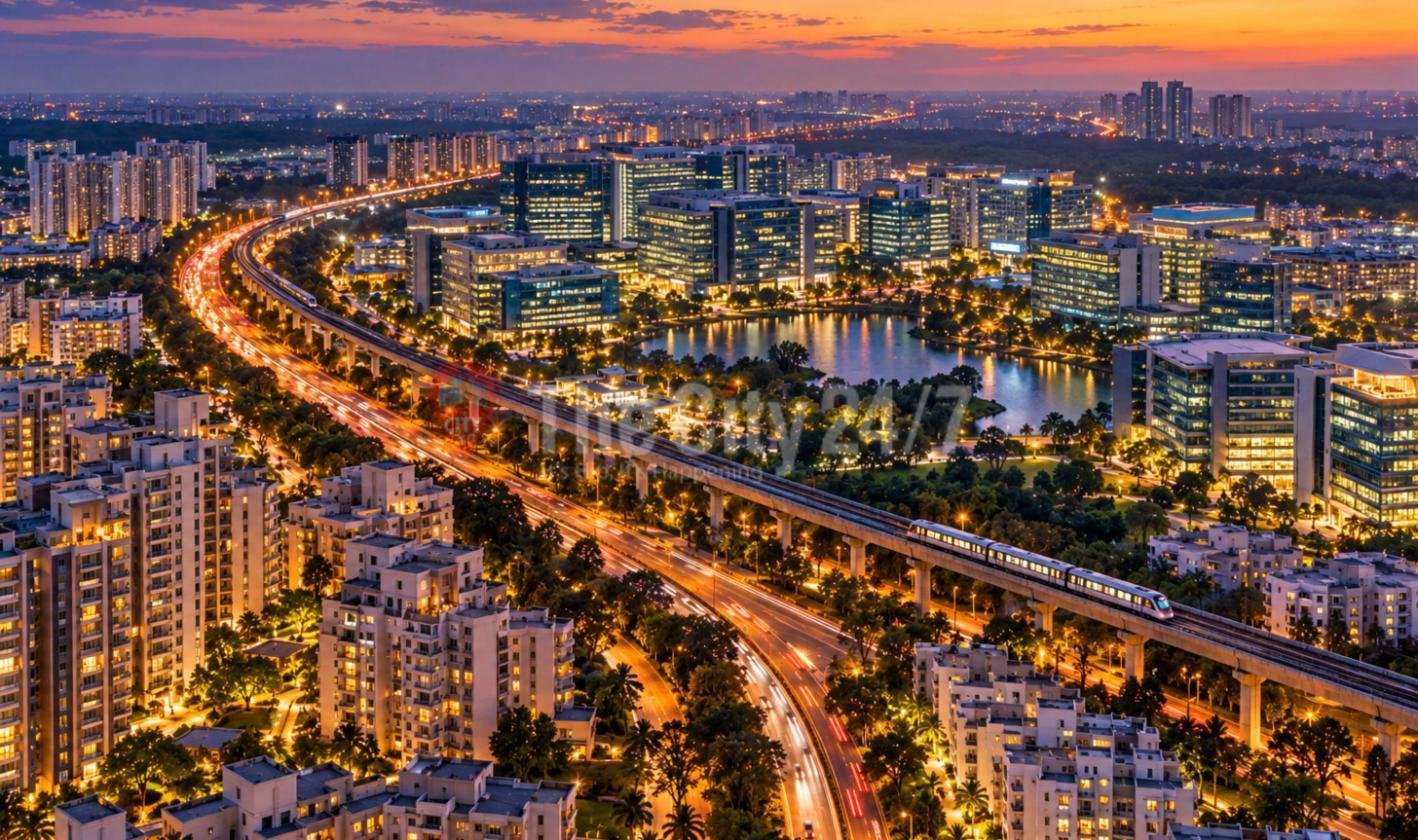
“In Bengaluru, choosing where to live is choosing how much of your life to spend on the Outer Ring Road. Nothing else about the decision comes close.”
• On the only variable that compounds daily
Most people moving to Bengaluru for work ask which area is nice. The more useful question is which areas serve their specific office, because this city's geography means a twenty minute difference in commute is worth more than almost any amenity a listing can advertise.
Bengaluru's employment sits in five main clusters: Whitefield and ITPL in the east, the Outer Ring Road belt from Marathahalli through Bellandur, Electronic City in the south, Manyata and the northern offices, and the central business district. Each is served by a different and largely non overlapping set of residential areas.
This guide takes each cluster and covers the areas that work for it, with rents, commute realities and metro position. Our renting guide covers the rental process, our areas to live guide covers the neighbourhoods in depth, and our where to buy guide covers purchase decisions.
Quick Information
Five employment clusters and where to live for each. Rents are for a typical 2BHK.
Where Should I Live If I Work in Whitefield or ITPL?
In Whitefield itself, or Brookefield, Hoodi, Kadugodi, Varthur or Kundalahalli. Rents run roughly twenty two thousand to fifty thousand for a two bedroom flat, and the Purple Line now reaches Whitefield.
The east is the clearest case in this guide: if you work at ITPL or in the Whitefield parks, live in the east. Commuting to Whitefield from the south or west means ninety minutes each way on the worst roads in the city, and people who try it generally move within a year. Our Whitefield guide and renting in Whitefield guide cover the area in detail.
The metro extension changed the calculation materially, both for commuting into the centre at weekends and for property values. Within the belt, Brookefield and Kundalahalli are closer to the ORR offices as well, Hoodi and Kadugodi are cheaper, and Varthur and the outer stretches are cheaper still with more infrastructure lag. Check water supply specifically: parts of the belt depend on borewells and tankers through summer.
“Nobody who commutes from Jayanagar to Whitefield is still doing it two years later. They either moved house or moved job, and usually the first.”
• On the commute that does not survive contact with reality
What About the Outer Ring Road Belt?
Bellandur, Haralur, Sarjapur Road, HSR Layout and Marathahalli, at roughly twenty five thousand to sixty thousand for a two bedroom. This is the hardest corridor in the city to commute into, so living close is not optional.
- Bellandur and Kadubeesanahalli. Closest to the offices, with the shortest commutes and the heaviest traffic outside your door. Water and lake issues have been most documented in this belt, so check carefully.
- HSR Layout. Better planned, more liveable, with good food and amenities, and a manageable commute to the ORR offices. Consistently one of the most popular choices for this corridor.
- Sarjapur Road and Haralur. Substantial apartment supply at a range of price points, with the caveat that the corridor's infrastructure has lagged its development considerably.
- Marathahalli. Central to the eastern corridor, well supplied with rentals, and convenient for both the ORR offices and Whitefield.
- The Blue Line matters enormously here. The ORR metro under construction will transform this corridor. Treat it as upside rather than as your plan, since timelines slip.
- Avoid crossing the ORR daily. The junctions at Silk Board, Agara and Iblur at peak hour are among the worst in India. Live on the same side as your office.
- Check the water position building by building. This is the corridor where tanker dependence in summer is most common, and it varies enormously between adjacent complexes.
Where Should I Live for Electronic City?
Electronic City itself, Bommanahalli, HSR Layout, Hosa Road or Chandapura. Roughly fifteen thousand to forty thousand for a two bedroom, which makes this the most affordable major corridor.
Electronic City is well served by two pieces of infrastructure the other corridors would envy: the elevated expressway on Hosur Road, which bypasses the worst of the surface traffic, and the Yellow Line metro. Together they make commuting into the district considerably more predictable than the ORR equivalent. Our Electronic City guide covers the area itself.
The trade off is distance from the rest of the city. Electronic City is at the southern edge, so evenings and weekends in Indiranagar or Koramangala involve a real journey. That suits people who want space and lower costs and frustrates people who want the city's social life on their doorstep. HSR Layout is the compromise many people choose: reasonable access to both Electronic City and the ORR, with far better amenities.
Where Should I Live for Manyata or the Central Business District?
For Manyata and the north: Thanisandra, Hebbal, Hennur, Jakkur or Yelahanka, at twenty to fifty thousand. For the CBD: Indiranagar, Domlur, Richmond Town, Frazer Town or Malleshwaram, at thirty to eighty thousand.
The northern corridor is the quietly good option. Roads are materially better than the east, the housing stock is newer, the airport is close, and Thanisandra and Hebbal sit directly beside the Manyata offices. Our north Bengaluru guide covers the area, and the schools position is reasonable, as our schools by area guide sets out.
The CBD is the most expensive and the most convenient. If you work centrally, living in Indiranagar, Domlur, Richmond Town, Frazer Town or Malleshwaram gives you metro access, the city's best food and evenings on your doorstep, and a short commute. Malleshwaram and Frazer Town are the value options within that set; Indiranagar is the premium. This is also the only cluster where living without a car is entirely straightforward.
How Do I Choose If My Situation Is Complicated?
- Two partners in different corridors. Optimise for the worse commute, or pick the corridor with better metro access for the other person. HSR, Domlur and Marathahalli are common compromises for east and central splits.
- Hybrid or three days a week. A longer commute becomes tolerable at two or three days. It is still worth testing it at peak hour, because three bad days a week is still bad.
- If you might change jobs. Living in the east keeps you near the largest employment concentration. Living centrally keeps you reachable from most corridors. Both are reasonable hedges.
- If schools matter. Schools are a ten year commitment and harder to change than a job. Our schools by area guide argues for choosing the school first and living within five kilometres of it.
- Rent before you buy. A year in the corridor tells you what the commute, water and neighbourhood are genuinely like. It is the cheapest insurance available on a large decision.
- Test the route, not the distance. 9.15 AM and 6.30 PM on a weekday, on the actual road, before signing. This single step prevents most of the regret in this guide.
- Ask about water before anything else. Cauvery or borewell, and what happens in April. Ask residents rather than the agent, and ask in the building rather than about the area.
Living Near Bangalore's Tech Parks: Frequently Asked Questions
Where should I live if I work in Whitefield or ITPL?
In the east: Whitefield itself, Brookefield, Hoodi, Kadugodi, Kundalahalli or Varthur, at roughly Rs 22,000 to 50,000 for a two bedroom flat. The Purple Line now reaches Whitefield, which improved both commuting and property values considerably.
Where is the best place to live near the Outer Ring Road?
Bellandur and Kadubeesanahalli for the shortest commute, HSR Layout for the best balance of liveability and access, and Sarjapur Road, Haralur or Marathahalli for supply at a range of price points. Rents run roughly Rs 25,000 to 60,000 for a two bedroom.
Where should I live for Electronic City?
Electronic City itself, Bommanahalli, HSR Layout, Hosa Road or Chandapura, at roughly Rs 15,000 to 40,000 for a two bedroom. It is the most affordable major corridor, served by the Yellow Line metro and the Hosur Road elevated expressway.
Where should I live if I work at Manyata Tech Park?
Thanisandra, Hebbal, Hennur, Jakkur or Yelahanka, at roughly Rs 20,000 to 50,000 for a two bedroom. The northern corridor has materially better roads than the east, newer housing stock and airport proximity.
Can I live in south Bangalore and work in Whitefield?
Technically yes and practically it does not last. That commute is roughly ninety minutes each way on the worst roads in the city, and people who attempt it generally move house or change job within a year.
How long should a commute in Bangalore be?
Under thirty minutes each way, and under twenty if you can manage it. In a city where twelve kilometres can take an hour, commute time is the variable that compounds daily and matters more than any amenity.
What if my partner and I work in different corridors?
Optimise for the worse commute, or choose the corridor with better metro access for the other person. HSR Layout, Domlur and Marathahalli are common compromises for households split between east and central offices.
Will the ORR metro change where I should live?
Substantially, when it opens. The Blue Line along the Outer Ring Road will transform commuting for Bellandur, Marathahalli and the Sarjapur corridor. Treat it as upside rather than as the basis for a decision, since infrastructure timelines here slip.
What should I check about water before renting near a tech park?
Whether the building has a Cauvery connection or depends on borewells, and whether tankers are used in summer. Ask current residents rather than the agent, ask about April specifically, and ask about the building rather than the area, since it varies enormously between adjacent complexes.
Is it better to rent near work or buy somewhere nicer?
Rent near work first. A year in the corridor tells you what the commute, water supply and neighbourhood are genuinely like, which is cheap insurance before committing to a purchase that ties you to a location for a decade.
Working Out Where to Live?
Commute realities change as roads and metro lines open, and people living in each corridor know the current picture far better than any listing. If you commute one of these routes daily, or you have just moved and learned something, click the WhatsApp icon at the bottom right of your screen and tell me. Water and traffic reports from residents are the most useful thing readers send. That is also the fastest way to reach The City 24/7 about anything at all.
And if you want the city explained one useful thing at a time, join our ever growing community. One weekly email, free.
Same city, new stories, always.

Related Stories
 PROPERTY
Bangalore's Emerging Corridors: Where the City Grows Next
September 13, 2026
 PROPERTY
East vs North vs South Bangalore: Where Should You Buy?
September 13, 2026
 PROPERTY
The Bangalore Property Guide: Rent, Buy, Khata and Where to Live
September 9, 2026
 PROPERTY
Bangalore's Property Market Explained: What Drives It and Where It Goes Next
September 13, 2026
 PROPERTY
The Best Areas for Families in Bangalore: Schools, Parks and Everyday Life
September 13, 2026
 PROPERTY
What It Costs to Buy or Rent in Bangalore: The Full Breakdown
September 13, 2026
