


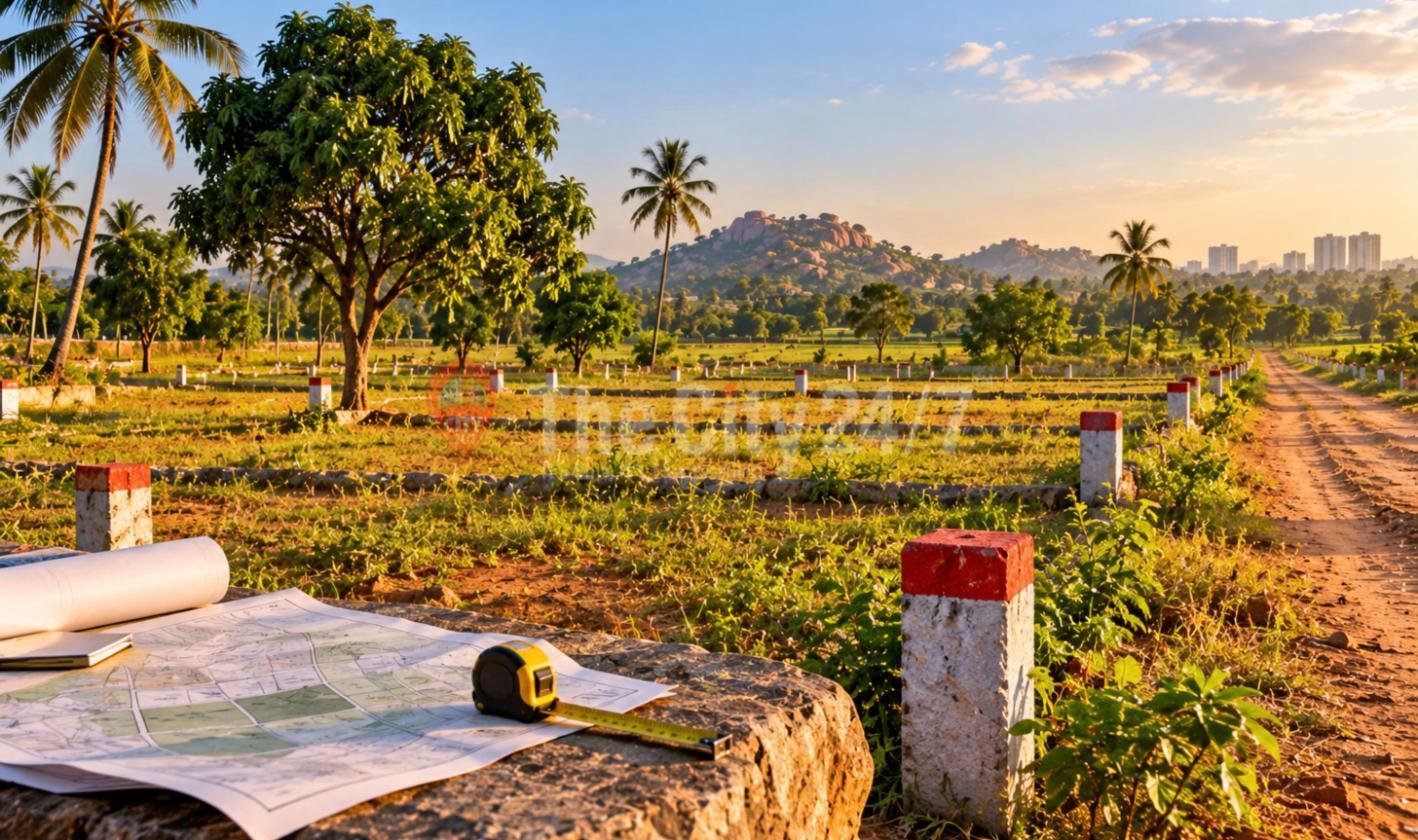
“Land in Karnataka is a legal purchase before it is a property purchase. If the documents are not right, nothing else about the deal matters.”
• On the category where due diligence is everything
Plots and agricultural land around Bengaluru attract buyers for good reasons: you build what you want, land has historically appreciated well in the growth corridors, and farm land carries an appeal that an apartment does not. It is also the segment where buyers lose money most often, and almost always for document reasons rather than market ones.
The specific complications are conversion status for agricultural land, whether a layout is approved and by which authority, revenue records that do not match reality, boundary and survey discrepancies, and the limits that still apply to who may purchase agricultural land.
This guide covers what to verify, in what order, for both approved plots and agricultural land, plus the practical questions about building afterwards. This is a category where a property lawyer is not optional, and nothing here substitutes for one.
Quick Information
Land specific checks. The conversion row is where most problems start.
What Is DC Conversion and Why Does It Matter?
Agricultural land in Karnataka must be formally converted to non agricultural use before it can be built on. The conversion order from the Deputy Commissioner is what permits that, and without it you cannot legally build.
This is the single most common problem in land purchases around this city. Agricultural land is cheaper, and it is regularly sold to buyers who assume conversion is a formality that will happen later. It is not: conversion requires an application, scrutiny and approval, it can be refused, and land in certain zones cannot be converted at all.
So the sequence matters. Verify the conversion order exists and covers the exact survey numbers and extent you are buying, before paying anything beyond a token. If the land is unconverted and the seller undertakes to convert it, that is a fundamentally different and riskier transaction, and it should be structured with payment contingent on conversion actually completing rather than on a promise.
“The phrase conversion will be done shortly means the land is currently agricultural. Price the deal on what it is today, not what somebody says it will become.”
• On the most expensive sentence in land buying
What Should I Check on an Approved Plot?
- Which authority approved the layout. BDA, BMRDA, a Greater Bengaluru Authority city corporation or panchayat. BDA and BMRDA approved layouts carry the strongest position. Panchayat approved layouts on the city's edges need careful scrutiny.
- The approved layout plan itself. Confirm your specific plot appears on the sanctioned plan with the same number and dimensions, and that roads and civic amenity areas match what exists on the ground.
- Khata status. A khata for the plot. B khata or no khata materially affects your ability to obtain a loan, get building plan approval and resell.
- Title chain and encumbrance. Thirty years of encumbrance history through Kaveri, and a full title chain examined by your lawyer, exactly as for any purchase.
- Release from acquisition. Check whether the land was ever under a government acquisition notification and, if so, that it was formally released. This is a recurring problem around Bengaluru.
- Survey sketch against physical boundaries. Walk the plot with the survey documents. Discrepancies between recorded and actual boundaries, and encroachment by neighbours, are both common.
- Betterment charges and development fees. Whether these have been paid to the authority. Outstanding charges become your liability and can block approvals.
- Access and infrastructure. Legal road access, water availability, and electricity connection. Land with no legal access road is close to unbuildable regardless of its other qualities.
Can I Buy Agricultural or Farm Land Near Bangalore?
Since the 2020 amendment to the Karnataka Land Reforms Act, any Indian citizen can buy agricultural land, whether or not they farm, and the old income ceiling is gone. NRIs still cannot buy agricultural land under FEMA rules, companies and trusts face separate limits, and holding ceilings still apply.
Check the current position anyway. The state government said in September 2024 that it intended to restore the old restrictions, and although no such law had been enacted at the time of writing, a change could affect your purchase. Confirm eligibility with a lawyer before paying anything beyond a token.
Beyond eligibility, farm land carries its own checks: the RTC or pahani record showing ownership and extent, the mutation register aligning with the title chain, survey documents, whether the land is in a green belt or restricted zone, tenancy claims under land reform legislation, and whether any part is government or inam land. Farm land marketed as managed farmland or weekend farm plots deserves particular scrutiny, since these frequently involve unconverted land, shared ownership structures or arrangements that do not give you what buyers assume they are getting.
Where Are People Buying Land Around Bangalore?
The northern corridor toward Devanahalli and the airport, the eastern stretch beyond Whitefield and Sarjapur, Kanakapura Road in the south, and the Hosur and Mysore road directions.
The northern corridor has the strongest fundamentals, driven by the airport, the aerospace and manufacturing employment around Devanahalli and better road access than the east. The eastern outer belt continues to develop on the back of the technology corridor, and Kanakapura Road and the southern directions attract both plot buyers and farm land purchasers, partly because the landscape is genuinely pleasant.
A word on horizons. Land in the outer corridors is a long term proposition, and the returns that people cite from past decades came from areas that happened to be absorbed by the city's growth. Not every outer corridor will be. Buy land you would be content to hold for a decade or more, verify everything, and treat any projection of imminent appreciation from a seller as marketing rather than analysis. Our market guide covers where growth is actually heading and why.
What About Building on It Afterwards?
- Plan sanction from the relevant authority. A Greater Bengaluru Authority city corporation, BDA, BMRDA or panchayat depending on jurisdiction. Building without sanction creates a property that is difficult to regularise, finance or sell.
- Setbacks, floor area ratio and height limits. These govern what you can actually build on the plot. Confirm them before buying, since they determine whether your plans are feasible at all.
- Water and electricity connections. BWSSB water availability in the area and a BESCOM connection. On the outer corridors, borewell viability and groundwater depth are the practical questions.
- Access road status. Whether the road is a recognised public road and its width, since setback and approval requirements depend on it. Private access arrangements can fail.
- Construction cost budget. Independent house construction costs vary widely by specification. Budget realistically and add contingency, since land buyers routinely underestimate this.
- Timeline reality. Between purchase, approvals and construction, an independent house is a multi year project. That is a different commitment from buying a completed flat.
- Resale considerations. A well built house on an approved plot with A khata sells reasonably. Anything with approval or title irregularities is substantially harder to sell.
Buying Plots and Land Near Bangalore: Frequently Asked Questions
What is DC conversion and why is it needed?
Agricultural land in Karnataka must be formally converted to non agricultural use through an order from the Deputy Commissioner before it can legally be built on. Without it you cannot build, conversion can be refused, and land in some zones cannot be converted at all.
What should I check before buying a plot in Bangalore?
Which authority approved the layout, whether your specific plot appears on the sanctioned plan, khata status, thirty years of encumbrance history, release from any acquisition notification, the survey sketch against physical boundaries, outstanding betterment charges, and legal road access.
Can anyone buy agricultural land in Karnataka?
Since the 2020 Land Reforms amendment, any Indian citizen can buy agricultural land in Karnataka without being a farmer or meeting an income limit. NRIs cannot buy agricultural land, companies and trusts face separate limits, and holding ceilings apply. The government has proposed restoring the old restrictions, so confirm the position with a property lawyer before proceeding.
What is an RTC or pahani?
The land revenue record showing ownership, extent and crop details for agricultural land. It should align with the title chain and the mutation register, and discrepancies between these records are a common source of land disputes.
Is managed farmland near Bangalore a good investment?
It deserves particular scrutiny. These arrangements frequently involve unconverted land, shared ownership structures or contractual arrangements that do not give buyers what they assume. Have a lawyer examine exactly what interest in land you are acquiring.
Where are people buying land around Bangalore?
The northern corridor toward Devanahalli and the airport, which has the strongest fundamentals, the eastern stretch beyond Whitefield and Sarjapur, Kanakapura Road in the south, and the Hosur and Mysore road directions.
What is the biggest risk in buying land near Bangalore?
Unapproved layouts and unconverted agricultural land sold as ready to build. Almost all losses in this segment are document problems rather than market problems, which is why legal due diligence at Rs 25,000 to 1 lakh is essential rather than optional.
How much does land due diligence cost?
Roughly Rs 25,000 to 1 lakh for a property lawyer, which is considerably more than for a flat because land involves revenue records, survey documents, conversion status and acquisition checks in addition to standard title work.
What approvals do I need to build on a plot?
Plan sanction from a Greater Bengaluru Authority city corporation, BDA, BMRDA or the panchayat depending on jurisdiction, within the applicable setback, floor area ratio and height limits. You will also need water and electricity connections and legally recognised road access of adequate width.
Should I check for government acquisition notifications?
Yes, and it is a recurring problem around Bengaluru. Verify whether the land was ever under an acquisition notification and, if so, that it was formally released. Your lawyer should check this specifically rather than assuming.
Verification Portals
Land purchases involve more records than any other property transaction. These are where they live.
Considering Land?
Land is the one category where I would tell anybody to slow down and spend properly on legal advice, because the failures here are expensive and usually unrecoverable. If you are considering a plot or farm land and something in the paperwork seems unclear, click the WhatsApp icon at the bottom right of your screen and ask. If you have been through a land purchase that went wrong, that account would help a lot of readers. That is also the fastest way to reach The City 24/7 about anything at all.
And if you want the city explained one useful thing at a time, join our ever growing community. One weekly email, free.
Same city, new stories, always.

Related Stories
 PROPERTY
Gated Communities and Builders in Bangalore: How to Choose Both Well
September 13, 2026
 PROPERTY
The Bangalore Property Buying Checklist: Every Document You Must Check
September 13, 2026
 PROPERTY
Buying Property in Bangalore: The Documents, the Costs and the Checks That Matter
September 9, 2026
 PROPERTY
Living in Jayanagar and Basavanagudi: Old Bengaluru, and Why Families Stay
September 9, 2026
 PROPERTY
PG and Co-Living in Bangalore: What It Costs, Where to Look and What Nobody Tells You
September 9, 2026
 PROPERTY
Renting on Sarjapur Road and Bellandur: The Corridor Everyone Moves To
September 9, 2026
