


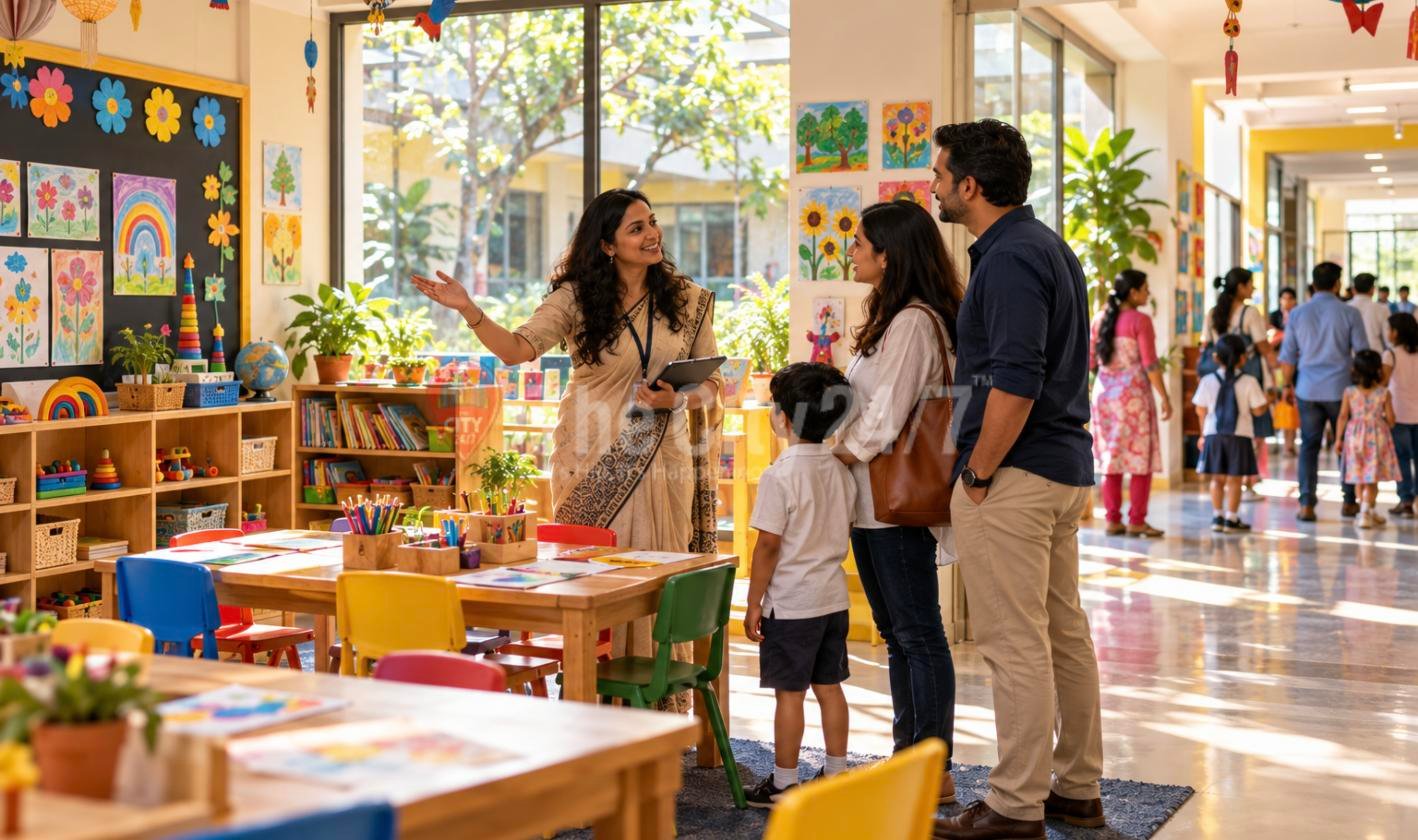
“Parents in Bengaluru research boards for six months and the commute for about ten minutes. It is almost always the wrong way round.”
• On the decision that shapes ten years
Choosing a school is the most consequential decision most families make in this city, and the market makes it genuinely difficult. Bengaluru has several hundred schools across five boards, fees ranging from a few thousand rupees a year to several lakhs, and an admissions culture that rewards people who started eighteen months early.
What makes it harder is that the loudest information is the least useful. Rankings are frequently paid placements. School websites tell you about infrastructure rather than teaching. And parent groups, which are the best source available, are also full of very strong opinions from people whose child is not your child.
So this guide is a decision framework rather than a list. The order in which the factors actually matter, what each one costs, the specific questions that reveal what a school is like, and the mistakes I see parents in this city regret. Our boards guide covers CBSE, ICSE, IB and IGCSE in detail, and the admissions guide covers timelines and paperwork.
Quick Information
The whole decision on one screen, in the order the factors actually matter. The first row is the one people skip.
What Matters Most When Choosing a School in Bangalore?
Distance, before anything else. A school under five kilometres or thirty minutes away will improve your child's life and yours more than any difference in board, facilities or reputation.
This is the single most underweighted factor in Bengaluru and it is specific to this city's geography. A school twelve kilometres away means a child on a bus at half past six in the morning, returning at half past four, exhausted, with no time for anything else. Over ten years that is thousands of hours, and it affects sleep, homework, friendships and every extracurricular activity they might otherwise have done.
It also affects you. School pickups, parent meetings, a sick child at eleven in the morning and forgotten sports kit all become forty minute journeys. Parents consistently tell me they underestimated this, and almost nobody says they wish they had chosen a school further away for the marginally better reputation. Drive the route at eight on a weekday before you apply anywhere.
Which Board Should I Choose?
CBSE if you may relocate within India or your child will sit national entrance exams, ICSE for breadth and English, State board for local affordability and Kannada, and IB or IGCSE if you are likely to move abroad.
- CBSE. The most widely available and the most portable within India, and aligned with national engineering and medical entrance exams. The default sensible choice for most families here, and our boards guide explains why.
- ICSE. Broader syllabus, stronger emphasis on English and more internal assessment. Suits children who read well and enjoy range, and is generally considered more demanding in volume.
- State board. Considerably cheaper, locally rooted, with Kannada properly taught. A genuinely reasonable choice that middle class parents dismiss too quickly, particularly at the good aided schools.
- IB and IGCSE. Inquiry led and internationally portable, at Rs 5 to 12 lakh a year. The right answer if you expect to move abroad and an expensive one if you do not.
- Do not choose a board in the abstract. A good school on a weaker board beats a poor school on a prestigious one, every time. Teaching quality varies far more between schools than between boards.
- Think about the exit, not the entry. Where will your child be at sixteen and eighteen, and which board serves that. Switching boards mid schooling is possible and disruptive, particularly after class eight.
“A good school on an ordinary board will serve your child better than an ordinary school on a prestigious one. The variation between schools dwarfs the variation between boards.”
• The thing I most wish parents heard earlier
What Will School Actually Cost?
Budget twenty to forty percent above the tuition figure. A school quoting two lakh a year will realistically cost two and a half to two and three quarter lakh once transport, books, uniform and activities are added.
The components: tuition, which is what schools quote; a one off admission fee and sometimes a refundable deposit, which can be substantial at premium schools; transport at roughly twenty five thousand to ninety thousand a year depending on distance; books and uniform; and activities, trips and examination fees. Annual increases of five to ten percent are normal and should be modelled across the full school career, not just next year.
Rough ranges by segment: state board fifteen thousand to eighty thousand a year, mainstream private CBSE and ICSE eighty thousand to three and a half lakh, premium CBSE and ICSE three and a half to six lakh, and IB or IGCSE five to twelve lakh and upward. Ask for the complete fee schedule in writing, including what rises annually and what the exit refund policy is, because that conversation is much easier before you pay the admission fee than after.
What Should I Ask on a School Visit?
- What is the average class size in primary? Under thirty is good in this market, and over forty is common and worth questioning. Ask for the actual number in the year your child would join, not the school average.
- How long has the average teacher been here? Teacher retention is the best single proxy for school quality that a parent can actually measure. High turnover is a warning regardless of facilities.
- What happens when a child falls behind? The most revealing question you can ask. Listen for a specific process involving specific people, not a reassurance about individual attention.
- How do you handle bullying? Again, listen for process rather than denial. A school that says bullying does not happen here is a school that is not looking.
- What is the homework load in each stage? Ask for hours per night. Then ask parents in that year whether the answer is accurate, because it frequently is not.
- Can I see a normal classroom, mid lesson? Not the display classroom. A school confident in its teaching will allow this, and how the children and teacher behave when you walk in tells you more than the tour.
- May I speak to two current parents? A school that facilitates this is confident. Then ask those parents what they would change, which is the question that produces honest answers.
- What is the total fee, including everything? In writing, with the annual increase and the refund policy. Do this before the admission fee is paid.
How Do I Judge a School's Culture?
By how the children behave when nobody is managing them, how teachers speak to students, and what the school is proud of. Visit during a normal school day rather than on an open day.
Open days are performances. A normal Tuesday at half past eleven tells you whether children move through corridors happily or fearfully, whether teachers use their names, whether the place feels warm or anxious. Ask to visit at a normal time and note how the school responds to the request, which is itself informative.
Then listen to what they volunteer. A school that leads with board exam percentages and competitive results is telling you what it values, which may be exactly what you want or may be a poor fit for a particular child. A school that leads with arts, sport or pastoral care is telling you something different. Neither is wrong, and the mismatch between a family's values and a school's is the most common cause of an unhappy child in a perfectly good school.
What Do Parents Most Regret?
- Choosing a school too far away. The single most common regret in this city, and the one that cannot be fixed without changing schools. Do the commute before you apply.
- Paying for facilities rather than teaching. A swimming pool and a robotics lab are visible. Teacher retention and class size are not, and they matter far more to what your child actually learns.
- Trusting a ranked list. Most published school rankings in India are paid placements. Current parents at that specific school are the only reliable source.
- Starting too late. Applications largely run November to January for a June start, and the premium and IB schools carry waiting lists. Twelve to eighteen months of lead time is realistic.
- Choosing for the child you imagine rather than the one you have. A high pressure academic school is excellent for some children and damaging for others. Be honest about which yours is.
- Not budgeting the full cost. Twenty to forty percent above tuition, rising five to ten percent a year. Parents who do not model this end up moving a child for financial reasons, which is the worst reason.
- Ignoring the sibling question. If you expect a second child, ask about sibling admission policy now. Running two schools in Bengaluru traffic is genuinely difficult.
Choosing a School in Bangalore: Frequently Asked Questions
What is the most important factor when choosing a school in Bangalore?
Distance. A school under five kilometres or thirty minutes away will do more for your child's wellbeing than any difference in board or facilities, because the alternative is a child on a bus from half past six in the morning for ten years. Drive the route at eight on a weekday before applying.
Which board is best in Bangalore?
CBSE if you may relocate within India or your child will sit national entrance exams, ICSE for breadth and English, State board for affordability and Kannada, and IB or IGCSE if you expect to move abroad. Teaching quality varies far more between schools than between boards.
How much do schools cost in Bangalore?
Roughly Rs 15,000 to 80,000 a year for state board, Rs 80,000 to 3.5 lakh for mainstream private CBSE and ICSE, Rs 3.5 to 6 lakh for premium schools and Rs 5 to 12 lakh for IB and IGCSE. Budget 20 to 40 percent above tuition for transport, books, uniform and activities.
When should I start looking for a school in Bangalore?
Twelve to eighteen months ahead. Applications largely open between November and January for the academic year starting in June, and premium and IB schools carry waiting lists that make late applications difficult.
What should I ask when visiting a school?
The actual class size in your child's year, how long the average teacher has been there, what happens when a child falls behind, how bullying is handled, the nightly homework load, and whether you can see a normal classroom mid lesson and speak to two current parents.
Are school rankings in India reliable?
Generally not. Most published rankings are paid placements. The only reliable source is current parents at that specific school, ideally in your child's year, and the most useful question to ask them is what they would change.
What hidden costs do Bangalore schools have?
A one off admission fee and sometimes a refundable deposit, transport at Rs 25,000 to 90,000 a year, books, uniform, activity and trip charges, and examination fees. Annual increases of five to ten percent are normal, so model the full school career rather than next year.
How do I judge a school's culture?
Visit on a normal school day rather than an open day, and watch how children behave when nobody is managing them and how teachers speak to students. Then note what the school volunteers first, whether board percentages or arts and pastoral care, since that tells you what it values.
What class size should I look for in Bangalore?
Under thirty in primary is good in this market. Over forty is common and worth questioning directly. Ask for the actual number in the specific year your child would join rather than the school wide average.
Is it a problem to change schools or boards later?
It is possible and disruptive, and it becomes harder after class eight when board syllabi diverge significantly. Think about where your child will be at sixteen and eighteen when choosing, rather than only about the year they are entering.
Useful Links
Board and regulatory bodies for verifying a school's affiliation and status.
Choosing a School This Year?
Fee structures, class sizes and admission timelines change every year, and parents in the middle of the process know the current reality better than any guide. If something here does not match what you have been told, or you have just been through an admission and learned something worth passing on, click the WhatsApp icon at the bottom right of your screen and tell me. Parent to parent information is genuinely the most valuable thing on this subject. That is also the fastest way to reach The City 24/7 about anything at all.
And if you want the city explained one useful thing at a time, join our ever growing community. One weekly email, free, and useful well before admission season.
Same city, new stories, always.

Related Stories
 EDUCATION
How to Choose a School in Bangalore: Boards, Areas, Fees and the Questions to Ask
September 8, 2026
 EDUCATION
CBSE vs ICSE vs IB in Bangalore: Which Board Is Right for Your Child?
September 12, 2026
 EDUCATION
Good Schools in Bangalore Under a Lakh a Year: Where to Actually Look
September 18, 2026
 EDUCATION
The Top Boys' Schools in Bangalore: Bishop Cotton, Baldwin and What They Actually Cost
September 18, 2026
 EDUCATION
The Top Christian and Convent Schools in Bangalore: Why They Still Dominate the City's Education
September 18, 2026
 EDUCATION
The Top Girls' Schools in Bangalore: The List, and What Happens After Class 10
September 18, 2026
