


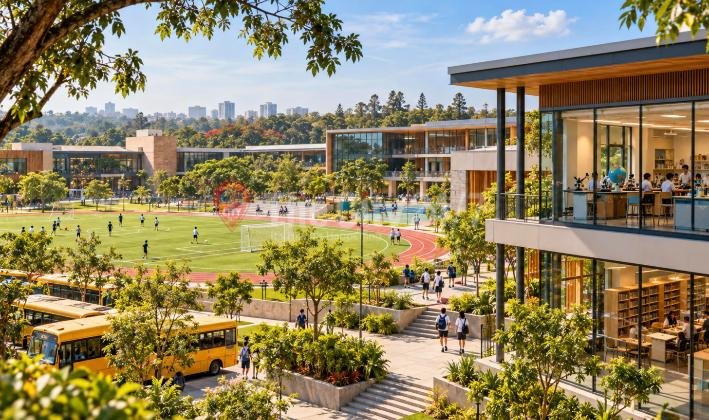
“The word international is not regulated. Anybody can put it on a signboard, and plenty have. IB authorisation and Cambridge registration are regulated, and those you can check in two minutes.”
• The most useful thing a parent can know here
Bengaluru has one of India's largest concentrations of international schools, and for good reason: a large expatriate population, a very large population of Indian professionals who have worked abroad, and a returning diaspora who want their children in a system they recognise. The segment is genuinely well developed here.
It is also the segment where the gap between price and quality is widest. Fees run six to twelve lakh a year and higher, and the word international carries no regulatory meaning whatsoever. What does carry meaning is IB authorisation and Cambridge centre registration, both of which are verifiable in minutes on the respective websites, and both of which a surprising number of parents never check.
This guide covers what an international school actually is, the fees, where they cluster geographically, what admission involves, boarding options, and the specific questions that separate a serious school from an expensive one. Our boards guide compares IB and IGCSE against CBSE and ICSE in detail.
Quick Information
Fees, areas and the checks that matter. The authorisation row is non negotiable.
What Actually Makes a School International?
IB authorisation or Cambridge International registration. Nothing else. The word international in a school's name is marketing and carries no regulatory meaning in India.
This is the single most important thing to understand about this segment, and it is easily checked. The International Baccalaureate Organisation publishes its authorised world schools, and Cambridge International publishes its registered centres. Both are searchable in two minutes. A school claiming to be international that appears on neither list is running CBSE or ICSE with an international name, which may still be a perfectly good school and is not what you are being sold.
There is also a middle category worth knowing: schools that run CBSE or ICSE with international programmes bolted on, or that offer IGCSE alongside an Indian board. Some of these are excellent. The question to ask is precisely which curriculum your child would follow in each year group, and which examinations they would sit at sixteen and eighteen, with the answer in writing.
What Do International Schools Cost in Bangalore?
Six to twelve lakh a year for IB and five to ten lakh for IGCSE, plus a one off admission fee of one to five lakh, plus twenty to forty percent on top for everything else.
- Tuition is the quoted figure and not the cost. Ask for the complete fee schedule in writing, including annual increases, which commonly run five to ten percent.
- The admission fee is substantial. Commonly Rs 1 to 5 lakh as a one off, sometimes with a separate refundable deposit. Establish what is refundable and under what conditions before paying.
- Transport is Rs 50,000 to 1.2 lakh a year. These campuses are frequently on the city's edges, so bus distances are long and costs are higher than at a neighbourhood school.
- Books, uniform, devices and trips. IB in particular involves laptops, project materials and residential trips. Ask for last year's actual total per child rather than a list.
- Examination fees at the exit years. IB Diploma and A Level registration and subject fees are charged separately and are not trivial. Confirm who pays them.
- Model the full run. At 8 percent annual increases, a Rs 8 lakh fee today is substantially more by class twelve. Parents who do not model this end up moving a child mid schooling, which is the worst outcome.
- Ask about sibling policy. Some schools offer sibling concessions or priority admission. At these fee levels the difference across two children is significant.
“Ask how many students completed the IB Diploma last year and what the average score was. A serious school answers immediately with numbers. Anything else is an answer too.”
• The question that separates the segment
Where Are Bangalore's International Schools?
Concentrated in Whitefield and the east, along Sarjapur Road, in north Bengaluru around Hennur and Yelahanka, and down Kanakapura Road. They follow campus land and the tech corridors where parents work.
The geography is driven by two things: these schools need large campuses, which means land on the city's periphery rather than in Malleshwaram, and their parent base works in the technology corridors. So the eastern belt around Whitefield and Sarjapur Road has the highest concentration, which suits families living in that half of the city and is genuinely difficult for anyone in the south or west.
North Bengaluru around Hennur, Yelahanka and the airport corridor has grown substantially, partly serving the newer residential development there. Kanakapura Road in the south and the outskirts generally hold several of the boarding and large campus schools. The practical implication is the one from our choosing a school guide: pick the area first, because a twelve lakh school forty minutes away in Bengaluru traffic is a worse daily experience for your child than a good school nearby.
What Does the Admission Process Involve?
An application, an age appropriate assessment or interaction, a parent interview, and then an offer. Waiting lists are real at the popular schools and year groups, so apply twelve to eighteen months ahead.
The assessment varies by age: play based observation for early years, written and verbal assessment for primary and above, and prior school reports at every stage. The parent interview is a genuine part of the process at these schools, and it is mutual, so treat it as your opportunity to ask the questions in this guide rather than only as an examination of your family.
Documents typically include the child's birth certificate, previous school reports and a transfer certificate, passport and visa documents for expatriate families, and address and identity proof. Expect a deposit on acceptance. And note that entry points matter: most schools have natural intake years where places are plentiful and other years where a single seat may not exist, so ask specifically about the year you need rather than about the school in general.
What Questions Should I Ask an International School?
- Are you IB authorised or Cambridge registered, and since when? Then verify it independently. A school in candidate status is not yet authorised, which is a material difference worth understanding.
- How many students completed the Diploma last year, and what were the scores? Ask for the number sitting and the number completing, along with the average. A small completion number relative to the cohort tells you something.
- Where did last year's graduating class go? Specific universities and countries. This is the outcome you are buying and a serious school tracks it carefully.
- What is the teacher turnover rate? International schools frequently employ expatriate teachers on short contracts. High churn undermines the continuity that IB in particular depends on.
- How many teachers are IB trained? IB pedagogy requires specific training. A school running the programme with largely untrained teachers is delivering something else.
- What is the actual class size in my child's year? Eighteen to twenty five is typical and is one of the real things you are paying for. Verify it for the specific year group.
- What support exists for learning differences? Ask for the specialist staff, the process and the additional cost. Answers vary enormously across this segment.
- What is the fee increase history over five years? Past increases predict future ones better than any assurance, and this determines whether you can afford class twelve.
International Schools in Bangalore: Frequently Asked Questions
How much do international schools cost in Bangalore?
Roughly Rs 6 to 12 lakh a year for IB and Rs 5 to 10 lakh for Cambridge IGCSE, plus a one off admission fee commonly between Rs 1 and 5 lakh. Add 20 to 40 percent for transport, books, devices, trips and activities.
What makes a school genuinely international?
IB authorisation or Cambridge International registration, both of which are verifiable in minutes on ibo.org and cambridgeinternational.org. The word international in a school's name carries no regulatory meaning in India.
Where are most international schools in Bangalore?
Whitefield and the eastern belt, Sarjapur Road, north Bengaluru around Hennur and Yelahanka, and Kanakapura Road. They follow available campus land and the technology corridors where their parent base works.
When should I apply to an international school in Bangalore?
Twelve to eighteen months ahead. Waiting lists are real at popular schools and year groups, and most schools have natural intake years where places are plentiful and other years where a single seat may not be available.
What is the admission process for international schools?
An application, an age appropriate assessment or play based interaction, a parent interview and then an offer, followed by a deposit on acceptance. Documents typically include a birth certificate, previous school reports, a transfer certificate and identity and address proof.
What should I ask an international school before enrolling?
Whether they are IB authorised or Cambridge registered and since when, how many students completed the Diploma last year and with what scores, where the graduating class went, teacher turnover, how many teachers are IB trained, actual class size, learning support, and the five year fee increase history.
Is IB better than CBSE?
Not better, different. IB suits families expecting to study abroad and offers inquiry led teaching with continuous assessment. CBSE is far cheaper, more portable within India and aligned to JEE and NEET. Teaching quality at the specific school matters more than either.
Do international schools in Bangalore offer boarding?
Several on the city's outskirts do, at a substantial premium over day fees. These tend to be the large campus schools along Kanakapura Road and in the outer north and east.
What is the difference between IB and IGCSE?
IB runs PYP, MYP and the Diploma with inquiry led teaching, continuous assessment and an extended essay. Cambridge runs Lower and Upper Secondary to IGCSE at sixteen, then AS and A Level, which is modular, subject flexible and has a more familiar exam structure.
What is IB candidate status?
A school in candidate status has applied for authorisation but has not yet received it, which is a material difference from being authorised. Verify current status directly on the IB website rather than relying on a school's description.
Verify Before You Visit
Two minutes on these two sites will tell you more than any school brochure.
Considering an International School?
Fees in this segment rise every year and admission conditions change, so the ranges here are the ones I can stand behind today. If you have just been through an admission and the numbers or the process were different, click the WhatsApp icon at the bottom right of your screen and tell me. Parents mid process are the only reliable source on this, particularly on what a school actually costs across a full year. That is also the fastest way to reach The City 24/7 about anything at all.
And if you want the city explained one useful thing at a time, join our ever growing community. One weekly email, free.
Same city, new stories, always.

Related Stories
 EDUCATION
How to Choose a School in Bangalore: Boards, Areas, Fees and the Questions to Ask
July 7, 2026
 EDUCATION
The Top Boys' Schools in Bangalore: Bishop Cotton, Baldwin and What They Actually Cost
August 31, 2026
 EDUCATION
The Top Girls' Schools in Bangalore: The List, and What Happens After Class 10
August 31, 2026
 EDUCATION
Preschools and Montessori in Bangalore: Fees, Methods and Safety Checks
August 2, 2026
 EDUCATION
Good Schools in Bangalore Under a Lakh a Year: Where to Actually Look
September 6, 2026
 EDUCATION
The Best CBSE Schools in Bangalore: The List, the Fees and the Honest Caveats
September 1, 2026
