


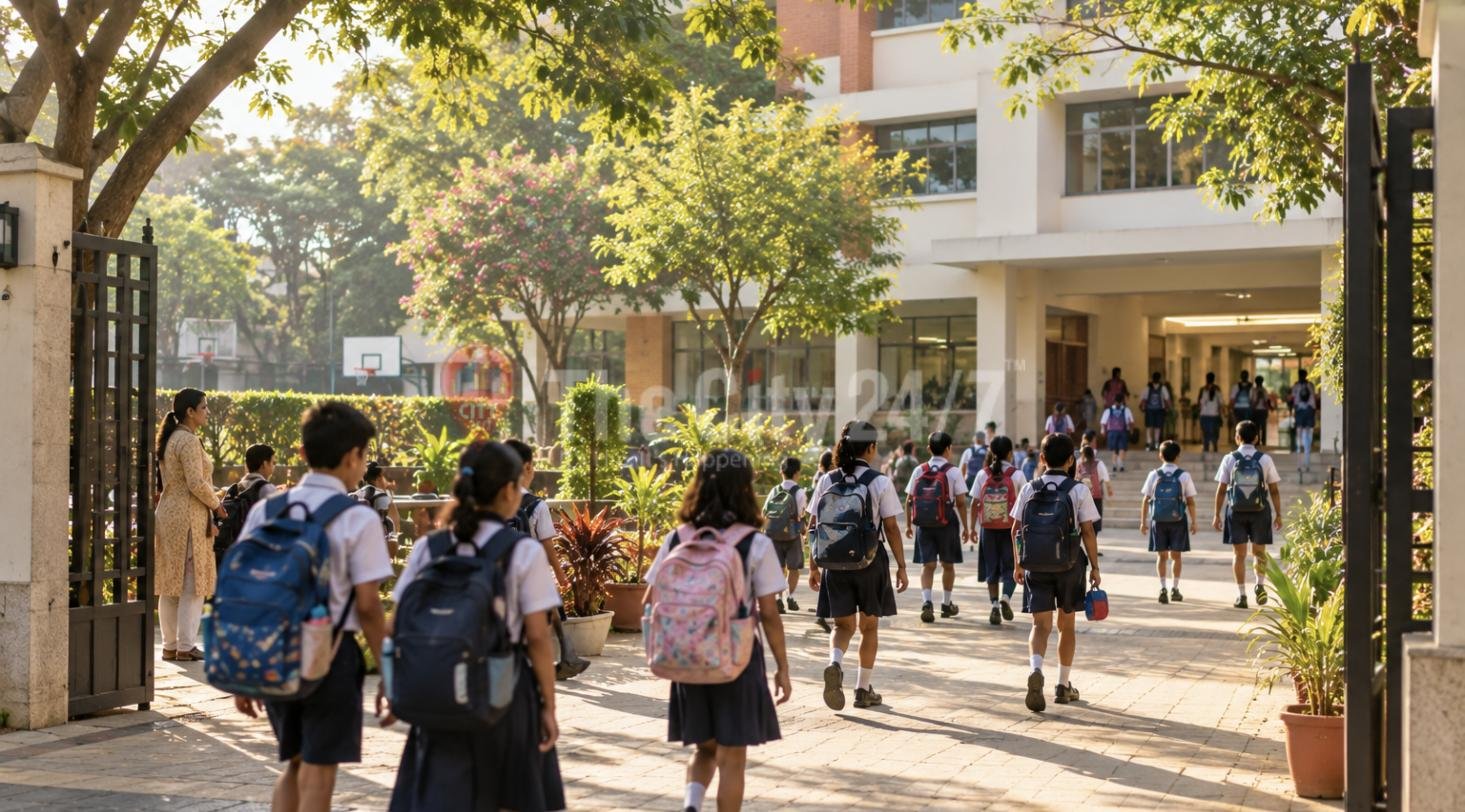
“There is an enormous gap in this city between what good schooling costs and what people believe it costs, and the gap is filled by marketing.”
• On the fee myth
You can get genuinely good schooling in Bengaluru for Rs 30,000 to Rs 1 lakh a year, and the places to look are the Kendriya Vidyalaya network if you qualify, the congregational convent schools like St Anne's, Carmel, Sacred Heart and Little Flower, long-established trust-run neighbourhood schools in the south and west, and the RTE quota at private schools for eligible families.
The reason this is hard to find online is simple. Schools charging Rs 30,000 a year do not have marketing budgets, do not appear in sponsored listicles and often have websites that were last updated in 2014. The schools you find easily are the ones paying to be found.
This guide covers where the affordable schools actually are, what you give up and what you do not, how the Right to Education quota works, and the specific questions that separate a good low-fee school from a bad one. The difference matters more at this price point than anywhere else, because the variance is wider.
Quick Information
Good schooling under a lakh exists. It just does not advertise, so you have to go looking.
Where Do You Find Affordable Good Schools in Bangalore?
In four places: the Kendriya Vidyalaya network, the congregational convent schools, long-established trust-run neighbourhood schools in south and west Bengaluru, and through the RTE quota at private schools. None of them will come up first in a search, and all of them are worth more of your time than the sponsored results.
- Kendriya Vidyalayas. Three in Bengaluru's north and west: the IISc campus at Yeshwanthpur, Hebbal at Nagavara, and No 2 at Jalahalli East. CBSE through Class 12, nominal fees, strong academics, genuinely mixed intake. Admission runs on central government priority categories.
- Congregational convent schools. St Anne's, Carmel, Sacred Heart, Little Flower and similar Catholic schools have campuses across the city at Rs 40,000 to Rs 90,000 a year. Established, disciplined, open to all faiths, and far easier to enter than the cantonment names.
- Trust-run neighbourhood schools. Jayanagar, Basavanagudi, Banashankari, Padmanabhanagar, Vijayanagar, Rajajinagar, Basaveshwaranagar and Malleshwaram are full of schools running since the 1960s and 1970s at Rs 30,000 to Rs 80,000. This is the largest pool and the least visible.
- Government schools. Free or nominal, Karnataka state board, Kannada or English medium. Quality varies enormously between individual schools, so judge the specific school rather than the category.
- RTE quota seats. Twenty-five per cent of entry-class seats at eligible private schools are reserved under the Right to Education Act for disadvantaged and weaker-section children. Since Karnataka's 2018 rule change, this applies only where no government or aided school is in the neighbourhood, so very few Bengaluru private schools now offer RTE seats. A separate state application process with its own timeline.
- Older institutional schools. HAL Public School in Vimanapura, the railway and defence schools, and similar employer-linked institutions, which are substantially cheaper than comparable private campuses.
- Aided schools. Government-aided private schools, where the state pays part of the cost. Fees are low and many have long track records.
- Where not to look. East Bengaluru's Whitefield and Sarjapur corridor, where the entry price for a private school is several times what the west charges.
“The school charging thirty thousand rupees does not advertise. That is the reason you have not heard of it, not evidence that it is bad.”
• On why these are invisible
How Do You Judge a Low-Fee School Without Getting It Wrong?
Look at teacher retention, board results over three years, class size, the state of the toilets and how staff speak to children. Those five things tell you almost everything, and none of them appears in a brochure. At this price point the variance between schools is wide, so the visit matters more than anywhere else.
- Teacher retention. The single best indicator. Ask how many teachers have been there more than five years. A school where staff stay is a school that treats them properly.
- Board results over three years. Not the topper's marks. The pass rate and the distribution. Ask for three years, and ask how many children were held back from appearing.
- Class size. Forty-plus is normal at this price point. Ask the real number for the class your child would join, not the school average.
- The toilets. Ask to see them. A school that maintains its toilets maintains everything else, and a school that does not will not respect your child's day either.
- How staff talk to children. Stand in a corridor for five minutes during a changeover. You will learn more than in an hour with the principal.
- Corporal punishment. Illegal, and still present at some schools. Ask directly what the discipline policy is and how complaints are handled. Watch how the question is received.
- Safety and transport. Gate security, visitor logs, and if you use the bus, the driver and attendant arrangements. Ask specifically.
- What to ignore. The reception area, the trophy cabinet, the smart board in the demo room and the brochure. None of these correlate with teaching.
- Talk to current parents. Stand at the gate at pickup and ask two or three. Nobody will refuse, and the answers are unfiltered.
The most valuable twenty minutes you will spend is at the school gate at 3.30 PM, asking parents whether they would choose it again. No tour, no brochure and no listicle comes close to that.
How Does the RTE Quota Work in Bangalore?
Under the Right to Education Act, eligible private schools reserve twenty-five per cent of their entry-class seats for children from disadvantaged groups and weaker sections, with the state reimbursing the school. Karnataka changed its rules in 2018 so that a child can get an RTE seat in a private unaided school only if there is no government or aided school in the neighbourhood, and since most Bengaluru neighbourhoods have one, very few private schools in the city now offer RTE seats. In Karnataka this runs as a separate online application and lottery process on the state education department's portal, with its own annual timeline.
- What it is. A statutory reservation of a quarter of entry-class seats at eligible private unaided schools, with fees covered by the state.
- Who is eligible. Children from specified disadvantaged groups and economically weaker sections, subject to income and category criteria set by the state.
- The entry class. The reservation applies at the school's entry level, usually LKG or Class 1. It is not available for mid-school entry.
- How to apply. Through the Karnataka school education department's online process, with documentation of income, category and residence. Watch the portal for the annual window.
- Allocation. Typically by lottery among eligible applicants for each school, weighted by neighbourhood proximity. You choose preferences, you do not choose the outcome.
- Important caveat. Karnataka's rules on which private schools fall within scope have changed over the years, with government and aided schools prioritised in the allocation sequence. Check the current year's rules rather than an old article.
- What it covers. Tuition. Uniform, books and transport may still be charged, so ask the school what remains payable.
- Where to verify. The Karnataka Department of School Education portal is the only authoritative source. Agents charging to help with RTE applications are not necessary.
What Do You Actually Give up at an Affordable School?
Campus size, sports facilities, technology, air conditioning and international exposure. What you do not necessarily give up is teaching quality, discipline, care or board results, because at a well-run trust school those depend on people rather than on capital spending.
- Space. The real difference. A Rs 30,000 school in Jayanagar has a courtyard, not fifteen acres. For sport-focused children that matters.
- Facilities. Fewer labs, smaller libraries, less technology, no air conditioning, basic auditoriums.
- Class size. Larger classes are the most significant educational trade-off, and it is a real one. Ask the actual number.
- Enrichment. Fewer trips, clubs, external coaches and visiting programmes. Families often fill this privately, which shifts some cost back.
- International options. No IB, no IGCSE, and limited exposure to study-abroad pathways. If that is your plan, this is not your price point.
- What survives. Good teachers, consistent discipline, solid board results and children who are known by name. Many affordable schools do all four better than campuses charging ten times as much.
- The honest summary. You are buying teaching, not infrastructure. If the teaching is good, the deal is excellent. If it is not, no fee level fixes it.
Which Bangalore Areas Have the Most Affordable Good Schools?
West and south Bengaluru, comfortably. Vijayanagar, Rajajinagar, Basaveshwaranagar, Mahalakshmi Layout, Banashankari, Padmanabhanagar, Basavanagudi and parts of Jayanagar have the deepest supply of competent low-fee schools, along with cheaper rents than the east.
- Vijayanagar and Basaveshwaranagar. Excellent supply of mid and low-fee schools, good metro access, affordable rents. Probably the best value combination in the city.
- Banashankari and Padmanabhanagar. Strong school supply, good PU colleges nearby, materially cheaper than Jayanagar for much the same access.
- Basavanagudi and Jayanagar. Dense old-school supply at a range of price points, including some genuinely cheap and long-established institutions. Rents are higher.
- Rajajinagar and Mahalakshmi Layout. Broad mid and low-fee choice plus NPS Rajajinagar at the top end if you can get in.
- Vimanapura and Old Airport Road. HAL Public School and older institutional schools at far below east Bengaluru prices. Underrated for families.
- Kengeri, Nagarbhavi and Mysore Road. The western edge, with newer and cheaper supply and Purple Line metro access.
- Where it is hardest. Whitefield, Sarjapur Road, Indiranagar, Koramangala and HSR Layout, where land costs push even mid-market schools above Rs 1.5 lakh.
- The commute bonus. In the west and south, affordable schools are inside the neighbourhoods, so many families skip the bus entirely. That is another Rs 25,000 to Rs 40,000 a year saved and a calmer morning.
FAQs
Can you find a good school in Bangalore under Rs 1 lakh a year?
Yes, comfortably. Rs 30,000 to Rs 1 lakh a year covers a large number of competent private schools, particularly trust-run neighbourhood schools and congregational convent schools in south and west Bengaluru. The Kendriya Vidyalayas cost a fraction of that if you meet the eligibility criteria.
Which are the cheapest good schools in Bangalore?
The Kendriya Vidyalayas at IISc Yeshwanthpur, Hebbal and Jalahalli East, with nominal fees and strong academics, though admission runs on central government priority categories. After those, the congregational convent schools such as St Anne's, Carmel, Sacred Heart and Little Flower, and long-established trust-run schools across Jayanagar, Basavanagudi, Vijayanagar and Rajajinagar.
How do I judge a low-fee school in Bangalore?
Look at teacher retention over five years, board results across three years, the actual class size for your child's year, the state of the toilets, and how staff speak to children during a corridor changeover. Then stand at the gate at pickup and ask two or three parents whether they would choose it again.
How does the RTE 25 per cent quota work in Karnataka?
Eligible private schools reserve a quarter of their entry-class seats for children from disadvantaged groups and economically weaker sections, with the state reimbursing tuition. Applications run through an online process on the Karnataka school education department portal with an annual window and a lottery allocation. Since a 2018 rule change, Karnataka applies the quota to private unaided schools only where no government or aided school is in the neighbourhood, so very few Bengaluru private schools offer RTE seats. Check the current year's notification.
Which area of Bangalore has affordable schools?
West and south Bengaluru. Vijayanagar, Basaveshwaranagar, Rajajinagar, Mahalakshmi Layout, Banashankari, Padmanabhanagar and Basavanagudi have the deepest supply of competent low-fee schools and cheaper rents. Whitefield, Sarjapur Road, Indiranagar and Koramangala are the hardest.
Are government schools in Bangalore any good?
It depends entirely on the individual school, and the variation is wide. Some Karnataka government schools are well run with committed teachers, others are badly under-resourced. Judge the specific school by visiting it, asking about teacher attendance and looking at results, rather than judging the category.
What do you sacrifice at an affordable school in Bangalore?
Campus space, sports facilities, technology, enrichment programmes and any international curriculum option, plus larger class sizes, which is the most significant educational trade-off. Teaching quality, discipline, care and board results are not automatically sacrificed, because those depend on people rather than capital spending.
Is a donation ever required for school admission in Bangalore?
No, and capitation fees are illegal in Karnataka. Any school or agent demanding a donation is breaking the law and telling you how the institution operates. Refuse, and report it to the Karnataka Department of School Education.
Contact Details
Where to check RTE rules, board affiliations and school recognition, and where to report a capitation demand.
Name a School That Deserves to Be Found
This is the guide I most want help with. If your child goes to a school in Bengaluru charging under a lakh a year that does a genuinely good job, click the WhatsApp icon at the bottom right of your screen and name it, with the area and the approximate fee. These schools have no marketing and no visibility, and a parent recommendation is worth more than anything I can write. That is also the easiest way to reach The City 24/7 about anything at all.
And if you want education guides, admission timelines and neighbourhood notes landing in your inbox, join our ever growing community at thecity247.com/newsletter. Free, and about ten seconds of your life.
Same city, new stories, always.

Related Stories
 EDUCATION
How to Choose a School in Bangalore: Boards, Areas, Fees and the Questions to Ask
July 7, 2026
 EDUCATION
The Best CBSE Schools in Bangalore: The List, the Fees and the Honest Caveats
September 1, 2026
 EDUCATION
The Best ICSE Schools in Bangalore: Where the City's Oldest Schools Still Win
September 1, 2026
 EDUCATION
The Top Boys' Schools in Bangalore: Bishop Cotton, Baldwin and What They Actually Cost
August 31, 2026
 EDUCATION
The Top Girls' Schools in Bangalore: The List, and What Happens After Class 10
August 31, 2026
 EDUCATION
International Schools in Bangalore: Fees, Areas and How to Tell a Real One
August 3, 2026
