


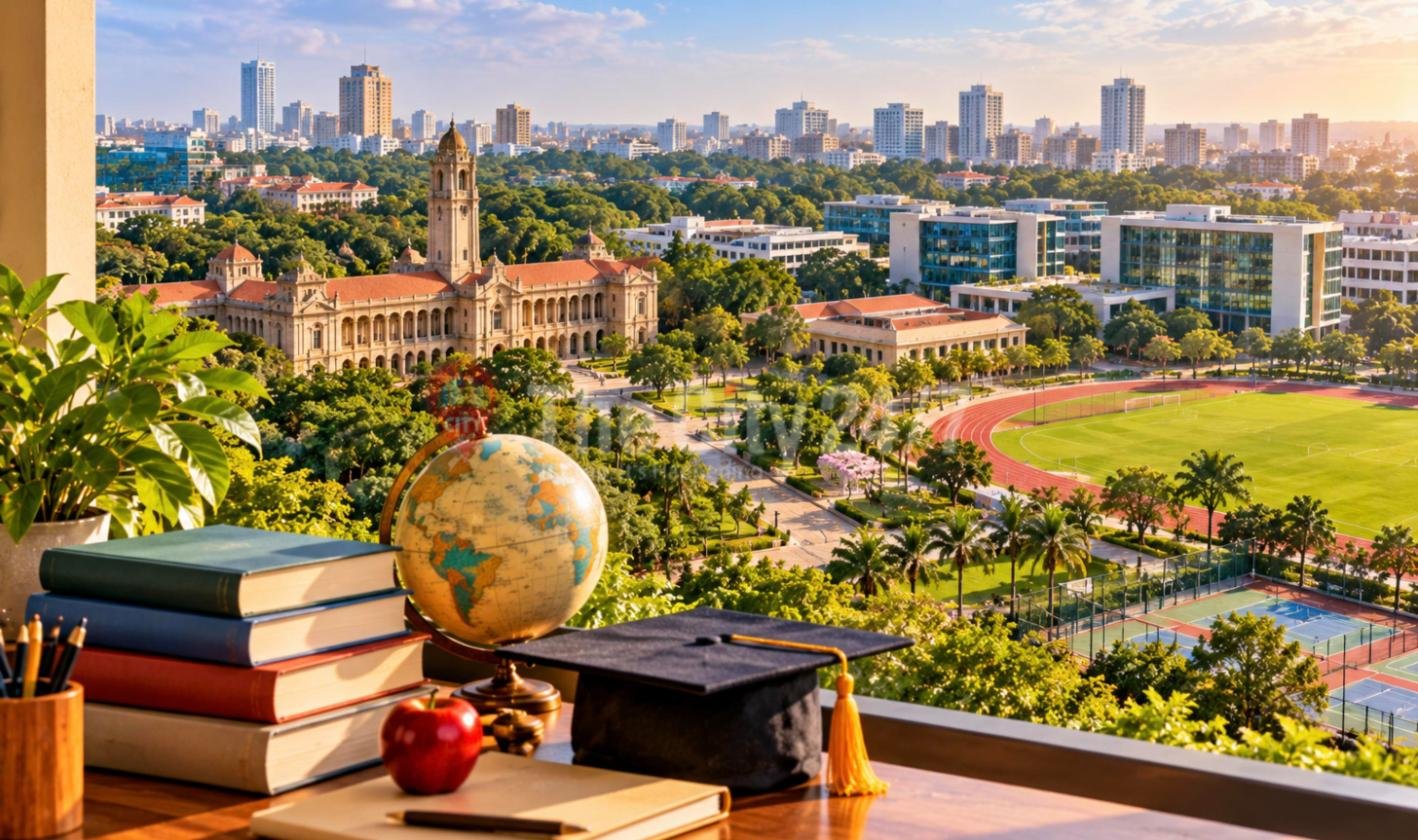
“Parents here do not choose a school. They choose a board, a commute, a fee bracket and a waiting list, and then a school emerges from the intersection of the four.”
• On how admissions really work
Bengaluru is one of the best-educated cities in India and has been for a century, from the Indian Institute of Science onward. That legacy shows up as genuine breadth: state board schools charging a few thousand rupees a term, CBSE and ICSE schools across every price band, IB and IGCSE campuses with international fee structures, and a college ecosystem covering engineering, medicine, law, design and management with national standing.
The problem is not supply. It is navigation. Admission cycles open far earlier than newcomers expect, fee structures are quoted in ways that hide half the cost, and the single biggest determinant of a child's daily life here is not the school's ranking but how long the bus takes to reach it. This guide covers boards, fees, timelines, the commute question, and the college landscape, and it links onward to the detailed school and college guides.
One thing up front, and it is the thing experienced Bengaluru parents say most often: a very good school forty minutes away beats an excellent school ninety minutes away, every single time. Children lose those hours from sleep, play and homework, and nobody gets them back.
Quick Information
Boards, fees, timelines and the numbers nobody puts on the website, in one table. Read it before you tour a single campus.
Which Board Should I Choose for My Child in Bangalore?
Choose CBSE if you may relocate within India or your child will write national entrance exams, ICSE for language and breadth, IB or IGCSE if university abroad is likely, and state board for local rootedness and affordability. That is the honest summary, and the rest is detail.
- CBSE. The most portable option in India and the closest fit to JEE and NEET syllabi. Structured, exam-focused and available at every price point in Bengaluru. The default choice for transferable families.
- ICSE and ISC. Broader, more language and literature intensive, generally stronger on English and project work. Well represented in the older parts of the city and popular with families staying put.
- IB. Inquiry-based, internationally recognised, strong on independent thinking and coursework. Excellent preparation for foreign universities and the most expensive route by a wide margin.
- IGCSE and Cambridge. Flexible subject combinations, internationally portable, common in Whitefield and Sarjapur Road. Often paired with A Levels or an IB diploma programme afterward.
- Karnataka State Board. Affordable, locally rooted, Kannada-inclusive, and perfectly capable of producing strong outcomes. Underrated by newcomers and the right answer for many families.
- The switching question. Changing boards after Class 8 is disruptive and after Class 10 harder still. Decide with a ten year horizon rather than a two year one.
Our CBSE versus ICSE comparison and the best schools in Bangalore guide go deeper on both the boards and the individual schools.
It is the most revealing question you can ask on a school tour and almost nobody asks it. High teacher turnover undoes good infrastructure, good branding and good marketing very quickly. Ask how long the current class teachers have been at the school. Watch how comfortable the answer is.
How Much Do Schools in Bangalore Actually Cost?
Anywhere from nearly nothing to twelve lakh a year, and the advertised tuition fee is usually sixty to seventy five percent of what you will actually pay. The gap is admission fees, deposits, transport, uniforms, books, activity charges and annual maintenance.
- Government and aided schools. Nominal fees. Quality varies considerably by school, and some are genuinely good, particularly in the older areas.
- Private state board. Roughly 15000 to 60000 a year. Solid, local, affordable, and the mainstay of the city's middle class.
- Mid-range CBSE and ICSE. Roughly 60000 to 1.5 lakh a year. The largest and most competitive segment in Bengaluru, with big variation in quality at the same price.
- Premium CBSE and ICSE. 1.5 to 3.5 lakh a year. Better facilities, smaller classes, longer waiting lists, and heavy demand in the east and south-east.
- International, IB and IGCSE. 4 to 12 lakh a year plus one-time costs. Genuine international curricula and international pricing to match.
- The one-time hit. Admission fees and refundable caution deposits can run from tens of thousands to several lakh at the top end. Ask for the full first-year number in writing.
- Transport. 20000 to 60000 a year, distance banded. Ask for the actual route and pickup time, not just the fee.
When Does School Admission Season Start in Bangalore?
Applications for the June academic year typically open between November and January, and popular schools close their lists early. If you are moving to Bengaluru with school-age children, start the process a full year ahead, not a term ahead.
- August to October. Research and shortlist. Visit campuses while school is in session, which is the only time a visit tells you anything.
- November to January. Applications open at most private schools. Forms, interaction sessions and, for the sought-after schools, waiting lists forming immediately.
- January to March. Offers, fee payment deadlines and confirmation. Deposits are often non-refundable, so do not accept two places casually.
- March to April. Previous academic year ends. Transfer certificates issued, which you will need for any mid-stream move.
- Late May or June. New academic year begins. Mid-year admissions are possible but limited to schools with genuine vacancies.
- The RTE route. Twenty five percent of seats in eligible private schools are reserved under the Right to Education Act, with its own separate application timeline and documentation via the state education department. Since Karnataka's 2018 rule change, this applies only where no government or aided school is in the neighbourhood, so very few Bengaluru private schools now offer RTE seats.
Which Areas of Bangalore Are Best for Schools?
Whitefield and Sarjapur Road for international schools, Jayanagar, Basavanagudi and Malleshwaram for established CBSE and ICSE institutions, and north Bengaluru for newer campuses with space. Where you live should follow this decision, not precede it.
- Whitefield and Varthur. The densest cluster of international and IB schools in the city, built around the tech corridor's demand. Large campuses, high fees, strong facilities.
- Sarjapur Road. The other international belt, with a heavy concentration of premium schools serving the ORR and Sarjapur residential growth.
- Jayanagar, Basavanagudi and JP Nagar. The city's traditional education heartland. Long-established ICSE and CBSE schools, strong academic records, mature institutions.
- Malleshwaram and Rajajinagar. Old, respected schools and colleges, reasonable fees, and a genuinely academic neighbourhood culture.
- North Bengaluru, Hebbal and Yelahanka. Newer campuses with more land, growing quickly alongside the residential boom and the airport corridor.
- Indiranagar and central. Good established schools, but constrained campuses and difficult morning traffic. Excellent if you live within a couple of kilometres.
- Electronic City and Hosur Road. A growing school supply serving the corridor, which spares families the daily crossing into the city.
Ask for the actual bus route your address would sit on, and the pickup time. A twelve kilometre school can mean a 6.30 AM pickup and a 4.45 PM drop, which is nine hours away from home for a seven year old. Many parents discover this in July, after the fees are paid.
What Are the Best Colleges in Bangalore?
Bengaluru has institutions of genuine national standing across nearly every discipline, led by the Indian Institute of Science, IIM Bangalore and the National Law School of India University. Below that tier the city's depth is unusual: strong engineering, medicine, commerce, design and liberal arts options all in one place.
- Research and postgraduate. The Indian Institute of Science for science and engineering research, IIM Bangalore for management, and NLSIU for law. All three are among the best in the country in their fields.
- Engineering. RV College, BMS College, MS Ramaiah, PES, Dayananda Sagar and others, entered through KCET for state quota, COMEDK for the private consortium, or JEE for national institutes.
- Commerce, arts and science. Christ University, St Joseph's, Mount Carmel and Jain University, all with strong reputations and competitive admissions.
- Medicine. St John's Medical College, Bangalore Medical College, MS Ramaiah and Vydehi, entered through NEET.
- Design and creative. Srishti Manipal and several specialist institutions, in a city with a large working design industry to absorb graduates.
- Professional and executive. A deep market for MBA, analytics, product and technology programmes, much of it aimed at the city's own working professionals.
Our best colleges in Bangalore guide covers the institutions, streams and entrance routes in detail, and our upskilling guide covers the professional and executive options.
How Do I Evaluate a School in Bangalore Properly?
Visit during a working day, talk to parents at the gate rather than in the admissions office, and ask about teacher retention, class size and how the school handles a struggling child. Brochures and rankings tell you almost nothing that matters.
- Visit at pickup time. You will learn more in fifteen minutes at the gate at 3.15 PM than in an hour with the admissions team. Watch the children, not the corridors.
- Talk to current parents. Not the ones the school introduces you to. The ones waiting outside. They will tell you about fee increases, teacher turnover and communication honestly.
- Ask about class size and teacher ratio. And ask what it actually is this year, in the specific class your child would join, not the school average.
- Ask how they handle difficulty. What happens when a child falls behind, or is bullied, or needs learning support. The quality of that answer distinguishes good schools from well-marketed ones.
- Check the fee escalation history. Ask what fees were three years ago. Annual increases of ten percent or more compound significantly across a decade.
- Look at the whole day. Sports, arts, music, free play and outdoor time. In a city with Bengaluru's weather, a school that keeps children indoors all day is wasting the single best thing about living here.
- Trust the commute over the brochure. It remains the most important variable and the one parents most consistently underweight.
Education in Bangalore: Frequently Asked Questions
Which board is best for schools in Bangalore?
CBSE if you may move within India or your child will write JEE or NEET, ICSE for language and breadth, IB or IGCSE if university abroad is likely, and Karnataka State Board for affordability and local rootedness. All four are widely available across the city.
How much do schools cost in Bangalore?
Private state board schools run roughly 15000 to 60000 rupees a year, mid-range CBSE and ICSE 60000 to 1.5 lakh, premium CBSE and ICSE 1.5 to 3.5 lakh, and IB or IGCSE 4 to 12 lakh. Add admission fees, deposits, transport, uniforms and books, which typically add 25 to 40 percent to the tuition figure.
When do school admissions open in Bangalore?
Most private schools open applications between November and January for the academic year starting in late May or June. Sought-after schools fill and form waiting lists early, so begin research by August or September the previous year.
Which area of Bangalore is best for schools?
Whitefield and Sarjapur Road for international and IB schools, Jayanagar, Basavanagudi and Malleshwaram for established CBSE and ICSE institutions, and north Bengaluru around Hebbal and Yelahanka for newer campuses. Choose the school first, then live near it.
What is the RTE quota in Bangalore schools?
Under the Right to Education Act, eligible private schools reserve 25 percent of entry-level seats for children from specified categories, with a separate application process and timeline administered by the Karnataka education department. Since a 2018 rule change, Karnataka applies it to private unaided schools only where no government or aided school is in the neighbourhood, so very few Bengaluru private schools offer RTE seats.
Is CBSE or ICSE better in Bangalore?
CBSE is more portable across India and better aligned to national entrance exams. ICSE is broader, more language and literature intensive and stronger on project work. Neither is objectively better, and the more important question is which specific school you are choosing.
What are the best colleges in Bangalore?
The Indian Institute of Science, IIM Bangalore and the National Law School of India University lead nationally. RV, BMS, MS Ramaiah and PES are prominent for engineering, Christ, St Joseph's and Mount Carmel for commerce and arts, St John's and Bangalore Medical College for medicine, and Srishti Manipal for design.
How do I get into an engineering college in Bangalore?
Through KCET for Karnataka state quota seats, COMEDK for the private college consortium, or JEE for national institutes. Each has its own application window, and many students write more than one.
How long should my child's school commute be in Bangalore?
Under thirty minutes each way if at all possible. A twelve kilometre school can mean a 6.30 AM pickup and a late afternoon drop, and those hours come out of sleep and play. Experienced parents here consistently rate commute above school ranking.
What should I ask when visiting a school in Bangalore?
Teacher retention and how long the current class teachers have been there, actual class size this year, how the school supports a child who falls behind, the fee level three years ago, and the real bus route and pickup time from your address.
Are government schools in Bangalore any good?
Quality varies, but some government and aided schools, particularly in the older neighbourhoods, have long records and committed teachers at nominal fees. They are frequently dismissed by newcomers without being visited, which is a mistake worth avoiding.
Official Education Links
The department portals and boards you will need during admission season.
Going Through Admissions Right Now?
If you are in the middle of a Bengaluru admission season and something here is out of date, or if you have found a school or college worth telling other parents about, click the WhatsApp icon at the bottom right of your screen and tell me. Parents send me the most useful corrections of anything I publish, because they are living it in real time. That is also the fastest way to reach The City 24/7 about anything at all.
And if you want the city explained one useful thing at a time, join our ever growing community. One weekly email, free, and no admission consultant fees involved.
Same city, new stories, always.

Related Stories
 EDUCATION
The Top Boys' Schools in Bangalore: Bishop Cotton, Baldwin and What They Actually Cost
September 18, 2026
 EDUCATION
The Top Girls' Schools in Bangalore: The List, and What Happens After Class 10
September 18, 2026
 EDUCATION
The Top Medical Colleges in Bangalore: MBBS Seats, Fees and How Counselling Actually Works
September 18, 2026
 EDUCATION
The Best CBSE Schools in Bangalore: The List, the Fees and the Honest Caveats
September 18, 2026
 EDUCATION
The Top Christian and Convent Schools in Bangalore: Why They Still Dominate the City's Education
September 18, 2026
 EDUCATION
The Best ICSE Schools in Bangalore: Where the City's Oldest Schools Still Win
September 18, 2026
