


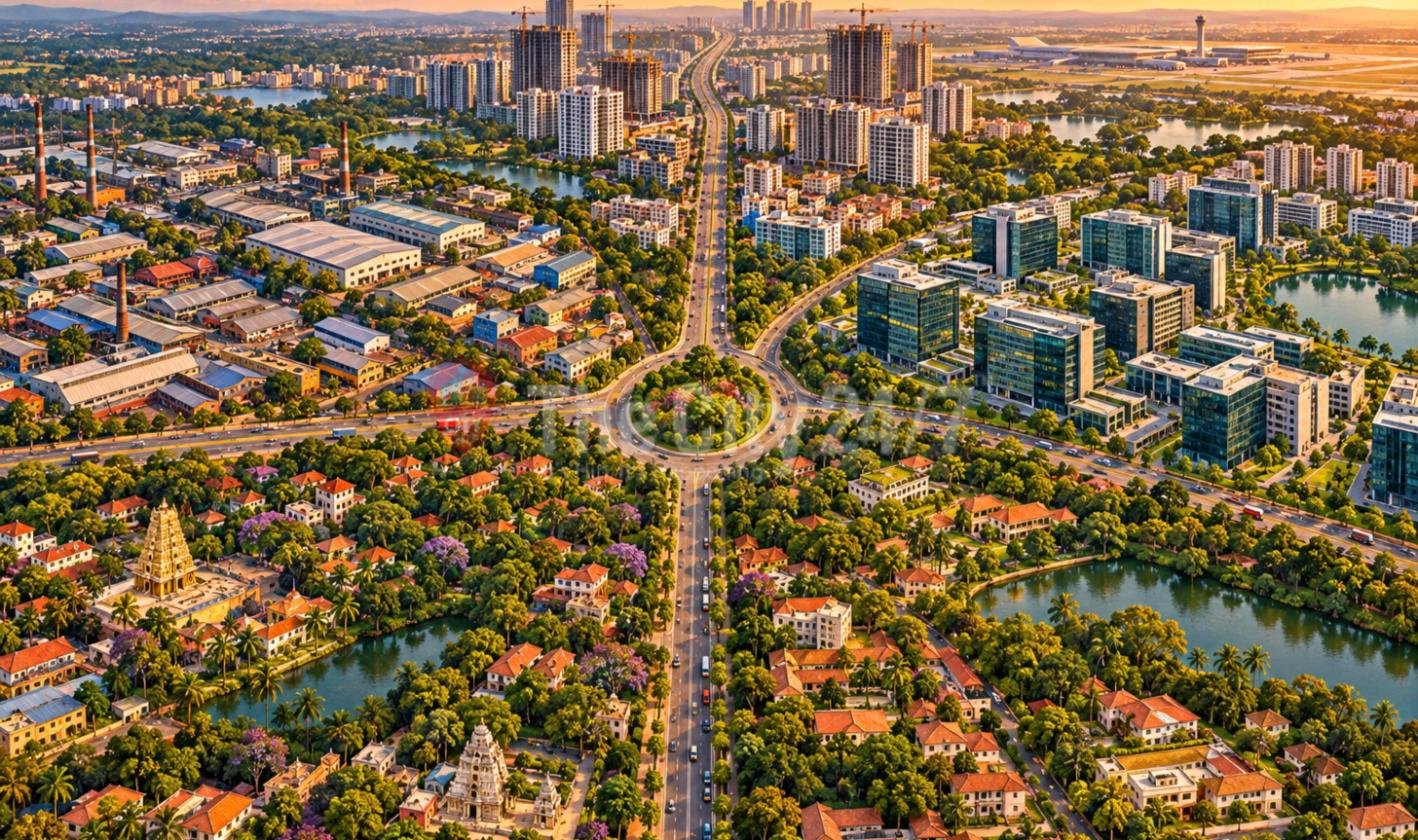
“South Bangalore thinks it is the real city, east Bangalore thinks it is the future, north Bangalore has the airport and west Bangalore is quietly getting on with it.”
• A fair summary of local opinion
If you work in tech on the Outer Ring Road or in Whitefield, live east. If you want the most liveable version of this city, live south. If you fly often or want new housing, live north. If you want value with metro access, live west. That is the whole comparison, and the rest of this guide explains why.
Bangalore's four quadrants developed in completely different eras and for completely different reasons, and the result is that choosing a side of the city is a bigger decision than choosing a neighbourhood within it. Rent, commute, schools, food and even the weather in the evening differ meaningfully across them.
Quick Information
A compass for the city. Print it, argue with it, then choose.
What Is South Bangalore Like?
The most liveable part of the city, and the one that feels most like itself. South Bangalore covers Jayanagar, JP Nagar, Basavanagudi, Banashankari and BTM Layout, and it combines mid-century planned layouts with the oldest continuous residential culture in the city.
What you get: wide shaded roads, proper markets, established schools, good Green Line metro access, and a food culture built on darshinis, sweet shops and eighty year old establishments. What you give up: proximity to the eastern tech corridor, and a certain amount of newness.
- Best for. Families, anyone who cooks, anyone who wants to walk to a market, and Electronic City commuters since the Yellow Line opened.
- The case against. If you work in Whitefield or on the ORR, the daily commute will define your life.
- Rents. Moderate to high in Jayanagar, better value further south in JP Nagar and Banashankari.
- Character. The most Kannada, the most established and the least transient part of Bengaluru.
What Is East Bangalore Like?
The engine room, and the hardest commute in the city. East Bangalore is Whitefield, Marathahalli, Brookefield, Bellandur, Sarjapur Road and the ITPL corridor, and it exists in its current form because the technology industry built it.
What you get: the largest concentration of tech employment, new apartment stock with amenities, the international school belt, and a genuinely international food and retail scene. What you give up: the Outer Ring Road, which between Silk Board and KR Puram is the most punishing stretch of road in Bengaluru.
- Best for. Anyone working in Whitefield, ITPL or on the ORR. Living east is not optional in that case, it is essential.
- The case against. If you do not work east, the commute in is brutal and the area's character is newer and more corporate.
- Metro. The Purple Line extension changed east Bangalore permanently and made Whitefield genuinely connected.
- Rents. High in prime Whitefield and Bellandur, considerably better past Marathahalli.
What Is North Bangalore Like?
The newest, and the one with the most to gain from the next decade of infrastructure. North Bangalore runs through Hebbal, Yelahanka, Jakkur, Thanisandra and out towards Devanahalli and the airport, and it has absorbed both the Manyata tech corridor and much of the city's new large-format housing.
What you get: newer buildings, more space per rupee, quieter streets in Yelahanka and Jakkur, the shortest airport run in the city, and the venues that now host most of Bengaluru's biggest concerts. What you give up: walkable neighbourhood life, and the Hebbal flyover, which is a daily negotiation.
- Best for. Frequent flyers, families wanting new housing and international schools, Manyata corridor employees.
- The case against. Thinner social infrastructure than the centre, and you will drive more than you would elsewhere.
- The big future factor. The Blue Line metro to the airport is under construction and will reshape this side of the city when it opens.
- Rents. Good value in Thanisandra, Jakkur and Yelahanka. High in prime Hebbal.
What Is West Bangalore Like?
The most underrated part of the city, and the best value with real metro access. West Bangalore covers Rajajinagar, Vijayanagar, Basaveshwaranagar, Nagarbhavi and out to Kengeri, and it has the Purple Line running straight through it.
What you get: solid mid-range housing at noticeably lower rents than the centre, genuine old-Bangalore character around Rajajinagar and Malleshwaram's edge, excellent local food, and metro access that makes the rest of the city reachable. What you give up: proximity to the tech corridors, and the restaurant density of the centre.
- Best for. Value seekers, students, families on a budget, and anyone whose work is central or on the Purple Line.
- The case against. Long commutes to the east and to Electronic City.
- Character. Established, residential and unpretentious. This is where a lot of Bangalore actually lives.
- Rents. The best value of the four quadrants for comparable space.
Which Side of Bangalore Has the Best Commute?
Whichever side your office is on, and there is no clever answer to this. The city's traffic is directional and time-specific, and the only reliable strategy is to live and work on the same side.
- Working central. South or west. Both have direct metro access to the centre.
- Working ORR or Whitefield. East, without question.
- Working Electronic City. South, along the Hosur Road and Yellow Line corridor.
- Working Manyata or north. North. Thanisandra, Hebbal or Yelahanka.
- Working from home. South or west for quality of life, north for space, and honestly you have the best deal in the city.
Which Side Is Best for Families and Schools?
South for established schools and daily liveability, east and north for the international school belt. South Bangalore's schools have decades of history and sit within short distances of residential layouts. Whitefield and north Bengaluru have most of the newer international options, along with the gated communities that many families with school-age children prefer.
North vs South vs East vs West Bangalore: Frequently Asked Questions
Which is the best side of Bangalore to live on?
The side your workplace is on. Beyond that, south Bangalore is the most liveable, east is essential for tech corridor workers, north offers the newest housing and airport access, and west is the best value.
Why is east Bangalore's traffic so bad?
Because the Outer Ring Road between Silk Board and KR Puram carries an enormous concentration of tech employment on a limited road network. It is the hardest commute in the city.
Is north Bangalore a good investment?
It is the fastest changing part of the city, and the Blue Line metro to the airport, currently under construction, is the single biggest factor in its future.
What makes south Bangalore different?
Mid-century planned layouts, established markets and schools, strong Green Line metro access, and the most continuous residential culture in the city.
Is west Bangalore worth considering?
Yes, and it is the most underrated of the four. Purple Line metro access, real old-Bangalore character and the best value rents for comparable space.
Which side has the best schools?
South Bangalore for established CBSE and ICSE schools, east and north for most of the international options.
Which side is closest to the airport?
North, by a wide margin. From south Bangalore an airport run can take over two hours in the evening.
Where should I live if I work in Electronic City?
South, along the Hosur Road corridor. The Yellow Line metro, which opened in August 2025, made this stretch far more practical.
Which side has the best food?
All four, differently. South for traditional Karnataka and darshini food, east for international, west for old Bangalore establishments and north for newer restaurants.
Contact Details and Useful Links
Useful official sources when comparing areas across the city.
Weighing up Two Sides of the City?
Tell me where you work and what you are looking for, and I will give you a straight recommendation. Click the WhatsApp icon at the bottom right of your screen. That is also the easiest way to reach The City 24/7 about anything at all.
And if you want the city explained one useful thing at a time, join our ever growing community. A weekly email, free, and a lot more reliable than the algorithm.
Same city, new stories, always.

Related Stories
 CITY GUIDE
Bangalore's Most Interesting Streets, and What Each One Is For
July 29, 2026
 CITY GUIDE
The Cost of Living in Bangalore: What It Actually Takes Each Month
July 13, 2026
 CITY GUIDE
The Best Areas to Live in Bangalore: An Honest Comparison
July 3, 2026
 CITY GUIDE
A Guide to Bangalore's Markets: Go at Six, Leave by Nine
August 1, 2026
 CITY GUIDE
Bangalore Weather, Month by Month: Why This City Has India's Best Climate
July 24, 2026
 CITY GUIDE
How to Get Around Bangalore: Metro, Buses, Autos and Hard-Won Advice
July 7, 2026
