


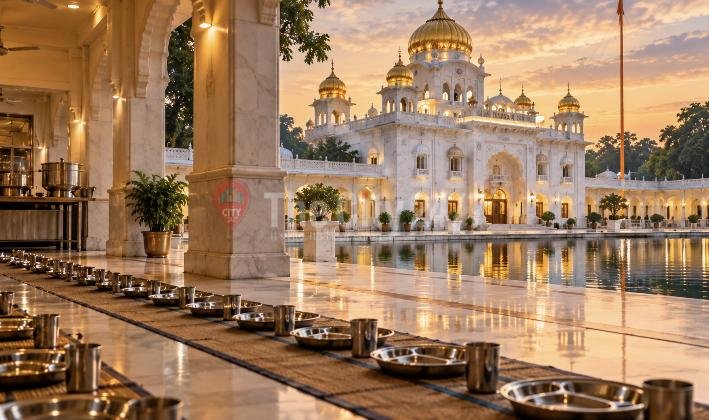
“There is a building in this city where anyone, of any faith or none, can walk in, sit on the floor next to anyone else, and be fed. It is worth understanding why that is the design.”
• On the langar
Guru Nanak Darbar Gurdwara is open roughly 5 AM to 10 PM daily with free entry, on Gorguntepalya Road in north Bengaluru. It is the largest Sikh temple in the city, open to people of all faiths, and it serves free langar, the community meal, to anyone who comes. Head covering is required and footwear is removed.
Bengaluru has a long-established Sikh community, built around military postings, business and migration across the twentieth century, and this gurdwara is its principal institution. The building itself is large, calm and in the white-and-gold idiom familiar from gurdwaras across India, with a main prayer hall where the Guru Granth Sahib is installed.
The reason to write about it at length is the langar. The institution of a free kitchen serving all comers, seated together on the floor without distinction, is a specific and deliberate rejection of caste and status hierarchy, and it operates here every day. This guide covers timings, etiquette and what a visit involves.
Quick Information
One of the easiest religious sites in the city to visit as an outsider, provided you get three small things right.
What Are Guru Nanak Darbar Timings and Is Entry Free?
Open roughly 5 AM to 10 PM daily with free entry, and open to visitors of any faith. There is no ticket, no restriction on non-Sikhs, and no expectation of a donation, though an offering box exists if you wish to contribute.
- Early morning. The quietest and most atmospheric time, with morning prayers and very few visitors.
- Midday. Langar is typically served around this time, and the kitchen is at its busiest and most interesting.
- Evening. Busy with local worshippers after work, and the building is lit.
- Festival days. Guru Nanak Jayanti in November and Baisakhi in April bring large crowds and extended programmes.
- Time needed. Thirty to sixty minutes, or longer if you stay for the meal, which you should.
Three things and you are fine: cover your head, remove your shoes, and no tobacco anywhere on the premises. Everything else follows naturally, and staff are patient with people who clearly do not know the drill.
What Is Langar and Can Anyone Eat It?
Langar is the free community meal served in every gurdwara, cooked and served largely by volunteers, and yes, anyone can eat it regardless of faith, caste, income or background. Everybody sits on the floor in rows and is served the same food, which is the whole point of the institution.
- What is served. Simple vegetarian food: dal, a vegetable dish, roti or rice, and often kheer. Nutritious, generous and consistent.
- Who can eat. Everyone. There is no requirement of faith, no payment and no eligibility. This is not charity extended to the poor, it is a meal offered to all.
- Why seated on the floor. Deliberate. Sitting in rows at the same level removes visible distinctions of status, which is the theological point being made.
- Etiquette. Sit where directed, accept what is offered, do not waste food, and take your plate to the wash area if that is the practice.
- Volunteering, or seva. Chopping, cooking, serving and washing are done by volunteers and visitors are welcome to help. Ask at the kitchen.
- What not to do. Do not offer money for the meal. Contributions go in the offering box if you wish, but the meal itself is not transactional.
“Everybody sits on the floor in the same row and eats the same food. That arrangement is not about humility for its own sake, it is a specific argument about hierarchy, made at every meal.”
• On why langar is designed this way
What Is the Etiquette for Visiting a Gurdwara as a Non-Sikh?
Cover your head, remove your footwear, wash your feet at the entrance, avoid tobacco and alcohol entirely, dress modestly, and sit on the floor in the prayer hall. Gurdwaras are among the most welcoming religious institutions to outsiders and the expectations are few and easy.
- Head covering. Required for everyone, men and women. Scarves or bandanas are usually available at the entrance, and a clean handkerchief works.
- Footwear. Left at free counters. There is usually a shallow water channel to walk through before entering.
- Dress. Modest. Cover shoulders and knees. Nothing more specific is required.
- In the prayer hall. Sit on the floor, do not point your feet towards the Guru Granth Sahib, and stay quiet. You may bow or simply sit respectfully.
- Prasad. Karah prasad, a sweet semolina preparation, is offered. Accept it with both hands cupped.
- Tobacco and alcohol. Strictly prohibited. Do not carry cigarettes onto the premises.
- Photography. Restricted in the prayer hall. Ask before photographing anywhere, and never during prayers.
What Happens Inside the Gurdwara?
The main prayer hall houses the Guru Granth Sahib, the Sikh scripture, installed on a raised platform under a canopy, with kirtan, the singing of hymns, taking place through much of the day. Around it are the langar hall, the kitchen and community spaces.
- The Darbar Sahib. The main hall where the Guru Granth Sahib is installed. Sit, listen to the kirtan, and stay as long as you like.
- Kirtan. Devotional singing of the scripture, usually with harmonium and tabla. This is the sound of the building.
- The langar hall. The dining hall, with rows of seating on the floor and volunteers serving.
- The kitchen. Often visible and often enormous, run by volunteers. Worth looking at to understand the scale of what is cooked daily.
- Nishan Sahib. The saffron flag outside, which marks a gurdwara anywhere in the world.
- Sarovar. Some gurdwaras have a water tank. Practices vary by location.
What Festivals Are Celebrated at Guru Nanak Darbar?
Guru Nanak Jayanti in November is the largest, marking the birth of the first Sikh Guru, with processions, continuous scripture reading and expanded langar. Baisakhi in April and Guru Gobind Singh Jayanti are also major occasions.
- Guru Nanak Jayanti. November, following the lunar calendar. The most significant day, with nagar kirtan processions, akhand path continuous scripture reading and very large langar service.
- Baisakhi. April, marking the founding of the Khalsa. Celebratory, with processions and community programmes.
- Guru Gobind Singh Jayanti. Marking the tenth Guru's birth, usually in December or January.
- Nagar kirtan. Street processions with the scripture carried in a decorated float, which is when the gurdwara becomes visible to the whole neighbourhood.
- Visiting during festivals. Welcoming and crowded. A good introduction if you do not mind numbers, and use the metro.
How Do You Get to Guru Nanak Darbar?
Green Line metro to Goraguntepalya or Yeshwanthpur, then a short walk or auto ride. It sits on Gorguntepalya Road in north Bengaluru, near the Tumkur Road corridor, and the metro is the simplest approach given traffic in that area.
- Metro. Goraguntepalya or Yeshwanthpur on the Green Line, then a short auto ride.
- Bus. Good BMTC coverage along Tumkur Road, Yeshwanthpur and Goraguntepalya.
- Car. Parking available on site, though the Tumkur Road corridor is heavily congested at peak hours.
- Other gurdwaras in the city. There are gurdwaras in Ulsoor, the Cantonment area and elsewhere, several of them long-established and also welcoming.
- Combine with. Yeshwanthpur, Malleshwaram and Sankey Tank are all in this half of the city.
FAQs
What are Guru Nanak Darbar Gurdwara timings?
Roughly 5 AM to 10 PM daily with free entry. Early mornings are quietest, midday is when langar is typically served, and evenings are busy with local worshippers. Festival days have extended programmes.
Can non-Sikhs visit the gurdwara?
Yes. Gurdwaras are open to people of all faiths and none, with no ticket and no restriction. The only requirements are to cover your head, remove your footwear, dress modestly and avoid tobacco and alcohol on the premises.
Is the langar really free for everyone?
Yes. Langar is the free community meal served in every gurdwara, cooked and served largely by volunteers, and anyone may eat it regardless of faith, caste, income or background. Everyone sits on the floor in rows and receives the same food, which is the point of the institution.
What should I wear to a gurdwara?
Modest clothing covering shoulders and knees, and a head covering, which is required for everyone. Scarves are usually available at the entrance and a clean handkerchief will do. Footwear is removed at free counters and you walk through a shallow water channel before entering.
What is served in the langar?
Simple vegetarian food, typically dal, a vegetable dish, roti or rice, and often kheer. It is nutritious and generous. Do not offer money for the meal, though you may contribute to the offering box if you wish.
Can I volunteer at the gurdwara?
Yes. Seva, or voluntary service, is central to how a gurdwara runs, and visitors are welcome to help with chopping, cooking, serving or washing. Ask at the kitchen and somebody will find you a job.
When is Guru Nanak Jayanti?
It falls in November, following the lunar calendar, and is the largest festival at the gurdwara, marked with nagar kirtan street processions, continuous scripture reading and greatly expanded langar service. Baisakhi in April is the other major occasion.
Which metro station is closest to Guru Nanak Darbar?
Goraguntepalya or Yeshwanthpur on the Green Line, then a short walk or auto ride. The gurdwara is on Gorguntepalya Road in north Bengaluru, and the metro is easier than driving given congestion on the Tumkur Road corridor.
Contact Details
Useful sources for timings and festival dates, which follow the Sikh calendar.
Have You Eaten Here?
If you volunteer at a gurdwara in this city, or if the timings and langar hours have changed, click the WhatsApp icon at the bottom right of your screen and tell me. I would like to write about Bengaluru's Sikh community at greater length. That is also the easiest way to reach The City 24/7 about anything at all.
And if you want city guides, weekend plans and neighbourhood notes landing in your inbox, join our ever growing community at thecity247.kit.com/join-the-community. Free, and about ten seconds of your life.
Same city, new stories, always.

Related Stories
 CITY GUIDE
Someshwara Temple, Ulsoor: Probably the Oldest Building You Can Walk Into in Bengaluru
September 19, 2026
 CITY GUIDE
The History of Bangalore: From a Mud Fort in 1537 to India's Tech Capital
November 1, 2026
 CITY GUIDE
25 Things You Probably Didn't Know About Bangalore
November 1, 2026
 CITY GUIDE
The Ultimate Guide to Bangalore: Everything You Need to Know
November 1, 2026
 CITY GUIDE
Aquarium Paradise, Palace Road: India's Longest Underwater Tunnel Is in Bengaluru
September 24, 2026
 CITY GUIDE
Dodda Ganapathi, Basavanagudi: The 18 Foot Ganesha They Cover in Butter
September 24, 2026
