


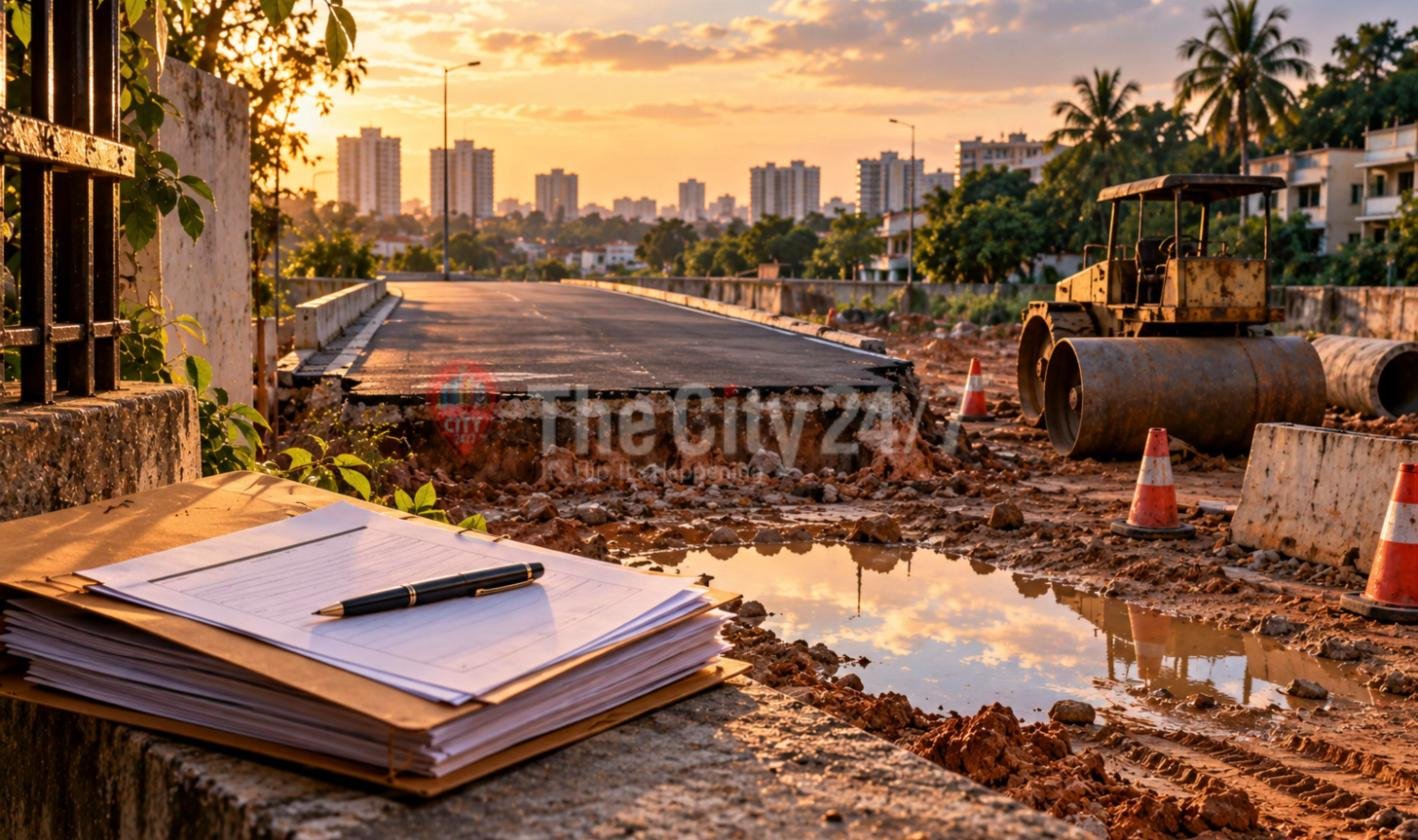
“Somebody sanctioned it, somebody tendered it, somebody certified it complete and somebody got paid. All four of those are documents, and all four are obtainable.”
• On the road that was funded and never built
Bengaluru's civic complaints have a particular quality of futility to them. You report a pothole and it is marked resolved without being filled. You apply for a Khata transfer and it sits for eight months. A road on your street is dug up, half surfaced and abandoned. Every one of these situations has an official record behind it, and the Right to Information Act gives you the right to read it.
The complication in Bengaluru right now is structural. The Greater Bengaluru Authority replaced BBMP on 2 September 2025, and the city is now administered as five corporations covering north, south, east, west and central Bengaluru. Which corporation holds your ward, and therefore which Public Information Officer to address, is the first thing to establish.
This guide is the practical companion to our general RTI guide. It covers which authority holds which kind of civic record, the wording that works for each common problem, and the sequence of complaint first and RTI second that gets results fastest.
Quick Information
Your problem, the authority that holds the file, and what to ask them for. Verify the current authority structure before filing.
Which Authority Holds the Record I Need?
It depends entirely on the asset. Bengaluru's civic responsibilities are split across half a dozen bodies, and an RTI sent to the wrong one is weeks lost.
- Roads, footpaths, storm water drains and garbage. The corporation covering your ward, through its engineering or solid waste sections. Since the Greater Bengaluru Authority restructuring, identify which of the five corporations your ward now sits in before addressing anything.
- Khata, property tax and trade licences. The corporation revenue section for your ward. These are the records behind most stalled property applications.
- Water supply and sewerage. The Bangalore Water Supply and Sewerage Board, which is a separate authority with its own Public Information Officers. New connections, billing disputes and sewage overflow all sit here.
- Power supply and outages. BESCOM. Street lighting is usually a corporation responsibility even though the power comes from BESCOM, which is a distinction worth getting right before filing.
- Metro construction and its consequences. The Bangalore Metro Rail Corporation. Road restoration after metro works is a frequent source of confusion between BMRCL and the corporation.
- Layouts, plan approvals and development. The Bangalore Development Authority for its layouts and for planning matters within its remit.
- Lakes, pollution and tree felling. The Karnataka State Pollution Control Board for pollution, the corporation for lake maintenance in many cases, and the forest cell for tree felling permissions.
“Half the wasted RTIs in this city are wasted on the wrong authority. Spend ten minutes working out who owns the asset before you spend ten rupees.”
• On the most common avoidable error
How Do I Use RTI on a Road That Was Never Built?
Ask for the paper trail of the work: the sanction, the tender, the work order, the measurement book, the completion certificate and the payments. If the road does not exist but the payments do, the documents make that visible without you having to allege anything.
- Ask for the sanction order. Naming the work, the ward and the period. This establishes that the work was approved and for how much.
- Ask for the tender documents and the work order. Who was awarded the contract, on what terms and when.
- Ask for the measurement book entries. The record of what was physically measured as executed. This is the document that matters most when the work on the ground does not match the paperwork.
- Ask for the completion certificate. And the date it was issued and by whom.
- Ask for the payment details. Amounts released against the work and the dates of release.
- Ask for inspection reports. Any quality inspection or third party check carried out on the work.
- Do not ask why the road is not there. That is an opinion, and it can be lawfully declined. The documents will answer it far better than any officer would.
How Do I Use RTI on a Stalled Khata or Property Tax File?
Ask for the movement of your own application: date of receipt, current stage, the name and designation of every officer who has held it, the dates it moved, and the recorded reasons for any delay.
This is probably the single most effective civic RTI a Bengaluru resident can file, because it is narrow, entirely about records that definitely exist, and it makes the delay attributable. It is remarkable how often a file that has not moved in five months moves in the fortnight after such an application is received.
Include your application reference number, the property details and the date of application, and ask for certified copies of the file notings. The notings are where the actual reasons live, and they are frequently more informative than any status page.
What About Water Connections and BWSSB?
The Water Supply and Sewerage Board holds its own records and has its own Public Information Officers. Ask for the application file, the feasibility report and the recorded reason for any pending status.
New connection delays usually come down to a feasibility assessment, a pending payment, or a network constraint in the area. All three are documented. Where the answer is a network constraint, asking for the plan and timeline for augmentation in that area is a legitimate follow up, and the answer tells you whether to wait or to plan around it.
For billing disputes, ask for the meter reading records for the period, the basis of the assessment, and the record of any inspection carried out at the premises.
How Do I Use RTI on Garbage Collection and Contracts?
Ask for the contract covering your ward, the scope of service it specifies, the payments made against it and the record of complaints received for the area.
Solid waste management in Bengaluru runs largely on contracts, and a contract specifies frequency, coverage and obligations. Where collection in your area does not match what the contract requires, you now have a documented gap rather than a grievance. That is a materially stronger position with any authority, and a much stronger basis for a first appeal or a complaint to the corporation.
Also worth asking for: the record of penalties imposed on the contractor for the ward, if any. A contractor never penalised in an area with persistent complaints is its own piece of information.
“A complaint says the garbage is not collected. A contract says how often it is supposed to be. Only one of those is hard to argue with.”
• On why contracts beat complaints
Should I Complain First or File the RTI First?
Complain first, always, and get a complaint number. Then RTI the complaint record. The complaint creates the paper trail that the RTI then makes visible.
- 1. File the civic complaint through the official channel. And note the complaint number, the date and any acknowledgement. Screenshot everything, since portals lose things.
- 2. Wait a reasonable period. Give the department a genuine opportunity to act. An RTI filed the next morning reads as antagonism and achieves less.
- 3. RTI the complaint record. Ask for the action taken report, the name and designation of the officer assigned, the date of any site visit and the basis on which the complaint was closed if it was.
- 4. Include the complaint number. It makes the request unambiguous and hard to answer vaguely.
- 5. Ask what the department's own standard is. The circular or guideline setting out the response time for that category of complaint. A department that has missed its own published standard is in a weak position.
- 6. Appeal on the thirty first day. If nothing arrives. This is where most civic RTIs quietly die, and it is the stage that actually produces results.
Can a Group File Together?
Any citizen can file individually, and for a street or apartment level problem, several residents filing related applications is considerably more effective than one.
Resident welfare associations in Bengaluru have used this well. A coordinated set of applications, each narrow and each properly worded, produces a fuller picture than a single sprawling request and is harder to brush off. It also spreads the work of following up and appealing, which is where individual efforts usually run out of energy.
Divide by subject rather than duplicating. One person takes the sanction and tender documents, another the complaint records, another the payments. Ten rupees each, one shared spreadsheet of what came back.
What Do I Do With the Answer?
Read it against what is actually on the ground, and then use the gap. An answer showing a completed and paid for work that does not exist is the basis for a complaint to a higher authority, to the Lokayukta, or for public pressure.
Certified copies matter here, which is why it is worth asking for them at the application stage. A certified copy of a completion certificate for a road that was never built is a document you can act on. An uncertified printout is easier to dismiss.
And publish what you find, whether to a resident group, a councillor or the press. The information itself changes very little. What changes things is that it is now visible to people who can act.
Frequently Asked Questions
Who do I file an RTI to for Bangalore road and civic problems now?
To the Public Information Officer of the corporation covering your ward. The Greater Bengaluru Authority replaced BBMP on 2 September 2025 and the city is administered as five corporations covering north, south, east, west and central Bengaluru, so establish which one your ward falls in before addressing the application.
How do I find out if a road in my area was actually funded?
Ask for the sanction order, tender documents, work order, measurement book entries, completion certificate and payment records for the work, naming the road, the ward and the period. Do not ask why the road was not built, since that is an opinion and can be declined. The documents answer the question far better.
Can an RTI make my stalled Khata application move?
Frequently, yes. Asking for the date of receipt, the current stage, the name and designation of every officer who has held the file, the dates it moved and the recorded reason for delay is a narrow, legitimate request about records that certainly exist. Files often move shortly after such an application is received.
Should I complain first or file an RTI first?
Complain first through the official channel and note the complaint number, then give the department a reasonable period to act, then file the RTI asking for the action taken report and the record of how the complaint was handled. The complaint creates the paper trail that the RTI then makes visible.
Which authority handles water problems in Bangalore?
The Bangalore Water Supply and Sewerage Board, which is a separate authority from the city corporations with its own Public Information Officers. New connections, billing disputes and sewage matters go there rather than to the corporation.
Who is responsible for streetlights, BESCOM or the corporation?
Street lighting is generally a corporation responsibility even though the power supply comes from BESCOM. Getting this distinction right before filing saves several weeks, since a misdirected application has to be transferred.
Can a resident welfare association file an RTI?
Any citizen can file, and for street or neighbourhood level problems several residents filing related but distinct applications is considerably more effective than one person filing a sprawling request. Divide the subject matter between people rather than duplicating the same request.
What can I do with the information once I get it?
Use the gap between the record and the reality. A certified copy showing a completed and paid work that does not exist on the ground supports a complaint to a higher authority or to the Lokayukta, and it is far more actionable than a grievance. Ask for certified copies at the application stage rather than plain printouts.
Authorities and Portals
Identify the right authority first. These are the main bodies holding Bengaluru's civic records.
Got a Civic Problem That Will Not Move?
Tell me what the problem is and which part of the city it is in, by clicking the WhatsApp icon at the bottom right of your screen, and I will tell you which authority holds the file and what I would ask them for. And if you have filed a civic RTI that got results, what you asked for would be genuinely valuable to everybody else on this page. That is also the fastest way to reach The City 24/7 about anything at all.
And if you want the city explained one useful thing at a time, join our ever growing community. One weekly email, free.
This guide is general information and not legal advice. Authority structures in Bengaluru are undergoing change following the Greater Bengaluru Authority restructuring, so verify which body holds your ward and the current filing route before applying. Same city, new stories, always.

Related Stories
 SERVICES
How to Apply for a Birth Certificate in Bangalore: Online and Offline
August 16, 2026
 SERVICES
How to File an RTI in Karnataka for Ten Rupees and Actually Get an Answer
August 15, 2026
 SERVICES
How to Apply for a Trade Licence for Your New Shop or Business in Bangalore
August 8, 2026
 SERVICES
Missed the Property Tax Deadline? What Happens and How to Fix It
August 7, 2026
 SERVICES
Getting Things Done in Bangalore: A Guide to Civic Services and Paperwork
July 22, 2026
 SERVICES
Common Reasons Caste Certificate Applications Get Rejected, and How to Avoid Them
August 18, 2026
