

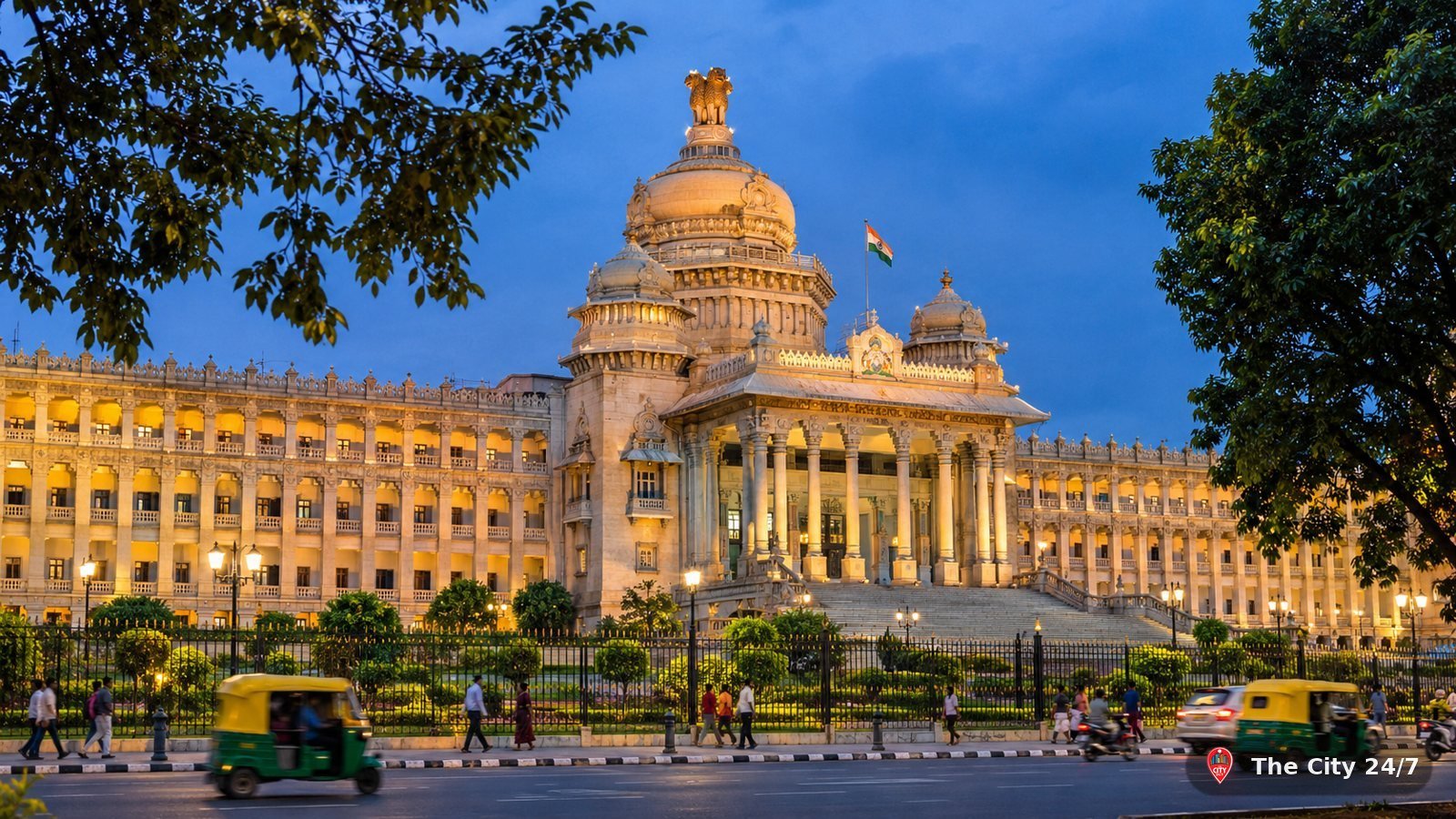
“Most politicians leave behind speeches. Kengal Hanumanthaiah left behind 60 acres of granite with his ambition carved over the door.”
• Tariq Sallam, on the man behind Bengaluru's most photographed building
Stand at the bottom of the steps of Vidhana Soudha on a Sunday evening when the lights come on, and you will notice two things. First, the building is absurdly confident. Second, there is a statue of a man in a Gandhi cap out front, and almost nobody stops to read the name on it.
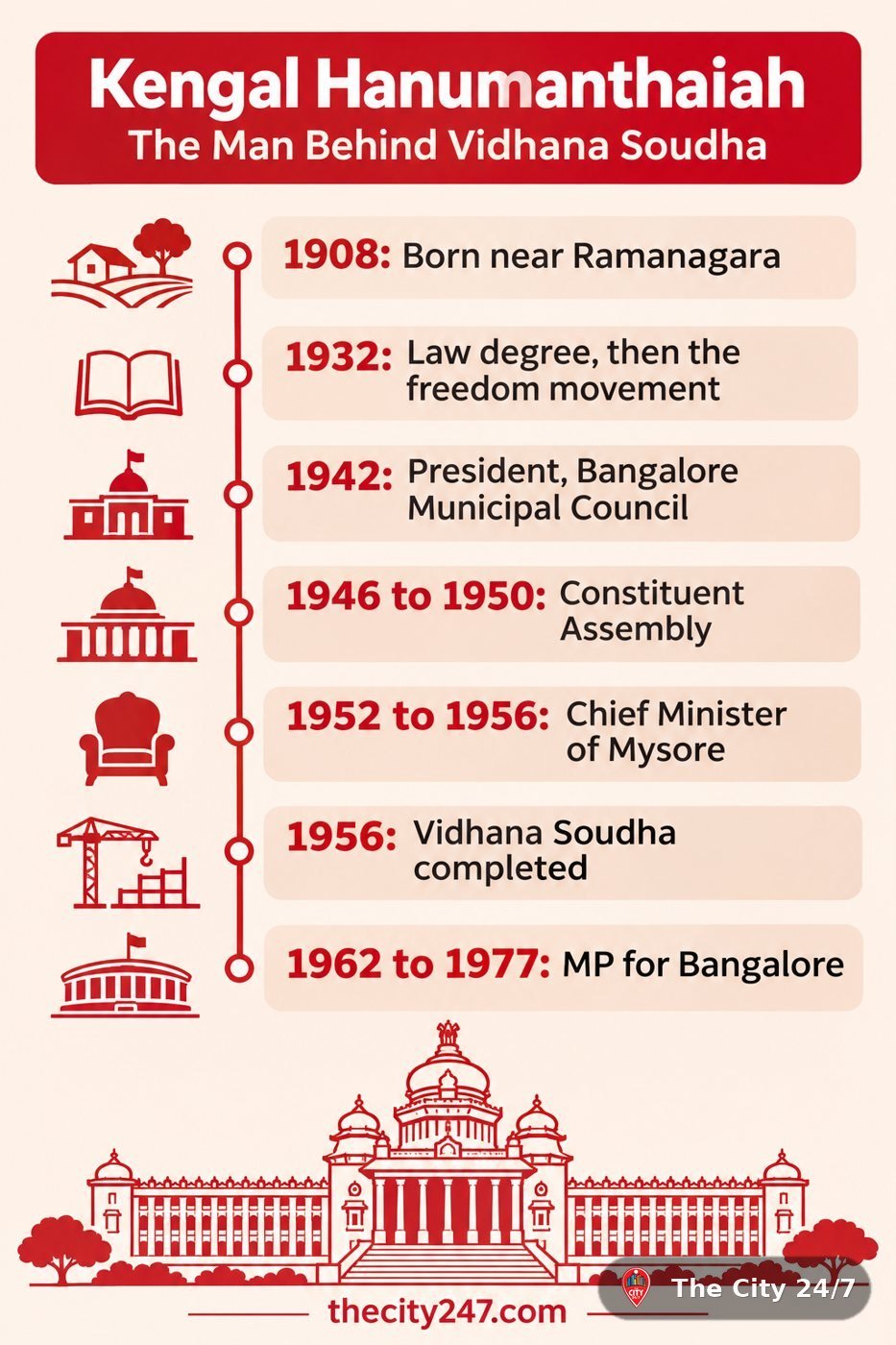
That man is Kengal Hanumanthaiah. A poor village boy from near Ramanagara who became a lawyer, went to jail for the freedom movement, helped debate India's Constitution, and then, as Chief Minister of Mysore State, decided that the legislature of a free state should not sit in a borrowed colonial building. So he built a new one, in granite, in an Indian style, and spent so much doing it that his own government ordered an inquiry.
This is my People of Bangalore profile of Kengal Hanumanthaiah: who he was, how Vidhana Soudha happened, the stories and the controversies, what he did after, and where you can still find him in Bengaluru today.
Quick Information
Lawyer, jailbird, Constitution maker, Chief Minister, builder. Also the reason your auto driver says 'Vidhana Soudha' with a little pride.
Who Was Kengal Hanumanthaiah?
Kengal Hanumanthaiah was a lawyer, freedom fighter and Congress politician who served as the second Chief Minister of Mysore State from 1952 to 1956, and is remembered above all as the man who built Vidhana Soudha. He was born in February 1908 in Lakkappanahalli, a village near Ramanagara on the edge of today's Bengaluru region, into a Vokkaliga farming family.
He grew up poor, the eldest of four sons, and studied at schools in Kengeri and Bangalore. The 'Kengal' in his name, by most accounts, points back to that Kengeri connection. He went on to Maharaja's College in Mysore, where he was active in student politics and the Karnataka Sangha, and then to law college in Poona, which he finished in 1932.
What I find striking is how local his story is. He was not a prince, a British-trained administrator or a business magnate. He was a boy from a village an hour down the Mysuru road who ended up shaping the skyline of the city next door.
How Did Hanumanthaiah Get Into Politics?
He gave up a legal career for the freedom movement in the 1930s and spent the next decade and a half in Congress politics in Bangalore and the Mysore State, much of it in and out of jail. He had started young: as a student he attended the 1927 Madras Congress session and led protests against the Simon Commission.
After returning to Bangalore and enrolling as a lawyer, he was persuaded by senior Congress leaders to quit practice and work full time for the movement. He was jailed several times, by most counts seven or more, including a long term for sedition. Along the way he built a serious local base.
- Bangalore District Congress: president of the Bangalore District Congress Committee for about ten years.
- Bangalore Municipal Council: its president in 1942, which means he was running the city's civic body in the middle of the Quit India year.
- Mysore Representative Assembly: leader of the Congress party in the 1940s, as the princely state moved towards responsible government.
“He ran Bangalore's municipality in 1942 and went to jail for the country. Most of us cannot run an apartment association without a WhatsApp war.”
What Did He Do in the Constituent Assembly?
He was one of the members who represented Mysore in the Constituent Assembly of India from December 1946 to January 1950, and he argued hard for decentralisation and stronger states. He was sceptical of a two-house legislature for states, critical of the emergency provisions, and worried that the draft leaned too heavily on Western models.
His most quoted line from those debates is a lovely one. He said, in effect, that the country had wanted the music of the veena or the sitar, but had been given an English band. Keep that line in mind, because it is almost the whole philosophy of Vidhana Soudha in one sentence.
Why Did Hanumanthaiah Build Vidhana Soudha?
He built Vidhana Soudha because he wanted the legislature of a free Mysore State to sit in a building that looked unmistakably Indian, not in a colonial office. After 1947 the legislature had been meeting in Attara Kacheri, the red Gothic building across the road that now houses the High Court, and he saw it as a symbol of the old order.
The foundation stone for a new legislature had been laid by Jawaharlal Nehru on 13 July 1951, under his predecessor K. C. Reddy, who reportedly favoured something closer to Attara Kacheri in style. When Hanumanthaiah became Chief Minister in March 1952, he scrapped that idea and pushed for a far grander, Indian design that would also house the secretariat, records and other offices.
The Russian Delegation Story
The story he himself told is that he was showing a Soviet cultural delegation around Bangalore in the early 1950s, and the visitors kept asking whether India had no architecture of its own, since every grand building they saw was European. He took that personally. Whether the conversation happened exactly as told or improved a little with retelling, it explains the building perfectly.
Look up at the front of Vidhana Soudha and you will see the words 'Government Work is God's Work', with the Kannada 'Sarkarada kelasa devara kelasa'. It is one of the most quoted lines in the state, and one of the most ironic, depending on which government office you visited last week.
How Was Vidhana Soudha Built?
Vidhana Soudha was built by the state's Public Works Department between about 1952 and 1956, without a private main contractor, under Chief Engineer B. R. Manickam. It sits on roughly 60 acres at the north end of Cubbon Park, has around 172 rooms, and is built almost entirely in granite, including pink stone from Magadi and dark stone from Turuvekere.
- Style: Neo-Dravidian, mixing temple-style columns and brackets from Chalukya, Hoysala and Vijayanagara traditions with domes and a grand portico.
- The dome: about 18 metres across, topped by the Lion Capital, the national emblem.
- The people: more than 5,000 workers and around 1,500 stone carvers, masons and wood carvers. Several accounts say many of the unskilled labourers were prisoners who were released when the work was done, though how many is disputed.
- The inside: teak and sandalwood doors, a large assembly hall and a council hall, and painted interiors from 1956.
How Much Did Vidhana Soudha Cost?
The final cost is usually given as about Rs 1.8 crore, against an original estimate of around Rs 33 lakh for a much smaller, two-storey building. Sources do not agree on the exact figure, but they all agree on the shape of the story: it went far over the first budget.
That overrun became a political weapon. Opposition members attacked the spending, and a committee headed by a retired judge was set up to look into it. Hanumanthaiah's term as Chief Minister ended in August 1956, a few months before the reorganised, bigger Mysore State came into being, amid party politics and a falling-out with legislators. He was succeeded by Kadidal Manjappa.
“He went over budget on the one government building nobody in Karnataka would now trade for anything. Some cost overruns age better than others.”
Seventy years on, the verdict of the city is fairly clear. Nehru called it a temple dedicated to the nation, the poet Kuvempu called it poetry in stone, and it remains the image on half the souvenirs, news bulletins and wedding albums in Bengaluru.
What Did Hanumanthaiah Do After Being Chief Minister?
He moved to national politics, representing Bangalore in the Lok Sabha from 1962 to 1977, serving as a Union minister and chairing the Administrative Reforms Commission. Accounts list him in charge of portfolios including Law and Social Welfare and later Railways in the early 1970s.
- Lok Sabha: MP for Bangalore City from 1962 and Bangalore from 1967. In 1971 he defeated the Kannada poet Gopalakrishna Adiga; in 1977, the post-Emergency wave, he lost to K. S. Hegde.
- Administrative Reforms Commission: he chaired India's Administrative Reforms Commission in the late 1960s, a fitting job for a man who had spent his life arguing about how government should be organised.
- International work: he represented India at parliamentary conferences abroad, including leading the delegation to the Commonwealth Parliamentary Conference in Ottawa in 1966.
- Final years: he left the Congress in 1977 and died on 1 December 1980, aged 72.
Where Can You Find Kengal Hanumanthaiah in Bengaluru Today?
In three easy places: his statue in front of Vidhana Soudha, the road named after him near Lalbagh, and the Kengeri bus terminal junction that carries his name.
- Vidhana Soudha, Ambedkar Veedhi: his statue stands in front of the building. Go on a Sunday or public holiday evening when the facade is lit, and stand on the Attara Kacheri side for the full view. Karnataka introduced guided public tours of the building in 2025; check the current booking rules before you go.
- Kengal Hanumanthaiah Road: the road most of us still call Double Road, running towards Lalbagh. Next time you are stuck at a signal there, you have something to read about.
- Kengeri TTMC: the junction at the Kengeri bus terminal is named after him, a nod to the town where he went to school.
My suggested Hanumanthaiah evening: metro to Dr B. R. Ambedkar Station (Vidhana Soudha), walk the length of Ambedkar Veedhi with Attara Kacheri on one side and Vidhana Soudha on the other, find the statue, and then wander into Cubbon Park as the lights come on. It costs nothing and it is the best hour of architecture in the city.
Why Does Kengal Hanumanthaiah Belong in People of Bangalore?
He was from the Bengaluru region, studied here, ran the city's municipal council, represented Bangalore in Parliament for 15 years, and gave the city its most recognisable building. Yet most of us know the building and not the man. That gap is exactly what this series is for.
I also think he is a useful reminder for a city that loves to complain about its government. Hanumanthaiah believed public buildings should make ordinary citizens feel that the state belongs to them. You can argue with his budget. It is harder to argue with the result.
Kengal Hanumanthaiah died in 1980, so this is not an interview. It is pieced together from online research: encyclopaedia entries, the Constituent Assembly members' records, published histories of Vidhana Soudha and news features from its jubilee. Where sources disagree (his exact birth date, the cost of the building, how many prisoners worked on it), I have said so rather than picked one. If you have family records or corrections, I would love to hear from you.
Kengal Hanumanthaiah: Frequently Asked Questions
Who was Kengal Hanumanthaiah?
A lawyer, freedom fighter and Congress leader (1908 to 1980) from Lakkappanahalli near Ramanagara who was Chief Minister of Mysore State from 1952 to 1956 and built Vidhana Soudha.
Who built Vidhana Soudha?
It was built by the state Public Works Department under Chief Engineer B. R. Manickam, driven politically by Chief Minister Kengal Hanumanthaiah. Nehru laid the foundation stone in July 1951 and the building was completed in 1956.
Why did Kengal Hanumanthaiah build Vidhana Soudha?
He wanted the legislature of a free state to sit in a building in an Indian architectural style rather than a colonial one. He often told the story of a Soviet delegation asking whether India had any architecture of its own.
How much did Vidhana Soudha cost to build?
The final cost is usually given as about Rs 1.8 crore, against an early estimate of about Rs 33 lakh for a smaller building. Exact figures vary between sources.
Was Vidhana Soudha built by prisoners?
Several accounts say many of the unskilled labourers were prisoners who were released after the work, alongside thousands of other workers and skilled carvers. The numbers are disputed.
Which road is named after Kengal Hanumanthaiah?
Double Road near Lalbagh in Bengaluru is officially Kengal Hanumanthaiah Road. The junction at the Kengeri bus terminal is also named after him.
When was Kengal Hanumanthaiah Chief Minister?
From 30 March 1952 to 19 August 1956. He followed K. C. Reddy and was succeeded by Kadidal Manjappa.
What is written on Vidhana Soudha?
'Government Work is God's Work', with the Kannada 'Sarkarada kelasa devara kelasa', on the front of the building.
Is Hanumanthaiah Part of Your Family Story?
If your grandparents worked on Vidhana Soudha, heard him speak, or you have old photographs of the building going up in the 1950s, click the WhatsApp icon at the bottom right of your screen and send them to The City 24/7. Stories like these deserve to be kept.
And if you want a new Bengaluru story in your inbox every week, join the newsletter at thecity247.com/newsletter (https://thecity247.com/newsletter/).
Next time the lights come on at Vidhana Soudha, say hello to the man in the cap. Same city, new stories, always.

Related Stories
 PEOPLE OF BANGALORE
D. V. Gundappa: The Matric Dropout Who Wrote Bengaluru's Favourite Book of Wisdom
November 3, 2026
 PEOPLE OF BANGALORE
Who Am I? Just a Mallu Boy Trying to Find His Way in Namma Bengaluru
November 1, 2026
 SCIENCE
U R Rao: How India's First Satellite Was Built in a Bengaluru Industrial Shed
October 16, 2026
 SPIRITUALITY
Sri Sri Ravi Shankar: The Art of Living and the Ashram on Kanakapura Road
October 2, 2026
 LITERATURE
Vikram Sampath: Writing History From Bengaluru
September 28, 2026
 SCIENCE
B. P. Radhakrishna: The Bengaluru Man Called the Doyen of Indian Geology
September 25, 2026
